 Hispanopedia Wiki
El Reino Indogriego , también conocido como Reino Yavana (también Yavanarajya [4] por la palabra Yona , que proviene de los jonios ), fue un reino griego de la era helenística que cubría varias partes de los actuales Afganistán , Pakistán y el noroeste de la India . [5] [6] [7] [8] [9] [10] Existió desde aproximadamente el año 200 a. C. hasta aproximadamente el año 10 d . C.
El término "Reino Indogriego" describe vagamente una serie de diversos estados helenísticos, gobernando desde capitales regionales como Taxila , Sagala , Pushkalavati y Alejandría en el Cáucaso (ahora Bagram ). [11] [12] [13] Otros centros solo se insinúan; por ejemplo, la Geographia de Ptolomeo y la nomenclatura de reyes posteriores sugieren que un tal Teófilo en el sur de la esfera de influencia indogriega también puede haber sido una sede real en algún momento.
El reino fue fundado cuando el rey grecobactriano Demetrio I de Bactria invadió la India desde Bactria alrededor del año 200 a. C. [14] Los griegos al este del Imperio seléucida finalmente se dividieron del Reino grecobactriano y de los reinos indogriegos en el subcontinente indio noroccidental. [15]
Durante los dos siglos de su gobierno, los reyes indogriegos combinaron las lenguas y símbolos griegos e indios , como se ve en sus monedas, y mezclaron ideas griegas e indias, como se ve en los restos arqueológicos. [16] La difusión de la cultura indogriega tuvo consecuencias que todavía se sienten hoy en día, particularmente a través de la influencia del arte grecobudista . [17] La etnicidad de los indogriegos también puede haber sido híbrida hasta cierto punto. Eutidemo I era, según Polibio, [18] un griego de Magnesia . Su hijo, Demetrio I , fundador del reino indogriego, era por lo tanto de etnia griega al menos por su padre. Se arregló un tratado de matrimonio para el mismo Demetrio con una hija del gobernante seléucida Antíoco III . La etnicidad de los gobernantes indogriegos posteriores a veces es menos clara. [19] Por ejemplo, se supone que Artemidoro (80 a. C.) era de ascendencia indoescita , aunque ahora se lo considera un rey indogriego normal. [20]
Menandro I Soter , el más conocido entre los reyes indogriegos, a menudo se lo llama simplemente "Menandro", a pesar de que hubo otro rey indogriego conocido como Menandro II. La capital de Menandro I estaba en Sagala, en el Punjab (actual Sialkot). Tras la muerte de Menandro, la mayor parte de su imperio se dividió y la influencia indogriega se redujo considerablemente. Muchos reinos y repúblicas nuevos al este del río Ravi comenzaron a acuñar nuevas monedas que representaban victorias militares. [21] Las entidades más importantes que se formaron fueron la República Yaudheya , Arjunayanas y los Audumbaras . Se dice que tanto los Yaudheyas como los Arjunayanas obtuvieron la "victoria por la espada". [22] La dinastía Datta y la dinastía Mitra pronto siguieron en Mathura .
Los indogriegos finalmente desaparecieron como entidad política alrededor del año 10 d. C. tras las invasiones de los indoescitas , aunque probablemente algunos sectores de la población griega permanecieron durante varios siglos más bajo el gobierno posterior de los indopartos , los kushanos [a] y los indoescitas , cuyo estado de sátrapas occidentales persistió y abarcó a los griegos locales , hasta el año 415 d. C.
Fondo
Presencia griega inicial en el subcontinente indio

Los griegos comenzaron a establecerse en la parte noroeste del subcontinente indio durante la época del imperio persa aqueménida . Darío el Grande conquistó la zona, pero junto con sus sucesores también conquistó gran parte del mundo griego, que en ese momento incluía toda la península de Anatolia occidental . Cuando las aldeas griegas se rebelaron bajo el yugo persa, a veces sufrieron una limpieza étnica, reubicándolas en el otro lado del imperio. Así, llegaron a existir muchas comunidades griegas en las partes indias del imperio persa. [ cita requerida ]
En el siglo IV a. C., Alejandro Magno derrotó y conquistó el imperio persa. En 326 a. C., esto incluía la parte noroccidental del subcontinente indio hasta el río Hífasis . Alejandro estableció satrapías y fundó varios asentamientos, entre ellos Bucéfala ; se volvió hacia el sur cuando sus tropas se negaron a ir más al este. [23] Las satrapías indias del Punjab quedaron en manos de Poro y Taxiles , quienes fueron confirmados nuevamente en el Tratado de Triparadiso en 321 a. C., y las tropas griegas restantes en estas satrapías quedaron bajo el mando del general de Alejandro, Eudemo . Después de 321 a. C. Eudemo derrocó a Taxiles, hasta que abandonó la India en 316 a. C. Al sur, otro general también gobernó sobre las colonias griegas del Indo: Peitón, hijo de Agenor , [24] hasta su partida a Babilonia en 316 a. C.
Alrededor de 322 a. C., los griegos (descritos como Yona o Yavana en fuentes indias) pudieron haber participado, junto con otros grupos, en el levantamiento de Chandragupta Maurya contra la dinastía Nanda , y haber llegado hasta Pataliputra para la captura de la ciudad de los Nandas. La Mudrarakshasa de Visakhadutta , así como la obra jaina Parisishtaparvan, hablan de la alianza de Chandragupta con el rey del Himalaya Parvatka, a menudo identificado con Porus , [25] y según estos relatos, esta alianza le dio a Chandragupta un ejército compuesto y poderoso formado por Yavanas (griegos), Kambojas , Shakas (escitas), Kiratas (nepaleses), Parasikas (persas) y Bahlikas (bactrianos) que tomaron Pataliputra . [26] [27] [28]
En el año 305 a. C., Seleuco I dirigió un ejército al Indo , donde se encontró con Chandragupta . El enfrentamiento terminó con un tratado de paz y un «acuerdo de matrimonio mixto» ( Epigamia , griego: Ἐπιγαμία), que significaba un matrimonio dinástico o un acuerdo de matrimonio mixto entre indios y griegos. En consecuencia, Seleuco cedió sus territorios orientales a Chandragupta, posiblemente hasta Arachosia , y recibió 500 elefantes de guerra (que desempeñaron un papel clave en la victoria de Seleuco en la batalla de Ipso ): [29]
Los indios ocupan en parte algunos de los territorios situados a lo largo del Indo, que antiguamente pertenecían a los persas. Alejandro privó de ellos a los arianes y estableció allí sus propias colonias. Pero Seleuco Nicátor se los dio a Sandrocoto como consecuencia de un contrato matrimonial y recibió a cambio quinientos elefantes.
— Estrabón 15.2.1(9) [30]
No se conocen los detalles del acuerdo matrimonial, [31] pero como las extensas fuentes disponibles sobre Seleuco nunca mencionan a una princesa india, se piensa que la alianza marital fue en sentido inverso, con el propio Chandragupta o su hijo Bindusara casándose con una princesa seléucida, de acuerdo con las prácticas griegas contemporáneas para formar alianzas dinásticas. Una fuente puránica india , el Pratisarga Parva del Bhavishya Purana , describió el matrimonio de Chandragupta con una princesa griega (" Yavana "), hija de Seleuco, [32] antes de detallar con precisión la genealogía temprana de Maurya:
" Chandragupta se casó con una hija de Suluva , el rey Yavana de Pausasa . De esta manera, mezcló a los budistas y a los Yavanas. Gobernó durante 60 años. De él nació Vindusara y gobernó durante el mismo número de años que su padre. Su hijo fue Ashoka ."
— Pratisarga Parva [33] [32]

Chandragupta , sin embargo, siguió el jainismo hasta el final de su vida. Consiguió en su corte para matrimonio a la hija de Seleuco Nicátor , Berenice ( Suvarnnaksi ), y de esta manera, mezcló a los indios y a los griegos. Su nieto Ashoka , como han sugerido Woodcock y otros eruditos, "de hecho puede haber sido mitad o al menos un cuarto griego". [35]
También varios griegos, como el historiador Megástenes , [36] seguido por Deímaco y Dionisio , fueron enviados a residir en la corte maurya . [37] Los dos gobernantes continuaron intercambiándose regalos. [38] La intensidad de estos contactos está atestiguada por la existencia de un departamento estatal maurya dedicado a los extranjeros griegos ( yavana ) y persas, [39] o los restos de cerámica helenística que se pueden encontrar en todo el norte de la India. [40]
En estas ocasiones, las poblaciones griegas aparentemente permanecieron en el noroeste del subcontinente indio bajo el gobierno de Maurya. El nieto de Chandragupta, Ashoka , que se había convertido a la fe budista, declaró en los Edictos de Ashoka , grabados en piedra, algunos de ellos escritos en griego, [41] [42] que las poblaciones griegas dentro de su reino también se habían convertido al budismo: [43]
Aquí en el dominio del rey entre los griegos, los Kambojas , los Nabhakas, los Nabhapamkits, los Bhojas, los Pitinikas, los Andhras y los Palidas, en todas partes la gente está siguiendo las instrucciones del Amado de los Dioses en el Dharma .
— Rock Edict Nb13 (S. Dhammika).
En sus edictos, Ashoka menciona que había enviado emisarios budistas a los gobernantes griegos hasta el Mediterráneo ( Edicto No. 13 ), [44] [45] y que desarrolló la medicina herbal en sus territorios, para el bienestar de los humanos y los animales ( Edicto No. 2 ). [46]

Los griegos en la India parecen incluso haber desempeñado un papel activo en la propagación del budismo, ya que algunos de los emisarios de Ashoka, como Dharmaraksita , [47] o el maestro Mahadharmaraksita , [48] se describen en fuentes pali como monjes budistas griegos (" Yona ", es decir, jonios), activos en el proselitismo budista (el Mahavamsa , XII). [49] También se cree que los griegos contribuyeron al trabajo escultórico de los Pilares de Ashoka , [50] y, de manera más general, al florecimiento del arte Maurya. [51] Algunos griegos (Yavanas) pueden haber desempeñado un papel administrativo en los territorios gobernados por Ashoka: la inscripción rupestre de Junagadh de Rudradaman registra que durante el gobierno de Ashoka, un rey/gobernador Yavana llamado Tushaspha estaba a cargo en el área de Girnar , Gujarat , mencionando su papel en la construcción de un depósito de agua. [52] [53]
Nuevamente en el año 206 a. C., el emperador seléucida Antíoco dirigió un ejército al valle de Kabul , donde recibió elefantes de guerra y regalos del rey local Sophagasenus : [54]
Él (Antíoco) cruzó el Cáucaso (el Cáucaso Indico o Paropamisus: mod. Hindú Kúsh ) y descendió a la India; renovó su amistad con Sophagasenus , el rey de los indios; recibió más elefantes, hasta que tuvo ciento cincuenta en total; y habiendo abastecido nuevamente a sus tropas, partió nuevamente personalmente con su ejército: dejando a Andróstenes de Cícico el deber de llevarse a casa el tesoro que este rey había acordado entregarle.
Dominación griega en Bactria

Alejandro también había establecido varias colonias en la vecina Bactria , como Alejandría del Oxus (la actual Ai-Khanoum ) y Alejandría del Cáucaso (la medieval Kapisa , la actual Bagram ). Tras la muerte de Alejandro en el 323 a. C., Bactria quedó bajo el control de Seleuco I Nicátor , que fundó el Imperio seléucida . El reino grecobactriano se fundó cuando Diodoto I, el sátrapa de Bactria (y probablemente de las provincias circundantes) se separó del Imperio seléucida alrededor del 250 a. C. Las fuentes antiguas conservadas (véase más abajo) son algo contradictorias y no se ha establecido la fecha exacta de la independencia bactriana. De forma algo simplificada, hay una cronología alta (c. 255 a. C.) y una cronología baja (c. 246 a. C.) para la secesión de Diodoto. [57] La cronología alta tiene la ventaja de explicar por qué el rey seléucida Antíoco II emitió muy pocas monedas en Bactria, ya que Diodoto se habría independizado allí a principios del reinado de Antíoco. [58] Por otro lado, la cronología baja, de mediados de la década de 240 a. C., tiene la ventaja de conectar la secesión de Diodoto I con la Tercera Guerra Siria , un conflicto catastrófico para el Imperio seléucida.
Diodoto, gobernador de las mil ciudades de Bactria ( en latín : Theodotus, mille urbium Bactrianarum praefectus ), desertó y se autoproclamó rey; todos los demás pueblos de Oriente siguieron su ejemplo y se separaron de los macedonios.
— ( Justino , XLI,4 [59] )
El nuevo reino, altamente urbanizado y considerado uno de los más ricos de Oriente ( opulentissimum illud mille urbium Bactrianum imperium "El extremadamente próspero imperio bactriano de las mil ciudades" Justino, XLI,1 [60] ), crecería aún más en poder y emprendería una expansión territorial hacia el este y el oeste:
Los griegos que provocaron la rebelión de Bactriana se hicieron tan poderosos a causa de la fertilidad del país que se convirtieron en dueños, no sólo de Ariana , sino también de la India , como dice Apolodoro de Artemita : y más tribus fueron sometidas por ellos que por Alejandro... Sus ciudades fueron Bactra (también llamada Zariaspa, por donde fluye un río que lleva el mismo nombre y desemboca en el Oxus ), y Darapsa, y varias otras. Entre ellas estaba Eucratidia , que recibió el nombre de su gobernante.
— (Estrabón, XI.XI.I [61] )

Cuando el gobernante de la vecina Partia , el antiguo sátrapa y autoproclamado rey Andrágoras , fue eliminado por Arsaces , el ascenso del Imperio parto cortó a los grecobactrianos el contacto directo con el mundo griego. El comercio terrestre continuó a un ritmo reducido, mientras que el comercio marítimo entre el Egipto griego y Bactria se desarrolló.
Diodoto fue sucedido por su hijo Diodoto II , quien se alió con el parto Arsaces en su lucha contra Seleuco II :
Poco después, aliviado por la muerte de Diodoto, Arsaces hizo las paces y concluyó una alianza con su hijo, también de nombre Diodoto; algún tiempo después luchó contra Seleuco que vino a castigar a los rebeldes, y prevaleció: los partos celebraron este día como el que marcó el comienzo de su libertad.
— (Justino, XLI,4) [62]
Eutidemo , un griego de Magnesia según Polibio [63] y posiblemente sátrapa de Sogdiana , derrocó a Diodoto II alrededor del 230 a. C. y comenzó su propia dinastía. El control de Eutidemo se extendió a Sogdiana, yendo más allá de la ciudad de Alejandría Eschate fundada por Alejandro Magno en Fergana :
"También poseían Sogdiana, situada por encima de Bactriana hacia el este, entre el río Oxus, que forma la frontera entre los bactrianos y los sogdianos, y el río Iaxartes . Y el Iaxartes forma también la frontera entre los sogdianos y los nómadas.
— Estrabón XI.11.2 [64]

Eutidemo fue atacado por el gobernante seléucida Antíoco III alrededor del 210 a. C. Aunque comandaba 10.000 jinetes, Eutidemo inicialmente perdió una batalla en el Arrio [65] y tuvo que retirarse. Luego resistió con éxito un asedio de tres años en la ciudad fortificada de Bactra (la moderna Balkh ), antes de que Antíoco finalmente decidiera reconocer al nuevo gobernante y ofrecer una de sus hijas al hijo de Eutidemo, Demetrio, alrededor del 206 a. C. [66] Los relatos clásicos también relatan que Eutidemo negoció la paz con Antíoco III sugiriendo que merecía crédito por derrocar al rebelde original Diodoto, y que estaba protegiendo a Asia Central de las invasiones nómadas gracias a sus esfuerzos defensivos:
...porque si no cedía a esta exigencia, ninguno de los dos estaría a salvo, pues grandes hordas de nómadas estaban cerca y eran un peligro para ambos, y si los admitían en el país, éste ciertamente quedaría completamente barbarizado.
— ( Polibio , 11.34) [63]
Tras la marcha del ejército seléucida, el reino bactriano parece haberse expandido. En el oeste, es posible que se absorbieran zonas del noreste de Irán , posiblemente hasta Partia , cuyo gobernante había sido derrotado por Antíoco el Grande . Estos territorios posiblemente sean idénticos a las satrapías bactrianas de Tapuria y Traxiana .
Al norte, Eutidemo también gobernaba Sogdiana y Fergana , y hay indicios de que desde Alejandría Eschate los grecobactrianos pudieron haber liderado expediciones hasta Kashgar y Ürümqi en el Turquestán chino , lo que condujo a los primeros contactos conocidos entre China y Occidente alrededor del 220 a. C. El historiador griego Estrabón también escribe que:
Extendieron su imperio hasta los Seres (chinos) y los Phryni.
— ( Estrabón , XI.XI.I) [61]

Se han encontrado varias estatuillas y representaciones de soldados griegos al norte del Tien Shan , a las puertas de China, y hoy están en exhibición en el museo de Xinjiang en Urumqi (Boardman [67] ).
También se han sugerido influencias griegas en el arte chino ( Hirth , Rostovtzeff ). Se pueden encontrar diseños con flores en roseta , líneas geométricas e incrustaciones de vidrio, que sugieren influencias helenísticas, [68] en algunos espejos de bronce de principios de la dinastía Han . [69]
La numismática también sugiere que algunos intercambios de tecnología pueden haber ocurrido en estas ocasiones: los grecobactrianos fueron los primeros en el mundo en emitir monedas de cuproníquel (ratio 75/25), [70] una tecnología de aleación solo conocida por los chinos en ese momento bajo el nombre de "cobre blanco" (algunas armas del período de los Estados Combatientes eran de aleación de cobre y níquel [71] ). La práctica de exportar metales chinos, en particular hierro, para el comercio está atestiguada alrededor de ese período. Los reyes Eutidemo, Eutidemo II, Agatocles y Pantaleón hicieron estas emisiones de monedas alrededor de 170 a. C. y, alternativamente, se ha sugerido que un mineral de cobre niquelífero fue la fuente de las minas de Anarak . [72] El cuproníquel no volvería a usarse en la acuñación de monedas hasta el siglo XIX.
La presencia del pueblo chino en el subcontinente indio desde tiempos antiguos también está sugerida por los relatos de los " Ciñas " en el Mahabharata y el Manu Smriti .
El explorador y embajador de la dinastía Han, Zhang Qian, visitó Bactria en el año 126 a. C. e informó de la presencia de productos chinos en los mercados bactrianos:
"Cuando estuve en Bactria ( Daxia )", informó Zhang Qian, "vi cañas de bambú de Qiong y telas fabricadas en la provincia de Shu (territorios del sudoeste de China). Cuando pregunté a la gente cómo habían conseguido esos artículos, respondieron: "Nuestros comerciantes van a comprarlos a los mercados de Shendu (India)".
A su regreso, Zhang Qian informó al emperador chino Han Wudi del nivel de sofisticación de las civilizaciones urbanas de Fergana, Bactriana y Partia, quien se interesó en desarrollar relaciones comerciales con ellas:
El Hijo del Cielo, al oír todo esto, razonó así: Fergana ( Dayuan ) y las posesiones de Bactria ( Daxia ) y Partia ( Anxi ) son países grandes, llenos de cosas raras, con una población que vive en residencias fijas y se dedica a ocupaciones algo idénticas a las del pueblo chino, y que da gran valor a los ricos productos de China.
— ( Hanshu , antigua historia de los Han)
Posteriormente se enviaron varios enviados chinos a Asia Central, lo que desencadenó el desarrollo de la Ruta de la Seda a partir de finales del siglo II a. C. [73]

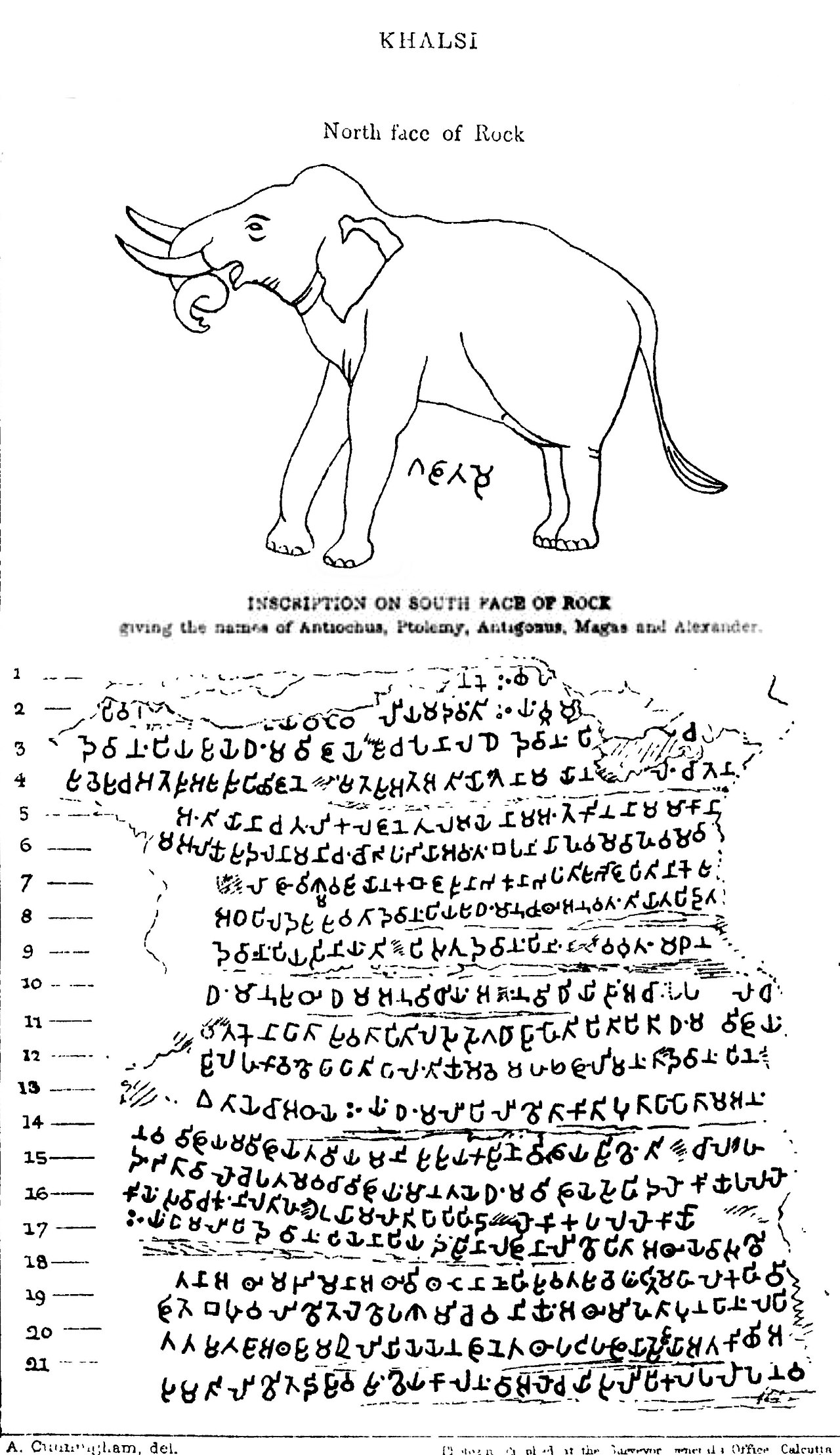
El emperador indio Chandragupta , fundador de la dinastía Maurya , había reconquistado el noroeste de la India tras la muerte de Alejandro Magno alrededor del 322 a. C. Sin embargo, se mantuvieron contactos con sus vecinos griegos del Imperio seléucida , se estableció una alianza dinástica o el reconocimiento de matrimonios mixtos entre griegos e indios (descrito como un acuerdo sobre Epigamia en fuentes antiguas), y varios griegos, como el historiador Megástenes , residieron en la corte Maurya. Posteriormente, cada emperador Maurya tuvo un embajador griego en su corte.
El nieto de Chandragupta, Ashoka , se convirtió a la fe budista y se convirtió en un gran proselitista en la línea del canon pali tradicional del budismo theravada , dirigiendo sus esfuerzos hacia el mundo indio y el helenístico desde alrededor del 250 a. C. Según los Edictos de Ashoka , grabados en piedra, algunos de ellos escritos en griego, envió emisarios budistas a las tierras griegas de Asia y hasta el Mediterráneo. Los edictos nombran a cada uno de los gobernantes del mundo helenístico de la época.
La conquista del Dharma se ha ganado aquí, en las fronteras, e incluso a seiscientas yojanas (4.000 millas) de distancia, donde gobierna el rey griego Antíoco , más allá de allí donde gobiernan los cuatro reyes llamados Ptolomeo , Antígono , Magas y Alejandro , asimismo en el sur entre los Cholas , los Pandyas , y hasta Tamraparni .
— ( Edictos de Ashoka , 13º Edicto de la Roca, S. Dhammika)
Algunas de las poblaciones griegas que habían permanecido en el noroeste de la India aparentemente se convirtieron al budismo:
Aquí en el dominio del rey entre los griegos, los Kambojas , los Nabhakas, los Nabhapamkits, los Bhojas, los Pitinikas, los Andhras y los Palidas, en todas partes la gente está siguiendo las instrucciones del Amado de los Dioses en el Dharma .
— ( Edictos de Ashoka , 13º Edicto de la Roca, S. Dhammika)
Además, según fuentes pali , algunos de los emisarios de Ashoka eran monjes budistas griegos, lo que indica estrechos intercambios religiosos entre las dos culturas:
Cuando el thera (anciano) Moggaliputta, el iluminador de la religión del Conquistador (Ashoka), hubo concluido el (tercer) concilio… envió theras, uno aquí y otro allá: …y a Aparantaka (los "países occidentales" correspondientes a Gujarat y Sindh ) envió al griego ( Yona ) llamado Dhammarakkhita … y al thera Maharakkhita lo envió al país de los Yona.
— ( Mahavamsa XII)
Los grecobactrianos probablemente recibieron a estos emisarios budistas (al menos Maharakkhita, lit. "El Gran Salvado", que fue "enviado al país de los Yona") y de alguna manera toleraron la fe budista, aunque quedan pocas pruebas. En el siglo II d. C., el dogmático cristiano Clemente de Alejandría reconoció la existencia de Sramanas budistas entre los bactrianos ("bactrianos" significaba "griegos orientales" en ese período), e incluso su influencia en el pensamiento griego:
Así, la filosofía, cosa de la mayor utilidad, floreció en la antigüedad entre los bárbaros, derramando su luz sobre las naciones. Y luego llegó a Grecia . En sus filas estaban los primeros en ser los profetas de los egipcios ; y los caldeos entre los asirios ; [74] y los druidas entre los galos ; y los sramanas entre los bactrianos ("Σαρμαναίοι Βάκτρων"); y los filósofos de los celtas ; y los magos de los persas , que predijeron el nacimiento del Salvador y llegaron a la tierra de Judea guiados por una estrella. También se cuentan los gimnosofistas indios y los demás filósofos bárbaros. Y de éstos hay dos clases, algunos de ellos llamados Sramanas ("Σαρμάναι"), y otros Brahmanes ("Βραφμαναι").
— Clemente de Alejandría, "Los Stromata, o Misceláneas", Libro I, Capítulo XV [75]
El ascenso de los shungas (185 a. C.)

En la India, la dinastía Maurya fue derrocada alrededor de 185 a. C. cuando Pushyamitra Shunga , el comandante en jefe de las fuerzas imperiales Maurya y un brahmán , asesinó al último de los emperadores Maurya, Brihadratha . [76] [77] Pushyamitra Shunga luego ascendió al trono y estableció el Imperio Shunga , que extendió su control hasta el oeste del Punjab .
Fuentes budistas, como el Ashokavadana , mencionan que Pushyamitra era hostil hacia los budistas y supuestamente persiguió la fe budista . Un gran número de monasterios budistas ( viharas ) supuestamente se convirtieron en templos hindúes , en lugares como Nalanda , Bodhgaya , Sarnath o Mathura . Si bien las fuentes seculares establecen que el hinduismo y el budismo competían durante esta época, y que los shungas preferían el primero al segundo, historiadores como Etienne Lamotte [78] y Romila Thapar [79] sostienen que los relatos budistas de la persecución de los budistas por parte de los shungas son en gran medida exagerados. Sin embargo, algunas fuentes puránicas también describen el resurgimiento del brahmanismo después de la dinastía Maurya y el asesinato de millones de budistas, como el Pratisarga Parva del Bhavishya Purana : [80]
"En esa época [después del reinado de Chandragupta , Bindusara y Ashoka ] el mejor de los brahmanas , Kanyakubja, realizó un sacrificio en la cima de una montaña llamada Arbuda. Por la influencia de los mantras védicos , cuatro Kshatriyas surgieron del yajna (sacrificio). (...) Mantuvieron a Ashoka bajo su control y aniquilaron a todos los budistas. Se dice que había 4 millones de budistas y todos ellos fueron asesinados con armas poco comunes".
— Pratisarga Parva [81] [80]
Historia
Fuentes

Se ha conservado algo de historia narrativa de la mayor parte del mundo helenístico, al menos de los reyes y las guerras; [83] esto falta en el caso de la India. La principal fuente grecorromana sobre los indogriegos es Justino , que escribió una antología extraída del historiador romano Pompeyo Trogo , que a su vez escribió, a partir de fuentes griegas, en la época de César Augusto . [84] Además de esta docena de frases, el geógrafo Estrabón menciona la India unas cuantas veces en el curso de su larga disputa con Eratóstenes sobre la forma de Eurasia. La mayoría de estas son afirmaciones puramente geográficas, pero menciona que las fuentes de Eratóstenes dicen que algunos de los reyes griegos conquistaron más que Alejandro; Estrabón no les cree en esto, ni tampoco cree que Menandro y Demetrio hijo de Eutidemo conquistaran más tribus que Alejandro. [85] Hay media historia sobre Menandro en uno de los libros de Polibio que no ha llegado hasta nosotros intacta. [86]
Existen fuentes literarias indias, que van desde el Milinda Panha , un diálogo entre un sabio budista Nagasena y nombres indianizados que pueden estar relacionados con reyes indogriegos como Menandro I. Los nombres en estas fuentes están constantemente indianizados, y existe cierta disputa sobre si, por ejemplo, Dharmamitra representa a "Demetrius" o es un príncipe indio con ese nombre. También hubo una expedición china a Bactria por Chang-k'ien bajo el emperador Wu de Han , registrada en los Registros del Gran Historiador y el Libro del Antiguo Han , con evidencia adicional en el Libro del Posterior Han ; la identificación de lugares y pueblos detrás de las transcripciones al chino es difícil, y se han propuesto varias interpretaciones alternativas. [87] [ cita completa requerida ]
Otra evidencia de la influencia más amplia y prolongada de los indogriegos es posiblemente la que sugiere la inscripción Yavanarajya , que data del siglo I a. C. y que menciona a los yavanas , un término que se deriva de "jonios" y que en esa época probablemente significaba "indogriegos". [88]
La expansión de Demetrio en la India

Demetrio I , hijo de Eutidemo , es considerado generalmente el rey grecobactriano que inició la expansión griega en la India . Por lo tanto, es el fundador del reino indogriego . Se desconocen las verdaderas intenciones de los reyes griegos al ocupar la India, pero se cree que la eliminación del Imperio Maurya por parte de los Sunga fomentó en gran medida esta expansión. Los indogriegos, en particular Menandro I, de quien se dice en el Milindapanha que se convirtió al budismo, también posiblemente recibieron la ayuda de los budistas indios. [90]
Hay una inscripción del reinado de su padre que ya proclama oficialmente la victoria de Demetrio. También tiene una de las pocas fechas absolutas en la historia indogriega: después de que su padre detuviera a Antíoco III durante dos años, 208-6 a. C., el tratado de paz incluía la oferta de matrimonio entre Demetrio y la hija de Antíoco. [91] Se han encontrado monedas de Demetrio I en Aracosia y en el valle de Kabul ; este último sería el primer ingreso de los griegos a la India, tal como la definían. También hay evidencia literaria de una campaña hacia el este contra los seres y los frinios ; pero el orden y la datación de estas conquistas son inciertos. [92]
Demetrio I parece haber conquistado el valle de Kabul, Aracosia y quizás Gandhara ; [93] no acuñó monedas indias, por lo que o bien sus conquistas no penetraron tan lejos en la India o murió antes de poder consolidarlas. En sus monedas, Demetrio I siempre lleva el casco de elefante que llevaba Alejandro, que parece ser un símbolo de sus conquistas indias. [94] Bopearachchi cree que Demetrio recibió el título de "rey de la India" tras sus victorias al sur del Hindu Kush. [95] También se le dio, aunque quizás sólo póstumamente, el título de Ἀνίκητος ("Aniketos", lit. Invencible ), un título de culto a Heracles , que Alejandro había adoptado; los reyes indogriegos posteriores Lisias, Filoxeno y Artemidoro también lo adoptaron. [96] Finalmente, Demetrio puede haber sido el fundador de una era Yavana recién descubierta , que comenzó en 186/5 a. C. [97]
Primer sistema monetario bilingüe y multirreligioso

Después de la muerte de Demetrio, los reyes bactrianos Pantaleón y Agatocles acuñaron las primeras monedas bilingües con inscripciones indias que se encontraron tan al este como Taxila [99], por lo que en su época (c. 185-170 a. C.) el reino bactriano parece haber incluido Gandhara. [100] Estas primeras monedas bilingües usaban la escritura Brahmi , mientras que los reyes posteriores generalmente usarían Kharoshthi . También llegaron al extremo de incorporar deidades indias, interpretadas de diversas formas como deidades hindúes o Buda . [98] También incluyeron varios dispositivos indios (león, elefante, toro cebú ) y símbolos, algunos de ellos budistas como el árbol en barandilla. [101] Estos símbolos también se pueden ver en la acuñación post-Maurya de Gandhara .

Las monedas hinduistas de Agatocles son pocas pero espectaculares. En 1970 se descubrieron en Ai-Khanoum seis dracmas de plata de estándar indio que representan deidades hindúes. [102] Se trata de los primeros avatares de Vishnu : Balarama - Sankarshana con atributos que consisten en la maza Gada y el arado , y Vasudeva - Krishna con los atributos de Vishnu de Shankha (una caja o caracola en forma de pera) y la rueda Sudarshana Chakra . [102] Estos primeros intentos de incorporar la cultura india fueron preservados solo en parte por reyes posteriores: todos continuaron acuñando monedas bilingües, a veces además de monedas áticas , pero las deidades griegas siguieron prevaleciendo. Sin embargo, los animales indios, como el elefante, el toro o el león, posiblemente con connotaciones religiosas, se utilizaron ampliamente en sus monedas cuadradas de estándar indio. Las ruedas budistas ( Dharmachakras ) todavía aparecen en las monedas de Menandro I y Menandro II . [103] [104]
Tras la muerte de Demetrio sucedieron varios reyes bactrianos, y parece probable que las guerras civiles entre ellos hicieran posible que Apolodoto I (c. 180/175 a. C.) se independizara como el primer rey indogriego propiamente dicho (que no gobernaba desde Bactria). Se han encontrado grandes cantidades de sus monedas en la India, y parece que reinó en Gandhara así como en el Punjab occidental. Apolodoto I fue sucedido o gobernó junto a Antímaco II , probablemente hijo del rey bactriano Antímaco I. [ 105]
Regla de Menandro I

El siguiente rey indogriego importante fue Menandro I , considerado el más exitoso de los reyes indogriegos y el que expandió el reino hasta su máxima extensión mediante sus diversas conquistas. [106] [107] Los hallazgos de sus monedas son los más numerosos y se producen en la mayor área geográfica, más que los de cualquier otro rey indogriego. Se pueden encontrar monedas estampadas con la imagen de Menandro tan lejos como el Punjab oriental, a más de 600 millas de distancia. Menandro parece haber iniciado una segunda ola de conquistas, y parece probable que las conquistas más orientales las hiciera él. [108]
Así, desde el año 165 a. C. hasta su muerte en el año 130 a. C., Menandro I gobernó Punjab con Sagala como su capital. [109] [110] Posteriormente, Menandro realizó una expedición a través del norte de la India hasta Mathura , donde se registró la inscripción de Yavnarajya. Sin embargo, no se sabe si se trataba de un imperio contiguo o si gobernaba a través de centros urbanos clave o polis. Poco después, Eucratides I, rey del reino grecobactriano, comenzó a guerrear con los indogriegos en la frontera noroccidental.
Según Apolodoro de Artemita , citado por Estrabón, el territorio indogriego durante un tiempo incluyó las provincias costeras indias de Sindh y posiblemente Gujarat . [111] Sin embargo, con métodos arqueológicos, el territorio indogriego solo puede confirmarse desde el valle de Kabul hasta el este de Punjab , por lo que la presencia griega en el exterior probablemente fue de corta duración o inexistente.


Algunas fuentes también afirman que los indogriegos pueden haber llegado a la capital shunga, Pataliputra, en el norte de la India. [114] Sin embargo, la naturaleza de esta expedición es un tema de controversia. El único relato primario registrado sobre esta campaña fue escrito en el Yuga Purana , sin embargo, este texto fue escrito como una profecía futura de un conflicto inminente. No se sabe si la expedición se llevó a cabo o si los yavanas (indogriegos) tuvieron éxito en esta campaña.
"Después de haber conquistado Saketa, el país de los Panchala y los Mathuras, los Yavanas, malvados y valientes, llegarán a Kusumadhvaja ("La ciudad del estandarte de las flores", Pataliputra). Una vez alcanzadas las gruesas fortificaciones de barro de Pataliputra, todas las provincias estarán en desorden, sin duda. Finalmente, se producirá una gran batalla, con máquinas de asedio en forma de árboles."
— Yuga Purana (Gargi-Samhita, párrafo 5)
Sin embargo, la afirmación de que los Yavanas tenían Pataliputra no está respaldada por relatos numismáticos o históricos, e incluso es contradicha por algunas inscripciones. El rey Kharavela de Kalinga , durante su cuarto año de reinado, fue registrado en la inscripción Hathigumpha por haber derrotado a un ejército indogriego desmoralizado de regreso a Mathura. No se sabe qué indogriego lideraba el ejército en ese momento, sin embargo, se presume que fue Menandro I o tal vez incluso un gobernante posterior. [115] Luego, durante su duodécimo año en el poder, se registra que Kharavela luchó contra el Imperio Shunga y derrotó al emperador Brhaspatimitra, conocido como Pushyamitra Shunga . [116] Luego se afirma que Kharavela saqueó la capital Pataliputra y recuperó los ídolos y tesoros jainistas que habían sido saqueados de Kalinga y llevados a Pataliputra. Basándose en la cronología y la fecha durante el siglo I a.C. , se postula que Menandro fue quien lideró a los indogriegos durante el reinado de Kharavela.
"Luego, en el octavo año, (Kharavela) con un gran ejército, tras saquear Goradhagiri, ejerce presión sobre Rajagaha (Rajagriha). Debido a la gran repercusión de este acto de valor, el rey Yavana (griego) Dimi[ta] se retiró a Mathura tras haber liberado a su desmoralizado ejército".
— Inscripción Hathigumpha (líneas 7-8)
El importante rey bactriano Eucratides parece haber atacado el reino indogriego a mediados del siglo II a. C. Un tal Demetrio, llamado "rey de los indios", parece haberse enfrentado a Eucratides en un asedio de cuatro meses, según informa Justino, pero finalmente perdió. [b]
No se sabe con certeza quién era este Demetrio ni cuándo se produjo el asedio. Algunos estudiosos creen que fue Demetrio I. "(Demetrio I) fue probablemente el Demetrio que asedió a Eucratides durante cuatro meses", DW Mac Dowall, pp. 201-202, Afganistán, antiguo camino entre el este y el oeste . Este análisis va en contra de Bopearachchi, que ha sugerido que Demetrio I murió mucho antes de que Eucratides llegara al poder.</ref> En cualquier caso, Eucratides parece haber ocupado territorio hasta el Indo , entre ca. 170 a. C. y 150 a. C. [117] Sus avances fueron finalmente recuperados por el rey indogriego Menandro I , [118]
Menandro también es recordado en la literatura budista, donde se le llama Milinda. En el Milinda Panha se le describe como un converso al budismo y como un arhat [119] cuyas reliquias fueron consagradas de una manera que recordaba a un Buda. [120] [121] También introdujo un nuevo tipo de moneda, con Atenea Alkidemos ("Protectora del pueblo") en el reverso, que fue adoptado por la mayoría de sus sucesores en Oriente. [122]
Tras la muerte de Menandro, su imperio se redujo considerablemente debido al surgimiento de nuevos reinos y repúblicas dentro de la India. [22] Las entidades más importantes que se reformaron fueron los Yaudheya y los Arjunayanas , que eran confederaciones militares que habían sido anexadas por el Imperio Maurya . Estas repúblicas comenzaron a acuñar nuevas monedas que mencionaban victorias militares, que recordaban a las monedas de tipo indogriego. Junto con la evidencia numismática, la inscripción rupestre de Junagadh de Rudradaman detalla las conquistas del rey saka Rudradaman I de los sátrapas occidentales sobre la República Yaudheya, reafirmando su independencia. [123]
A partir de mediados del siglo II a. C., los escitas , a su vez empujados por los yuezhi que estaban completando una larga migración desde la frontera de China , comenzaron a invadir Bactria desde el norte. [124] Alrededor del 130 a. C., el último rey grecobactriano, Heliocles, probablemente fue asesinado durante la invasión y el reino grecobactriano propiamente dicho dejó de existir. Los partos probablemente también desempeñaron un papel en la caída del reino bactriano y suplantaron a los escitas.
Sin embargo, no existen registros históricos de los acontecimientos que tuvieron lugar en el reino indogriego después de la muerte de Menandro alrededor del año 130 a. C., ya que los indogriegos se habían vuelto muy aislados del resto del mundo grecorromano. La historia posterior de los estados indogriegos, que duró hasta aproximadamente el cambio entre el año a. C. y el año d. C., se reconstruye casi en su totalidad a partir de análisis arqueológicos y numismáticos. [125]
Relatos occidentales
La presencia griega en Aracosia , donde vivían poblaciones griegas desde antes de que Chandragupta adquiriera el territorio de manos de Seleuco , es mencionada por Isidoro de Cárax . Describe allí ciudades griegas, una de ellas llamada Demetrias, probablemente en honor al conquistador Demetrio . [126]
Pompeyo Trogo mencionó a Apolodoto I (y a Menandro I) como importantes reyes indogriegos. [127] Se teoriza que los avances griegos llegaron temporalmente hasta la capital shunga Pataliputra (hoy Patna ) en la India oriental. Senior considera que estas conquistas solo pueden referirse a Menandro: [128] En contra de esto, John Mitchener considera que los griegos probablemente asaltaron la capital india de Pataliputra durante la época de Demetrio, [129] aunque el análisis de Mitchener no se basa en evidencia numismática.

De las partes orientales de la India, entonces, hemos llegado a conocer todas aquellas partes que se encuentran de este lado del Hypanis , y también todas las partes más allá del Hypanis de las cuales se ha añadido un relato por aquellos que, después de Alejandro, avanzaron más allá del Hypanis, hasta el Ganges y Pataliputra .
— Estrabón , 15-1-27 [130] [131]
La gravedad del ataque está en duda: Menandro puede simplemente haberse unido a una incursión liderada por reyes indios por el Ganges , [132] ya que la presencia indogriega no ha sido confirmada tan al este.
Al sur, los griegos pueden haber ocupado las áreas de Sindh y Gujarat , incluido el puerto estratégico de Barygaza ( Bharuch ), [133] conquistas también atestiguadas por monedas que datan del gobernante indogriego Apolodoto I y por varios escritores antiguos (Estrabón 11; Periplus of the Erythraean Sea , Cap. 41/47): [134]
Los griegos... tomaron posesión, no sólo de Patalene , sino también, en el resto de la costa, de lo que se llama el reino de Saraostus y Sigerdis .
— Estrabón 11.11.1 [135]
El Periplo explica además el antiguo dominio indogriego y la continua circulación de monedas indogriegas en la región:
"Hasta el día de hoy circulan en Barygaza dracmas antiguas , procedentes de este país, con inscripciones en letras griegas y los emblemas de quienes reinaron después de Alejandro, Apolodoro [ sic ] y Menandro ".
— Periplo Cap. 47 [136]
Sin embargo, Narain descarta el relato del Periplo como "simplemente la historia de un marinero", y sostiene que los hallazgos de monedas no son necesariamente indicadores de ocupación. [137] Los tesoros de monedas sugieren además que en la India central, el área de Malwa también puede haber sido conquistada. [138]
Gobierno en Mathura

Según evidencias numismáticas, literarias y epigráficas, parece que los indogriegos también tuvieron control sobre Mathura durante el período entre 185 a. C. y 85 a. C., y especialmente durante el gobierno de Menandro I (165-135 a. C.). [140] Ptolomeo mencionó que el gobierno de Menandro se extendió hasta Mathura (Μόδυρα). [140]
Ligeramente al noroeste de Mathura, se encontraron numerosas monedas indogriegas en la ciudad de Khokrakot (actual Rohtak ), pertenecientes a nada menos que 14 reyes indogriegos diferentes, así como moldes de monedas en Naurangabad , [141] lo que sugiere una ocupación indogriega de Haryana en los siglos II y I a. C. [142] [143]

Una inscripción en Mathura descubierta en 1988, [145] la inscripción Yavanarajya , menciona "El último día del año 116 de la hegemonía Yavana ( Yavanarajya )". El "Yavanarajya" probablemente se refiere al gobierno de los indogriegos en Mathura hasta alrededor del 70-60 a. C. (año 116 de la era Yavana ). [139] La extensión del gobierno indogriego en Mathura ha sido discutida, pero también se sabe que no se han encontrado restos del gobierno Sunga en Mathura, [139] y su control territorial solo está probado hasta la ciudad central de Ayodhya en el centro norte de la India, a través de la inscripción Dhanadeva-Ayodhya . [146] Las excavaciones arqueológicas de monedas fundidas también han revelado la presencia de una dinastía Mitra (emisores de monedas que no se autodenominaban "reyes" en sus monedas) en Mathura en algún momento entre el 150 a. C. y el 20 a. C. [139] Además, también se han excavado en Mathura monedas pertenecientes a una dinastía Datta . Se desconoce si estas dinastías gobernaron de forma independiente o como sátrapas de reinos más grandes.
Figuras de extranjeros en Mathura
Varias figuras de extranjeros aparecen en las terracotas del arte de Mathura del siglo IV al II a. C., que se describen simplemente como "extranjeros" o persas o iraníes debido a sus rasgos extranjeros. [148] [149] [150] Estas figurillas podrían reflejar el aumento de los contactos de los indios con extranjeros durante este período. [149] Varias de ellas parecen representar a soldados extranjeros que visitaron la India durante el período Maurya e influyeron en los modelistas de Mathura con sus peculiares rasgos étnicos y uniformes. [151] También se conoce una cabeza con casco de un soldado, probablemente indogriego , y datada en el siglo I a. C., ahora en el Museo de Mathura. [147] Una de las estatuillas de terracota, generalmente apodada el "noble persa" y datada en el siglo II a. C., se puede ver con un abrigo, bufanda, pantalones y un turbante. [152] [153] [154] [148]
Es posible que Mathura haya sido conquistada por la dinastía Mitra o gobernada independientemente por la dinastía Datta durante el siglo I a. C. [155] En cualquier caso, Mathura estuvo bajo el control de los sátrapas indoescitas del norte desde el siglo I de la era cristiana.
Fuentes indias
Se piensa que el término Yavana es una transliteración de "jonios" y se sabe que designaba a los griegos helenísticos (empezando con los Edictos de Ashoka , donde Ashoka escribe sobre "el rey Yavana Antíoco "), [156] pero puede que a veces se haya referido también a otros extranjeros después del siglo I d. C. [157]
Patanjali , un gramático y comentarista de Pāṇini , alrededor de 150 a. C., describe en el Mahābhāsya la invasión en dos ejemplos utilizando el tiempo imperfecto sánscrito , que denota un evento reciente o en curso: [158] [159]
- " Arunad Yavanah Sāketam " ("Los yavanas (griegos) estaban asediando Saketa")
- " Arunad Yavano Madhyamikām " ("Los yavanas estaban sitiando Madhyamika " (el "País Medio")).
,_Udayagiri_and_Khandagiri_Caves.jpg/1280px-Yavana_warrior_(proper_left_side),_Udayagiri_and_Khandagiri_Caves.jpg)
El texto brahmánico del Yuga Purana describe los acontecimientos en forma de profecía, que puede haber sido histórica, [161] [162] [163] relata el ataque de los indogriegos a la capital Pataliputra, [164] una magnífica ciudad fortificada con 570 torres y 64 puertas según Megasthenes , [165] y describe la destrucción final de los muros de la ciudad: [166]
Luego, después de haberse acercado a Saketa junto con los Panchalas y los Mathuras , los Yavanas, valientes en la batalla, llegarán a Kusumadhvaja ("La ciudad del estandarte de flores", Pataliputra ). Luego, una vez que se haya llegado a Puspapura (otro nombre de Pataliputra) y se hayan derribado sus famosos muros de barro, todo el reino estará en desorden.
— Yuga Purana , párrafos 47-48, citado en Mitchener, The Yuga Purana , edición de 2002 [167] [131]
También se encuentran relatos de batallas entre los griegos y los shunga en la India central en el Mālavikāgnimitram , una obra de Kālidāsa que se cree que describe un encuentro entre un escuadrón de caballería griega y Vasumitra , el nieto de Pushyamitra , durante el reinado de este último, junto al río Sindh o el río Kali Sindh . [168]
Según el Yuga Purana, los Yavanas se retirarán a partir de entonces debido a conflictos internos:
“Los Yavanas (griegos) mandarán, los reyes desaparecerán. (Pero en última instancia) los Yavanas, intoxicados por la lucha, no se quedarán en Madhadesa (el País Medio ); sin duda habrá una guerra civil entre ellos, que surgirá en su propio país ( Bactria ), habrá una guerra terrible y feroz.” (Gargi-Samhita, capítulo Yuga Purana, No7). [167]
Según Mitchener, la inscripción de Hathigumpha indica la presencia de los indogriegos liderados por un gobernante que figura como "ta" de Mathura durante el siglo I a. C. [169] Aunque, el nombre del rey ha sido omitido y sin descifrar. Las sílabas restantes [ta] han sido discutidas. Tarn ha argumentado que se refiere al gobernante Demetrio. Sin embargo, esta interpretación es cuestionada por otros historiadores como Narain, que señalan las discrepancias en la cronología y el hecho de que Demetrio no se aventuró más allá de Punjab. [170] En cambio, la mayoría de los historiadores ahora teorizan que se trata del gobernante indogriego Menandro I, o tal vez un rey yávana posterior de Mathura.
"Luego, en el octavo año, ( Kharavela ) con un gran ejército, tras saquear Goradhagiri, ejerce presión sobre Rajagaha ( Rajagriha ). Debido a la gran repercusión de este acto de valor, el rey Yavana (griego) Dimi[ta] se retiró a Mathura tras haber liberado a su desmoralizado ejército".
— Inscripción de Hathigumpha , línea 8, probablemente del siglo I a. C. El texto original está en escritura brahmi. [171]
Pero si bien esta inscripción puede interpretarse como una indicación de que Demetrio I fue el rey que hizo conquistas en Punjab, sigue siendo cierto que nunca emitió monedas con el estándar indio, solo numerosas monedas con simbolismo de elefante, y se ha puesto en duda la restauración de su nombre en Kharosthi en la inscripción de Hathigumpha: Di-Mi-Ta . [172] El "Di" es una reconstrucción, y se puede notar que el nombre de otro rey indogriego, Amintas, se escribe A-Mi-Ta en Kharosthi y puede encajar.
Por lo tanto, Menandro sigue siendo el candidato más probable para cualquier avance al este de Punjab.
Consolidación
Se considera que Menandro fue probablemente el rey indogriego de mayor éxito y el que conquistó el territorio más extenso. [106] Los hallazgos de sus monedas son los más numerosos y los más difundidos de todos los reyes indogriegos. Menandro también es recordado en la literatura budista, donde se le llama Milinda, y se le describe en el Milinda Panha como un converso al budismo : [174] se convirtió en un arhat [119] cuyas reliquias fueron consagradas de una manera que recordaba a Buda. [120] [121] También introdujo un nuevo tipo de moneda, con Atenea Alkidemos ("Protectora del pueblo") en el reverso, que fue adoptado por la mayoría de sus sucesores en Oriente. [122]
Caída de Bactria y muerte de Menandro

A partir de mediados del siglo II a. C., los escitas , a su vez empujados por los yuezhi que estaban completando una larga migración desde la frontera de China , comenzaron a invadir Bactria desde el norte. [124] Alrededor del 130 a. C., el último rey grecobactriano, Heliocles, probablemente fue asesinado durante la invasión y el reino grecobactriano propiamente dicho dejó de existir. Los partos probablemente también desempeñaron un papel en la caída del reino bactriano.
Inmediatamente después de la caída de Bactria, las monedas de bronce del rey indogriego Zoilos I (130-120 a. C.), sucesor de Menandro en la parte occidental de los territorios indios, combinaban la maza de Hércules con una funda de arco de tipo escita y un arco recurvo corto dentro de una corona de la victoria , ilustrando la interacción con los pueblos montados a caballo originarios de las estepas, posiblemente los escitas (futuros indoescitas ) o los yuezhi (futuros kushans ) que habían invadido Greco-Bactria. [175] Este arco se puede contrastar con el arco largo helenístico tradicional representado en las monedas de la reina indogriega oriental Agathokleia . Ahora se sabe que 50 años después, el indoescita Maues estaba aliado con los reyes indogriegos de Taxila , y uno de esos reyes, Artemidoro, parece afirmar en sus monedas que es hijo de Maues, [176] aunque esto ahora se discute. [20]
Preservación del reino indogriego
El alcance del dominio indogriego aún es incierto y controvertido. Entre los probables miembros de la dinastía de Menandro se encuentran la reina gobernante Agathokleia , su hijo Estratón I y Nicias , aunque no se sabe con certeza si gobernaron directamente después de Menandro. [177]


Surgieron otros reyes, generalmente en la parte occidental del reino indogriego, como Zoilo I , Lisias , Antiálcidas y Filoxeno . [178] Estos gobernantes pueden haber sido parientes de las dinastías eucrátidas o eutidemas. Los nombres de los reyes posteriores eran a menudo nuevos (los miembros de las dinastías helenísticas generalmente heredaban los apellidos), pero los reversos y títulos antiguos fueron frecuentemente repetidos por los gobernantes posteriores.

Inmediatamente después de la caída de Bactria, las monedas de bronce del rey indogriego Zoilos I (130-120 a. C.), sucesor de Menandro en la parte occidental de los territorios indios, combinaban la maza de Hércules con una funda de arco de tipo escita y un arco recurvo corto dentro de una corona de la victoria , ilustrando la interacción con los pueblos montados a caballo originarios de las estepas, posiblemente los escitas (futuros indoescitas ) o los yuezhi (futuros kushans ) que habían invadido Greco-Bactria. [175] Este arco se puede contrastar con el arco largo helenístico tradicional representado en las monedas de la reina indogriega oriental Agathokleia . Ahora se sabe que 50 años después, el indoescita Maues estaba aliado con los reyes indogriegos de Taxila , y uno de esos reyes, Artemidoro, parece afirmar en sus monedas que es hijo de Maues, [176] aunque esto ahora se discute. [20]
While all Indo-Greek kings after Apollodotus I mainly issued bilingual (Greek and Kharoshti) coins for circulation in their own territories, several of them also struck rare Greek coins which have been found in Bactria. The later kings probably struck these coins as some kind of payment to the Scythian or Yuezhi tribes who now ruled there, though if as tribute or payment for mercenaries remains unknown.[179] For some decades after the Bactrian invasion, relationships seem to have been peaceful between the Indo-Greeks and these relatively hellenised nomad tribes.
Interactions with Indian culture and religions
Indo-Greeks in the regions of Vidisha and Sanchi (115 BC)


- Vidisha
It is around this time, in 115 BC, that the embassy of Heliodorus, from king Antialkidas to the court of the Sungas king Bhagabhadra in Vidisha, is recorded. In the Sunga capital, Heliodorus established the Heliodorus pillar in a dedication to Vāsudeva. This would indicate that relations between the Indo-Greeks and the Sungas had improved by that time, that people traveled between the two realms, and also that the Indo-Greeks readily followed Indian religions.[182]
- Sanchi
Also around the same period, circa 115 BC, decorative reliefs were introduced for the first time at nearby Sanchi, 6 km away from Vidisha, by craftsmen from the northwest.[183] These craftsmen left mason's marks in Kharoshthi, mainly used in the area around Gandhara, as opposed to the local Brahmi script.[183] This seems to imply that these foreign workers were responsible for some of the earliest motifs and figures that can be found on the railings of the stupa.[183] These early reliefs at Sanchi, (those of Sanchi Stupa No.2), are dated to 115 BC, while the more extensive pillar carvings are dated to 80 BC.[184] These reliefs have been described as "the oldest extensive stupa decoration in existence".[185] They are considered the origin of Jataka illustrations in India.[186]
Indo-Greeks and Bharhut (100-75 BC)


A warrior figure, the Bharhut Yavana, appeared prominently on a high relief on the railings of the stupa of Bharhut circa 100 BC.[194][195] The warrior has the flowing head band of a Greek king, a northern tunic with Hellenistic pleats, he hold a grape in his hand, and has a Buddhist triratana symbol on his sword.[194] He has the role of a dvarapala, a Guardian of the entrance of the Stupa. The warrior has been described as a Greek,[194] Some have suggested that he might even represent king Menander.[189][190][191]
Also around that time, craftsmen from the Gandhara area are known to have been involved in the construction of the Buddhist torana gateways at Bharhut, which are dated to 100–75 BC:[196] this is because mason's marks in Kharosthi have been found on several elements of the Bharhut remains, indicating that some of the builders at least came from the north, particularly from Gandhara where the Kharoshti script was in use.[192][197][198]
Cunningham explained that the Kharosthi letters were found on the balusters between the architraves of the gateway, but none on the railings which all had Indian markings, summarizing that the gateways, which are artistically more refined, must have been made by artists from the North, whereas the railings were made by local artists.[193]
Sanchi Yavanas (50–1 BC)

Again in Sanchi, but this time dating to the period of Satavahana rule circa 50–1 BC, one frieze can be observed which shows devotees in Greek attire making a dedication to the Great Stupa of Sanchi.[199][200] The official notice at Sanchi describes "Foreigners worshiping Stupa". The men are depicted with short curly hair, often held together with a headband of the type commonly seen on Greek coins. The clothing too is Greek, complete with tunics, cloaks, and sandals, typical of the Greek travelling costume.[201] The musical instruments are also quite characteristic, such as the double flute called aulos. Also visible are carnyx-like horns.[202] They are all celebrating at the entrance of the stupa.
The actual participation of Yavanas/Yonas (Greek donors)[203] to the construction of Sanchi is known from three inscriptions made by self-declared Yavana donors:
- The clearest of these reads "Setapathiyasa Yonasa danam" ("Gift of the Yona of Setapatha"),[204][205] Setapatha being an uncertain city, possibly a location near Nasik,[206] a place where other dedications by Yavanas are known, in cave No.17 of the Nasik Caves complex, and on the pillars of the Karla Caves not far away.
- A second similar inscription on a pillar reads: "[Sv]etapathasa (Yona?)sa danam", with probably the same meaning, ("Gift of the Yona of Setapatha").[206][207]
- The third inscription, on two adjacent pavement slabs reads "Cuda yo[vana]kasa bo silayo" ("Two slabs of Cuda, the Yonaka").[208][206]
Decline
.png/1280px-Map_Asia_physical_(continental).png)
King Philoxenus (100–95 BC) briefly occupied the whole Greek territory from the Paropamisadae to Western Punjab, after that the territories fragmented again between smaller Indo-Greek kings. Throughout the 1st century BC, the Indo-Greeks progressively lost ground to the Indians in the east, and the Scythians, the Yuezhi, and the Parthians in the West. About 20 Indo-Greek kings are known during this period,[213] down to the last known Indo-Greek rulers, Strato II and Strato III, who ruled in the Punjab region until around 10 AD.[214]
Loss of Hindu Kush territories (70 BC–)


Around eight "western" Indo-Greek kings are known; most of them are distinguished by their issues of Attic coins for circulation in the neighbouring region.
One of the last important kings in the Paropamisadae (part of the Hindu Kush) was Hermaeus, who ruled until around 80 BC; soon after his death the Yuezhi or Sakas took over his areas from neighbouring Bactria. When Hermaeus is depicted on his coins riding a horse, he is equipped with the recurve bow and bow-case of the steppes and RC Senior believes him to be of partly nomad origin. The later king Hippostratus may however also have held territories in the Paropamisadae.
After the death of Hermaeus, the Yuezhi or Saka nomads became the new rulers of the Paropamisadae, and minted vast quantities of posthumous issues of Hermaeus up to around 40 AD, when they blend with the coinage of the Kushan king Kujula Kadphises.[215] The first documented Yuezhi prince, Sapadbizes, ruled around 20 BC, and minted in Greek and in the same style as the western Indo-Greek kings, probably depending on Greek mints and chelators.
Loss of Central territories (48/47 BC)


Around 80 BC, an Indo-Scythian king named Maues, possibly a general in the service of the Indo-Greeks, ruled for a few years in northwestern India before the Indo-Greeks again took control. He seems to have been married to an Indo-Greek princess named Machene.[216] King Hippostratus (65–55 BC) seems to have been one of the most successful subsequent Indo-Greek kings until he lost to the Indo-Scythian Azes I, who established an Indo-Scythian dynasty in 48/47 BC.[c] Various coins seem to suggest that some sort of alliance may have taken place between the Indo-Greeks and the Scythians.[d]
Although the Indo-Scythians clearly ruled militarily and politically, they remained surprisingly respectful of Greek and Indian cultures. Their coins were minted in Greek mints, continued using proper Greek and Kharoshthi legends, and incorporated depictions of Greek deities, particularly Zeus.[217] The Mathura lion capital inscription attests that they adopted the Buddhist faith, as do the depictions of deities forming the vitarka mudra on their coins. Greek communities, far from being exterminated, probably persisted under Indo-Scythian rule. There is a possibility that a fusion, rather than a confrontation, occurred between the Greeks and the Indo-Scythians: in a recently published coin, Artemidorus seems to present himself as "son of Maues"[218] ( but this is now disputed),[219] and the Buner reliefs show Indo-Greeks and Indo-Scythians reveling in a Buddhist context.
The last known mention of an Indo-Greek ruler is suggested by an inscription on a signet ring of the 1st century AD in the name of a king Theodamas, from the Bajaur area of Gandhara, in modern Pakistan. No coins of him are known, but the signet bears in kharoshthi script the inscription "Su Theodamasa", "Su" being explained as the Greek transliteration of the ubiquitous Kushan royal title "Shau" ("Shah", "King").[220]
Loss of Eastern territories (10 AD)


The Indo-Greek kingdoms lost most of their eastern territories in the 1st century BC following the death of Menander.[221] The Arjunayanas and the Yaudheya Republic mention military victories on their coins ("Victory of the Arjunayanas", "Victory of the Yaudheyas"). These entities would remain independent until being conquered by the Saka King Rudradaman I of the Western Satraps.
Rudradaman (...) who by force destroyed the Yaudheyas who were loath to submit, rendered proud as they were by having manifested their' title of' heroes among all Kshatriyas.
They would again win independence until being conquered by Samudragupta (350-375 CE) of the Gupta Empire, and would disintegrate soon after.
During the 1st century BC, the Trigartas, Audumbaras[222] and finally the Kunindas[223] also started to mint their own coins, usually in a style highly reminiscent of Indo-Greek coinage.[224][225][226]
The Yavanas may have ruled as far as the area of Mathura from the time of Menander I until the middle of the 1st century BC: the Maghera inscription, from a village near Mathura, records the dedication of a well "in the one hundred and sixteenth year of the reign of the Yavanas", which corresponds to circa 70 BC.[227] In the 1st century BC, however, they lost the area of Mathura, either to the Mitra rulers under the Shunga Empire or to the Datta dynasty.[155]
Fleeing the Sakas in the west, the Indo-Greeks continued to rule a territory in the eastern Punjab. The kingdom of the last Indo-Greek kings Strato II and Strato III was conquered by the Northern Satrap Saka ruler Rajuvula around 10 AD.[228]
Later contributions


 , circa AD 120.
Some Greek nuclei may have continued to survive until the 2nd century AD.[230]
Nahapana had at his court a Greek writer named Yavanesvara ("Lord of the Greeks"), who translated from Greek to Sanskrit the Yavanajataka ("Saying of the Greeks"), an astrological treatise and India's earliest Sanskrit work in horoscopy.[231]
Buddhist caves
A large number of Buddhist caves in India, particularly in the west of the country, were artistically hewn between the 1st century BC and the 2nd century AD. Numerous donors provided the funds for the building of these caves and left donatory inscriptions, including laity, members of the clergy, government officials. Foreigners, mostly self-declared Yavanas, represented about 8% of all inscriptions.[232]
- Karla Caves
Yavanas from the region of Nashik are mentioned as donors for six structural pillars in the Great Buddhist Chaitya of the Karla Caves built and dedicated by Western Satraps ruler Nahapana in 120 AD,[233] although they seem to have adopted Buddhist names.[234] In total, the Yavanas account for nearly half of the known dedicatory inscriptions on the pillars of the Great Chaitya.[235] To this day, Nasik is known as the wine capital of India, using grapes that were probably originally imported by the Greeks.[236]

 ). Shivneri Caves 1st century AD.
- Shivneri Caves
Two more Buddhist inscriptions by Yavanas were found in the Shivneri Caves.[237] One of the inscriptions mentions the donation of a tank by the Yavana named Irila, while the other mentions the gift of a refectory to the Sangha by the Yavana named Cita.[237] On this second inscription, the Buddhist symbols of the triratna and of the swastika (reversed) are positioned on both sides of the first word "Yavana(sa)".
- Pandavleni Caves
One of the Buddhist caves (Cave No.17) in the Pandavleni Caves complex near Nashik was built and dedicated by "Indragnidatta the son of the Yavana Dharmadeva, a northerner from Dattamittri", in the 2nd century AD.[238][239][240] The city of "Dattamittri" is thought to be the city of Demetrias in Arachosia, mentioned by Isidore of Charax.[238]
- Manmodi Caves
In the Manmodi Caves, near Junnar, an inscription by a Yavana donor appears on the façade of the main Chaitya, on the central flat surface of the lotus over the entrance: it mentions the erection of the hall-front (façade) for the Buddhist Samgha, by a Yavana donor named Chanda:[241]
, c. AD 120.[241]"yavanasa camdānam gabhadā[ra]"
"The meritorious gift of the façade of the (gharba) hall by the Yavana Chanda"— Inscription on the façade of the Manmodi Chaitya.[242][243][244]
These contributions seem to have ended when the Satavahana King Gautamiputra Satakarni vanquished the Western Satrap ruler Nahapana, who had ruled over the area where these inscriptions were made, c. AD 130. This victory is known from the fact that Gautamiputra Satakarni restruck many of Nahapana's coins, and that he is claimed to have defeated a confederacy of Shakas (Western Kshatrapas), Pahlavas (Indo-Parthians), and Yavanas (Indo-Greeks), in the inscription of his mother Queen Gotami Balasiri at Cave No. 3 of the Nasik Caves:[245][246]
...Siri-Satakani Gotamiputa (....) who crushed down the pride and conceit of the Kshatriyas; who destroyed the Sakas, Yavanas and Palhavas; who rooted out the Khakharata race; who restored the glory of the Satavahana family...
— Nasik Caves inscription of Queen Gotami Balasiri, circa AD 170, Cave No.3[247]
Inscriptions of the 3rd century (AD 210–325) at the Nagarjunakonda Buddhist complex in southern India again mention the involvement of the Yavanas with Buddhism:[248] an inscription in a monastery (Site No.38) describes its residents as Acaryas and Theriyas of the Vibhajyavada school, "who had gladdened the heart of the people of Kasmira, Gamdhara, Yavana, Vanavasa,[249] and Tambapamnidipa".[250]
Yavana era for Buddha sculptures

Several Gandhara Buddha statues with dated inscriptions, are now thought to have been dated in the Yavana era (originating c. 186 BC). One of the statues of the Buddha from Loriyan Tangai has an inscription mentioning "the year 318". The era in question is not specified, but it is now thought, following the discovery of the Bajaur reliquary inscription and a suggestion by Richard Salomon which has gained wide acceptance,[252] that it is dated in the Yavana era beginning in 186 BC, and gives a date for the Buddha statue of c. AD 143.[251]

The inscription at the base of the statue is:
sa 1 1 1 100 10 4 4 Prothavadasa di 20 4 1 1 1 Budhagosa danamu(khe) Saghorumasa sadaviyasa
"In year 318, the day 27 of Prausthapada, gift of Buddhaghosa, the companion of Samghavarma"
— Inscription of the Buddha of Loriyan Tangai.[251]
This would make it one of the earliest known representations of the Buddha, after the Bimaran casket (1st century AD), and at about the same time as the Buddhist coins of Kanishka.[251]
Another statue of Buddha, the Buddha of Hashtnagar, is inscribed from the year 384, also probably in the Yavana era, which is thought to be AD 209. Only the pedestal is preserved in the British Museum, the statue itself, with folds of clothing having more relief than those of the Loriyan Tangai Buddha, having disappeared.[251]
Ideology

Buddhism flourished under the Indo-Greek kings, and their rule, especially that of Menander, has been remembered as benevolent. It has been suggested, although direct evidence is lacking, that their invasion of India was intended to show their support for the Mauryan empire with which they may have had a long history of marital alliances,[e] exchange of presents,[f] demonstrations of friendship,[g] exchange of ambassadors[h] and religious missions[i]. The historian Diodorus even wrote that the king of Pataliputra had "great love for the Greeks".[259][260]
The Greek expansion into Indian territory may have been intended to protect Greek populations in India,[261] and to protect the Buddhist faith from the religious persecutions of the Shungas.[262] The city of Sirkap founded by Demetrius combines Greek and Indian influences without signs of segregation between the two cultures.
The first Greek coins to be minted in India, those of Menander I and Apollodotus I bear the mention "Saviour king" (ΒΑΣΙΛΕΩΣ ΣΩΤΗΡΟΣ), a title with high value in the Greek world which indicated an important deflective victory. For instance, Ptolemy I had been Soter (saviour) because he had helped save Rhodes from Demetrius the Besieger, and Antiochus I because he had saved Asia Minor from the Gauls. The title was also inscribed in Pali as ("Tratarasa") on the reverse of their coins. Menander and Apollodotus may indeed have been saviours to the Greek populations residing in India, and to some of the Indians as well.[263]
Also, most of the coins of the Greek kings in India were bilingual, written in Greek on the front and in Pali on the back (in the Kharosthi script, derived from Aramaic, rather than the more eastern Brahmi, which was used only once on coins of Agathocles of Bactria), a tremendous concession to another culture never before made in the Hellenic world.[264] From the reign of Apollodotus II, around 80 BC, Kharosthi letters started to be used as mintmarks on coins in combination with Greek monograms and mintmarks, suggesting the participation of local technicians to the minting process.[265] Incidentally, these bilingual coins of the Indo-Greeks were the key in the decipherment of the Kharoshthi script by James Prinsep (1835) and Carl Ludwig Grotefend (1836).[266][267] Kharoshthi became extinct around the 3rd century AD.
In Indian literature, the Indo-Greeks are described as Yavanas (in Sanskrit),[268][269][270] or Yonas (in Pali)[271] both thought to be transliterations of "Ionians". In the Harivamsa the "Yavana" Indo-Greeks are qualified, together with the Sakas, Kambojas, Pahlavas and Paradas as Kshatriya-pungava i.e. foremost among the Warrior caste, or Kshatriyas. The Majjhima Nikaya explains that in the lands of the Yavanas and Kambojas, in contrast with the numerous Indian castes, there were only two classes of people, Aryas and Dasas (masters and slaves).
Religion
.jpg/1280px-Capitello_corinzio_con_busti_di_devoti_clarified_-_Butkara_I_(Swat).jpg)
In addition to the worship of the Classical pantheon of the Greek deities found on their coins (Zeus, Herakles, Athena, Apollo...), the Indo-Greeks were involved with local faiths, particularly with Buddhism, but also with Hinduism and Zoroastrianism.[276]
Interactions with Buddhism
Chandragupta Maurya, the founder of the Mauryan Empire, conquered the Greek satraps left by Alexander, which belonged to Seleucus I Nicator of the Seleucid Empire. The Mauryan Emperor Ashoka would then establish the largest empire in the Indian Subcontinent through an aggressive expansion. Ashoka converted to Buddhism following the destructive Kalinga War, abandoning further conquests in favor of humanitarian reforms.[277] Ashoka erected the Edicts of Ashoka to spread Buddhism and the 'Law of Piety' throughout his dominion. In one of his edicts, Ashoka claims to have converted his Greek population along with others to Buddhism.
Here in the king's domain among the Greeks, the Kambojas, the Nabhakas, the Nabhapamkits, the Bhojas, the Pitinikas, the Andhras and the Palidas, everywhere people are following Beloved-of-the-Gods' instructions in Dharma.[278]
The last Mauryan Emperor Brihadratha was assassinated by Pushyamitra Shunga, the former senapati or "army lord" of the Mauryan Empire and founder of the Shunga Empire. Pushyamitra is alleged to have persecuted Buddhism in favor of Hinduism, likely in attempt to further remove the legacy of the Mauryan Empire.[279]
... Pushyamitra equipped a fourfold army, and intending to destroy the Buddhist religion, he went to the Kukkutarama (in Pataliputra). ... Pushyamitra therefore destroyed the sangharama, killed the monks there, and departed. ... After some time, he arrived in Sakala, and proclaimed that he would give a ... reward to whoever brought him the head of a Buddhist monk.[280]
It is possible that Menander I Soter or the "Saviour king", choose Sakala as his capital due to the Buddhist presence there. Menander I, is stated to have converted to Buddhism[281] in the Milinda Panha, which records the dialogue between Menander and the Buddhist monk Nagasena. Menander is claimed to have obtained the title of an arhat.
And afterwards, taking delight in the wisdom of the Elder, he (Menander) handed over his kingdom to his son, and abandoning the household life for the house-less state, grew great in insight, and himself attained to Arahatship!
— The Questions of King Milinda, Translation by T. W. Rhys Davids.
The wheel he represented on some of his coins was most likely Buddhist Dharmachakra,.[282]
Another Indian text, the Stupavadana of Ksemendra, mentions in the form of a prophecy that Menander will build a stupa in Pataliputra.[283]
Plutarch also presents Menander as an example of benevolent rule, and explains that upon his death, the honour of sharing his remains was claimed by the various cities under his rule, and they were enshrined in "monuments" (μνημεία, probably stupas), in a parallel with the historic Buddha:[284]
But when one Menander, who had reigned graciously over the Bactrians, died afterwards in the camp, the cities indeed by common consent celebrated his funerals; but coming to a contest about his relics, they were difficultly at last brought to this agreement, that his ashes being distributed, everyone should carry away an equal share, and they should all erect monuments to him.
— Plutarch, "Political Precepts" Praec. reip. ger. 28, 6).[285]
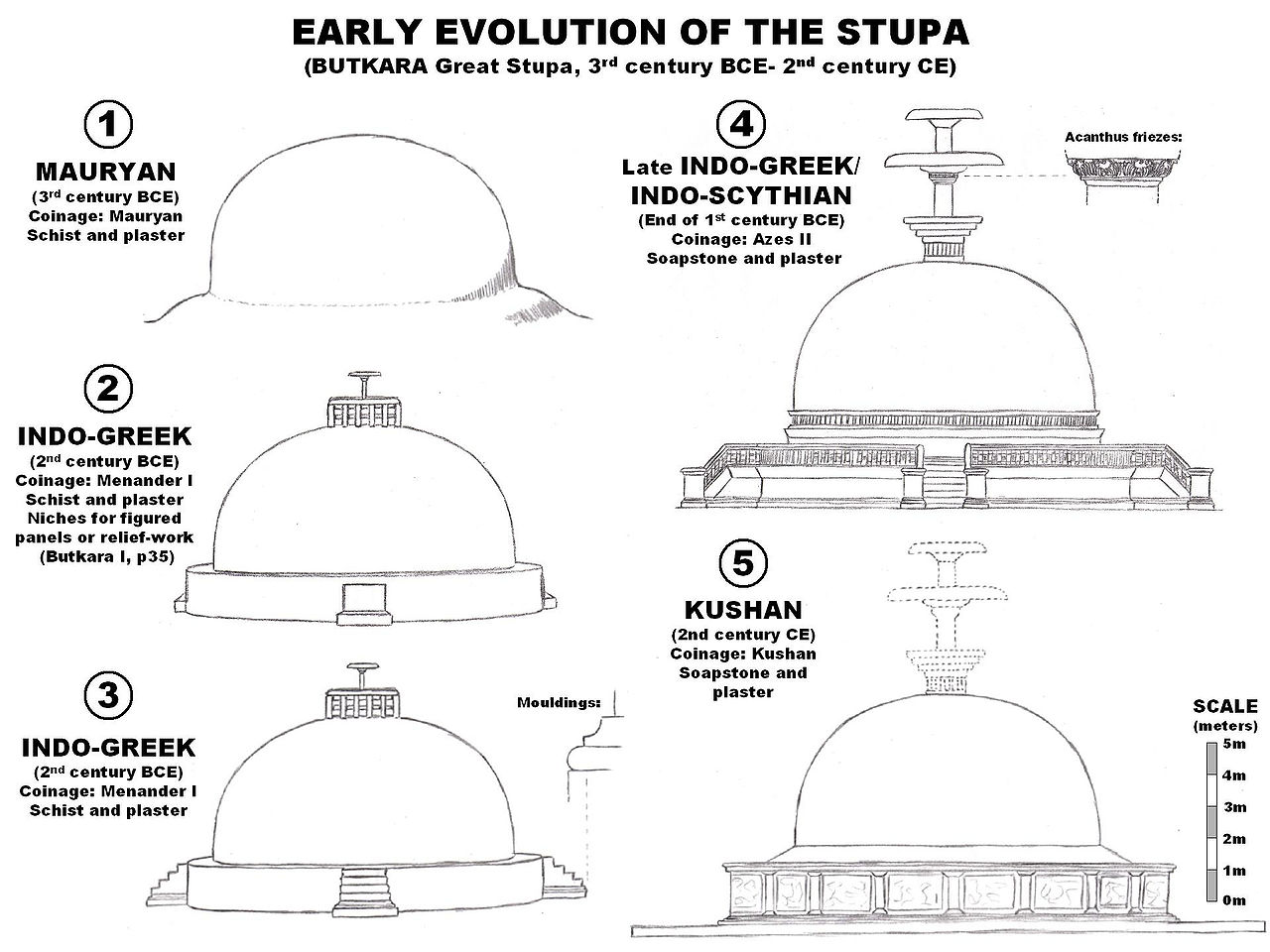
The Butkara stupa was "monumentalized" by the addition of Hellenistic architectural decorations during Indo-Greek rule in the 2nd century BC.[275] A coin of Menander I was found in the second oldest stratum (GSt 2) of the Butkara stupa suggesting a period of additional constructions during the reign of Menander.[286] It is thought that Menander was the builder of the second oldest layer of the Butkara stupa, following its initial construction during the Mauryan Empire.[287]
"Followers of the Dharma"

Several Indo-Greek kings use the title "Dharmikasa", i.e. "Follower of the Dharma", in the Kharoshti script on the obverse of their coins. The corresponding legend in Greek is "Dikaios" ("The Just"), a rather usual attribute on Greek coins. The expression "Follower of the Dharma" would of course resonate strongly with Indian subjects, used to this expression being employed by pious kings, especially since the time of Ashoka who advocated the Dharma in his inscriptions. The seven kings using "Dharmakasa", i.e. "Follower of the Dharma", are late Indo-Greek kings, from around 150 BC, right after the reign of Menander I, and mainly associated with the area of Gandhara: Zoilos I (130–120 BC), Strato (130–110 BC), Heliokles II (95–80 BC), Theophilos (130 or 90 BC), Menander II (90–85 BC), Archebios (90–80 BC) and Peukolaos (c. 90 BC).[288] The attribute of Dharmika was again used a century later by a known Buddhist practitioner, Indo-Scythian king Kharahostes, to extoll on his coins the virtues of his predecessor king Azes.[289]
Blessing gestures
From the time of Agathokleia and Strato I, circa 100 BC, kings and divinities are regularly show on coins making blessing gestures,[290] which often seem similar to the Buddhist Vitarka mudra.[291] As centuries passed, the exact shapes taken by the hand becomes less clear. This blessing gesture was also often adopted by the Indo-Scythians.[292]
-
 Philoxenus (c. 100 BC), unarmed, making a blessing gesture.
 -
 Nicias making a blessing gesture.
 -
 Strato I in combat gear, making a blessing gesture, circa 100 BC.
 -
 Various blessing gestures: divinities (top), kings (bottom).


Vaishnavites
The Heliodorus pillar is a stone column that was erected around 113 BC in central India[citation needed] in Vidisha near modern Besnagar, by Heliodorus, a Greek ambassador of the Indo-Greek king Antialcidas[230] to the court of the Shunga king Bhagabhadra. The pillar originally supported a statue of Garuda. In the dedication, the Indo-Greek ambassador explains he is a devotee of "Vāsudeva, the God of Gods". Historically, it is the first known inscription related to the Bhagavata cult in India.[180]
Art

In general, the art of the Indo-Greeks is poorly documented, and few works of art (apart from their coins and a few stone palettes) are directly attributed to them. The coinage of the Indo-Greeks however is generally considered some of the most artistically brilliant of Antiquity.[293] The Hellenistic heritage (Ai-Khanoum) and artistic proficiency of the Indo-Greek world would suggest a rich sculptural tradition as well, but traditionally very few sculptural remains have been attributed to them. On the contrary, most Gandharan Hellenistic works of art are usually attributed to the direct successors of the Indo-Greeks in India in the 1st century AD, such as the nomadic Indo-Scythians, the Indo-Parthians and, in an already decadent state, the Kushans[294] In general, Gandharan sculpture cannot be dated exactly, leaving the exact chronology open to interpretation.

The possibility of a direct connection between the Indo-Greeks and Greco-Buddhist art has been reaffirmed recently as the dating of the rule of Indo-Greek kings has been extended to the first decades of the 1st century AD, with the reign of Strato II in the Punjab.[295] Also, Foucher, Tarn, and more recently, Boardman, Bussagli and McEvilley have taken the view that some of the most purely Hellenistic works of northwestern India and Afghanistan, may actually be wrongly attributed to later centuries, and instead belong to a period one or two centuries earlier, to the time of the Indo-Greeks in the 2nd–1st century BC:[j]

This is particularly the case of some purely Hellenistic works in Hadda, Afghanistan, an area which "might indeed be the cradle of incipient Buddhist sculpture in Indo-Greek style".[296] Referring to one of the Buddha triads in Hadda, in which the Buddha is sided by very Classical depictions of Herakles/Vajrapani and Tyche/Hariti, Boardman explains that both figures "might at first (and even second) glance, pass as, say, from Asia Minor or Syria of the first or second century BC (...) these are essentially Greek figures, executed by artists fully conversant with far more than the externals of the Classical style".[297]
Alternatively, it has been suggested that these works of art may have been executed by itinerant Greek artists during the time of maritime contacts with the West from the 1st to the 3rd century AD.[298]
The Greco-Buddhist art of Gandhara, beyond the omnipresence of Greek style and stylistic elements which might be simply considered an enduring artistic tradition,[299] offers numerous depictions of people in Greek Classical realistic style, attitudes and fashion (clothes such as the chiton and the himation, similar in form and style to the 2nd century BC Greco-Bactrian statues of Ai-Khanoum, hairstyle), holding contraptions which are characteristic of Greek culture (amphoras, "kantaros" Greek drinking cups), in situations which can range from festive (such as Bacchanalian scenes) to Buddhist-devotional.[300][301]

Uncertainties in dating make it unclear whether these works of art actually depict Greeks of the period of Indo-Greek rule up to the 1st century BC, or remaining Greek communities under the rule of the Indo-Parthians or Kushans in the 1st and 2nd century AD. Benjamin Rowland thinks that the Indo-Greeks, rather than the Indo-Scythians or the Kushans, may have been the models for the Bodhisattva statues of Gandhara[302]
Economy
Very little is known about the economy of the Indo-Greeks, although it seems to have been rather vibrant.[303][304]
Coinage
The abundance of their coins would tend to suggest large mining operations, particularly in the mountainous area of the Hindu-Kush, and an important monetary economy. The Indo-Greek did strike bilingual coins both in the Greek "round" standard and in the Indian "square" standard,[305] suggesting that monetary circulation extended to all parts of society. The adoption of Indo-Greek monetary conventions by neighbouring kingdoms, such as the Kunindas to the east and the Satavahanas to the south,[306] would also suggest that Indo-Greek coins were used extensively for cross-border trade.
Tribute payments

It would also seem that some of the coins emitted by the Indo-Greek kings, particularly those in the monolingual Attic standard, may have been used to pay some form of tribute to the Yuezhi tribes north of the Hindu-Kush.[179] This is indicated by the coins finds of the Qunduz hoard in northern Afghanistan, which have yielded quantities of Indo-Greek coins in the Hellenistic standard (Greek weights, Greek language), although none of the kings represented in the hoard are known to have ruled so far north.[307] Conversely, none of these coins have ever been found south of the Hindu-Kush.[308]
Trade with China

The Indo-Greek kings in Southern Asia issued the first known cupro-nickel coins, with Euthydemus II, dating from 180 to 170 BC, and his younger brothers Pantaleon and Agathocles around 170 BC. As only China was able to produce cupro-nickel at that time, and as the alloy ratios are exclusively similar, it has been suggested that the metal was the result of exchanges between China and Bactria.[309]
An indirect testimony by the Chinese explorer Zhang Qian, who visited Bactria around 128 BC, suggests that intense trade with Southern China was going through northern India. Zhang Qian explains that he found Chinese products in the Bactrian markets, and that they were transiting through northwestern India, which he incidentally describes as a civilization similar to that of Bactria:
"When I was in Bactria", Zhang Qian reported, "I saw bamboo canes from Qiong and cloth (silk?) made in the province of Shu. When I asked the people how they had gotten such articles, they replied: "Our merchants go buy them in the markets of Shendu (northwestern India). Shendu, they told me, lies several thousand li southeast of Bactria. The people cultivate land, and live much like the people of Bactria".
— Sima Qian, "Records of the Great Historian", trans. Burton Watson, p. 236.
Recent excavations at the burial site of China's first Emperor Qin Shi Huang, dating back to the 3rd century BCE, also suggest Greek influence in the artworks found there, including in the manufacture of the famous Terracotta army. It is also suggested that Greek artists may have come to China at that time to train local artisans in making sculptures.[310][311]
Indian Ocean trade
Maritime relations across the Indian Ocean started in the 3rd century BC, and further developed during the time of the Indo-Greeks together with their territorial expansion along the western coast of India. The first contacts started when the Ptolemies constructed the Red Sea ports of Myos Hormos and Berenike, with destination the Indus delta, the Kathiawar peninsula or Muziris. Around 130 BC, Eudoxus of Cyzicus is reported (Strabo, Geog. II.3.4)[312] to have made a successful voyage to India and returned with a cargo of perfumes and gemstones. By the time Indo-Greek rule was ending, up to 120 ships were setting sail every year from Myos Hormos to India (Strabo Geog. II.5.12).[313]
Armed forces

The coins of the Indo-Greeks provide rich clues on their uniforms and weapons. Typical Hellenistic uniforms are depicted, with helmets being either round in the Greco-Bactrian style, or the flat kausia of the Macedonians (coins of Apollodotus I).
Military technology
Their weapons were spears, swords, longbow (on the coins of Agathokleia) and arrows. Around 130 BC, the Central Asian recurve bow of the steppes with its gorytos box started to appear for the first time on the coins of Zoilos I, suggesting strong interactions (and apparently an alliance) with nomadic peoples, either the Yuezhi or the Scythians.[314] The recurve bow becomes a standard feature of Indo-Greek horsemen by 90 BC, as seen on some of the coins of Hermaeus.
Generally, Indo-Greek kings are often represented riding horses, as early as the reign of Antimachus II around 160 BC. The equestrian tradition probably goes back to the Greco-Bactrians, who are said by Polybius to have faced a Seleucid invasion in 210 BC with 10,000 horsemen.[315] Although war elephants are never represented on coins, a harness plate (phalera) dated to the 3rd–2nd century BC, today in the Hermitage Museum, depicts a helmetted Greek combatant on an Indian war elephant.
The Milinda Panha, in the questions of Nagasena to king Menander, provides a rare glimpse of the military methods of the period:
-(Nagasena) Has it ever happened to you, O king, that rival kings rose up against you as enemies and opponents?
-(Menander) Yes, certainly.
-Then you set to work, I suppose, to have moats dug, and ramparts thrown up, and watch towers erected, and strongholds built, and stores of food collected?
-Not at all. All that had been prepared beforehand.
-Or you had yourself trained in the management of war elephants, and in horsemanship, and in the use of the war chariot, and in archery and fencing?
-Not at all. I had learnt all that before.
-But why?
-With the object of warding off future danger.— (Milinda Panha, Book III, Chap 7)
The Milinda Panha also describes the structure of Menander's army:
Now one day Milinda the king proceeded forth out of the city to pass in review the innumerable host of his mighty army in its fourfold array (of elephants, cavalry, bowmen, and soldiers on foot).
— (Milinda Panha, Book I)
Size of Indo-Greek armies

The armed forces of the Indo-Greeks engaged in battles with other Indian kingdoms. The ruler of Kalinga, King Kharavela, states in the Hathigumpha inscription that during the 8th year of his reign he led a large army in the direction of a Yavana King, and that he forced their demoralized army to retreat to Mathura.
"Then in the eighth year, (Kharavela) with a large army having sacked Goradhagiri causes pressure on Rajagaha (Rajagriha). On account of the loud report of this act of valour, the Yavana (Greek) King Dimi[ta] retreated to Mathura having extricated his demoralized army."
— Hathigumpha inscription, lines 7–8, probably in the 1st century BCE. Original text is in Brahmi script.[171]
The name of the Yavana king is not clear, but it contains three letters, and the middle letter can be read as ma or mi.[316] R. D. Banerji and K.P. Jayaswal read the name of the Yavana king as "Dimita", and identify him with Demetrius I of Bactria. However, according to Ramaprasad Chanda, this identification results in "chronological impossibilities".[317] The Greek ambassador Megasthenes took special note of the military strength of Kalinga in his Indica in the middle of the 3rd century BC:
The royal city of the Calingae (Kalinga) is called Parthalis. Over their king 60,000 foot-soldiers, 1,000 horsemen, 700 elephants keep watch and ward in "procinct of war."
— Megasthenes fragm. LVI. in Plin. Hist. Nat. VI. 21. 8–23. 11.[318]
An account by the Roman writer Justin gives another hint of the size of Indo-Greek armies, which, in the case of the conflict between the Greco-Bactrian Eucratides and the Indo-Greek Demetrius II, he numbers at 60,000 (although they allegedly lost to 300 Greco-Bactrians):
Eucratides led many wars with great courage, and, while weakened by them, was put under siege by Demetrius, king of the Indians. He made numerous sorties, and managed to vanquish 60,000 enemies with 300 soldiers, and thus liberated after four months, he put India under his rule
— Justin, XLI,6[319]
The Indo-Greek armies would be conquered by Indo-Scythians, a nomadic tribe from Central Asia.
Legacy

From the 1st century AD, the Greek communities of central Asia and the northwestern Indian subcontinent lived under the control of the Kushan branch of the Yuezhi, apart from a short-lived invasion of the Indo-Parthian Kingdom.[321] The Kushans founded the Kushan Empire, which was to prosper for several centuries. In the south, the Greeks were under the rule of the Western Kshatrapas. The Kalash tribe of the Chitral Valley claim to be descendants of the Indo-Greeks; although this is disputed.

It is unclear how much longer the Greeks managed to maintain a distinct presence in the Indian sub-continent. The legacy of the Indo-Greeks was felt however for several centuries, from the usage of the Greek language and calendrical methods,[322] to the influences on the numismatics of the Indian subcontinent, traceable down to the period of the Gupta Empire in the 4th century.[323]
The Greeks may also have maintained a presence in their cities until quite late. Isidorus of Charax in his 1st century AD "Parthian stations" itinerary described an "Alexandropolis, the metropolis of Arachosia", thought to be Alexandria Arachosia, which he said was still Greek even at such a late time:
Beyond is Arachosia. And the Parthians call this White India; there are the city of Biyt and the city of Pharsana and the city of Chorochoad and the city of Demetrias; then Alexandropolis, the metropolis of Arachosia; it is Greek, and by it flows the river Arachotus. As far as this place the land is under the rule of the Parthians.[324]
The Indo-Greeks may also have had some influence on the religious plane as well, especially in relation to the developing Mahayana Buddhism. Mahayana Buddhism has been described as "the form of Buddhism which (regardless of how Hinduized its later forms became) seems to have originated in the Greco-Buddhist communities of India, through a conflation of the Greek Democritean–Sophistic–Pyrrhonist tradition with the rudimentary and unformalized empirical and skeptical elements already present in early Buddhism".[325]
Chronology

Today 36 Indo-Greek kings are known. Several of them are also recorded in Western and Indian historical sources, but the majority are known through numismatic evidence only. The exact chronology and sequencing of their rule is still a matter of scholarly inquiry, with adjustments regular being made with new analysis and coin finds (overstrikes of one king over another's coins being the most critical element in establishing chronological sequences).
There is an important evolution of coin shape (round to square) and material (from gold to silver to brass) across the territories and the periods, and from Greek type to Indian type over a period of nearly 3 centuries. Also, the quality of coinage illustration decreases down to the 1st century AD. Coinage evolution is an important point of Indo-Greek history, and actually one of the most important since most of these kings are only known by their coins, and their chronology is mainly established by the evolution of the coin types.
The system used here is adapted from Osmund Bopearachchi, supplemented by the views of R C Senior and occasionally other authorities.[326]
See also
- Greco-Bactrian Kingdom
- Yavana era
- Yavana Kingdom
- Seleucid Empire
- Greco-Buddhism
- Gandharan Buddhism
- Indo-Scythians
- India (Herodotus)
- Indo-Parthian Kingdom
- Kandahar Greek Inscription
- Kandahar Bilingual Rock Inscription
- Kushan Empire
- Roman commerce
- Timeline of Indo-Greek Kingdoms
- Gandhara Kingdom
- Partition of Babylon
References
Notes
- ^ "When the Greeks of Bactria and India lost their kingdom they were not all killed, nor did they return to Greece. They merged with the people of the area and worked for the new masters; contributing considerably to the culture and civilization in southern and central Asia." Narain, "The Indo-Greeks" 2003, p. 278
- ^ Justin refers to an incident in which Eucratides with a small force of 300 was besieged for four months by "Demetrius, king of the Indians" with a large army of 60,000. The numbers are obviously an exaggeration. Eucratides managed to break out and went on to conquer India.
- ^ G.K. Jenkins, using overstrikes and monograms, showed that, contrary to what Narai would write two years later, Apollodotus II and Hippostratus were posterior, by far, to Maues. (...) He reveals an overstike if Azes I over Hippostratus. (...) Apollodotus and Hippostratus are thus posterior to Maues and anterior to Azes I, whose era we now starts in 57 BC." Bopearachchi, p. 126-127.
- ^ "It is curious that on his copper Zoilos used a bow and quiver as a type. A quiver was a badge used by the Parthians (Scythians) and had been used previously by Diodotos, who we know had made a treaty with them. Did Zoilos use Scythian mercenaries in his quest against Menander perhaps?" Senior, Indo-Scythian coins, p. xxvii
- ^ Marital alliances:
- Discussion on the dynastic alliance in Tarn, pp. 152–153: "It has been recently suggested that Ashoka was grandson of the Seleucid princess, whom Seleucus gave in marriage to Chandragupta. Should this far-reaching suggestion be well founded, it would not only throw light on the good relations between the Seleucid and Maurya dynasties, but would mean that the Maurya dynasty was descended from, or anyhow connected with, Seleucus... when the Mauryan line became extinct, he (Demetrius) may well have regarded himself, if not as the next heir, at any rate as the heir nearest at hand". Also: "The Seleucid and Maurya lines were connected by the marriage of Seleucus' daughter (or niece) either to Chandragupta or his son Bindusara" John Marshall, Taxila, p20. This thesis originally appeared in "The Cambridge Shorter History of India": "If the usual oriental practice was followed and if we regard Chandragupta as the victor, then it would mean that a daughter or other female relative of Seleucus was given to the Indian ruler or to one of his sons, so that Ashoka may have had Greek blood in his veins." The Cambridge Shorter History of India, J. Allan, H. H. Dodwell, T. Wolseley Haig, p33.[254]
- Description of the 302 BC marital alliance in:[255] "The Indians occupy in part some of the countries situated along the Indus, which formerly belonged to the Persians: Alexander deprived the Ariani of them, and established there settlements of his own. But Seleucus Nicator gave them to Sandrocottus in consequence of a marriage contract, and received in return five hundred elephants." The ambassador Megasthenes was also sent to the Mauryan court on this occasion.
- ^ Exchange of presents:
- Classical sources have recorded that Chandragupta sent various aphrodisiacs to Seleucus: "And Theophrastus says that some contrivances are of wondrous efficacy in such matters as to make people more amorous. And Phylarchus confirms him, by reference to some of the presents which Sandrakottus, the king of the Indians, sent to Seleucus; which were to act like charms in producing a wonderful degree of affection, while some, on the contrary, were to banish love" Athenaeus of Naucratis, "The deipnosophists" Book I, chapter 32 [256]
- Ashoka claims he introduced herbal medicine in the territories of the Greeks, for the welfare of humans and animals (Edict No2).
- Bindusara asked Antiochus I to send him some sweet wine, dried figs and a sophist: "But dried figs were so very much sought after by all men (for really, as Aristophanes says, "There's really nothing nicer than dried figs"), that even Amitrochates, the king of the Indians, wrote to Antiochus, entreating him (it is Hegesander who tells this story) to buy and send him some sweet wine, and some dried figs, and a sophist; and that Antiochus wrote to him in answer, "The dry figs and the sweet wine we will send you; but it is not lawful for a sophist to be sold in Greece" Athenaeus, "Deipnosophistae" XIV.67 [257]
- ^ Treaties of friendship:
- When Antiochos III, after having made peace with Euthydemus, went to India in 209 BC, he is said to have renewed his friendship with the Indian king there and received presents from him: "He crossed the Caucasus (Hindu Kush) and descended into India; renewed his friendship with Sophagasenus the king of the Indians; received more elephants, until he had a hundred and fifty altogether; and having once more provisioned his troops, set out again personally with his army: leaving Androsthenes of Cyzicus the duty of taking home the treasure which this king had agreed to hand over to him."[258]
- ^ Ambassadors:
- Known ambassadors to India are Megasthenes, Deimakos and Dionysius.
- ^ Religious missions:
- In the Edicts of Ashoka, king Ashoka claims to have sent Buddhist emissaries to the Hellenistic west around 250 BC.
- ^ On the Indo-Greeks and the Gandhara school:
- 1) "It is necessary to considerably push back the start of Gandharan art, to the first half of the first century BC, or even, very probably, to the preceding century.(...) The origins of Gandharan art... go back to the Greek presence. (...) Gandharan iconography was already fully formed before, or at least at the very beginning of our era" Mario Bussagli "L'art du Gandhara", p331–332
- 2) "The beginnings of the Gandhara school have been dated everywhere from the first century B.C. (which was M.Foucher's view) to the Kushan period and even after it" (Tarn, p. 394). Foucher's views can be found in "La vieille route de l'Inde, de Bactres a Taxila", pp340–341). The view is also supported by Sir John Marshall ("The Buddhist art of Gandhara", pp5–6).
- 3) Also the recent discoveries at Ai-Khanoum confirm that "Gandharan art descended directly from Hellenized Bactrian art" (Chaibi Nustamandy, "Crossroads of Asia", 1992).
- 4) On the Indo-Greeks and Greco-Buddhist art: "It was about this time (100 BC) that something took place which is without parallel in Hellenistic history: Greeks of themselves placed their artistic skill at the service of a foreign religion, and created for it a new form of expression in art" (Tarn, p. 393). "We have to look for the beginnings of Gandharan Buddhist art in the residual Indo-Greek tradition, and in the early Buddhist stone sculpture to the South (Bharhut etc...)" (Boardman, 1993, p. 124). "Depending on how the dates are worked out, the spread of Gandhari Buddhism to the north may have been stimulated by Menander's royal patronage, as may the development and spread of the Gandharan sculpture, which seems to have accompanied it" McEvilley, 2002, "The shape of ancient thought", p. 378.
Citations
- ^ Schwartzberg, Joseph E. (1978). A Historical atlas of South Asia. University of Chicl.uchicago.edu/reference/schwartzberg/pager.html?object=182.
- ^ name=Indo-Greek: 30em">Tarn, William Woodthorpe (1966), "Alexandria of the Caucasus and Kapisa", The Greeks in Bactria and India, Cambridge University Press, pp. 460–462, doi:10.1017/CBO9780511707353.019, ISBN 978051170735
- ^ Taagepera, Rein (1979). "Size and Duration of Empires: Growth-Decline Curves, 600 B.C. to 600 A.D.". Social Science History. 3 (3/4): 132. doi:10.2307/1170959. JSTOR 1170959.
- ^ Wilson, John (1877). Indian Caste. Times of India Office. p. 353.
- ^ Jackson J. Spielvogel (14 September 2016). Western Civilization: Volume A: To 1500. Cengage Learning. p. 96. ISBN 978-1-305-95281-2.
The invasion of India by a Greco-Bactrian army in ... led to the creation of an Indo-Greek kingdom in northwestern India (present-day India and Pakistan).
- ^ Erik Zürcher (1962). Buddhism: its origin and spread in words, maps, and pictures. St Martin's Press. p. 45.
Three phases must be distinguished, (a) The Greek rulers of Bactria (the Oxus region) expand their power to the south, conquer Afghanistan and considerable parts of north-western India, and establish an Indo-Greek kingdom in the Panjab where they rule as 'kings of India'; i
- ^ Heidi Roupp (4 March 2015). Teaching World History: A Resource Book. Routledge. p. 171. ISBN 978-1-317-45893-7.
There were later Indo-Greek kingdoms in northwest India. ...
- ^ Hermann Kulke; Dietmar Rothermund (2004). A History of India. Psychology Press. p. 74. ISBN 978-0-415-32919-4.
They are referred to as 'Indo-Greeks' and there were about forty such kings and rulers who controlled large areas of northwestern India and Afghanistan. Their history ...
- ^ Los Angeles County Museum of Art; Pratapaditya Pal (1986). Indian Sculpture: Circa 500 B.C.-A.D. 700. University of California Press. p. 15. ISBN 978-0-520-05991-7.
Since parts of their territories comprised northwestern India, these later rulers of Greek origin are generally referred to as Indo-Greeks.
- ^ Joan Aruz; Elisabetta Valtz Fino (2012). Afghanistan: Forging Civilizations Along the Silk Road. Metropolitan Museum of Art. p. 42. ISBN 978-1-58839-452-1.
The existence of Greek kingdoms in Central Asia and northwestern India after Alexander's conquests had been known for a long time from a few fragmentary texts from Greek and Latin classical sources and from allusions in contemporary Chinese chronicles and later Indian texts.
- ^ Mortimer Wheeler Flames over Persepolis (London, 1968). Pp. 112 ff. It is unclear whether the Hellenistic street plan found by Sir John Marshall's excavations dates from the Indo-Greeks or from the Kushans, who would have encountered it in Bactria; Tarn (1951, pp. 137, 179) ascribes the initial move of Taxila to the hill of Sirkap to Demetrius I, but sees this as "not a Greek city but an Indian one"; not a polis or with a Hippodamian plan.
- ^ "Menander had his capital in Sagala" Bopearachchi, "Monnaies", p. 83.
- ^ McEvilley supports Tarn on both points, citing Woodcock: "Menander was a Bactrian Greek king of the Euthydemid dynasty. His capital (was) at Sanghol in the Punjab, "in the country of the Yonakas (Greeks)"." McEvilley, p. 377. However, "Even if Sagala proves to be a city, it does not seem to be Menander's capital for the Milindapanha states that Menander came down to Sagala to meet Nagasena, just as the Ganges flows to the sea."
- ^ Thonemann, Peter (2016-01-14). The Hellenistic World: Using Coins as Sources. Cambridge University Press. p. 97. ISBN 978-1-316-43229-7.
- ^ "Indo-Greek Campaigns".
- ^ "A vast hoard of coins, with a mixture of Greek profiles and Indian symbols, along with interesting sculptures and some monumental remains from Taxila, Sirkap and Sirsukh, point to a rich fusion of Indian and Hellenistic influences", India, the Ancient Past, Burjor Avari, p. 130
- ^ Ghose, Sanujit (2011). "Cultural links between India and the Greco-Roman world". Ancient History Encyclopedia
- ^ 11.34
- ^ ("Notes on Hellenism in Bactria and India". W. W. Tarn. Journal of Hellenic Studies, Vol. 22 (1902), pp. 268–293).
- ^ a b c Osmund Bopearachchi Was Indo-Greek Artemidoros the son of Indo-Sctythian Maues
- ^ "Most of the people east of the Ravi already noticed as within Menander's empire -Audumbaras, Trigartas, Kunindas, Yaudheyas, Arjunayanas- began to coins in the first century BC, which means that they had become independent kingdoms or republics.", Tarn, The Greeks in Bactria and India
- ^ a b Tarn, William Woodthorpe (2010-06-24). The Greeks in Bactria and India. Cambridge University Press. ISBN 9781108009416.
- ^ India, the Ancient Past, Burjor Avari, pp. 92-93
- ^ :"To the colonies settled in India, Python, the son of Agenor, was sent." Justin XIII.4[usurped]
- ^ Chandragupta Maurya and His Times, Radhakumud Mookerji, Motilal Banarsidass Publ., 1966, pp. 26-27 [1]
- ^ Chandragupta Maurya and His Times, Radhakumud Mookerji, Motilal Banarsidass Publ., 1966, p. 27 [2]
- ^ History Of The Chamar Dynasty, Raj Kumar, Gyan Publishing House, 2008, p. 51 [3]
- ^ "Kusumapura was besieged from every direction by the forces of Parvata and Chandragupta: Shakas, Yavanas, Kiratas, Kambojas, Parasikas, Bahlikas and others, assembled on the advice of Chanakya" in Mudrarakshasa 2. Sanskrit original: "asti tava Shaka-Yavana-Kirata-Kamboja-Parasika-Bahlika parbhutibhih Chankyamatipragrahittaishcha Chandergupta Parvateshvara balairudidhibhiriva parchalitsalilaih samantaad uprudham Kusumpurama". From the French translation, in "Le Ministre et la marque de l'anneau", ISBN 2-7475-5135-0
- ^ India, the Ancient Past, Burjor Avari, pp. 106-107
- ^ "Strabo 15.2.1(9)".
- ^ Barua, Pradeep. The State at War in South Asia. Vol. 2. U of Nebraska Press, 2005. pp13-15 via Project MUSE (subscription required)
- ^ a b Foreign Influence on Ancient India, Krishna Chandra Sagar, Northern Book Centre, 1992, p. 83 [4]
- ^ Pratisarga Parva p. 18. Original Sanskrit of the first two verses: "Chandragupta Sutah Paursadhipateh Sutam. Suluvasya Tathodwahya Yavani Baudhtatapar".
- ^ "A minor rock edict, recently discovered at Kandahar, was inscribed in two scripts, Greek and Aramaic", India, the Ancient Past, Burjor Avari, p. 112
- ^ "The treaty between the two kings was settled with a marriage agreement by which a daughter of Seleucus Nicator entered the house of Chandragupta. Since she hardly had become the wife of any lesser person than the Indian emperor himself or his son and heir Bindusāra, the fascinating possibility arises that Aśoka, the greatest of the Mauryan emperors, may in fact, have been half or at least a quarter Greek." Vassiliades, 2016, p. 21, quoting Woodcock, "The Greeks in India", p. 17
- ^ India, the Ancient Past, Burjor Avari, pp. 108-109
- ^ "Three Greek ambassadors are known by name: Megasthenes, ambassador to Chandragupta; Deimachus, ambassador to Chandragupta's son Bindusara; and Dyonisius, whom Ptolemy Philadelphus sent to the court of Ashoka, Bindusara's son", McEvilley, p. 367
- ^ Classical sources have recorded that following their treaty, Chandragupta and Seleucus exchanged presents, such as when Chandragupta sent various aphrodisiacs to Seleucus: "And Theophrastus says that some contrivances are of wondrous efficacy in such matters as to make people more amorous. And Phylarchus confirms him, by reference to some of the presents which Sandrakottus, the king of the Indians, sent to Seleucus; which were to act like charms in producing a wonderful degree of affection, while some, on the contrary, were to banish love" Athenaeus of Naucratis, "The deipnosophists" Book I, chapter 32 Ath. Deip. I.32. Mentioned in McEvilley, p. 367
- ^ "The very fact that both Megasthenes and Kautilya refer to a state department run and maintained specifically for the purpose of looking after foreigners, who were mostly Yavanas and Persians, testifies to the impact created by these contacts.", Narain, "The Indo-Greeks", p. 363
- ^ "It also explains (...) random finds from the Sarnath, Basarth, and Patna regions of terra-cotta pieces of distinctive Hellenistic or with definite Hellenistic motifs and designs", Narain, "The Indo-Greeks" 2003, p. 363
- ^ "The second Kandahar edict (the purely Greek one) of Ashoka is a part of the "corpus" known as the "Fourteen-Rock-Edicts"" Narain, "The Indo-Greeks" 2003, p. 452
- ^ "It is also in Kandahar that were found the fragments of a Greek translation of Edicts XII and XIII, as well as the Aramean translation of another edict of Ashoka", Bussagli, p. 89
- ^ "Within Ashoka's domain Greeks may have had special privileges, perhaps ones established by the terms of the Seleucid alliance. Rock Edict Thirteen indicates the existence of a Greek principality in the northwest of Ashoka's empire—perhaps Kandahar, or Alexandria-of-the-Arachosians—which was not ruled by him and for which he troubled to send Buddhist missionaries and published at least some of his edicts in Greek", McEvilley, p. 368
- ^ "Thirteen, the longest and most important of the edicts, contains the claim, seemingly outlandish at first glance, that Ashoka had sent missions to the lands of the Greek monarchs—not only those of Asia, such as the Seleucids, but those back in the Mediterranean also", McEvilley, p. 368
- ^ "When Ashoka was converted to Buddhism, his first thought was to despatch missionaries to his friends, the Greek monarchs of Egypt, Syria, and Macedonia", Rawlinson, Intercourse between India and the Western world, p. 39, quoted in McEvilley, p. 368
- ^ "In Rock Edict Two Ashoka even claims to have established hospitals for men and beasts in the Hellenistic kingdoms", McEvilley, p. 368
- ^ "One of the most famous of these emissaries, Dharmaraksita, who was said to have converted thousands, was a Greek (Mhv.XII.5 and 34)", McEvilley, p. 370
- ^ "The Mahavamsa tells that "the celebrated Greek teacher Mahadharmaraksita in the second century BC led a delegation of 30,000 monks from Alexandria-of-the-Caucasus (Alexandra-of-the-Yonas, or of-the-Greeks, the Ceylonese text actually says) to the opening of the great Ruanvalli Stupa at Anuradhapura"", McEvilley, p. 370, quoting Woodcock, "The Greeks in India", p. 55
- ^ Full text of the Mahavamsa Click chapter XII
- ^ "The finest of the pillars were executed by Greek or Perso-Greek sculptors; others by local craftsmen, with or without foreign supervision" Marshall, "The Buddhist art of Gandhara", p4
- ^ "A number of foreign artisans, such as the Persians or even the Greeks, worked alongside the local craftsmen, and some of their skills were copied with avidity" Burjor Avari, "India, The ancient past", p. 118
- ^ Foreign Influence on Ancient India by Krishna Chandra Sagar p. 138
- ^ The Idea of Ancient India: Essays on Religion, Politics, and Archaeology by Upinder Singh p. 18
- ^ "Antiochos III, after having made peace with Euthydemus I after the aborted siege of Bactra, renewed with Sophagasenus the alliance concluded by his ancestor Seleucos I", Bopearachchi, Monnaies, p. 52
- ^ Polybius (1962) [1889]. "11.39". Histories. Evelyn S. Shuckburgh (translator). Macmillan, Reprint Bloomington.
- ^ Polybius; Friedrich Otto Hultsch (1889). The Histories of Polybius. Macmillan and Company. p. 78.
- ^ J. D. Lerner, The Impact of Seleucid Decline on the Eastern Iranian Plateau: the Foundations of Arsacid Parthia and Graeco-Bactria, (Stuttgart 1999)
- ^ F. L. Holt, Thundering Zeus (Berkeley 1999)
- ^ Justin XLI, paragraph 4[usurped]
- ^ Justin XLI, paragraph 1[usurped]
- ^ a b Strabo XI.XI.I
- ^ Justin XLI[usurped]
- ^ a b Polybius 11.34
- ^ Strabo 11.11.2
- ^ Polybius 10.49, Battle of the Arius
- ^ Polybius 11.34 Siege of Bactra
- ^ On the image of the Greek kneeling warrior: "A bronze figurine of a kneeling warrior, not Greek work, but wearing a version of the Greek Phrygian helmet.. From a burial, said to be of the 4th century BC, just north of the Tien Shan range". Ürümqi Xinjiang Museum. (Boardman "The diffusion of Classical Art in Antiquity")
- ^ Notice of the British Museum on the Zhou vase (2005, attached image): "Red earthenware bowl, decorated with a slip and inlaid with glass paste. Eastern Zhou period, 4th–3rd century BC. This bowl was probably intended to copy a more precious and possibly foreign vessel in bronze or even silver. Glass was little used in China. Its popularity at the end of the Eastern Zhou period was probably due to foreign influence."
- ^ "The things which China received from the Graeco-Iranian world-the pomegranate and other "Chang-Kien" plants, the heavy equipment of the cataphract, the traces of Greeks influence on Han art (such as) the famous white bronze mirror of the Han period with Graeco-Bactrian designs (...) in the Victoria and Albert Museum" (Tarn, The Greeks in Bactria and India, pp. 363–364)
- ^ Copper-Nickel coinage in Greco-Bactria. Archived 2005-03-06 at the Wayback Machine
- ^ Ancient Chinese weapons Archived 2005-03-07 at the Wayback Machine A halberd of copper-nickel alloy, from the Warring States Period.
- ^ A.A. Moss pp317-318 Numismatic Chronicle 1950
- ^ C.Michael Hogan, Silk Road, North China, Megalithic Portal, ed. A. Burnham
- ^ Viglas, Katelis (2016). "Chaldean and Neo-Platonic Theology". Philosophia e-Journal of Philosophy and Culture (14): 171–189.
The name "Chaldeans" refers generally to the Chaldean people who lived in the land of Babylonia, and especially to the Chaldean "magi" of Babylon......The "Chaldeans" were the guardians of the sacred science: the astrological knowledge and the divination mixed with religion and magic. They were considered the last representatives of the Babylonian sages......In Classical Antiquity, the name "Chaldeans" primarily stood for the priests of the Babylonian temples. In Hellenistic times, the term "Chaldeos" was synonymous with the words "mathematician" and "astrologer"......The Neo-Platonists connected the Chaldean Oracles with the ancient Chaldeans, obtaining a prestige coming from the East and legitimizing their existence as bearers and successors of an ancient tradition.
- ^ Clement of Alexandria "The Stromata, or Miscellanies" Book I, Chapter XV
- ^ "General Pushyamitra, who is at the origin of the Shunga dynasty. He was supported by the Brahmins and even became the symbol of the Brahmanical turnover against the Buddhism of the Mauryas. The capital was then transferred to Pataliputra (today's Patna)", Bussagli, p. 99
- ^ Pushyamitra is described as a "senapati" (Commander-in-chief) of Brihadratha in the Puranas
- ^ E. Lamotte: History of Indian Buddhism, Institut Orientaliste, Louvain-la-Neuve 1988 (1958), p. 109.
- ^ Aśoka and the Decline of the Mauryas by Romila Thapar, Oxford University Press,1960 p. 200
- ^ a b Encyclopaedia of Indian Traditions and Cultural Heritage, Anmol Publications, 2009, p. 18
- ^ Pratisarga Parva p. 18
- ^ Jairazbhoy, Rafique Ali (1995). Foreign influence in ancient Indo-Pakistan. Sind Book House. p. 100. ISBN 978-969-8281-00-7.
Apollodotus, founder of the Graeco- Indian kingdom (c. 160 BC).
- ^ See Polybius, Arrian, Livy, Cassius Dio, and Diodorus. Justin, who will be discussed shortly, provides a summary of the histories of Hellenistic Macedonia, Egypt, Asia, and Parthia.
- ^ For the date of Trogus, see the OCD on "Trogus" and Yardley/Develin, p. 2; since Trogus' father was in charge of Julius Caesar's diplomatic missions before the history was written (Justin 43.5.11), Senior's date in the following quotation is too early: "The Western sources for accounts of Bactrian and Indo-Greek history are: Polybius, a Greek born c.200 BC; Strabo, a Roman who drew on the lost history of Apollodoros of Artemita (c. 130–87 BC), and Justin, who drew on Trogus, a post 87 BC writer", Senior, Indo-Scythian coins IV, p. x; the extent to which Strabo is citing Apollodorus is disputed, beyond the three places he names Apollodorus (and he may have those through Eratosthenes). Polybius speaks of Bactria, not of India.
- ^ Strabo, Geographia 11.11.1 p. 516 Casaubon. 15.1.2, p. 686 Casaubon, "tribes" is Jones' version of ethne (Loeb)
- ^ For a list of classical testimonia, see Tarn's Index II; but this covers India, Bactria, and several sources for the Hellenistic East as a whole.
- ^ Tarn, App. 20; Narain (1957) pp. 136, 156 et alii.
- ^ Sonya Rhie Quintanilla (2007). History of Early Stone Sculpture at Mathura: Ca. 150 BCE - 100 CE. BRILL Academic. pp. 254–255. ISBN 978-90-04-15537-4.
- ^ Demetrius is said to have founded Taxila (archaeological excavations), and also Sagala in the Punjab, which he seemed to have called Euthydemia, after his father ("the city of Sagala, also called Euthydemia" (Ptolemy, Geographia, VII 1))
- ^ A Journey Through India's Past Chandra Mauli Mani, Northern Book Centre, 2005, p. 39
- ^ Polybius 11.34
- ^ The first conquests of Demetrius have usually been held to be during his father's lifetime; the difference has been over the actual date. Tarn and Narain agreed on having them begin around 180; Bopearachchi moved this back to 200, and has been followed by much of the more recent literature, but see Brill's New Pauly: Encyclopaedia of the Ancient World (Boston, 2006) "Demetrius" §10, which places the invasion "probably in 184". D.H. MacDowall, "The Role of Demetrius in Arachosia and the Kabul Valley", published in the volume: O. Bopearachchi, Landes (ed), Afghanistan Ancien Carrefour Entre L'Est Et L'Ouest, (Brepols 2005) discusses an inscription dedicated to Euthydemus, "Greatest of all kings" and his son Demetrius, who is not called king but "Victorious" (Kallinikos). This is taken to indicate that Demetrius was his father's general during the first conquests. It is uncertain whether the Kabul valley or Arachosia were conquered first, and whether the latter province was taken from the Seleucids after their defeat by the Romans in 190 BC. Peculiar enough, more coins of Euthydemus I than of Demetrius I have been found in the mentioned provinces. The calendar of the "Yonas" is proven by an inscription giving a triple synchronism to have begun in 186/5 BC; what event is commemorated is itself uncertain. Richard Salomon "The Indo-Greek era of 186/5 B.C. in a Buddhist reliquary inscription", in Afghanistan, Ancien Carrefour cited.
- ^ "Demetrius occupied a large part of the Indus delta, Saurashtra and Kutch", Burjor Avari, p. 130
- ^ "It would be impossible to explain otherwise why in all his portraits Demetrios is crowned with an elephant scalp", Bopearachchi, Monnaies, p. 53
- ^ "We think that the conquests of these regions south of the Hindu Kush brought to Demetrius I the title of "King of India" given to him by Apollodorus of Artemita." Bopearachchi, p. 52
- ^ For Heracles, see Lillian B. Lawler "Orchesis Kallinikos" Transactions and Proceedings of the American Philological Association, Vol. 79. (1948), pp. 254–267, p. 262; for Artemidorus, see K. Walton Dobbins "The Commerce of Kapisene and Gandhāra after the Fall of Indo-Greek Rule" Journal of the Economic and Social History of the Orient, Vol. 14, No. 3. (Dec., 1971), pp. 286–302 (Both JSTOR). Tarn, p. 132, argues that Alexander did not assume as a title, but was only hailed by it, but see Peter Green, The Hellenistic Age, p. 7; see also Senior, Indo-Scythian coins, p. xii. No undisputed coins of Demetrius I himself use this title, but it is employed on one of the pedigree coins issued by Agathocles, which bear on the reverse the classical profile of Demetrius crowned by the elephant scalp, with the legend DEMETRIOS ANIKETOS, and on the reverse Herakles crowning himself, with the legend "Of king Agathocles" (Boppearachchi, "Monnaies", p. 179 and Pl 8). Tarn, The Greeks in Bactria and India, Chap IV.
- ^ "It now seems most likely that Demetrios was the founder of the newly discovered Greek Era of 186/5", Senior, Indo-Scythian coins IV
- ^ a b Holt, Frank Lee (1988). Alexander the Great and Bactria: The Formation of a Greek Frontier in Central Asia. Brill Archive. ISBN 9004086129.
- ^ MacDowall, 2004
- ^ "The only thing that seems reasonably sure is that Taxila was part of the domain of Agathocles", Bopearachchi, Monnaies, p. 59
- ^ Krishan, Yuvraj; Tadikonda, Kalpana K. (1996). The Buddha Image: Its Origin and Development. Bharatiya Vidya Bhavan. p. 22. ISBN 9788121505659.
- ^ a b Iconography of Balarāma, Nilakanth Purushottam Joshi, Abhinav Publications, 1979, p. 22 [5]
- ^ Stanton, Andrea L.; Ramsamy, Edward; Seybolt, Peter J.; Elliott, Carolyn M. (2012). Cultural Sociology of the Middle East, Asia, and Africa: An Encyclopedia. SAGE Publications. p. 28. ISBN 9781452266626.
- ^ Singh, Nagendra Kr; Mishra, A. P. (2007). Encyclopaedia of Oriental Philosophy and Religion: Buddhism. Global Vision Publishing House. pp. 351, 608–609. ISBN 9788182201156.
- ^ Bopearachchi, Monnaies, p. 63
- ^ a b "Numismats and historians are unanimous in considering that Menander was one of the greatest, if not the greatest, and the most famous of the Indo-Greek kings. The coins to the name of Menander are incomparably more abundant than those of any other Indo-Greek king" Bopearachchi, "Monnaies Gréco-Bactriennes et Indo-Grecques", p. 76.
- ^ "Menander". Encyclopædia Britannica Online.
Menander, also spelled Minedra or Menadra, Pali Milinda (flourished 160 BCE?–135 BCE?), the greatest of the Indo-Greek kings and the one best known to Western and Indian classical authors. He is believed to have been a patron of the Buddhist religion and the subject of an important Buddhist work, the Milinda-panha ("The Questions of Milinda"). Menander was born in the Caucasus, but the Greek biographer Plutarch calls him a king of Bactria, and the Greek geographer and historian Strabo includes him among the Bactrian Greeks "who conquered more tribes than Alexander [the Great]."
- ^ "There is certainly some truth in Apollodorus and Strabo when they attribute to Menander the advances made by the Greeks of Bactria beyond the Hypanis and even as far as the Ganges and Palibothra (...) That the Yavanas advanced even beyond in the east, to the Ganges-Jamuna valley, about the middle of the second century BC is supported by the cumulative evidence provided by Indian sources", Narain, "The Indo-Greeks" p. 267.
- ^ Ahir, D. C. (1971). Buddhism in the Punjab, Haryana, and Himachal Pradesh. Maha Bodhi Society of India. p. 31. OCLC 1288206.
Demetrius died in 166 B.C., and Apollodotus, who was a near relation of the King died in 161 B.C. After his death, Menander carved out a kingdom in the Punjab. Thus from 161 B.C. onward Menander was the ruler of Punjab till his death in 145 B.C. or 130 B.C..
- ^ Magill, Frank Northen (2003). Dictionary of World Biography, Volume 1. Taylor & Francis. p. 717. ISBN 9781579580407.
MENANDER Born: c. 210 B.C.; probably Kalasi, Afghanistan Died: c. 135 B.C.; probably in northwest India Areas of Achievement: Government and religion Contribution: Menander extended the Greco-Bactrian domains in India more than any other ruler. He became a legendary figure as a great patron of Buddhism in the Pali book the Milindapanha. Early Life – Menander (not to be confused with the more famous Greek dramatist of the same name) was born somewhere in the fertile area to the south of the Paropaisadae or present Hindu Kush Mountains of Afghanistan. The only reference to this location is in the semilegendary Milindapanha (first or second century A.D.), which says that he was born in a village called Kalasi near Alasanda, some two hundred yojanas (about eighteen miles) from the town of Sagala (probably Sialkot in the Punjab). The Alasanda refers to the Alexandria in Afghanistan and not the one in Egypt.
- ^ "The Greeks... took possession, not only of Patalena, but also, on the rest of the coast, of what is called the kingdom of Saraostus and Sigerdis." Strabo 11.11.1 (Strabo 11.11.1)
- ^ Baums, Stefan (2017). A framework for Gandharan chronology based on relic inscriptions, in "Problems of Chronology in Gandharan Art". Archaeopress.}
- ^ The coins of the Greek and Scythic kings of Bactria and India in the British Museum, p.50 and Pl. XII-7 [6]
- ^ Rocher, Ludo (1986), The Puranas, p. 254: "The Yuga [Purana] is important primarily as a historical document. It is a matter-of-fact chronicle [...] of the Magadha empire, down to the breakdown of the Sungas and the arrival of the Sakas. It is unique in its description of the invasion and retirement of the Yavanas in Magadha."
- ^ Sen, Sailendra Nath. (1999). Ancient Indian history and civilization (Second ed.). New Delhi: New Age International. ISBN 81-224-1198-3. OCLC 133102415.
- ^ Sahu, N. K. (1959). "Bahasatimita of the Hathigumpha Inscription". Proceedings of the Indian History Congress. 22: 84–87. ISSN 2249-1937. JSTOR 44304273.
- ^ Bopearachchi, p. 72
- ^ "As Bopearachchi has shown, Menander was able to regroup and take back the territory that Eucratides I had conquered, perhaps after Eucratides had died (1991, pp. 84–6). Bopearachchi demonstrates that the transition in Menander's coin designs were in response to changes introduced by Eucratides".
- ^ a b "(In the Milindapanha) Menander is declared an arhat", McEvilley, p. 378.
- ^ a b "Plutarch, who talks of the burial of Menander's relics under monuments or stupas, had obviously read or heard some Buddhist account of the Greek king's death", McEvilley, p. 377.
- ^ a b "The statement of Plutarch that when Menander died "the cities celebrated (...) agreeing that they should divide ashes equally and go away and should erect monuments to him in all their cities", is significant and reminds one of the story of the Buddha", Narain, "The Indo-Greeks" 2003, p. 123, "This is unmistakably Buddhist and recalls the similar situation at the time of the Buddha's passing away", Narain, "The Indo-Greeks" 2003, p. 269.
- ^ a b Bopearachchi, "Monnaies", p. 86.
- ^ Rudradaman (...) who by force destroyed the Yaudheyas who were loath to submit, rendered proud as they were by having manifested their' title of' heroes among all Kshatriyas. — Junagadh rock inscription
- ^ a b "By about 130 BC nomadic people from the Jaxartes region had overrun the northern boundary of Bactria itself", McEvilley, p. 372.
- ^ Senior, Indo-Scythian coins and history IV, p. xxxiii
- ^ In the 1st century BC, the geographer Isidorus of Charax mentions Parthians ruling over Greek populations and cities in Arachosia: "Beyond is Arachosia. And the Parthians call this White India; there are the city of Biyt and the city of Pharsana and the city of Chorochoad and the city of Demetrias; then Alexandropolis, the metropolis of Arachosia; it is Greek, and by it flows the river Arachotus. As far as this place the land is under the rule of the Parthians." "Parthians stations", 1st century BC. Mentioned in Bopearachchi, "Monnaies Greco-Bactriennes et Indo-Grecques", p. 52. Original text in paragraph 19 of Parthian stations
- ^ Pompeius Trogus, Prologue to Book XLI.
- ^ "When Strabo mentions that "Those who after Alexander advanced beyond the Hypanis to the Ganges and Polibothra (Pataliputra)" this can only refer to the conquests of Menander.", Senior, Indo-Scythian coins and history, p. XIV
- ^ Mitchener, The Yuga Purana, 2000, p. 65: "In line with the above discussion, therefore, we may infer that such an event (the incursions to Pataliputra) took place, after the reign of Shalishuka Maurya (c.200 BC) and before that of Pushyamitra Shunga (187 BC). This would accordingly place the Yavana incursions during the reign of the Indo-Greek kings Euthydemus (c. 230–190 BC) or Demetrios (c. 205–190 as co-regent, and 190–171 BC as supreme ruler".
- ^ According to Tarn, the word used for "advance" (Proelonthes) can only mean a military expedition. The word generally means "going forward"; according to the LSJ this can, but need not, imply a military expedition. See LSJ, sub προέρχομαι. Strabo 15-1-27
- ^ a b McEvilley, 2002, The Shape of Ancient Thought, p. 371
- ^ A.K. Narain and Keay 2000
- ^ "Menander became the ruler of a kingdom extending along the coast of western India, including the whole of Saurashtra and the harbour Barukaccha. His territory also included Mathura, the Punjab, Gandhara and the Kabul Valley", Bussagli p101)
- ^ Tarn, pp.147–149
- ^ Strabo on the extent of the conquests of the Greco-Bactrians/Indo-Greeks: "They took possession, not only of Patalena, but also, on the rest of the coast, of what is called the kingdom of Saraostus and Sigerdis. In short, Apollodorus says that Bactriana is the ornament of Ariana as a whole; and, more than that, they extended their empire even as far as the Seres and the Phryni." Strabo 11.11.1 (Strabo 11.11.1)
- ^ Full text, Schoff's 1912 translation
- ^ "the account of the Periplus is just a sailor's story", Narain (pp. 118–119)
- ^ "A distinctive series of Indo-Greek coins has been found at several places in central India: including at Dewas, some 22 miles to the east of Ujjain. These therefore add further definite support to the likelihood of an Indo-Greek presence in Malwa" Mitchener, "The Yuga Purana", p. 64
- ^ a b c d History of Early Stone Sculpture at Mathura: Ca. 150 BCE - 100 CE, Sonya Rhie Quintanilla, BRILL, 2007, pp. 8–10 [7]
- ^ a b Quintanilla, Sonya Rhie (2007). History of Early Stone Sculpture at Mathura: Ca. 150 BCE - 100 CE. BRILL. p. 9. ISBN 9789004155374.
- ^ "Coin-moulds of the Indo-Greeks have also been recovered from Ghuram and Naurangabad." Punjab History Conference, Punjabi University, 1990, Proceedings, Volume 23, p. 45
- ^ History and Historians in Ancient India, Dilip Kumar Ganguly, Abhinav Publications, 1984 p. 108
- ^ Encyclopaedia of Tourism Resources in India, Volume 1, Manohar Sajnani, Gyan Publishing House, 2001 p. 93
- ^ The Art and Architecture of the Indian Subcontinent, James C. Harle, Yale University Press, 1994 p. 67
- ^ Published in "L'Indo-Grec Menandre ou Paul Demieville revisite," Journal Asiatique 281 (1993) p. 113
- ^ Ancient Indian History and Civilization, Sailendra Nath Sen, New Age International, 1999, p. 169
- ^ a b "Helmeted head of a soldier, probably Indo-Greek, 1st century bc, Mathura Museum" in Jha, Dwijendra Narayan (1977). Ancient India: an introductory outline. People's Pub. House. p. xi. ISBN 9788170070399.
- ^ a b c Vishnu, Asha (1993). Material Life of Northern India: Based on an Archaeological Study, 3rd Century B.C. to 1st Century B.C. Mittal Publications. p. 141. ISBN 9788170994107.
- ^ a b "Iranian Heads From Mathura, some terracotta male-heads were recovered, which portray the Iranian people with whom the Indians came into closer contact during the fourth and third centuries B.C. Agrawala calls them the representatives of Iranian people because their facial features present foreign ethnic affinities." Srivastava, Surendra Kumar (1996). Terracotta art in northern India. Parimal Publications. p. 81.
- ^ "Mathura has also yielded a special class of terracotta heads in which the facial features present foreign ethnic affinities." Dhavalikar, Madhukar Keshav (1977). Masterpieces of Indian Terracottas. Taraporevala. p. 23.
- ^ "Soldier heads. During the Mauryan period, the military activity was more evidenced in the public life. Possibly, foreign soldiers frequently visited India and attracted Indian modellers with their ethnic features and uncommon uniform. From Mathura in Uttar Pradesh and Basarh in Bihar, some terracotta heads have been reported, which represent soldiers. Artistically, the Basarh terracotta soldier-heads are better, executed than those from Mathura." in Srivastava, Surendra Kumar (1996). Terracotta art in northern India. Parimal Publications. p. 82.
- ^ Vishnu, Asha (1993). Material Life of Northern India: Based on an Archaeological Study, 3rd Century B.C. to 1st Century B.C. Mittal Publications. p. XV. ISBN 9788170994107.
- ^ "The figure of a Persian youth (35.2556) wearing coat, scarf, trousers and turban is a rare item." Museum, Mathura Archaeological (1971). Mathura Museum Introduction: A Pictorial Guide Book. Archaeological Museum. p. 14.
- ^ Sharma, Ramesh Chandra (1994). The Splendour of Mathurā Art and Museum. D.K. Printworld. p. 58.[permanent dead link]
- ^ a b History of Early Stone Sculpture at Mathura: Ca. 150 BCE - 100 CE, Sonya Rhie Quintanilla, BRILL, 2007, p. 170
- ^ "Because the Ionians were either the first or the most dominant group among the Greeks with whom people in the east came in contact, the Persians called all of them Yauna, and the Indians used Yona and Yavana for them", Narain, The Indo-Greeks, p. 249
- ^ "The term (Yavana) had a precise meaning until well into the Christian era, when gradually its original meaning was lost and, like the word Mleccha, it degenerated into a general term for a foreigner" Narain, p. 18
- ^ "Indo-Greek, Indo-Scythian and Indo-Parthian coins in the Smithsonian institution", Bopearachchi, p16.
- ^ Tarn, pp. 145–146
- ^ "The taut posture and location at the entrance of the cave (Rani Gumpha) suggests that the male figure is a guard or dvarapala. The aggressive stance of the figure and its western dress (short kilt and boots) indicates that the sculpture may be that of a Yavana, foreigner from the Graeco-Roman world." in Early Sculptural Art in the Indian Coastlands: A Study in Cultural Transmission and Syncretism (300 BCE-CE 500), by Sunil Gupta, D K Printworld (P) Limited, 2008, p. 85
- ^ "But the real story of the Indo-Greek invasion becomes clear only on the analysis of the material contained in the historical section of the Gargi Samhita, the Yuga Purana" Narain, p110, The Indo-Greeks. Also "The text of the Yuga Purana, as we have shown, gives an explicit clue to the period and nature of the invasion of Pataliputra in which the Indo-Greeks took part, for it says that the Pancalas and the Mathuras were the other powers who attacked Saketa and destroyed Pataliputra", Narain, p. 112
- ^ "For any scholar engaged in the study of the presence of the Indo-Greeks or Indo-Scythians before the Christian Era, the Yuga Purana is an important source material" Dilip Coomer Ghose, General Secretary, The Asiatic Society, Kolkata, 2002
- ^ "..further weight to the likelihood that this account of a Yavana incursion to Saketa and Pataliputra-in alliance with the Pancalas and the Mathuras—is indeed historical" Mitchener, The Yuga Purana, p. 65.
- ^ "The advance of the Greek to Pataliputra is recorded from the Indian side in the Yuga-purana", Tarn, p. 145
- ^ "The greatest city in India is that which is called Palimbothra, in the dominions of the Prasians ... Megasthenes informs us that this city stretched in the inhabited quarters to an extreme length on each side of eighty stadia, and that its breadth was fifteen stadia, and that a ditch encompassed it all round, which was six hundred feet in breadth and thirty cubits in depth, and that the wall was crowned with 570 towers and had four-and-sixty gates." Arr. Ind. 10. "Of Pataliputra and the Manners of the Indians.", quoting Megasthenes Text Archived December 10, 2008, at the Wayback Machine
- ^ "The text of the Yuga Purana, as we have shown, gives an explicit clue to the period and nature of the invasion of Pataliputra in which the Indo-Greeks took part, for it says that the Pancalas and the Mathuras were the other powers who attacked Saketa and destroyed Pataliputra", Narain, The Indo-Greeks, p. 112.
- ^ a b The Sungas, Kanvas, Republican Kingdoms and Monarchies, Mahameghavahanas, Dilip Kumar Chakrabarti, p. 6 [8]
- ^ "Indo-Greek, Indo-Scythian and Indo-Parthian coins in the Smithsonian institution", Bopearachchi, p16. Also: "Kalidasa recounts in his Mālavikāgnimitra (5.15.14–24) that Puspamitra appointed his grandson Vasumitra to guard his sacrificial horse, which wandered on the right bank of the Sindhu river and was seized by Yavana cavalrymen—the later being thereafter defeated by Vasumitra. The "Sindhu" referred to in this context may refer the river Indus: but such an extension of Shunga power seems unlikely, and it is more probable that it denotes one of two rivers in central Indiaeither the Sindhu river which is a tributary of the Yamuna, or the Kali-Sindhu river which is a tributary of the Chambal." The Yuga Purana, Mitchener, 2002.)"
- ^ "The name Dimita is almost certainly an adaptation of "Demetrios", and the inscription thus indicates a Yavana presence in Magadha, probably around the middle of the 1st century BC." Mitchener, The Yuga Purana, p. 65.
- ^ "The Hathigumpha inscription seems to have nothing to do with the history of the Indo-Greeks; certainly it has nothing to do with Demetrius I", Narain, The Indo-Greeks, p. 50.
- ^ a b Translation in Epigraphia Indica 1920 p. 87
- ^ P.L.Gupta: Kushâna Coins and History, D.K.Printworld, 1994, p. 184, note 5
- ^ "Numismats and historians all consider that Menander was one of the greatest, if not the greatest, and the most illustrious of the Indo-Greek kings", Bopearachchi, "Monnaies", p. 76
- ^ "Menander, the probable conqueror of Pataliputra, seems to have been a Buddhist, and his name belongs in the list of important royal patrons of Buddhism along with Ashoka and Kanishka", McEvilley, p. 375.
- ^ a b Boot, Hooves and Wheels: And the Social Dynamics behind South Asian Warfare, Saikat K Bose, Vij Books India Pvt Ltd, 2015, p. 226 [9]
- ^ a b On the Cusp of an Era: Art in the Pre-Kuṣāṇa World, Doris Srinivasan, BRILL, 2007, p. 101 [10]
- ^ Bopearachchi, Monnaies, p. 88
- ^ Senior, Indo-Scythian coins and history IV, p. xi
- ^ a b "P.Bernard thinks that these emissions were destined to commercial exchanges with Bactria, then controlled by the Yuezhi, and were post-Greek coins remained faithful to Greco-Bactrian coinage. In a slightly different perspective (...) G. Le Rider considers that these emission were used to pay tribute to the nomads of the north, who were thus incentivized not to pursue their forays in the direction of the Indo-Greek realm", Bopearachchi, "Monnaies", p. 76.
- ^ a b Osmund Bopearachchi, 2016, Emergence of Viṣṇu and Śiva Images in India: Numismatic and Sculptural Evidence
- ^ Hermann Kulke and Dietmar Rothermund (2004). A History of India. Routledge. p. 73. ISBN 978-0-415-32920-0.
- ^ Ancient Indian History and Civilization, Sailendra Nath Sen, New Age International, 1999 p. 170
- ^ a b c d An Encyclopaedia of Indian Archaeology, by Amalananda Ghosh, BRILL p. 295
- ^ a b c Buddhist Landscapes in Central India: Sanchi Hill and Archaeologies of Religious and Social Change, C. Third Century BC to Fifth Century AD, by Julia Shaw, Left Coast Press, 2013 p. 90
- ^ "The railing of Sanchi Stupa No.2, which represents the oldest extensive stupa decoration in existence, (and) dates from about the second century B.C.E" Constituting Communities: Theravada Buddhism and the Religious Cultures of South and Southeast Asia, John Clifford Holt, Jacob N. Kinnard, Jonathan S. Walters, SUNY Press, 2012 p. 197
- ^ Didactic Narration: Jataka Iconography in Dunhuang with a Catalogue of Jataka Representations in China, Alexander Peter Bell, LIT Verlag Münster, 2000 p. 15ff
- ^ Buddhist Landscapes in Central India: Sanchi Hill and Archaeologies of Religious and Social Change, C. Third Century BC to Fifth Century AD, Julia Shaw, Left Coast Press, 2013 p. 88ff
- ^ An Indian Statuette From Pompeii, Mirella Levi D'Ancona, in Artibus Asiae, Vol. 13, No. 3 (1950) p. 171
- ^ a b Faces of Power: Alexander's Image and Hellenistic Politics, Andrew Stewart, University of California Press, 1993 p. 180
- ^ a b Popular Controversies in World History: Investigating History's Intriguing Questions [4 volumes]: Investigating History's Intriguing Questions, Steven L. Danver, ABC-CLIO, 2010 p. 91
- ^ a b Buddhist Art & Antiquities of Himachal Pradesh, Up to 8th Century A.D., Omacanda Hāṇḍā, Indus Publishing, 1994 p. 48
- ^ a b The Diffusion of Classical Art in Antiquity, John Boardman, Princeton University Press, p. 115
- ^ a b "These little balusters are of considerable interest, as their sculptured statues are much superior in artistic design and execution to those of the railing pillars. They are further remarkable in having Arian letters engraved on their bases or capitals, a peculiarity which points unmistakably to the employment of Western artists, and which fully accounts for the superiority of their execution. The letters found are p, s, a, and b, of which the first three occur twice. Now, if the same sculptors had been employed on the railings, we might confidently expect to find the same alphabetical letters used as private marks. But the fact is just the reverse, for the whole of the 27 marks found on any portions of the railing are Indian letters. The only conclusion that I can come to from these facts is that the foreign artists who were employed on the sculptures of the gateways were certainly not engaged on any part of the railing. I conclude, therefore, that the Raja of Sungas, the donor of the gateways, must have sent his own party of workmen to make them, while the smaller gifts of pillars and rails were executed by the local artists." in The stūpa of Bharhut: a Buddhist monument ornamented with numerous sculptures illustrative of Buddhist legend and history in the third century B. C, by Alexander Cunningham p. 8 (Public Domain)
- ^ a b c "The Diffusion of Classical Art in Antiquity, John Boardman, 1993, p. 112
- ^ Didactic Narration: Jataka Iconography in Dunhuang with a Catalogue of Jataka Representations in China, Alexander Peter Bell, LIT Verlag Münster, 2000 p. 18
- ^ Buddhist Architecture, Huu Phuoc Le, Grafikol, 2010 p. 149ff
- ^ "There is evidence of Hellensitic sculptors being in touch with Sanchi and Bharhut" in The Buddha Image: Its Origin and Development, Yuvraj Krishan, Bharatiya Vidya Bhavan, 1996, p. 9
- ^ Huu Phuoc Le (2010). Buddhist Architecture. Grafikol. p. 161. ISBN 9780984404308.
- ^ Arora, Udai Prakash (1991). Graeco-Indica, India's cultural contacts. Ramanand Vidya Bhawan. p. 12. ISBN 9788185205533.
Sculptures showing Greeks or the Greek type of human figures are not lacking in ancient India. Apart from the proverbial Gandhara, Sanchi and Mathura have also yielded many sculptures that betray a close observation of the Greeks.
- ^ These "Greek-looking foreigners" are also described in Susan Huntington, "The art of ancient India", p. 100
- ^ "The Greeks evidently introduced the himation and the chiton seen in the terracottas from Taxila and the short kilt worn by the soldier on the Sanchi relief." in Foreign influence on Indian culture: from c. 600 B.C. to 320 A.D., Manjari Ukil Originals, 2006, p. 162
- ^ "The scene shows musicians playing a variety of instruments, some of them quite extraordinary such as the Greek double flute and wind instruments with dragon head from West Asia" in The Archaeology of Seafaring in Ancient South Asia, Himanshu Prabha Ray, Cambridge University Press, 2003 p. 255
- ^ Purātattva, Number 8. Indian Archaeological Society. 1975. p. 188.
A reference to a Yona in the Sanchi inscriptions is also of immense value.(...) One of the inscriptions announces the gift of a Setapathia Yona, "Setapathiyasa Yonasa danam" i.e the gift of a Yona, inhabitant of Setapatha. The word Yona can't be here anything, but a Greek donor
- ^ Epigraphia Indica Vol.2 p. 395 inscription 364
- ^ John Mashall, The Monuments of Sanchi p. 348 inscription No.475
- ^ a b c The Idea of Ancient India: Essays on Religion, Politics, and Archaeology, SAGE Publications India, Upinder Singh, 2016 p. 18
- ^ John Mashall, The Monuments of Sanchi p. 308 inscription No.89
- ^ John Mashall, The Monuments of Sanchi p. 345 inscription No.433
- ^ Coatsworth, John; Cole, Juan; Hanagan, Michael P.; Perdue, Peter C.; Tilly, Charles; Tilly, Louise (16 March 2015). Global Connections: Volume 1, To 1500: Politics, Exchange, and Social Life in World History. Cambridge University Press. p. 138. ISBN 978-1-316-29777-3.
- ^ Atlas of World History. Oxford University Press. 2002. p. 51. ISBN 978-0-19-521921-0.
- ^ Fauve, Jeroen (2021). The European Handbook of Central Asian Studies. Ibidem Press. p. 403. ISBN 978-3-8382-1518-1.
- ^ Török, Tibor (July 2023). "Integrating Linguistic, Archaeological and Genetic Perspectives Unfold the Origin of Ugrians". Genes. 14 (7): Figure 1. doi:10.3390/genes14071345. ISSN 2073-4425. PMC 10379071. PMID 37510249.
- ^ "During the century that followed Menander more than twenty rulers are known to have struck coins", Narain, "The Indo-Greeks" 2003, p. 270
- ^ Bernard (1994), p. 126.
- ^ "Kujula Kadphises, founder of the Kushan Empire, succeeded there (in the Paropamisadae) to the nomads who minted imitations of Hermaeus" Bopearachchi, "Monnaies", p. 117
- ^ "Maues himself issued joint coins with Machene, (...) probably a daughter of one of the Indo-Greek houses" Senior, Indo-Scythians, p. xxxvi
- ^ "The Indo-Scythian conquerors, who, also they adopted the Greek types, minted money with their own names". Bopearachchci, "Monnaies", p. 121
- ^ Described in R. C. Senior "The Decline of the Indo-Greeks" [11]. See also this source Archived 2007-10-15 at the Wayback Machine
- ^ Osmund Bopearachchi, Catalogue raisonné, p. 172-175
- ^ "We get two Greeks of the Parthian period, the first half of the first century AD, who used the Indian form of their names, King Theodamas on his signet-ring found in Bajaur, and Thedorus son of Theoros on two silver bowls from Taxila." Tarn, p. 389.
- ^ "Most of the people east of the Ravi already noticed as within Menander's empire—Audumbaras, Trigartas, Kunindas, Yaudheyas, Arjunayanas—began to coins in the first century BC, which means that they had become independent kingdoms or republics.", Tarn, p. 324.
- ^ "The coinage of the former (the Audumbaras) to whom their trade was of importance, starts somewhere in the first century BC; they occasionally imitate the types of Demetrius and Apollodotus I", Tarn, p. 325.
- ^ The Kunindas must have been included in the Greek empire, not only because of their geographical position, but because they started coining at the time which saw the end of Greek rule and the establishment of their independence", Tarn, p. 238.
- ^ "Further evidence of the commercial success of the Greek drachms is seen in the fact that they influenced the coinage of the Audumbaras and the Kunindas", Narain The Indo-Greeks, p. 114
- ^ "The wealthy Audumbaras (...) some of their coins after Greek rule ended imitated Greek types", Tarn, p. 239.
- ^ "Later, in the first century a ruler of the Kunindas, Amogabhuti, issued a silver coinage "which would compete in the market with the later Indo-Greek silver"", Tarn, p. 325.
- ^ The Sanskrit inscription reads "Yavanarajyasya sodasuttare varsasate 100 10 6". R.Salomon, "The Indo-Greek era of 186/5 B.C. in a Buddhist reliquary inscription", in "Afghanistan, ancien carrefour entre l'est et l'ouest", p373
- ^ "Around 10 AD, with the joint rule of Straton II and his son Straton in the area of Sagala, the last Greek kingdom succumbed to the attacks of Rajuvula, the Indo-Scythian satrap of Mathura.", Bopearachchi, "Monnaies", p. 125
- ^ Epigraphia Indica Vol.18 p. 328 Inscription No10
- ^ a b Shane Wallace Greek Culture in Afghanistan and India: Old Evidence and New Discoveries 2016, p. p. 210
- ^ Mc Evilley "The shape of ancient thought", p385 ("The Yavanajataka is the earliest surviving Sanskrit text in astrology, and constitute the basis of all later Indian developments in horoscopy", himself quoting David Pingree "The Yavanajataka of Sphujidhvaja" p5)
- ^ Buddhist architecture, Lee Huu Phuoc, Grafikol 2009, pp. 98–99
- ^ World Heritage Monuments and Related Edifices in India, Volume 1 ʻAlī Jāvīd, Tabassum Javeed, Algora Publishing, 2008 p. 42
- ^ * Inscription no.7: "(This) pillar (is) the gift of the Yavana Sihadhaya from Dhenukataka" in Problems of Ancient Indian History: New Perspectives and Perceptions, Shankar Goyal - 2001, p. 104
* Inscription no.4: "(This) pillar (is) the gift of the Yavana Dhammadhya from Dhenukataka"
Description in Hellenism in Ancient India by Gauranga Nath Banerjee p. 20 - ^ Epigraphia Indica Vol.18 pp. 326–328 and Epigraphia Indica Vol.7 [Epigraphia Indica Vol.7 pp. 53–54
- ^ Philpott, Don (2016). The World of Wine and Food: A Guide to Varieties, Tastes, History, and Pairings. Rowman & Littlefield. p. 133. ISBN 9781442268043.
- ^ a b The Greek-Indians of Western India: A Study of the Yavana and Yonaka Buddhist Cave Temple Inscriptions, 'The Indian International Journal of Buddhist Studies', NS 1 (1999-2000) S._1_1999-2000_pp._83-109 {{p.|87–88}}
- ^ a b c Epigraphia Indica p. 90ff
- ^ Hellenism in Ancient India, Gauranga Nath Banerjee p. 20
- ^ The Roman Empire and the Indian Ocean: The Ancient World Economy and the Kingdoms of Africa, Arabia and India, Raoul McLaughlin, Pen and Sword, 2014 p. 170
- ^ a b Religions and Trade: Religious Formation, Transformation and Cross-Cultural Exchange between East and West, BRILL, 2013 p. 97 Note 97
- ^ Journal of the Epigraphical Society of India. The Society. 1994. pp. iv.
- ^ Archaeological Survey of Western India. Government Central Press. 1879. pp. 43–44.
- ^ Karttunen, Klaus (2015). "Yonas and Yavanas In Indian Literature". Studia Orientalia. 116: 214.
- ^ Upinder Singh (2008). A History of Ancient and Early Medieval India: From the Stone Age to the 12th Century. Pearson Education India. ISBN 978-81-317-1120-0. p. 383
- ^ Nasik cave inscription No 1. "( Of him) the Kshatriya, who flaming like the god of love, subdued the Sakas, Yavavas and Palhavas" in Parsis of ancient India by Hodivala, Shapurji Kavasji p. 16
- ^ Epigraphia Indica pp. 61–62
- ^ Tiwari, Shiv Kumar (2002). Tribal Roots of Hinduism. Sarup & Sons. p. 311. ISBN 9788176252997.
- ^ Longhurst, A. H. (1932). The Great Stupa at Nagarjunakonda in Southern India. The Indian Antiquary. p. 186.
- ^ Singh, Upinder (2016). The Idea of Ancient India: Essays on Religion, Politics, and Archaeology. SAGE Publications India. pp. 45–55. ISBN 9789351506478.
- ^ a b c d e Problems of Chronology in Gandharan Art, Juhyung Rhi, pp. 35–51, 2017
- ^ Problems of Chronology in Gandharan Art p. 39
- ^ Problems of Chronology in Gandharan Art p. 37
- ^ Source
- ^ Strabo 15.2.1(9)
- ^ Ath. Deip. I.32
- ^ Athenaeus, "Deipnosophistae" XIV.67
- ^ Polybius 11.39
- ^ The historian Diodorus wrote that the king of Pataliputra, apparently a Mauryan king, "loved the Greeks": "Iambulus, having found his way to a certain village, was then brought by the natives into the presence of the king of Palibothra, a city which was distant a journey of many days from the sea. And since the king loved the Greeks ("Philhellenos") and devoted to learning he considered Iambulus worthy of cordial welcome; and at length, upon receiving a permission of safe-conduct, he passed over first of all into Persia and later arrived safe in Greece" Diodorus ii,60.
- ^ "Diodorus testifies to the great love of the king of Palibothra, apparently a Mauryan king, for the Greeks" Narain, "The Indo-Greeks", p. 362.
- ^ "Obviously, for the Greeks who survived in India and suffered from the oppression of the Shunga (for whom they were aliens and heretics), Demetrios must have appeared as a saviour" Mario Bussagli, p. 101
- ^ "We can now, I think, see what the Greek 'conquest' meant and how the Greeks were able to traverse such extraordinary distances. To parts of India, perhaps to large parts, they came, not as conquerors, but as friends or 'saviours'; to the Buddhist world in particular they appeared to be its champions" (Tarn, p. 180)
- ^ Tarn p. 175. Also: "The people to be 'saved' were in fact usually Buddhists, and the common enmity of Greek and Buddhists to the Sunga king threw them into each other's arms", Tarn p. 175. "Menander was coming to save them from the oppression of the Sunga kings", Tarn p. 178.
- ^ Whitehead, "Indo-Greek coins", pp. 3–8
- ^ Bopearachchi p. 138
- ^ Salomon, Richard (1998). Indian Epigraphy: A Guide to the Study of Inscriptions in Sanskrit, Prakrit, and the other Indo-Aryan Languages. Oxford University Press. pp. 210–211. ISBN 978-0-19-535666-3.
- ^ Whitehead, p. vi.
- ^ "These Indo-Greeks were called Yavanas in ancient Indian literature" p. 9 + note 1 "The term had a precise meaning until well into the Christian era, when gradually its original meaning was lost and, like the word Mleccha, it degenerated into a general term for a foreigner" p. 18, Narain "The Indo-Greeks"
- ^ "All Greeks in India were however known as Yavanas", Burjor Avari, "India, the ancient past", p. 130
- ^ "The term Yavana may well have been first applied by the Indians to the Greeks of various cities of Asia Minor who were settled in the areas contiguous to north-west India" Narain "The Indo-Greeks", p. 227
- ^ "Of the Sanskrit Yavana, there are other forms and derivatives, viz. Yona, Yonaka, Javana, Yavana, Jonon or Jononka, Ya-ba-na etc... Yona is a normal Prakrit form from Yavana", Narain "The Indo-Greeks", p. 228
- ^ Avari, Burjor (2016). India: The Ancient Past: A History of the Indian Subcontinent from C. 7000 BCE to CE 1200. Routledge. p. 167. ISBN 9781317236733.
- ^ Hinüber (2000), pp. 83–86, para. 173–179.
- ^ The coins of the Greek and Scythic kings of Bactria and India in the British Museum, p. 50 and Pl. XII-7 [12]
- ^ a b "De l'Indus à l'Oxus: archéologie de l'Asie Centrale", Pierfrancesco Callieri, p212: "The diffusion, from the second century BC, of Hellenistic influences in the architecture of Swat is also attested by the archaeological searches at the sanctuary of Butkara I, which saw its stupa "monumentalized" at that exact time by basal elements and decorative alcoves derived from Hellenistic architecture".
- ^ Tarn, p. 391: "Somewhere I have met with the zhole-hearted statement that every Greek in India ended by becoming a Buddhist (...) Heliodorus the ambassador was a Bhagavatta, a worshiper of Vshnu-Krishna as the supreme deity (...) Theodorus the meridrarch, who established some relics of the Buddha "for the purpose of the security of many people", was undoubtedly Buddhist". Images of the Zoroastrian divinity Mithra – depicted with a radiated phrygian cap – appear extensively on the Indo-Greek coinage of the Western kings. This Zeus-Mithra is also the one represented seated (with the gloriole around the head, and a small protrusion on the top of the head representing the cap) on many coins of Hermaeus, Antialcidas or Heliokles II.
- ^ The Contribution of the Emperor Asoka Maurya to the Development of the Humanitarian Ideal in Warfare 30-04-1995 Article, International Review of the Red Cross, No. 305, by Gerald Draper
- ^ Rock Edict Nb13 (S. Dhammika)
- ^ Lahiri, Bela (1974). Indigenous states of northern India, circa 200 B.C. to 320 A.D. University of Calcutta
- ^ Strong, John S. (1989). The Legend of King Aśoka : a study and translation of the Aśokāvadāna. Princeton: Princeton University Press. ISBN 0-691-01459-0.
- ^ "It is not unlikely that "Dikaios", which is translated Dhramaika in the Kharosthi legend, may be connected with his adoption of the Buddhist faith." Narain, "The Indo-Greeks" 2003, p. 124
- ^ "It is probable that the wheel on some coins of Menander is connected with Buddhism", Narain, The Indo-Greeks, p. 122
- ^ Stupavadana, Chapter 57, v15. Quotes in E.Seldeslachts.
- ^ McEvilley, p. 377
- ^ Plutarch "Political precepts", p147–148
- ^ Handbuch der Orientalistik, Kurt A. Behrendt, BRILL, 2004, p. 49 sig
- ^ "King Menander, who built the penultimate layer of the Butkara stupa in the first century BCE, was an Indo-Greek." Albinia, Alice (2012). Empires of the Indus: The Story of a River.
- ^ Foreign Impact on Indian Life and Culture (c. 326 B.C. to C. 300 A.D.) Satyendra Nath Naskar, Abhinav Publications, 1996, p. 69 [13]
- ^ The Crossroads of Asia, Elizabeth Errington, Ancient India and Iran Trust, Fitzwilliam Museum, Ancient India and Iran Trust, 1992, p. 16
- ^ Mentioned throughout "Monnaies Greco-Bactriennes et Indo-Grecques", Osmund Bopearachchi, Bibliothèque Nationale, 1991
- ^ Cultural Sociology of the Middle East, Asia, and Africa: An Encyclopedia, Andrea L. Stanton, Edward Ramsamy, Peter J. Seybolt, Carolyn M. Elliott, SAGE Publications, 2012 p. 28 [14]
- ^ Francfort, Henri-Paul (1 January 2022). "A "Blessing" Hand Gesture in Images of Deities and Kings in the Arts of Bactria and Gandhāra (2nd Century B.C.E.–1st Century C.E.): The Sign of the Horns". Bulletin of the Asia Institute.
- ^ "The extraordinary realism of their portraiture. The portraits of Demetrius, Antimachus and of Eucratides are among the most remarkable that have come down to us from antiquity" Hellenism in Ancient India, Banerjee, p134
- ^ "Just as the Frank Clovis had no part in the development of Gallo-Roman art, the Indo-Scythian Kanishka had no direct influence on that of Indo-Greek Art; and besides, we have now the certain proofs that during his reign this art was already stereotyped, of not decadent" Hellenism in Ancient India, Banerjee, p147
- ^ "The survival into the 1st century AD of a Greek administration and presumably some elements of Greek culture in the Punjab has now to be taken into account in any discussion of the role of Greek influence in the development of Gandharan sculpture", The Crossroads of Asia, p14
- ^ Boardman, p. 141
- ^ Boardman, p. 143.
- ^ "Others, dating the work to the first two centuries A.D., after the waning of Greek autonomy on the Northwest, connect it instead with the Roman Imperial trade, which was just then getting a foothold at sites like Barbaricum (modern Karachi) at the Indus-mouth. It has been proposed that one of the embassies from Indian kings to Roman emperors may have brought back a master sculptorto oversee work in the emerging Mahayana Buddhist sensibility (in which the Buddha came to be seen as a kind of deity), and that "bands of foreign workmen from the eastern centres of the Roman Empire" were brought to India" (Mc Evilley "The shape of ancient thought", quoting Benjamin Rowland "The art and architecture of India" p. 121 and A. C. Soper "The Roman Style in Gandhara" American Journal of Archaeology 55 (1951) pp. 301–319)
- ^ Boardman, p. 115
- ^ McEvilley, pp. 388-390
- ^ Boardman, 109–153
- ^ "It is noteworthy that the dress of the Gandharan Bodhisattva statues has no resemblance whatever to that of the Kushan royal portrait statues, which has many affiliations with Parthian costume. The finery of the Gandhara images must be modeled on the dress of local native nobility, princes of Indian or Indo-Greek race, who had no blood connection with the Scythian rulers. It is also evident that the facial types are unrelated to the features of the Kushans as we know them from their coins and fragmentary portrait statues.", Benjamin Rowland JR, foreword to "The Dyasntic art of the Kushan", John Rosenfield, 1967.
- ^ "Those tiny territories of the Indo-Greek kings must have been lively and commercially flourishing places", India: The ancient past, Burjor Avari, p. 130
- ^ "No doubt the Greeks of Bactria and India presided over a flourishing economy. This is clearly indicated by their coinage and the monetary exchange they had established with other currencies." Narain, "The Indo-Greeks" 2003, p. 275.
- ^ Bopearachchi, "Monnaies", p. 27
- ^ Rapson, clxxxvi-
- ^ Bopearachchi, "Monnaies", p. 75.
- ^ Fussman, JA 1993, p. 127 and Bopearachchi, "Graeco-Bactrian issues of the later Indo-Greek kings", Num. Chron. 1990, pp. 79–104)
- ^ a b Science and civilisation in China: Chemistry and chemical technology by Joseph Needham, Gwei-Djen Lu p. 237ff
- ^ "Western contact with China began long before Marco Polo, experts say". BBC News. 12 October 2016. Retrieved 16 April 2017.
- ^ "The Mausoleum of China's First Emperor Partners with the BBC and National Geographic Channel to Reveal Groundbreaking Evidence That China Was in Contact with the West During the Reign of the First Emperor". businesswire.com. 12 October 2016. Retrieved 16 April 2017.
- ^ "Strabo II.3.4‑5 on Eudoxus".
- ^ "Since the merchants of Alexandria are already sailing with fleets by way of the Nile and of the Persian Gulf as far as India, these regions also have become far better known to us of today than to our predecessors. At any rate, when Gallus was prefect of Egypt, I accompanied him and ascended the Nile as far as Syene and the frontiers of Ethiopia, and I learned that as many as one hundred and twenty vessels were sailing from Myos Hormos for India, whereas formerly, under the Ptolemies, only a very few ventured to undertake the voyage and to carry on traffic in Indian merchandise." Strabo II.5.12
- ^ "It is curious that on his copper Zoilos used a Bow and quiver as a type. A quiver was a badge used by the Parthians (Scythians) and had been used previously by Diodotos, who we know had made a treaty with them. Did Zoilos use Scythian mercenaries in his quest against Menander perhaps?" Senior, Indo-Scythian coins, p. xxvii
- ^ "Polybius 10.49, Battle of the Arius".
- ^ PL Gupta 1994
- ^ Sudhakar Chattopadhyaya (1974). Some Early Dynasties of South India. Motilal Banarsidass. pp. 44–50. ISBN 978-81-208-2941-1.
- ^ "Megasthenes Indica". Archived from the original on December 10, 2008.
- ^ "Justin XLI". Archived from the original on August 28, 2003.
{{cite web}}: CS1 maint: unfit URL (link) - ^ Tarn, p. 494.
- ^ "Though the Indo-Greek monarchies seem to have ended in the first century BC, the Greek presence in India and Bactria remained strong", McEvilley, p. 379
- ^ "The use of the Greek months by the Sakas and later rulers points to the conclusion that they employed a system of dating started by their predecessors." Narain, "Indo-Greeks" 2003, p. 190
- ^ "Evidence of the conquest of Saurastra during the reign of Chandragupta II is to be seen in his rare silver coins which are more directly imitated from those of the Western Satraps... they retain some traces of the old inscriptions in Greek characters, while on the reverse, they substitute the Gupta type (a peacock) for the chaitya with crescent and star." in Rapson "A catalogue of Indian coins in the British Museum. The Andhras etc...", p. cli
- ^ "Parthians stations", 1st century AD. Original text in paragraph 19 of Parthian stations
- ^ McEvilley, Thomas C. (2012). The Shape of Ancient Thought: Comparative Studies in Greek and Indian Philosophies. Simon and Schuster. p. 503. ISBN 9781581159332.
- ^ Under each king, information from Bopearachchi is taken from Monnaies Gréco-Bactriennes et Indo-Grecques, Catalogue Raisonné (1991) or occasionally SNG9 (1998). Senior's chronology is from The Indo-Greek and Indo-Scythian king sequences in the second and first centuries BC, ONS179 Supplement (2004), whereas the comments (down to the time of Hippostratos) are from The decline of the Indo-Greeks (1998).
- ^ O. Bopearachchi, "Monnaies gréco-bactriennes et indo-grecques, Catalogue raisonné", Bibliothèque Nationale, Paris, 1991, p. 453
- ^ History of Early Stone Sculpture at Mathura: Ca. 150 BCE – 100 CE, Sonya Rhie Quintanilla, BRILL, 2007, p. 9 [15]
Works cited
- Avari, Burjor (2007). India: The ancient past. A history of the Indian sub-continent from c. 7000 BC to AD 1200. Routledge. ISBN 978-0-415-35616-9.
- Banerjee, Gauranga Nath (1961). Hellenism in ancient India. Delhi: Munshi Ram Manohar Lal. ISBN 978-0-8364-2910-7. OCLC 1837954.
- Bernard, Paul (1994). "The Greek Kingdoms of Central Asia." In: History of civilizations of Central Asia, Volume II. The development of sedentary and nomadic civilizations: 700 B.C. to A.D. 250, pp. 99–129. Harmatta, János, ed., 1994. Paris: UNESCO Publishing. ISBN 92-3-102846-4.
- Boardman, John (1994). The Diffusion of Classical Art in Antiquity. Princeton, New Jersey: Princeton University Press. ISBN 978-0-691-03680-9.
- Bopearachchi, Osmund (1991). Monnaies Gréco-Bactriennes et Indo-Grecques, Catalogue Raisonné (in French). Bibliothèque Nationale de France. ISBN 978-2-7177-1825-6.

- Bopearachchi, Osmund (1998). SNG 9. New York: American Numismatic Society. ISBN 978-0-89722-273-0.
- Bopearachchi, Osmund (2003). De l'Indus à l'Oxus, Archéologie de l'Asie Centrale (in French). Lattes: Association imago-musée de Lattes. ISBN 978-2-9516679-2-1.
- Bopearachchi, Osmund (1993). Indo-Greek, Indo-Scythian and Indo-Parthian coins in the Smithsonian Institution. Washington: National Numismatic Collection, Smithsonian Institution. OCLC 36240864.
- Bussagli, Mario; Francine Tissot; Béatrice Arnal (1996). L'art du Gandhara (in French). Paris: Librairie générale française. ISBN 978-2-253-13055-0.
- Cambon, Pierre (2007). Afghanistan, les trésors retrouvés (in French). Musée Guimet. ISBN 978-2-7118-5218-5.
- Errington, Elizabeth; Joe Cribb; Maggie Claringbull; Ancient India and Iran Trust; Fitzwilliam Museum (1992). The Crossroads of Asia: transformation in image and symbol in the art of ancient Afghanistan and Pakistan. Cambridge: Ancient India and Iran Trust. ISBN 978-0-9518399-1-1.
- Faccenna, Domenico (1980). Butkara I (Swāt, Pakistan) 1956–1962, Volume III 1. Rome: IsMEO (Istituto Italiano Per Il Medio Ed Estremo Oriente).
- Foltz, Richard (2010). Religions of the Silk Road: premodern patterns of globalization. New York: Palgrave Macmillan. ISBN 978-0-230-62125-1.
- Keown, Damien (2003). A Dictionary of Buddhism. New York: Oxford University Press. ISBN 978-0-19-860560-7.
- Lowenstein, Tom (2002). The vision of the Buddha: Buddhism, the path to spiritual enlightenment. London: Duncan Baird. ISBN 978-1-903296-91-2.
- Marshall, Sir John Hubert (2000). The Buddhist art of Gandhara: the story of the early school, its birth, growth, and decline. New Delhi: Munshiram Manoharlal. ISBN 978-81-215-0967-1.
- Marshall, John (1956). Taxila. An illustrated account of archaeological excavations carried out at Taxila (3 volumes). Delhi: Motilal Banarsidass.
- McEvilley, Thomas (2002). The Shape of Ancient Thought. Comparative studies in Greek and Indian Philosophies. Allworth Press and the School of Visual Arts. ISBN 978-1-58115-203-6.
- Mitchiner, John E.; Garga (1986). The Yuga Purana: critically edited, with an English translation and a detailed introduction. Calcutta, India: Asiatic Society. ISBN 978-81-7236-124-2. OCLC 15211914.
- Narain, A.K. (1957). The Indo-Greeks. Oxford: Clarendon Press.
- reprinted by Oxford, 1962, 1967, 1980; reissued (2003), "revised and supplemented", by B. R. Publishing Corporation, New Delhi.
- Narain, A.K. (1976). The coin types of the Indo-Greeks kings. Chicago, USA: Ares Publishing. ISBN 978-0-89005-109-2.
- Puri, Baij Nath (2000). Buddhism in Central Asia. Delhi: Motilal Banarsidass. ISBN 978-81-208-0372-5.
- Rosenfield, John M. (1967). The Dynastic Arts of the Kushans. Berkeley, California: University of California Press. ISBN 978-81-215-0579-6.
- Salomon, Richard (January–March 1982). "The "Avaca" Inscription and the Origin of the Vikrama Era". Journal of the American Oriental Society. 102 (1): 59–68. doi:10.2307/601111. JSTOR 601111.
- Seldeslachts, E. (2003). The end of the road for the Indo-Greeks?. Iranica Antica, Vol XXXIX, 2004.
- Senior, R. C. (2006). Indo-Scythian coins and history. Volume IV. Classical Numismatic Group, Inc. ISBN 978-0-9709268-6-9.
- Tarn, W. W. (1938). The Greeks in Bactria and India. Cambridge University Press.
- Second edition, with addenda and corrigenda, (1951). Reissued, with updating preface by Frank Lee Holt (1985), Ares Press, Chicago ISBN 0-89005-524-6
- Afghanistan, ancien carrefour entre l'est et l'ouest (in French and English). Belgium: Brepols. 2005. ISBN 978-2-503-51681-3.
- 東京国立博物館 (Tokyo Kokuritsu Hakubutsukan); 兵庫県立美術館 (Hyogo Kenritsu Bijutsukan) (2003). Alexander the Great: East-West cultural contacts from Greece to Japan. Tokyo: 東京国立博物館 (Tokyo Kokuritsu Hakubutsukan). OCLC 53886263.
{{cite book}}: CS1 maint: multiple names: authors list (link) - Vassiliades, Demetrios (2000). The Greeks in India – A Survey in Philosophical Understanding. New Delhi: Munshiram Manoharlal Publishers Pvt Limited. ISBN 978-81-215-0921-3.
- Vassiliades, Demetrios (2016). Greeks and Buddhism: An Intercultural Encounter. Athens: Indo-Hellenic Society for Culture and Development. ISBN 978-618-82624-0-9.

External links

- Indo-Greek history and coins
- Ancient coinage of the Greco-Bactrian and Indo-Greek kingdoms
- Text of Prof. Nicholas Sims-Williams (University of London) mentioning the arrival of the Kushans and the replacement of Greek Language.
- Wargame reconstitution of Indo-Greek armies
- The impact of Greco-Indian Culture on Western Civilisation
- Some new hypotheses on the Greco-Bactrian and Indo-Greek kingdoms by Antoine Simonin
- Greco-Bactrian and Indo-Greek Kingdoms in Ancient Texts