 Hispanopedia Wiki

El conflicto de Cachemira es un conflicto territorial sobre la región de Cachemira , principalmente entre India y Pakistán , y también entre China y la India en la parte noreste de la región. [1] [2] El conflicto comenzó después de la partición de la India en 1947, cuando tanto India como Pakistán reclamaron la totalidad del antiguo estado principesco de Jammu y Cachemira . Es una disputa sobre la región que se intensificó en tres guerras entre India y Pakistán y varias otras escaramuzas armadas. India controla aproximadamente el 55% de la superficie terrestre de la región que incluye Jammu , el valle de Cachemira , la mayor parte de Ladakh , el glaciar Siachen , [3] [4] y el 70% de su población; Pakistán controla aproximadamente el 30% de la superficie terrestre que incluye Azad Cachemira y Gilgit-Baltistán ; y China controla el 15% restante de la superficie terrestre, que incluye la región de Aksai Chin , el Tracto Trans-Karakoram , en su mayor parte deshabitado , y parte del sector Demchok . [3] [nota 1]
Después de la partición de la India y una rebelión en los distritos occidentales del estado , las milicias tribales paquistaníes invadieron Cachemira, lo que llevó al gobernante hindú de Jammu y Cachemira a unirse a la India. [11] La guerra indo-paquistaní resultante terminó con un alto el fuego mediado por la ONU a lo largo de una línea que finalmente se denominó Línea de Control . [12] [13] En 1962, China invadió y libró una guerra con la India a lo largo de la disputada frontera indochina, incluso en Ladakh administrada por la India , lo que marcó su entrada en el conflicto de Cachemira. [14] En 1965, Pakistán intentó infiltrarse en Cachemira administrada por la India para precipitar una insurgencia allí, lo que resultó en otra guerra librada por los dos países por la región. Después de más combates durante la guerra de 1971 , el Acuerdo de Simla estableció formalmente la Línea de Control entre los territorios bajo control indio y paquistaní. [15] [16] En 1999, un conflicto armado entre los dos países estalló nuevamente en Kargil sin ningún efecto sobre el status quo . [17]
En 1989, estalló una insurgencia armada contra el gobierno indio en el valle de Cachemira administrado por la India , basada en demandas de autodeterminación después de años de privación de derechos políticos y alienación, con apoyo logístico de Pakistán. [18] [19] [20] [21] Encabezada por un grupo que buscaba la creación de un estado independiente, la insurgencia fue asumida dentro de los primeros años de su estallido por grupos yihadistas respaldados por Pakistán que luchaban por fusionarse con Pakistán. [22] [23] [24] [25] La militancia continuó durante la década de 1990 y principios de la década de 2000, momento en el que estaba siendo impulsada en gran medida por militantes extranjeros [26] [27] y se extendió a partes de la región adyacente de Jammu [28] [29] [30] [31] —pero declinó después. La insurgencia fue combatida activamente en Jammu y Ladakh, donde reavivó las antiguas demandas de autonomía respecto del dominio de Cachemira y una mayor integración con la India. [32] [33] [34] [35] Los combates provocaron decenas de miles de víctimas, tanto combatientes como civiles. La militancia también provocó el éxodo de los hindúes de Cachemira del valle de Cachemira, predominantemente musulmán, a principios de los años 1990. La contrainsurgencia por parte del gobierno indio se acompañó de la represión de la población local y una mayor militarización de la región, mientras varios grupos insurgentes participaban en una variedad de actividades delictivas. [36] [37] [38] [39] La década de 2010 estuvo marcada por disturbios civiles en el valle de Cachemira, alimentados por una militarización inquebrantable, violaciones de derechos, mal gobierno y corrupción, [40] [41] en los que los jóvenes locales que protestaban se enfrentaron violentamente con las fuerzas de seguridad indias, [42] con manifestaciones a gran escala que tuvieron lugar durante los disturbios de 2010 desencadenados por un encuentro supuestamente escenificado, [43] [44] y durante los disturbios de 2016 que se produjeron tras el asesinato de un joven militante de un grupo yihadista , que había ganado popularidad a través de las redes sociales. [45] [46] [47] Más disturbios en la región estallaron después del ataque de Pulwama en 2019. [ 48]
Según los académicos, las fuerzas indias han cometido muchos abusos de los derechos humanos y actos de terrorismo contra la población civil de Cachemira, incluyendo ejecuciones extrajudiciales , violaciones , torturas y desapariciones forzadas . [49] [50] Según Amnistía Internacional , ningún miembro del ejército indio desplegado en Jammu y Cachemira ha sido juzgado por violaciones de los derechos humanos en un tribunal civil hasta junio de 2015 [update], aunque se han celebrado cortes marciales militares. [51] Amnistía Internacional también ha acusado al gobierno indio de negarse a procesar a los autores de abusos en la región. [52] Además, ha habido casos de abusos de los derechos humanos en Azad Cachemira , incluyendo, entre otros, represiones políticas y desapariciones forzadas. [53] Brad Adams , director para Asia de Human Rights Watch, dijo en 2006 que "aunque 'Azad' significa 'libre', los residentes de Azad Cachemira no son nada libres. Las autoridades paquistaníes gobiernan Azad Cachemira con estrictos controles sobre las libertades básicas". [54] Los informes de la OACDH sobre Cachemira publicaron dos informes sobre "la situación de los derechos humanos en la Cachemira administrada por la India y la Cachemira administrada por Pakistán".
Conflicto entre India y Pakistán
Fondo
El Imperio afgano durrani gobernó Cachemira desde 1752 [55] hasta su conquista en 1819 por el Imperio sij bajo el mando de Ranjit Singh . El rajá de Jammu Gulab Singh , que era vasallo del Imperio sij y un noble influyente en la corte sij, envió expediciones a varios reinos fronterizos y terminó rodeando Cachemira en 1840. Después de la Primera Guerra Anglo-Sikh (1845-1846), Cachemira fue cedida en virtud del Tratado de Lahore a la Compañía de las Indias Orientales , que la transfirió a Gulab Singh a través del Tratado de Amritsar , a cambio del pago de la indemnización adeudada por el imperio sij. Gulab Singh tomó el título de maharajá de Jammu y Cachemira.
Desde 1846 hasta la partición de la India en 1947, Cachemira fue gobernada por maharajás de la dinastía Dogra de Gulab Singh , como un estado principesco bajo la supremacía británica . El Raj británico manejaba la defensa, los asuntos externos y las comunicaciones para el estado principesco y situó a un residente británico en Srinagar para supervisar la administración interna. Según el censo de 1941, la población del estado era 77 por ciento musulmana, 20 por ciento hindú y 3 por ciento de otros (sijs y budistas). [56] A pesar de su mayoría musulmana, el gobierno principesco era un estado dominado abrumadoramente por los hindúes. [57] La mayoría musulmana sufría los altos impuestos de la administración y tenía pocas oportunidades de crecimiento y progreso. [58]
Partición e invasión
El gobierno británico en el subcontinente indio terminó en 1947 con la creación de nuevos estados: los dominios de Pakistán y la India , como estados sucesores de la India británica . La supremacía británica sobre los 562 estados principescos indios terminó. Según la Ley de Independencia de la India de 1947 , "la soberanía de Su Majestad sobre los Estados indios caduca, y con ella, todos los tratados y acuerdos vigentes en la fecha de aprobación de esta Ley entre Su Majestad y los gobernantes de los Estados indios". [59] [60] A partir de entonces, los estados quedaron libres para elegir si unirse a la India o Pakistán o permanecer independientes. Jammu y Cachemira, el mayor de los estados principescos, tenía una población predominantemente musulmana gobernada por el maharajá hindú Hari Singh . Decidió permanecer independiente porque esperaba que los musulmanes del estado no estuvieran contentos con la adhesión a la India, y los hindúes y los sikhs se volverían vulnerables si se unía a Pakistán. [61] [62] El 11 de agosto, el maharajá destituyó a su primer ministro, Ram Chandra Kak , que había defendido la independencia. Los observadores y los académicos interpretan esta acción como una inclinación hacia la adhesión a la India. [62] [63] Los paquistaníes decidieron adelantarse a esta posibilidad arrebatando Cachemira por la fuerza si era necesario. [64]
Pakistán hizo varios esfuerzos para persuadir al maharajá de Cachemira para que se uniera a Pakistán. En julio de 1947, se cree que Mohammad Ali Jinnah le escribió al maharajá prometiéndole "todo tipo de trato favorable", a lo que siguieron las presiones de los líderes del partido de Jinnah, la Liga Musulmana , ante el Primer Ministro del Estado . Ante la indecisión del maharajá sobre la adhesión, los agentes de la Liga Musulmana trabajaron clandestinamente en Poonch para alentar a los musulmanes locales a una revuelta armada , explotando un malestar interno relacionado con quejas económicas. Las autoridades del Punjab paquistaní libraron una "guerra privada" al obstruir el suministro de combustible y productos básicos al Estado. Más tarde, en septiembre, funcionarios de la Liga Musulmana en la provincia de la Frontera Noroeste , incluido el Ministro Principal Abdul Qayyum Khan , ayudaron y posiblemente organizaron una invasión a gran escala de Cachemira por parte de miembros de la tribu pastún . [65] : 61 [66] Varias fuentes indican que los planes fueron ultimados el 12 de septiembre por el Primer Ministro Liaquat Ali Khan , basándose en propuestas preparadas por el Coronel Akbar Khan y Sardar Shaukat Hayat Khan . Un plan exigía organizar una insurgencia armada en los distritos occidentales del estado y el otro organizar una invasión tribal pastún . Ambos planes se pusieron en marcha. [67] [68]
La división de Jammu del estado se vio envuelta en la violencia de la Partición. Un gran número de hindúes y sikhs de Rawalpindi y Sialkot comenzaron a llegar en marzo de 1947 tras las masacres en Rawalpindi , trayendo "historias desgarradoras de atrocidades musulmanas". Según Ilyas Chattha, esto provocó una contraviolencia contra los musulmanes de Jammu , que tenía "muchos paralelos con la de Sialkot". [69] La violencia en los distritos orientales de Jammu que comenzó en septiembre, se convirtió en una "masacre" generalizada de musulmanes alrededor de octubre, organizada por las tropas Hindu Dogra del Estado y perpetrada por los hindúes locales, incluidos miembros del Rashtriya Swayamsevak Sangh , y los hindúes y sikhs desplazados de las áreas vecinas de Pakistán Occidental. El propio Maharajá estuvo implicado en algunos casos. Un gran número de musulmanes fueron asesinados. Otros huyeron a Pakistán Occidental, algunos de los cuales se dirigieron a los distritos occidentales de Poonch y Mirpur, que estaban en rebelión . Muchos de estos musulmanes creían que el maharajá ordenó las matanzas en Jammu, lo que instigó a los musulmanes de Pakistán Occidental a unirse al levantamiento en Poonch y ayudar a la formación del gobierno de Azad Cachemira. [70]
Las fuerzas rebeldes en los distritos occidentales de Jammu se organizaron bajo el liderazgo de Sardar Ibrahim , un líder de la Conferencia Musulmana . Tomaron el control de la mayor parte de las partes occidentales del estado el 22 de octubre. El 24 de octubre, formaron un gobierno provisional de Azad Cachemira (Cachemira libre) con sede en Palandri . [71]
Adhesión

El juez Mehr Chand Mahajan , candidato del maharajá para ser su próximo primer ministro, visitó a Nehru y Patel en Delhi el 19 de septiembre de 1947, solicitando suministros esenciales que habían sido bloqueados por Pakistán desde principios de septiembre. Comunicó la voluntad del maharajá de adherirse a la India. Sin embargo, Nehru exigió que el líder político encarcelado, el jeque Abdullah , fuera liberado de la prisión y se involucrara en el gobierno estatal. Sólo entonces permitiría que el estado se adhiriera. [72] [73] El maharajá liberó al jeque Abdullah el 29 de septiembre. [63]
Las tropas del maharajá no pudieron resistir el ataque de la milicia tribal en septiembre y octubre de 1947; estaban muy superadas en número y armamento por las milicias tribales, y también se enfrentaban a rebeliones internas de las tropas musulmanas. El maharajá hizo una petición urgente a Delhi para obtener ayuda militar. Ante la insistencia del gobernador general Lord Mountbatten , la India exigió al maharajá que se adhiriera antes de poder enviar tropas. En consecuencia, el maharajá firmó un instrumento de adhesión el 26 de octubre de 1947, que fue aceptado por el gobernador general al día siguiente. [74] [75] [76] Si bien el Gobierno de la India aceptó la adhesión, añadió la condición de que se sometería a una "remisión al pueblo" después de que el estado quedara libre de invasores, ya que "sólo el pueblo, no el maharajá, podía decidir dónde querían vivir los cachemires"; fue una adhesión provisional. [77] [78] [nota 2] El mayor partido político, la Conferencia Nacional , encabezado por el jeque Abdullah, respaldó la adhesión. En palabras del líder de la Conferencia Nacional , Syed Mir Qasim , la India tenía la justificación "legal" y "moral" para enviar al ejército gracias a la adhesión del maharajá y al apoyo del pueblo. [80] [nota 3]
Las tropas indias, que fueron trasladadas por aire en las primeras horas del 27 de octubre, aseguraron el aeropuerto de Srinagar. La ciudad de Srinagar estaba siendo patrullada por voluntarios de la Conferencia Nacional, con hindúes y sikhs moviéndose libremente entre los musulmanes, una "visión increíble" para los periodistas visitantes. La Conferencia Nacional también colaboró con el ejército indio para asegurar la ciudad. [81]
En el norte del estado se encontraba la Agencia Gilgit , que había sido arrendada por la India británica pero devuelta al maharajá poco antes de la Independencia. La población de Gilgit no estaba a favor de la adhesión del Estado a la India. Al percibir su descontento, el mayor William Brown, comandante del maharajá de los Scouts de Gilgit , se amotinó el 1 de noviembre de 1947, derrocando al gobernador Ghansara Singh. El golpe de estado incruento fue planeado por Brown hasta el último detalle bajo el nombre en clave de " Datta Khel " . Los líderes locales de Gilgit formaron un gobierno provisional ( Aburi Hakoomat ), nombrando al rajá Shah Rais Khan como presidente y a Mirza Hassan Khan como comandante en jefe. Pero el mayor Brown ya había telegrafiado a Khan Abdul Qayyum Khan pidiendo a Pakistán que asumiera el poder. Según el historiador Yaqoob Khan Bangash, el gobierno provisional carecía de influencia sobre la población, que tenía intensos sentimientos pro-Pakistán. [82] El agente político de Pakistán, Khan Mohammad Alam Khan, llegó el 16 de noviembre y se hizo cargo de la administración de Gilgit. [83] [84] Según varios eruditos, los habitantes de Gilgit, así como los de Chilas, Koh Ghizr, Ishkoman, Yasin, Punial, Hunza y Nagar, se unieron a Pakistán por elección propia. [85] [86] [87] [88]
Guerra indo-paquistaní de 1947
Las fuerzas rebeldes de los distritos occidentales del Estado y los miembros de la tribu pakhtoon paquistaní [nota 4] [nota 5] avanzaron rápidamente hacia el sector de Baramulla . En el valle de Cachemira, los voluntarios de la Conferencia Nacional trabajaron con el ejército indio para expulsar a los "asaltantes". [nota 6] La Primera Guerra de Cachemira resultante duró hasta fines de 1948.
El ejército paquistaní proporcionó armas, municiones y suministros a las fuerzas rebeldes, que fueron bautizadas como el "Ejército Azad". Los oficiales del ejército paquistaní se pusieron "convenientemente" de permiso y los ex oficiales del Ejército Nacional Indio fueron reclutados para comandar las fuerzas. En mayo de 1948, el ejército paquistaní entró oficialmente en el conflicto, en teoría para defender las fronteras de Pakistán, pero hizo planes para avanzar hacia Jammu y cortar las líneas de comunicación de las fuerzas indias en el valle de Mendhar . [89] C. Christine Fair señala que este fue el comienzo del uso de fuerzas irregulares y "guerra asimétrica" por parte de Pakistán para asegurar una negación plausible , lo que ha continuado desde entonces. [90]
El 1 de noviembre de 1947, Mountbatten voló a Lahore para una conferencia con Jinnah , proponiendo que, en todos los estados principescos donde el gobernante no accediera a un Dominio correspondiente a la población mayoritaria (que habría incluido Junagadh , Hyderabad y Cachemira), la adhesión debería decidirse por una "referencia imparcial a la voluntad del pueblo". Jinnah rechazó la oferta. Según el erudito indio AG Noorani , Jinnah terminó desperdiciando su influencia. [91]
Los soldados y miembros de tribus paquistaníes capturaron Rajouri el 7 de noviembre de 1947, lo que dio inicio a las masacres de Rajouri, en las que murieron más de 30.000 hindúes y sikhs, habitantes locales y refugiados de la Partición. Las masacres no terminarían hasta que el ejército indio recuperó Rajouri en abril de 1948. [92]
El 25 de noviembre, los miembros de las tribus y los soldados paquistaníes atacaron y tomaron Mirpur , y comenzaron la Masacre de hindúes y sijs de la zona. Se estima que más de 20.000 hindúes y sijs fueron asesinados en total. También se cometieron violaciones y otros crímenes después de la masacre. [93]
Según Jinnah, la India obtuvo la adhesión mediante "fraude y violencia". [94] Un plebiscito era innecesario y los estados debían adherirse de acuerdo con su población mayoritaria. Estaba dispuesto a instar a Junagadh a adherirse a la India a cambio de Cachemira. Para un plebiscito, Jinnah exigió la retirada simultánea de las tropas porque sentía que "el musulmán medio nunca tendría el coraje de votar por Pakistán" en presencia de tropas indias y con el jeque Abdullah en el poder. Cuando Mountbatten replicó que el plebiscito podría ser realizado por las Naciones Unidas, Jinnah, esperando que la invasión tuviera éxito y que Pakistán pudiera perder un plebiscito, rechazó nuevamente la propuesta, afirmando que los Gobernadores Generales deberían realizarlo en su lugar. Mountbatten señaló que era insostenible dada su posición constitucional y la India no aceptó la demanda de Jinnah de destituir al jeque Abdullah. [95] [nota 7]
Los primeros ministros Nehru y Liaquat Ali Khan se reunieron nuevamente en diciembre, cuando Nehru informó a Khan de la intención de la India de remitir la disputa a las Naciones Unidas en virtud del artículo 35 de la Carta de las Naciones Unidas, que permite a los Estados miembros llevar a la atención del Consejo de Seguridad situaciones "que probablemente pongan en peligro el mantenimiento de la paz internacional". [96]
Nehru y otros dirigentes indios temían desde 1947 que la adhesión "temporal" a la India pudiera irritar a la mayoría de los musulmanes de Cachemira. El vicepresidente Menon, secretario del Ministerio de Estado de Patel, admitió en una entrevista en 1964 que la India había sido absolutamente deshonesta en la cuestión del plebiscito. [97] El fiscal general Noorani culpa a muchos dirigentes indios y paquistaníes de la miseria del pueblo cachemir, pero dice que Nehru era el principal culpable. [98]
Mediación de la ONU
La India buscó una solución al problema en el Consejo de Seguridad de la ONU , a pesar de la oposición del jeque Abdullah . [nota 6] Tras la creación de la Comisión de las Naciones Unidas para la India y el Pakistán (UNCIP), el Consejo de Seguridad de la ONU aprobó la Resolución 47 el 21 de abril de 1948. La medida exigía un alto el fuego inmediato y pedía al Gobierno de Pakistán «que garantizara la retirada del estado de Jammu y Cachemira de los miembros de las tribus y los nacionales paquistaníes que no residieran allí normalmente y que hubieran entrado en el estado con el propósito de luchar». También pedía al Gobierno de la India que redujera sus fuerzas al mínimo, tras lo cual se deberían poner en práctica las circunstancias para la celebración de un plebiscito «sobre la cuestión de la adhesión del estado a la India o el Pakistán». Sin embargo, no fue hasta el 1 de enero de 1949 que se pudo poner en vigor el alto el fuego, firmado por el general Douglas Gracey en nombre de Pakistán y el general Roy Bucher en nombre de la India. [99] Sin embargo, tanto la India como el Pakistán no lograron llegar a un acuerdo de tregua debido a diferencias en la interpretación del procedimiento y el alcance de la desmilitarización. Un punto de conflicto fue si el ejército de Azad Cachemira debía disolverse durante la etapa de tregua o en la etapa del plebiscito. [100]
La Comisión de las Naciones Unidas sobre las Políticas Indígenas realizó tres visitas al subcontinente entre 1948 y 1949, tratando de encontrar una solución que fuera aceptable tanto para la India como para el Pakistán. [101] En agosto de 1948, informó al Consejo de Seguridad que "la presencia de tropas del Pakistán" en el interior de Cachemira representaba un "cambio material" en la situación. Se propuso un proceso de dos partes para la retirada de las fuerzas. En la primera parte, el Pakistán debía retirar sus fuerzas, así como a otros nacionales paquistaníes, del Estado. En la segunda parte, "cuando la Comisión haya notificado al Gobierno de la India" que se había completado la retirada del Pakistán, la India debía retirar la mayor parte de sus fuerzas. Una vez que se hubieran completado ambas retiradas, se celebraría un plebiscito. [102] [nota 8] La resolución fue aceptada por la India, pero rechazada en la práctica por el Pakistán. [nota 9]
El gobierno indio consideró que estaba en posesión legal de Jammu y Cachemira en virtud de la adhesión del Estado. La ayuda prestada por Pakistán a las fuerzas rebeldes y a las tribus pakhtunes se consideró un acto hostil y la posterior participación del ejército pakistaní se interpretó como una invasión del territorio indio. Desde la perspectiva india, el plebiscito tenía por objeto confirmar la adhesión, que ya estaba completa en todos los aspectos, y Pakistán no podía aspirar a una posición de igualdad con la India en la contienda. [103]
El Gobierno de Pakistán sostuvo que el estado de Jammu y Cachemira había firmado un acuerdo de suspensión de pagos con Pakistán que le impedía celebrar acuerdos con otros países. También sostuvo que el maharajá ya no tenía autoridad para ejecutar la adhesión porque su pueblo se había rebelado y él había tenido que huir de la capital. Creía que el movimiento de Azad Cachemira, así como las incursiones tribales, eran autóctonas y espontáneas, y que la asistencia que Pakistán les prestaba no estaba sujeta a críticas. [104]
En resumen, la India exigía un trato asimétrico de los dos países en los acuerdos de retirada, considerando a Pakistán como un "agresor", mientras que Pakistán insistía en la paridad. Los mediadores de la ONU tendían a la paridad, lo que no satisfacía a la India. [105] Al final, nunca se llevó a cabo ninguna retirada: la India insistía en que Pakistán tenía que retirarse primero y Pakistán sostenía que no había garantías de que la India se retirara después. [106] No se pudo llegar a ningún acuerdo entre los dos países sobre el proceso de desmilitarización. [nota 10]
El historiador de la Guerra Fría Robert J. McMahon afirma que los funcionarios estadounidenses culparon cada vez más a la India de rechazar varias propuestas de tregua de la UNCIP con el argumento de varios tecnicismos jurídicos dudosos, sólo para evitar un plebiscito. McMahon añade que tenían "razón", ya que una mayoría musulmana hizo que votar a favor de unirse a Pakistán fuera el "resultado más probable" y que posponer el plebiscito serviría a los intereses de la India. [107]
Los académicos han comentado que el fracaso de los esfuerzos de mediación del Consejo de Seguridad se debió al hecho de que el Consejo consideró la cuestión como una disputa puramente política sin investigar sus fundamentos legales. [nota 11] Documentos británicos desclasificados indican que Gran Bretaña y los EE. UU. habían dejado que sus cálculos de la Guerra Fría influyeran en su política en la ONU, haciendo caso omiso de los méritos del caso. [nota 12]
Plan Dixon

La UNCIP nombró a su sucesor, Sir Owen Dixon , para implementar la desmilitarización antes de un plebiscito estatal sobre la base del plan del general McNaughton, y para recomendar soluciones a los dos gobiernos. [108] [109] [110] Los esfuerzos de Dixon para un plebiscito estatal fracasaron debido al constante rechazo de la India a las diversas propuestas alternativas de desmilitarización, por lo que Dixon reprendió a la India con dureza. [111]
Dixon presentó entonces una propuesta alternativa, conocida ampliamente como el plan Dixon. Dixon no consideraba que el estado de Jammu y Cachemira fuera una unidad homogénea y, por lo tanto, propuso que el plebiscito se limitara al valle. Dixon estuvo de acuerdo en que la gente de Jammu y Ladakh estaba claramente a favor de la India; con igual claridad, los habitantes de Azad Cachemira y las áreas del norte querían ser parte de Pakistán. Esto dejó al valle de Cachemira y "quizás a algún país adyacente" alrededor de Muzaffarabad en un terreno político incierto. [112] Pakistán no aceptó este plan porque creía que el compromiso de la India con un plebiscito para todo el estado no debía abandonarse. [113] [114] [115]
Dixon también tenía preocupaciones de que los cachemires, al no ser gente de espíritu alegre, pudieran votar por miedo o bajo influencias indebidas. [116] Tras las objeciones de Pakistán, propuso que la administración del jeque Abdullah se mantuviera "en comisión" (en suspenso) mientras se celebraba el plebiscito. Esto no era aceptable para la India, que rechazó el plan de Dixon. Otro motivo para el rechazo de la India al plebiscito limitado fue que quería que las tropas indias permanecieran en Cachemira por "motivos de seguridad", pero no permitiría que las tropas paquistaníes lo hicieran. Sin embargo, el plan de Dixon había encapsulado una retirada de ambas partes. Dixon había creído que una administración neutral sería esencial para un plebiscito justo. [117]
Dixon llegó a la conclusión de que India nunca aceptaría unas condiciones y una desmilitarización que garantizaran un plebiscito libre y justo. [118] [119] El fracaso de Dixon también agravó las dudas del embajador estadounidense Loy Henderson sobre la sinceridad india y aconsejó a Estados Unidos que mantuviera distancia de la disputa de Cachemira, lo que Estados Unidos hizo posteriormente, y dejara el asunto en manos de las naciones de la Commonwealth para que intervinieran. [120]
Enfrentamiento militar de 1950
La convocatoria de la Asamblea Constituyente en la Cachemira india en julio de 1950 resultó polémica. Pakistán protestó ante el Consejo de Seguridad, que informó a la India de que esta decisión entraba en conflicto con los compromisos de las partes. La Conferencia Nacional rechazó esta resolución y Nehru la apoyó diciéndole al Dr. Graham que no recibiría ninguna ayuda para implementar la Resolución. [121] Un mes después, Nehru adoptó una actitud más conciliadora y dijo en una conferencia de prensa que las acciones de la Asamblea no afectarían el compromiso plebiscitario de la India. La demora causó frustración en Pakistán y Zafrullah Khan continuó diciendo que Pakistán no mantenía una mentalidad guerrera, pero que no sabía a qué llevaría la intransigencia india a Pakistán y a su pueblo. La India acusó a Pakistán de violaciones del alto el fuego y Nehru se quejó de "propaganda belicista" en Pakistán. [122] El 15 de julio de 1951, el Primer Ministro paquistaní se quejó de que la mayor parte del Ejército indio estaba concentrado en la frontera entre la India y Pakistán. [123]
Los primeros ministros de ambos países intercambiaron telegramas acusándose mutuamente de malas intenciones. Liaquat Ali Khan rechazó la acusación de Nehru de propaganda belicista. [nota 13] Khan la calificó de distorsión del descontento de la prensa paquistaní con la India por su persistencia en no celebrar un plebiscito y de tergiversación del deseo de liberar Cachemira como una guerra contra la India. Khan también acusó a la India de aumentar su presupuesto de defensa en los últimos dos años, acusación que Nehru rechazó al tiempo que expresaba su sorpresa por el rechazo de Khan a la "virulenta" propaganda antiindia. Khan y Nehru también discreparon sobre los detalles de las declaraciones de no guerra. Khan presentó entonces un plan de paz que exigía la retirada de las tropas, el asentamiento de Cachemira mediante un plebiscito, la renuncia al uso de la fuerza, el fin de la propaganda bélica y la firma de un pacto de no guerra. [124] Nehru no aceptó el segundo y tercer componente de este plan de paz. El plan de paz fracasó. Si bien un líder de la oposición en Pakistán llamó a la guerra, los líderes tanto de la India como de Pakistán instaron a la calma para evitar un desastre. [125]
La Commonwealth había abordado la cuestión de Cachemira en enero de 1951. El primer ministro australiano, Robert Menzies, sugirió que se estacionara una fuerza de la Commonwealth en Cachemira; que se estacionara una fuerza conjunta indo-paquistaní en Cachemira y que el administrador del plebiscito tuviera derecho a reclutar tropas locales mientras se celebraba el plebiscito. Pakistán aceptó estas propuestas, pero la India las rechazó porque no quería que Pakistán, que a los ojos de la India era el "agresor", tuviera una posición de igualdad. [126] El Consejo de Seguridad de la ONU pidió a la India y al Pakistán que cumplieran las resoluciones del plebiscito que ambos habían aceptado en 1948 y 1949. Estados Unidos y Gran Bretaña propusieron que si los dos no podían llegar a un acuerdo, se consideraría un arbitraje. Pakistán estuvo de acuerdo, pero Nehru dijo que no permitiría que una tercera persona decidiera el destino de cuatro millones de personas. Korbel criticó la postura de la India respecto de una técnica "válida" y "recomendada" de cooperación internacional. [127] [128]
Sin embargo, la paz duró poco. Más tarde, en 1953, el jeque Abdullah, que por entonces estaba a favor de resolver el problema de Cachemira mediante un plebiscito, una idea que era "anatema" para el gobierno indio según el historiador Zutshi, [129] se peleó con el gobierno indio. Fue destituido y encarcelado en agosto de 1953. Su antiguo adjunto, Bakshi Ghulam Mohammad , fue nombrado primer ministro y se desplegaron fuerzas de seguridad indias en el valle para controlar las calles. [130] [131]
La oferta plebiscitaria de Nehru
En mayo de 1953, el secretario de Estado de los EE. UU., John Foster Dulles, recomendó que India y Pakistán buscaran una solución bilateral. [132] [133] En esa época, el jeque Abdullah se peleó con el gobierno indio y perdió el apoyo de sus colegas en su gabinete. Fue destituido y encarcelado en agosto de 1953. Su ex viceministro, Bakshi Ghulam Mohammad , fue nombrado primer ministro y se desplegaron fuerzas de seguridad indias en el valle para controlar las calles. [130] [131]
Ante la "autoridad limitada" de la India en Cachemira, Nehru decidió que era necesario encontrar una solución. La India no podía mantener Cachemira "a punta de bayoneta". A partir de julio de 1953, volvió a impulsar la opción del plebiscito en las conversaciones con Pakistán. En conversaciones bilaterales celebradas en Delhi en agosto de 1953, propuso que se nombrara un administrador del plebiscito en el plazo de seis meses. Aparte de exigir que el administrador del plebiscito no perteneciera a una de las principales potencias, no puso ninguna otra condición. [130] [131] El historiador Gowher Rizvi señala un "cambio radical" de la posición anterior de la India. "Nehru estaba ahora dispuesto a ofrecer prácticamente todo lo que Pakistán había estado pidiendo desde 1947". [134] Nehru sugirió que el plebiscito podría celebrarse en todas las regiones del estado y que éste podría dividirse en función de los resultados. Estaba abierto a un "enfoque diferente" para la reducción de tropas en el Estado a fin de permitir una votación libre. [130] [131]
El primer ministro paquistaní Bogra pudo regresar a su país triunfante. Sin embargo, ante las preguntas y críticas de sus colegas, su compromiso comenzó a tambalearse. La principal objeción de los líderes paquistaníes fue la exigencia de Nehru de reemplazar al administrador del plebiscito ( el almirante Nimitz , designado por el Consejo de Seguridad de la ONU) por alguien de una potencia neutral más pequeña que no tuviera intereses estratégicos en la región. Los paquistaníes sospecharon motivos siniestros y el tiempo se agotó. [135] [136]
Guerra fría
En febrero de 1954, Estados Unidos anunció que quería brindar ayuda militar a Pakistán. En mayo, Estados Unidos firmó un pacto militar con Pakistán por el cual este país recibiría equipo y entrenamiento militar. El presidente estadounidense intentó aliviar las preocupaciones de la India ofreciéndole armamento similar, pero fue un intento fallido. [137] Las dudas de Nehru sobre el pacto entre Estados Unidos y Pakistán lo hicieron hostil a un plebiscito. [138] En consecuencia, cuando se concluyó el pacto en mayo de 1954, Nehru retiró la oferta de plebiscito y declaró que el statu quo era la única opción restante. [139]
La retirada de Nehru de la opción del plebiscito fue un duro golpe para todos los implicados. [140] Los estudiosos han sugerido que la India nunca tuvo la intención seria de celebrar un plebiscito, y que la retirada llegó a significar una reivindicación de su creencia. [141] [145] [146]
El escritor indio Nirad C. Chaudhuri ha observado que la aceptación por parte de Pakistán del apoyo occidental garantizó su supervivencia. [147] Él creía que la India tenía la intención de invadir Pakistán dos o tres veces durante el período 1947-1954. Para el académico Wayne Wilcox, Pakistán fue capaz de encontrar apoyo externo para contrarrestar la "superioridad hindú", volviendo a la posición de seguridad grupal de principios del siglo XX. [148]
Guerra chino-india
En 1962, las tropas de la República Popular China y la India se enfrentaron en territorio reclamado por ambas. China obtuvo una rápida victoria en la guerra. [149] Aksai Chin , parte de la cual estaba bajo jurisdicción china antes de la guerra, [150] [151] [152] [153] permaneció bajo control chino desde entonces. Otra zona más pequeña, el Trans-Karakoram , fue demarcada como la Línea de Control (LOC) entre China y Pakistán, aunque parte del territorio del lado chino es reclamado por la India como parte de Cachemira. La línea que separa a la India de China en esta región se conoce como la " Línea de Control Actual ". [154]
Operación Gibraltar y la guerra indo-pakistaní de 1965
Tras su fracaso en la conquista de Cachemira en 1947, Pakistán apoyó numerosas "células encubiertas" en Cachemira utilizando agentes basados en su embajada de Nueva Delhi. Después de su pacto militar con los Estados Unidos en la década de 1950, estudió intensamente la guerra de guerrillas mediante el compromiso con el ejército estadounidense. En 1965, decidió que las condiciones estaban maduras para una guerra de guerrillas exitosa en Cachemira. Con el nombre en código de " Operación Gibraltar ", se enviaron compañías a la Cachemira administrada por la India, la mayoría de cuyos miembros eran razakars (voluntarios) y muyahidines reclutados en la Cachemira administrada por Pakistán y entrenados por el ejército. Estas fuerzas irregulares fueron apoyadas por oficiales y hombres de la Infantería Ligera del Norte paramilitar y los Fusileros Azad de Cachemira , así como comandos del Grupo de Servicios Especiales . Se estima que alrededor de 30.000 infiltrados fueron enviados en agosto de 1965 como parte de la "Operación Gibraltar". [155]
El plan era que los infiltrados se mezclaran con la población local y la incitaran a la rebelión. Mientras tanto, comenzaría la guerra de guerrillas, destruyendo puentes, túneles y carreteras, así como instalaciones y aeródromos del ejército indio, creando las condiciones para una "insurrección armada" en Cachemira. [156] Si el intento fracasaba, Pakistán esperaba haber llamado la atención internacional sobre la cuestión de Cachemira. [157] Utilizando las sofisticadas armas recién adquiridas a través de la ayuda estadounidense, Pakistán creía que podría lograr victorias tácticas en una guerra rápida y limitada. [158]
Sin embargo, la "Operación Gibraltar" terminó en fracaso ya que los cachemires no se rebelaron. En cambio, entregaron a los infiltrados a las autoridades indias en cantidades sustanciales, y el ejército indio terminó luchando contra los regulares del ejército paquistaní. Pakistán afirmó que los hombres capturados eran "luchadores por la libertad" cachemires, una afirmación que fue desmentida por los medios internacionales. [159] [nota 14] El 1 de septiembre, Pakistán lanzó un ataque a través de la línea de alto el fuego, apuntando a Akhnoor en un esfuerzo por cortar las comunicaciones indias en Cachemira. En respuesta, India amplió la guerra lanzando un ataque al Punjab paquistaní a través de la frontera internacional. La guerra duró hasta el 23 de septiembre, terminando en un punto muerto. Tras el Acuerdo de Tashkent , ambas partes se retiraron a sus posiciones previas al conflicto y acordaron no interferir en los asuntos internos del otro.
Guerra indo-pakistaní de 1971 y Acuerdo de Simla

La guerra indo-pakistaní de 1971 supuso una derrota para Pakistán y una rendición militar en Pakistán Oriental . Bangladesh se creó como un estado independiente con el apoyo de la India y la India emergió como una clara potencia regional en el sur de Asia. [160]
Se celebró una cumbre bilateral en Simla como seguimiento de la guerra, donde India presionó por la paz en el sur de Asia. [161] [162] En juego estaban 5.139 millas cuadradas (13.310 km2 ) del territorio de Pakistán capturado por India durante el conflicto, y más de 90.000 prisioneros de guerra retenidos en Bangladesh. India estaba dispuesta a devolverlos a cambio de una "solución duradera" a la cuestión de Cachemira. El diplomático JN Dixit afirma que las negociaciones en Simla fueron dolorosas y tortuosas, y casi fracasaron. El punto muerto se rompió en una reunión personal entre los primeros ministros Zulfikar Ali Bhutto e Indira Gandhi , donde Bhutto reconoció que la cuestión de Cachemira debería resolverse finalmente y eliminarse como un obstáculo en las relaciones entre India y Pakistán; que la línea de alto el fuego, que pasaría a llamarse Línea de Control , podría convertirse gradualmente en una frontera de iure entre India y Pakistán; y que tomaría medidas para integrar las partes de Jammu y Cachemira controladas por Pakistán en los territorios federales de Pakistán. [161] Sin embargo, solicitó que la declaración formal del Acuerdo no incluyera una solución final de la disputa de Cachemira, ya que pondría en peligro a su incipiente gobierno civil y llevaría a militares y otros elementos de línea dura al poder en Pakistán. [163]
En consecuencia, los dos países formularon y firmaron el Acuerdo de Simla , por el cual los países resolvieron resolver sus diferencias por medios pacíficos mediante negociaciones bilaterales y mantener la santidad de la Línea de Control. No se descartaron las negociaciones multilaterales, pero se condicionaron a que ambas partes estuvieran de acuerdo con ellas. [164] : 49–50 Para la India, esto significaba el fin de las negociaciones multilaterales de la ONU u otras negociaciones multilaterales. Sin embargo, Pakistán reinterpretó la redacción a la luz de una referencia a la "carta de la ONU" en el acuerdo, y sostuvo que aún podía recurrir a la ONU. Estados Unidos, el Reino Unido y la mayoría de los gobiernos occidentales están de acuerdo con la interpretación de la India. [165]
El Acuerdo de Simla también establecía que las dos partes se reunirían nuevamente para establecer una paz duradera. Al parecer, Bhutto pidió tiempo para preparar al pueblo de Pakistán y a la Asamblea Nacional para un acuerdo final. Los comentaristas indios afirman que no cumplió su promesa. Bhutto dijo a la Asamblea Nacional el 14 de julio que había forjado un acuerdo igualitario a partir de un comienzo desigual y que no había transigido en cuanto al derecho de libre determinación para Jammu y Cachemira. La reunión prevista nunca se llevó a cabo. [166]
Conflicto interno
Movimientos políticos durante el gobierno de Dogra (1846-1947)
En 1932, el jeque Abdullah , un cachemiro, y Chaudhry Ghulam Abbas , un jammuita, lideraron la fundación de la Conferencia Musulmana de Jammu y Cachemira para promover los derechos de los musulmanes en el estado. [167] En 1938, cambiaron el nombre del partido a Conferencia Nacional para que fuera representativo de todos los cachemires independientemente de su religión. [168] [169] La medida acercó a Abdullah a Jawaharlal Nehru , el líder en ascenso del partido del Congreso. [170] La Conferencia Nacional finalmente se convirtió en un miembro destacado de la Conferencia Popular de los Estados de toda la India , una confederación patrocinada por el Congreso de los movimientos políticos en los estados principescos.
Tres años después, se produjeron divisiones dentro de la Conferencia debido a diferencias políticas, regionales e ideológicas. Una facción de la dirigencia del partido se desencantó con las inclinaciones de Abdullah hacia Nehru y el Congreso, y su secularización de la política de Cachemira. [171] [172] [173] [174] En consecuencia, Abbas se separó de la Conferencia Nacional y revivió la antigua Conferencia Musulmana en 1941, en colaboración con Mirwaiz Yusuf Shah . Estos acontecimientos indicaron fisuras entre los cachemires étnicos y los jammuitas, así como entre los hindúes y los musulmanes de Jammu. [175] Los musulmanes de la región de Jammu hablaban punjabi y sentían una mayor afinidad con los musulmanes punjabi que con los cachemires del valle. [176] A su debido tiempo, la Conferencia Musulmana comenzó a alinearse ideológicamente con la Liga Musulmana de toda la India y apoyó su llamado a un "Pakistán" independiente . [171] La Conferencia Musulmana obtuvo apoyo popular entre los musulmanes de la región de Jammu y algunos del Valle. [177] [178] Por el contrario, la Conferencia Nacional de Abdullah gozó de influencia en el Valle. [178] Chitralekha Zutshi afirma que las lealtades políticas de los habitantes de Cachemira del Valle estaban divididas en 1947, pero la Conferencia Musulmana no logró sacar provecho de ello debido a su fraccionamiento y a la falta de un programa político definido. [179]
En 1946, la Conferencia Nacional lanzó el movimiento “Quit Kashmir” (Salid de Cachemira), en el que pedía al maharajá que entregara el poder al pueblo. El movimiento fue criticado por la Conferencia Musulmana, que acusó a Abdullah de hacerlo para aumentar su propia popularidad, que se estaba debilitando debido a su postura pro-India. En cambio, la Conferencia Musulmana lanzó una “campaña de acción” similar al programa de la Liga Musulmana en la India británica. Tanto Abdullah como Abbas fueron encarcelados. [180] El 22 de julio de 1947, la Conferencia Musulmana comenzó a pedir la adhesión del estado a Pakistán. [181]
Los hindúes Dogra de Jammu se organizaron originalmente bajo la bandera de All Jammu and Kashmir Rajya Hindu Sabha , con Prem Nath Dogra como miembro principal. [182] En 1942, Balraj Madhok llegó al estado como pracharak del Rashtriya Swayamsevak Sangh (RSS). Estableció sucursales del RSS en Jammu y más tarde en el valle de Cachemira. Prem Nath Dogra también fue el presidente ( sanghchalak ) del RSS en Jammu. [183] [184] En mayo de 1947, después del plan de Partición, el Hindu Sabha dio su apoyo a lo que el Maharaja pudiera decidir con respecto al estatus del estado, lo que en efecto significaba apoyo a la independencia del estado. Sin embargo, después del levantamiento comunal de la Partición y la invasión tribal, su posición cambió a apoyar la adhesión del estado a la India y, posteriormente, la plena integración de Jammu con la India. [185] [186] En noviembre de 1947, poco después de la adhesión del estado a la India, los líderes hindúes lanzaron el Jammu Praja Parishad con el objetivo de lograr la "integración total" de Jammu y Cachemira con la India, oponiéndose al "gobierno anti-Dogra dominado por los comunistas del jeque Abdullah". [183] [187]
Autonomía y plebiscito (1947-1953)
El artículo 370 de la Constitución india otorga un estatus de autonomía especial al estado de Jammu y Cachemira , según el Instrumento de Adhesión . Este artículo especifica que el Estado debe estar de acuerdo con la aplicación de las leyes del parlamento indio, excepto las que se refieren a las comunicaciones, la defensa y los asuntos exteriores. El gobierno central no puede ejercer su poder para interferir en ninguna otra área de gobernanza del estado.
En una emisión del 2 de noviembre de 1947, el Primer Ministro Jawaharlal Nehru anunció que el destino de Cachemira sería decidido en última instancia por el pueblo, una vez que se estableciera la ley y el orden, a través de un referéndum "celebrado bajo auspicios internacionales como las Naciones Unidas". [188] El Gobierno de la India hizo una promesa similar cuando la disputa de Cachemira fue remitida al Consejo de Seguridad de la ONU el 1 de enero de 1948. [188] Según algunos relatos, Mountbatten tenía un acuerdo con Nehru de que más tarde se celebraría un referéndum sobre el futuro de la región. [189]
El jeque Abdullah juró como primer ministro del estado el 17 de marzo de 1948. En 1949, el gobierno indio obligó a Hari Singh a abandonar Jammu y Cachemira y ceder el gobierno al jeque Abdullah. Karan Singh , hijo del antiguo maharajá Hari Singh, fue nombrado Sadr-i-Riyasat (jefe constitucional del estado ) y gobernador del estado.
En 1951 se celebraron elecciones para la Asamblea Constituyente de Jammu y Cachemira , con 75 escaños asignados a la parte de Cachemira administrada por la India y 25 escaños reservados para la parte administrada por Pakistán. La Conferencia Nacional del jeque Abdullah ganó los 75 escaños en una elección amañada . [190] [191] En octubre de 1951, la Conferencia Nacional de Jammu y Cachemira bajo el liderazgo del jeque Abdullah formó la Asamblea Constituyente de Jammu y Cachemira para formular la Constitución del estado. En un principio, el jeque quería que la Asamblea Constituyente decidiera la adhesión del estado, pero Nehru no estuvo de acuerdo y declaró que ese "trato turbio" sería muy malo, ya que la cuestión estaba siendo decidida por la ONU. [192]
Se decía que el jeque Abdullah había gobernado el estado de manera antidemocrática y autoritaria durante este período. [193]
Según la historiadora Zutshi, a finales de los años 40, la mayoría de los musulmanes cachemires de la Cachemira india todavía debatían el valor de la asociación del estado con la India o Pakistán. En los años 50, dice, las medidas represivas del gobierno de la Conferencia Nacional y la aparente determinación del estado indio de resolver la adhesión del estado a la India sin tener en cuenta a su pueblo llevaron a los musulmanes cachemires a ensalzar las virtudes de Pakistán y a condenar la arbitrariedad de la India en su ocupación del territorio, e incluso aquellos que habían estado a favor de la India empezaron a hablar en términos de la asociación del estado con Pakistán. [194]
A principios de 1949, el partido nacionalista hindú Jammu Praja Parishad, activo en la región de Jammu, inició una campaña contra las políticas de la Conferencia Nacional gobernante. El gobierno la reprimió rápidamente arrestando a 294 miembros del Praja Parishad, incluido Prem Nath Dogra, su presidente. Aunque se decía que las reformas agrarias de Sheikh habían beneficiado a la gente de las zonas rurales, el Praja Parishad se oponía a la "Ley de abolición de las propiedades terratenientes", diciendo que iba en contra de los derechos constitucionales de la India, ya que implementaba la adquisición de tierras sin compensación. El Praja Parishad también exigía la plena integración con el resto de la India, en directa contradicción con las demandas de la Conferencia Nacional de una autonomía completa del estado. El 15 de enero de 1952, los estudiantes organizaron una manifestación contra el izamiento de la bandera del estado junto con la bandera de la Unión India. Fueron penalizados, lo que dio lugar a una gran procesión el 8 de febrero. Se llamó a los militares y se impuso un toque de queda de 72 horas. N. Gopalaswami Ayyangar , el ministro del Gabinete Central de la India a cargo de los asuntos de Cachemira, vino a negociar la paz, lo que irritó al jeque Abdullah. [195] [191]
Para romper el estancamiento constitucional, Nehru invitó a la Conferencia Nacional a enviar una delegación a Delhi. El "Acuerdo de Delhi de 1952" se formuló para establecer el alcance de la aplicabilidad de la Constitución india a Jammu y Cachemira y la relación entre el Estado y el Centro. Se alcanzó entre Nehru y Abdullah el 24 de julio de 1952. Después de esto, la Asamblea Constituyente abolió la monarquía en Cachemira y adoptó un Jefe de Estado electo ( Sadr-i Riyasat ). Sin embargo, la Asamblea se mostró reacia a implementar las medidas restantes acordadas en el Acuerdo de Delhi. [196] [197]
En 1952, el jeque Abdullah abandonó su postura anterior de apoyar la adhesión a la India para insistir en la autodeterminación de los cachemires. [198]
En noviembre de 1952, el Praja Parishad emprendió una tercera campaña de desobediencia civil, que nuevamente condujo a la represión por parte del gobierno estatal. El Parishad acusó a Abdullah de comunalismo (sectarismo), de favorecer los intereses musulmanes en el estado y sacrificar los intereses de los demás. El Jana Sangh se unió a Hindu Mahasabha y Ram Rajya Parishad para lanzar una agitación paralela en Delhi. En mayo de 1953, Shyama Prasad Mukherjee , un destacado líder indio de la época y fundador del partido nacionalista hindú Bharatiya Jana Sangh (más tarde evolucionado como BJP ), intentó entrar en Jammu y Cachemira después de negarse a obtener un permiso, citando sus derechos como ciudadano indio a visitar cualquier parte del país. Abdullah le prohibió la entrada y lo arrestó de inmediato cuando lo intentó. Se estima que 10.000 activistas fueron encarcelados en Jammu, Punjab y Delhi, incluidos miembros del Parlamento. Desafortunadamente, Mukherjee murió mientras estaba detenido el 23 de junio de 1953, lo que provocó un escándalo en toda la India y precipitó una crisis que se salió de control. [199] [196]
Los observadores afirman que Abdullah se enojó porque sintió que su "poder absoluto" estaba siendo comprometido en la India. [200]
Mientras tanto, la promesa de Nehru de convocar un referéndum para el pueblo de Cachemira no se materializó. El jeque Abdullah abogó por la independencia total y supuestamente se había aliado con Estados Unidos para conspirar contra la India. [201]
El 8 de agosto de 1953, el jeque Abdullah fue destituido como primer ministro por el Sadr-i-Riyasat Karan Singh bajo la acusación de haber perdido la confianza de su gabinete . Se le negó la oportunidad de demostrar su mayoría en el pleno de la cámara. También fue encarcelado en 1953, mientras que el adjunto disidente del jeque, Bakshi Ghulam Mohammad, fue nombrado nuevo primer ministro del estado . [202]
Período de integración y ascenso del separatismo en Cachemira (1954-1974)
Según toda la información que tengo, el 95 por ciento de los musulmanes de Cachemira no desean ser ciudadanos indios ni seguir siéndolo. Por lo tanto, dudo de que sea sensato intentar mantener a la gente por la fuerza en un lugar donde no desea quedarse. Esto no puede dejar de tener graves consecuencias políticas a largo plazo, aunque en un primer momento puede resultar beneficioso para la política y agradar a la opinión pública.
— Carta de Jayaprakash Narayan a Nehru, 1 de mayo de 1956. [203]
Bakshi Mohammad implementó todas las medidas del "Acuerdo de Delhi de 1952". [204] En mayo de 1954, como consecuencia del acuerdo de Delhi, [205] el Presidente de la India dictó la Orden de la Constitución (Aplicación a Jammu y Cachemira) de 1954 , en virtud del Artículo 370, con el consentimiento del Gobierno del Estado de Jammu y Cachemira. En esa orden, se agregó el Artículo 35A a la Constitución de la India para facultar a la legislatura del estado de Jammu y Cachemira a definir a los "residentes permanentes" del estado y otorgarles derechos y privilegios especiales. [206]
El 15 de febrero de 1954, bajo el liderazgo de Bakshi Mohammad, la Asamblea Constituyente de Jammu y Cachemira ratificó la adhesión del estado a la India . [207] [208] El 17 de noviembre de 1956, la Asamblea adoptó la Constitución de Jammu y Cachemira y entró en pleno vigor el 26 de enero de 1957. [209] El 24 de enero de 1957, la ONU aprobó una resolución que establecía que las decisiones de la Asamblea Constituyente no constituirían una disposición final del Estado, que debía llevarse a cabo mediante un plebiscito libre e imparcial. [210]
Mientras tanto, en la región de Azad Jammu y Cachemira administrada por Pakistán , en febrero de 1955 comienza el levantamiento de Poonch contra la destitución de Sardar Ibrahim Khan por parte del gobierno. La rebelión no sería sofocada hasta 1956. [211]
Tras el derrocamiento del jeque Abdullah, su lugarteniente Mirza Afzal Beg formó el Frente Plebiscitario el 9 de agosto de 1955 para luchar por la exigencia del plebiscito y la liberación incondicional del jeque Abdullah. Las actividades del Frente Plebiscitario finalmente condujeron a la institución del infame caso de la Conspiración de Cachemira en 1958 y otros dos casos. El 8 de agosto de 1958, Abdullah fue arrestado por los cargos relacionados con estos casos. [212]
El Ministro del Interior de la India, Pandit Govind Ballabh Pant , durante su visita a Srinagar en 1956, declaró que el Estado de Jammu y Cachemira era parte integral de la India y que no podía haber ninguna posibilidad de un plebiscito para determinar su estatus de nuevo, insinuando que la India resistiría los esfuerzos plebiscitarios de ahí en adelante. [213]
Después de los disturbios masivos debidos a la desaparición de la reliquia sagrada del Santuario de Hazratbal el 27 de diciembre de 1963, el Gobierno del Estado retiró todos los cargos en el caso de la conspiración de Cachemira como decisión diplomática, el 8 de abril de 1964. El jeque Abdullah fue liberado y regresó a Srinagar, donde fue recibido con gran entusiasmo por la gente del valle. Después de su liberación, se reconcilió con Nehru. Nehru pidió al jeque Abdullah que actuara como puente entre la India y Pakistán y que hiciera que el presidente Ayub Khan de Pakistán aceptara venir a Nueva Delhi para las conversaciones para una solución final del problema de Cachemira. El presidente Ayub Khan también envió telegramas a Nehru y al jeque Abdullah con el mensaje de que, como Pakistán también era parte en la disputa de Cachemira, cualquier resolución del conflicto sin su participación no sería aceptable para Pakistán. El jeque Abdullah viajó a Pakistán en la primavera de 1964. El presidente Ayub Khan mantuvo extensas conversaciones con él para explorar diversas vías para resolver el problema de Cachemira y aceptó ir a Delhi a mediados de junio para conversar con Nehru, como él había sugerido. Incluso se fijó la fecha de su visita propuesta y se comunicó a Nueva Delhi. Sin embargo, mientras Abdullah todavía estaba en Pakistán, llegaron noticias de la repentina muerte de Nehru el 27 de mayo de 1964. La iniciativa de paz murió con Nehru. [214]
Tras la muerte de Nehru en 1964, Abdullah estuvo preso entre 1965 y 1968 y en 1971 se exilió de Cachemira durante 18 meses. También se prohibió el Frente Plebiscitario , supuestamente para impedir que él y el Frente Plebiscitario que apoyaba participaran en las elecciones de Cachemira. [215]
El 21 de noviembre de 1964, los artículos 356 y 357 de la Constitución de la India se extendieron al estado, en virtud de los cuales el Gobierno central puede asumir el gobierno del estado y ejercer sus poderes legislativos. El 24 de noviembre de 1964, la Asamblea de Jammu y Cachemira aprobó una enmienda constitucional que cambiaba el cargo electo de Sadr-i-Riyasat por el de "Gobernador" nominado por el gobierno central y cambiaba el nombre de "Primer Ministro" por el de "Ministro Principal", lo que se considera el "fin del camino" del artículo 370 y de la autonomía constitucional garantizada por él. [209] El 3 de enero de 1965, antes de las elecciones a la Asamblea de 1967 , la Conferencia Nacional de Jammu y Cachemira se disolvió y se fusionó con el Congreso Nacional Indio , como una marcada estrategia centralizadora. [216]
Después de la guerra indo-pakistaní de 1965 , los nacionalistas de Cachemira Amanullah Khan y Maqbool Bhat , junto con Hashim Qureshi , formaron en 1966 otro Frente Plebiscitario en Azad Cachemira con un brazo armado llamado Frente de Liberación Nacional (NLF), con el objetivo de liberar Cachemira de la ocupación india y luego liberar todo Jammu y Cachemira. Más tarde, en 1976, Maqbool Bhat es arrestado a su regreso al valle. Amanullah Khan se mudó a Inglaterra y allí el NLF pasó a llamarse Frente de Liberación de Jammu y Cachemira (JKLF).
Poco después de la guerra de 1965, el activista pandit y escritor de Cachemira, Prem Nath Bazaz, escribió que la abrumadora mayoría de los musulmanes de Cachemira no eran amigos de la India y querían deshacerse de la estructura política, pero no querían usar la violencia para este propósito. Añadió: "Haría falta otro cuarto de siglo de represión y un cambio generacional para que el enfoque pacifista se convirtiera decisivamente en lucha armada, calificando a los cachemires de 'secesionistas renuentes'". [217]
En 1966, el líder de la oposición india, Jayaprakash, escribió a la Primera Ministra india, Indira Gandhi, que India gobierna Cachemira por la fuerza. [217]
En 1974, la ley de sujetos estatales fue abolida oficialmente en Gilgit Baltistán, lo que permitía a cualquier paquistaní establecerse y comprar tierras. [218]
Renacimiento de la Conferencia Nacional (1975-1983)
En 1971, la declaración de independencia de Bangladesh fue proclamada el 26 de marzo por el jeque Mujibur Rahman, y posteriormente estalló la Guerra de Liberación de Bangladesh en el antiguo Pakistán Oriental entre Pakistán y Bangladesh, al que más tarde se unió la India, y posteriormente estalló la guerra en la frontera occidental de la India entre India y Pakistán, las cuales culminaron en la creación de Bangladesh .
Se dice que, Sheikh Abdullah, observando el alarmante giro de los acontecimientos en el subcontinente, se dio cuenta de que para la supervivencia de la región, había una necesidad urgente de dejar de perseguir políticas de confrontación y promover la solución de los problemas mediante un proceso de reconciliación y diálogo. Los críticos de Sheikh sostienen la opinión de que renunció al preciado objetivo del plebiscito para obtener el puesto de Primer Ministro. Comenzó conversaciones con la entonces Primera Ministra Indira Gandhi para normalizar la situación en la región y llegó a un acuerdo con ella, llamado acuerdo Indira-Sheikh de 1975 , renunciando a la demanda de un plebiscito en lugar de que se le diera al pueblo el derecho a autogobernarse por un gobierno elegido democráticamente (como se prevé en el artículo 370 de la Constitución de la India ), en lugar del "gobierno títere" que se dice que había gobernado el estado hasta entonces. [219] Sheikh Abdullah revivió la Conferencia Nacional , y el Frente Plebiscitario de Mirza Afzal Beg se disolvió en el NC . Sheikh asumió nuevamente el cargo de Ministro Principal de Jammu y Cachemira después de 11 años. Más tarde, en 1977, el Gobierno central y el gobernante Partido del Congreso retiraron su apoyo, por lo que la Asamblea Estatal tuvo que ser disuelta y se convocaron elecciones de mitad de período. El partido de Sheikh, la Conferencia Nacional , obtuvo una mayoría (47 de 74 escaños) en las elecciones posteriores, con la promesa de restaurar la autonomía de Jammu y Cachemira, y Sheikh Abdullah fue reelegido como Ministro Principal. La elección de la Asamblea de 1977 se considera la primera elección "libre y justa" en el estado de Jammu y Cachemira. [209] [220] [221]
Permaneció como Ministro Principal de Jammu y Cachemira hasta su muerte en 1982. Más tarde, su hijo mayor, Farooq Abdullah, lo sucedió como Ministro Principal del estado .
Durante las elecciones a la Asamblea de 1983 , Indira Gandhi hizo una campaña agresiva, planteando el fantasma de una "invasión musulmana" en la región de Jammu debido a la Ley de Reubicación, aprobada por el entonces gobierno del CN, que dio a los cachemires que se fueron a Pakistán entre 1947 y 1954 el derecho a regresar, reclamar sus propiedades y reasentarse. Por otro lado, Farooq Abdullah se alió con el Mirwaiz Maulvi Mohammed Farooq para las elecciones y denunció que la autonomía del estado había sido erosionada por sucesivos gobiernos del Partido del Congreso. Las estrategias rindieron dividendos y el Congreso ganó 26 escaños, mientras que el CN consiguió 46. Salvo algún distrito electoral extraño, todas las victorias del Congreso fueron en las regiones de Jammu y Ladakh, mientras que el CN arrasó en el valle de Cachemira. Se dice que estas elecciones consolidaron la polarización política en líneas religiosas en el estado de Jammu y Cachemira. [222] [223]
Tras los resultados de las elecciones de 1983, los nacionalistas hindúes del estado exigían un control más estricto del gobierno central sobre el estado, mientras que los musulmanes de Cachemira querían preservar la autonomía del estado. Los grupos fundamentalistas islámicos clamaban por un plebiscito. Maulvi Farooq cuestionó la afirmación de que ya no había una disputa sobre Cachemira. Dijo que el movimiento popular en favor del plebiscito no moriría, aunque la India creyó que así sería cuando murió el jeque Abdullah. [223]
En 1983, algunos eruditos de la política cachemira testificaron que los cachemires siempre habían querido ser independientes, pero los más serios también se dieron cuenta de que eso no era posible, considerando el tamaño y las fronteras de Cachemira. [223]
Según el historiador Mridu Rai , durante tres décadas los políticos escogidos por Delhi en Cachemira habían apoyado la adhesión del Estado a la India a cambio de generosos desembolsos por parte de Delhi. Rai afirma que se celebraron elecciones estatales en Jammu y Cachemira, pero, a excepción de las elecciones de 1977 y 1983 , ninguna elección estatal fue justa. [224]
El activista pandit de Cachemira Prem Nath Bazaz escribió que si se celebraran elecciones libres, la mayoría de los escaños los ganarían aquellos no amigos de la India. [217]
El ascenso del movimiento separatista y el islamismo (1984-1986)
En la década de 1980, se produjeron en Cachemira protestas cada vez más intensas contra la India. La yihad soviética-afgana y la revolución islámica en Irán se estaban convirtiendo en fuentes de inspiración para un gran número de jóvenes musulmanes de Cachemira. Las autoridades estatales respondieron con un uso cada vez mayor de la fuerza bruta a las simples demandas económicas. Tanto el Frente de Liberación de Jammu y Cachemira (JKLF), partidario de la independencia, como los grupos islamistas pro-Pakistán, incluido el JIJK, movilizaron los sentimientos antiindios, que estaban creciendo rápidamente entre la población de Cachemira. [225] En 1984 se produjo un pronunciado aumento de la violencia terrorista en Cachemira. Cuando el militante del Frente de Liberación de Cachemira Maqbool Bhat fue ejecutado en febrero de 1984, estallaron huelgas y protestas de los nacionalistas de Cachemira en la región. Un gran número de jóvenes de Cachemira participaron en manifestaciones generalizadas contra la India, que se enfrentaron a duras represalias por parte de las fuerzas estatales indias. [226] [227] Los críticos del entonces Ministro Principal, Farooq Abdullah, afirmaron que Abdullah estaba perdiendo el control. Su visita a la Cachemira administrada por Pakistán se convirtió en una vergüenza, donde según Hashim Qureshi , compartió una plataforma con el Frente de Liberación de Cachemira. Aunque Abdullah afirmó que fue en nombre de Indira Gandhi y su padre, para que los sentimientos allí pudieran "conocerse de primera mano", pocas personas le creyeron. También hubo acusaciones de que había permitido que los grupos terroristas de Khalistan se entrenaran en la provincia de Jammu, aunque esas acusaciones nunca se probaron. El 2 de julio de 1984, Ghulam Mohammad Shah , que tenía el apoyo de Indira Gandhi, reemplazó a su cuñado Farooq Abdullah y se convirtió en el ministro principal de Jammu y Cachemira, después de que Abdullah fuera destituido, en lo que se denominó un "golpe" político. [227]
En 1986 algunos miembros del JKLF cruzaron a Pakistán para recibir entrenamiento en armas, pero el Jamaat Islami Jammu Kashmir, que consideraba que el nacionalismo cachemiro contradecía el universalismo islámico y su propio deseo de fusionarse con Pakistán, no apoyó al movimiento JKLF. Incluso ese mismo año, el miembro del Jamaat Syed Ali Shah Geelani, que más tarde se convirtió en partidario de la revuelta armada de Cachemira, instó a que la solución de la cuestión de Cachemira se alcanzara por medios pacíficos y democráticos. [228] Para lograr su objetivo de autodeterminación para el pueblo de Jammu y Cachemira, la posición declarada del Jamaat Islami era que las cuestiones de Cachemira se resolvieran por medios constitucionales y mediante el diálogo. [229]
La administración de Shah, que no tenía el mandato del pueblo, recurrió a los islamistas y opositores de la India, en particular a los molvi Iftikhar Hussain Ansari, Mohammad Shafi Qureshi y Mohinuddin Salati, para ganar algo de legitimidad a través de sentimientos religiosos. Esto dio espacio político a los islamistas que anteriormente habían perdido abrumadoramente, supuestamente debido a un fraude masivo, [230] en las elecciones estatales de 1983. [227] En 1986, Shah decidió construir una mezquita dentro de las instalaciones de un antiguo templo hindú dentro del área de la Nueva Secretaría Civil en Jammu para que estuviera disponible para los empleados musulmanes para el 'Namaz'. La gente de Jammu salió a las calles para protestar contra esta decisión, lo que llevó a un enfrentamiento entre hindúes y musulmanes. [231] A su regreso al valle de Cachemira en febrero de 1986, Gul Shah tomó represalias e incitó a los musulmanes de Cachemira diciendo Islam khatrey mein hey (trad. El Islam está en peligro). Como resultado, la violencia entre comunidades se apoderó de la región, en la que los hindúes fueron el blanco de ataques, especialmente los pandits de Cachemira, quienes más tarde, en el año 1990, huyeron del valle en gran número. Durante los disturbios de Anantnag en febrero de 1986 , aunque ningún hindú fue asesinado, muchas casas y otras propiedades pertenecientes a hindúes fueron saqueadas, quemadas o dañadas. [232] [233]
Shah recurrió al ejército para frenar la violencia contra los hindúes, pero no tuvo mucho efecto. Su gobierno fue destituido el 12 de marzo de 1986 por el entonces gobernador Jagmohan , tras los disturbios comunales en el sur de Cachemira. Esto llevó a Jagmohan a gobernar el estado directamente.
Se dice que Jagmohan no supo distinguir entre las formas seculares y las expresiones islamistas de la identidad cachemira, y por ello vio esa identidad como una amenaza. Esta falla fue explotada por los islamistas del valle, quienes desafiaron las políticas "nacionalistas hindúes" implementadas durante el mandato de Jagmohan, y de ese modo ganaron impulso. La lucha política fue entonces presentada como un conflicto entre la Nueva Delhi "hindú" (Gobierno central), y sus esfuerzos por imponer su voluntad en el estado, y la Cachemira "musulmana", representada por los islamistas políticos y los clérigos. [234] La inclinación pro hindú de Jagmohan en la administración condujo a un aumento en el atractivo del Frente Unido Musulmán. [235]
Elecciones estatales de 1987
Una alianza de partidos islámicos se organizó en el Frente Unido Musulmán (MUF) para competir en las elecciones estatales de 1987. [ 236] Culturalmente, el creciente énfasis en el secularismo condujo a una reacción violenta y los partidos islámicos se hicieron más populares. [237] El manifiesto electoral del MUF hizo hincapié en la necesidad de resolver todos los problemas pendientes de acuerdo con el acuerdo de Simla , trabajar por la unidad islámica y contra la interferencia política del centro. Su lema era querer la ley del Corán en la Asamblea. [238]
En estas elecciones se registró la mayor participación. Votó el 80% de la gente del Valle. El MUF obtuvo la victoria en solo 4 de los 43 distritos electorales en disputa a pesar de su alto porcentaje de votos del 31 por ciento (esto significa que su voto oficial en el Valle fue mayor a un tercio). Se creía ampliamente que las elecciones habían sido manipuladas por el partido gobernante Conferencia Nacional , aliado con el Congreso Nacional Indio . [239] [240] [241] [242] En ausencia de manipulación, los comentaristas creen que el MUF podría haber ganado entre quince y veinte escaños, una afirmación admitida por el líder de la Conferencia Nacional Farooq Abdullah . [242] [243] El académico Sumantra Bose , por otro lado, opina que el MUF habría ganado la mayoría de los distritos electorales en el Valle de Cachemira. [244]
BBC News informó que Khem Lata Wukhloo, que era líder del Partido del Congreso en ese momento, admitió el fraude generalizado en Cachemira. Declaró: Recuerdo que hubo un fraude masivo en las elecciones de 1987. Los candidatos perdedores fueron declarados ganadores. Eso sacudió la fe de la gente común en las elecciones y en el proceso democrático. [245]
Mientras tanto, en Gilgit Baltistán, administrado por Pakistán, tiene lugar la Masacre de Gilgit de 1988, patrocinada por el Estado y liderada por Osama bin Laden y otros grupos extremistas. [246]
Insurgencia popular y militancia de 1989
En los años transcurridos desde 1990, los musulmanes de Cachemira y el gobierno indio han conspirado para abolir las complejidades de la civilización cachemira. El mundo que habitaba ha desaparecido: el gobierno estatal y la clase política, el imperio de la ley, casi todos los habitantes hindúes del valle, el alcohol, los cines, los partidos de cricket, los picnics a la luz de la luna en los campos de azafrán, las escuelas, las universidades, la prensa independiente, los turistas y los bancos. En esta reducción de la realidad civil, los paisajes de Cachemira se redefinen: no son los lagos y los jardines mogoles ni los triunfos históricos de la agricultura, la artesanía y la cocina cachemiras, sino dos entidades que se enfrentan sin intermediarios: la mezquita y el campamento militar.
— El periodista británico James Buchan [247]
En 1989, una insurgencia popular y armada generalizada [248] [249] comenzó en Cachemira. Después de la elección de la asamblea legislativa estatal de 1987, algunos de los resultados fueron cuestionados. Esto resultó en la formación de alas militantes y marcó el comienzo de la insurgencia muyahidín , que continúa hasta el día de hoy. [250] [251] India sostiene que la insurgencia fue iniciada en gran parte por muyahidines afganos que entraron en el valle de Cachemira después del final de la guerra soviética-afgana . [251] Yasin Malik , líder de una facción del Frente de Liberación de Jammu y Cachemira (JKLF), fue uno de los cachemires que organizaron la militancia en Cachemira, junto con Ashfaq Majeed Wani , Javaid Ahmad Mir y Abdul Hamid Sheikh. Desde 1995, Malik ha renunciado al uso de la violencia y pide métodos estrictamente pacíficos para resolver la disputa. Malik desarrolló diferencias con uno de los líderes de alto rango, Farooq Siddiqui (alias Farooq Papa), por rechazar las demandas de una Cachemira independiente y tratar de llegar a un acuerdo con el Primer Ministro indio. Esto resultó en una división en la que Bitta Karate , Salim Nanhaji y otros camaradas de alto rango se unieron a Farooq Papa. [252] [253] Pakistán afirma que estos insurgentes son ciudadanos de Jammu y Cachemira, y se están levantando contra el ejército indio como parte de un movimiento de independencia. Amnistía Internacional ha acusado a las fuerzas de seguridad en la Cachemira controlada por la India de explotar una Ley de Fuerzas Armadas (Poderes Especiales) que les permite "detener a prisioneros sin juicio". El grupo argumenta que la ley, que permite a las fuerzas de seguridad detener a individuos por hasta dos años sin presentar cargos, viola los derechos humanos de los prisioneros. [254] [255] En 2011, la comisión estatal de derechos humanos dijo que tenía evidencia de que 2.156 cuerpos habían sido enterrados en 40 fosas en los últimos 20 años. [255] Las autoridades niegan tales acusaciones. Las fuerzas de seguridad afirman que los muertos no identificados son militantes que podrían haber venido originalmente de fuera de la India. También afirman que muchas de las personas desaparecidas han cruzado a la Cachemira administrada por Pakistán para participar en actividades militantes. [255] Sin embargo, según la comisión estatal de derechos humanos, entre los cuerpos identificados había 574 de "locales desaparecidos", y según el informe anual de derechos humanos de Amnistía Internacional (2012) era suficiente para "desmentir la afirmación de las fuerzas de seguridad de que eran militantes". [256]
La India afirma que estos insurgentes son grupos terroristas islámicos de la Cachemira administrada por Pakistán y Afganistán, que luchan por convertir Jammu y Cachemira en parte de Pakistán. [255] [257] Los analistas indios [258] y el JKLF han acusado a Pakistán de entrenar y respaldar a los terroristas. [259] [260] La India afirma que los terroristas han matado a muchos ciudadanos en Cachemira y han cometido violaciones de los derechos humanos, al tiempo que niega que sus propias fuerzas armadas sean responsables de abusos contra los derechos humanos. En una visita a Pakistán en 2006, el ex Ministro Principal de Cachemira Omar Abdullah señaló que los militantes extranjeros estaban involucrados en asesinatos imprudentes y caos en nombre de la religión. [261] Las autoridades indias dijeron en 2008 y 2021 que la militancia estaba en declive. [250] [262]
El gobierno paquistaní niega que apoye a los terroristas, limitándose a decir que en el pasado ha apoyado a "luchadores por la libertad". [263] En octubre de 2008, el presidente paquistaní Asif Ali Zardari llamó "terroristas" a los separatistas de Cachemira en una entrevista con The Wall Street Journal . [264] Estos comentarios provocaron indignación entre muchos cachemires, algunos de los cuales desafiaron el toque de queda impuesto por el ejército indio para quemarlo en efigie. [265]
En 2008, el líder separatista Mirwaiz Umar Farooq dijo al Washington Post que desde 1989, junto a la insurgencia en la Cachemira administrada por la India, ha existido un movimiento de protesta pacífico "puramente indígena, puramente cachemiro" [266]. El movimiento se creó por la misma razón que la insurgencia y comenzó después de las controvertidas elecciones de 1987. Según las Naciones Unidas, los cachemires tienen quejas contra el gobierno indio, en concreto contra el ejército indio, que ha cometido violaciones de los derechos humanos. [266] [262] [267]
En 1994, la ONG Comisión Internacional de Juristas envió una misión de investigación a Cachemira. La misión de la CIJ llegó a la conclusión de que el derecho de libre determinación al que los pueblos de Jammu y Cachemira adquirieron derecho como parte del proceso de partición no se había ejercido ni abandonado y, por lo tanto, seguía siendo ejercible. [268] Afirmó además que, como el pueblo de Cachemira tenía derecho a la libre determinación, de ello se deducía que su insurgencia era legítima. Sin embargo, de ello no se deducía que el Pakistán tuviera derecho a prestar apoyo a los militantes. [269]
Éxodo de los pandits de Cachemira entre 1989 y 1990
Debido a la creciente insurgencia y la militancia islámica en el valle de Cachemira, los pandits de Cachemira se vieron obligados a huir del valle. [270] Fueron blanco de grupos militantes como el Frente de Liberación de Jammu y Cachemira , Lashkar-e-Taiba y Jaish-e-Mohammed . El 4 de enero de 1990, el periódico Aftab, con sede en Srinagar, publicó un mensaje en el que amenazaba a todos los hindúes con abandonar Cachemira de inmediato, y lo atribuyó a la organización militante Hizbul Mujahideen . [271] [272] En los meses anteriores, alrededor de 300 hombres y mujeres hindúes, pandits de Cachemira, habían sido asesinados y las mujeres violadas. La mezquita emitió un comunicado en un altavoz pidiendo a los hindúes que abandonaran Cachemira sin sus mujeres. El 19 de enero de 1990, los pandits de Cachemira huyeron de Cachemira debido a atrocidades como asesinatos y violaciones en grupo. [273] [274]
El 21 de enero de 1990, dos días después de que Jagmohan asumiera el cargo de gobernador de Jammu y Cachemira, se produjo la masacre de Gawkadal en Srinagar, cuando las tropas paramilitares indias de la Fuerza de Policía de Reserva Central abrieron fuego contra un grupo de manifestantes de Cachemira en lo que algunos autores han descrito como "la peor masacre de la historia de Cachemira" (junto con la masacre de Bijbehara en 1993). [275] Al menos 50 personas fueron asesinadas, [276] y algunos informes de muertes llegaron a 280. [277] Después de la masacre, se produjeron más manifestaciones y, en enero de 1990, se cree que las fuerzas paramilitares indias mataron a unos 300 manifestantes. [278] Como afirmó Human Rights Watch en un informe de mayo de 1991, "En las semanas que siguieron [a la masacre de Gawakadal], cuando las fuerzas de seguridad abrieron fuego contra las multitudes que marchaban y los militantes intensificaron sus ataques contra la policía y los sospechosos de ayudarlos, la guerra civil de Cachemira comenzó en serio". [279]
El éxodo masivo comenzó el 1 de marzo de 1990, cuando cientos de miles de pandits de Cachemira abandonaron el estado; de los aproximadamente 300.000 [280] [281] [282] a 600.000 [283] [284] hindúes que vivían en el valle de Cachemira en 1990, solo entre 2.000 y 3.000 vivían allí en 2016. [285]
Conflicto de 1999 en Kargil

A mediados de 1999, supuestos insurgentes y soldados paquistaníes de la Cachemira paquistaní se infiltraron en Jammu y Cachemira. Durante la temporada de invierno, las fuerzas indias se desplazan regularmente a altitudes más bajas, ya que las severas condiciones climáticas hacen que sea casi imposible para ellas proteger los altos picos cerca de la Línea de Control. Esta práctica es seguida tanto por el ejército de la India como por el de Pakistán. El terreno dificulta que ambos lados mantengan un estricto control fronterizo sobre la Línea de Control. Los insurgentes se aprovecharon de esto y ocuparon picos de montaña vacíos en la cordillera de Kargil con vista a la autopista en la Cachemira india que conecta Srinagar y Leh . Al bloquear la autopista, podían cortar el único enlace entre el valle de Cachemira y Ladakh . Esto resultó en un conflicto a gran escala entre los ejércitos indio y paquistaní. La etapa final implicó importantes batallas por parte de las fuerzas indias y paquistaníes, con la India recuperando la mayoría de los territorios [286] [287] en poder de las fuerzas paquistaníes.
El temor a que la guerra de Kargil se convirtiera en una guerra nuclear llevó al entonces presidente de los Estados Unidos Bill Clinton a presionar a Pakistán para que se retirara. El ejército paquistaní retiró sus tropas restantes de la zona, poniendo fin al conflicto. La India recuperó el control de los picos de Kargil, que ahora patrulla y vigila durante todo el año.
Participación de Al Qaeda en la década de 2000
En una "Carta al pueblo estadounidense" escrita por Osama bin Laden en 2002, afirmó que una de las razones por las que luchaba contra Estados Unidos era su apoyo a la India en la cuestión de Cachemira. [288] Durante un viaje a Delhi en 2002, el Secretario de Defensa de Estados Unidos, Donald Rumsfeld, sugirió que Al Qaeda estaba activa en Cachemira, aunque no tenía ninguna prueba contundente. [289] [290] Una investigación realizada por un periodista del Christian Science Monitor en 2002 afirmó haber desenterrado pruebas de que Al Qaeda y sus afiliados estaban prosperando en la Cachemira administrada por Pakistán con la aprobación tácita de la agencia de Inteligencia Interservicios de Pakistán (ISI). [291] En 2002, un equipo integrado por personal del Servicio Aéreo Especial y de la Fuerza Delta fue enviado a la Cachemira administrada por la India para buscar a Osama bin Laden después de que se informara de que estaba siendo protegido por el grupo militante cachemiro Harkat-ul-Mujahideen . [292] Los funcionarios estadounidenses creían que Al Qaeda estaba ayudando a organizar una campaña de terror en Cachemira para provocar un conflicto entre la India y el Pakistán. Su estrategia era obligar a Pakistán a trasladar sus tropas a la frontera con la India, aliviando así la presión sobre los elementos de Al Qaeda que se ocultaban en el noroeste de Pakistán. Los analistas de inteligencia estadounidenses dicen que los operativos de Al Qaeda y los talibanes en la Cachemira administrada por el Pakistán están ayudando a los terroristas entrenados en Afganistán a infiltrarse en la Cachemira administrada por la India. [293] Fazlur Rehman Khalil , el líder de Harkat-ul-Mujahideen, firmó la declaración de guerra santa de Al Qaeda de 1998, que llamaba a los musulmanes a atacar a todos los estadounidenses y sus aliados. [294] En 2006, Al Qaeda afirmó haber establecido un ala en Cachemira, lo que preocupó al gobierno indio. [295] El teniente general del ejército indio HS Panag, GOC-in-C del Comando Norte, dijo a los periodistas que el ejército ha descartado la presencia de Al Qaeda en Jammu y Cachemira administrados por la India. Dijo que no hay evidencia para verificar los informes de los medios de comunicación de una presencia de Al Qaeda en el estado. Descartó los vínculos de Al Qaeda con los grupos militantes en Cachemira, incluidos Lashkar-e-Taiba y Jaish-e-Mohammed . Sin embargo, afirmó que tenían información sobre los fuertes vínculos de Al Qaeda con las operaciones de Lashkar-e-Taiba y Jaish-e-Mohammed en Pakistán. [296] Durante una visita a Pakistán en enero de 2010, el secretario de Defensa de Estados Unidos, Robert Gates, afirmó que Al Qaeda estaba tratando de desestabilizar la región y planeaba provocar una guerra nuclear entre India y Pakistán.[297]
En junio de 2011, un ataque con aviones no tripulados estadounidenses mató a Ilyas Kashmiri , jefe de Harkat-ul-Jihad al-Islami , un grupo militante de Cachemira asociado con Al Qaeda. [298] [299] Bruce Riedel describió a Kashmiri como un miembro "prominente" de Al Qaeda, [300] mientras que otros lo describieron como el jefe de operaciones militares de Al Qaeda. [301] Para entonces, Waziristán se había convertido en el nuevo campo de batalla para los militantes de Cachemira que luchaban contra la OTAN en apoyo de Al Qaeda. [302] Ilyas Kashmiri fue acusado por Estados Unidos de participar en un complot contra el Jyllands-Posten , el periódico danés en el centro de la controversia sobre las caricaturas de Mahoma publicadas en el Jyllands-Posten . [303] En abril de 2012, Farman Ali Shinwari, ex miembro de los grupos separatistas de Cachemira Harkat-ul-Mujahideen y Harkat-ul-Jihad al-Islami , fue nombrado jefe de Al Qaeda en Pakistán. [304]
2008-presente

En marzo de 2008, se registraron dos incidentes separados en la Cachemira administrada por la India: una explosión cerca de la secretaría civil y el tribunal superior, y un tiroteo entre fuerzas de seguridad y militantes que dejó cinco muertos. El tiroteo comenzó cuando las fuerzas de seguridad allanaron una casa en las afueras de la ciudad capital de Srinagar que albergaba a militantes. [305] El ejército indio ha estado llevando a cabo operaciones de acordonamiento y búsqueda contra militantes en la Cachemira administrada por la India desde que estalló la violencia en 1989. [305]
En mayo de 2008, el gobierno del estado de Jammu y Cachemira decidió transferir 100 acres (0,40 km2 ) de tierra a un fideicomiso que administra el santuario hindú de Amarnath en el valle de Cachemira, de mayoría musulmana. [306] Esta tierra se iba a utilizar para construir un refugio para albergar temporalmente a los peregrinos hindúes durante su peregrinación anual al templo de Amarnath . [307] Las fuerzas de seguridad indias, incluido el ejército, respondieron rápidamente para mantener el orden. Más de 40 manifestantes desarmados fueron asesinados. [308] [309] Las protestas más grandes vieron a más de medio millón de personas ondeando banderas paquistaníes y llorando por la libertad en una manifestación el 18 de agosto, según la revista Time . [307] [310] La situación provocó reacciones internacionales de los líderes separatistas y las Naciones Unidas. [311] [267] Después de los disturbios de 2008, los movimientos secesionistas recibieron un impulso. [312] [307] Estas manifestaciones han sido ajenas al hecho de que el gobierno de la India emprende con mucha regularidad actividades para ayudar a la comunidad musulmana y dona tierras y otras propiedades a las Juntas Waqf sistematizadas . [313] [314] A pesar de las protestas, las elecciones estatales de noviembre-diciembre de 2008 en la Cachemira administrada por la India registraron una alta participación electoral de más del 60% del total de electores registrados. [315] [316]
En 2009, comenzaron las protestas por la presunta violación y asesinato de dos mujeres jóvenes en Shopian, en el sur de Cachemira. [317] El verano siguiente se produjeron de nuevo protestas a gran escala cuyo detonante inmediato fue un falso encuentro organizado por los militares en Machil , Kupwara . [318] En estos disturbios de 2010 en Cachemira se manifestaron sentimientos separatistas, consignas a favor de la independencia, manifestantes que desafiaron los toques de queda, atacaron a las fuerzas de seguridad con piedras y quemaron vehículos policiales y edificios gubernamentales. [319] [320] [321] Las fuerzas de seguridad de Jammu y Cachemira dispararon munición real contra los manifestantes, lo que provocó 112 muertes. Las protestas se calmaron después de que el gobierno indio anunciara un paquete de medidas destinadas a desactivar las tensiones en septiembre de 2010. [322]
Las revelaciones hechas el 24 de septiembre de 2013 por el ex jefe del ejército indio, general VK Singh, afirman que los políticos estatales de Jammu y Cachemira están financiados por el servicio secreto del ejército para mantener la calma del público en general y que esta actividad ha estado ocurriendo desde la Partición. [323] [324] [325]
En octubre de 2014, tropas indias y paquistaníes intercambiaron disparos con armas pequeñas y morteros, que los funcionarios indios calificaron como la peor violación del alto el fuego de 2003, y que dejaron soldados y civiles muertos. Miles de personas huyeron de sus hogares en ambos lados después de que estallara la violencia el 5 de octubre. [326]
Las elecciones a la Asamblea Legislativa de Jammu y Cachemira de 2014 se celebraron del 25 de noviembre al 20 de diciembre. A pesar de los repetidos llamamientos al boicot de los líderes separatistas de Hurriyat , [327] las elecciones registraron la mayor participación de los votantes en los últimos 25 años, es decir, más del 65%, porcentaje superior al habitual en otros estados de la India . [328] [329] [330] El porcentaje de votación por fases es el siguiente (tabla):
El Parlamento Europeo acogió con satisfacción la celebración sin contratiempos de las elecciones legislativas estatales en Jammu y Cachemira a pesar de los llamamientos al boicot. [336] La UE dijo en su mensaje: "La elevada tasa de participación electoral demuestra que la democracia está firmemente arraigada en la India. La UE desea felicitar a la India y a su sistema democrático por la celebración de unas elecciones justas, sin violencia, en el estado de Jammu y Cachemira". [336] [337]
El 8 de julio de 2016, las fuerzas de seguridad acorralaron y mataron a un dirigente militante , Burhan Wani . Tras su muerte, las protestas y manifestaciones provocaron una "inestabilidad amplificada" en el valle de Cachemira. Se impusieron toques de queda en los diez distritos de Cachemira, más de 100 civiles murieron y más de 17.000 resultaron heridos en enfrentamientos con la policía. [338] [339] [340] Más de 600 personas presentan heridas de perdigones en la cara. Para evitar rumores volátiles, se bloquearon los servicios de telefonía móvil e Internet, y también se restringieron los periódicos en muchas partes de la región. [341]
Un ataque de cuatro militantes a una base del ejército indio el 18 de septiembre de 2016, también conocido como el ataque de Uri de 2016 , resultó en la muerte de 19 soldados, así como de los propios militantes. [342] La respuesta tomó varias formas, incluyendo el aplazamiento de la 19ª cumbre de la SAARC , [343] pidiendo al gobierno ruso que cancelara un ejercicio militar conjunto con Pakistán, [344] [345] y la decisión de la "Asociación de Productores Cinematográficos de la India" de suspender el trabajo con Pakistán. [346] Del lado paquistaní, se aumentó la alerta militar y se suspendieron algunos vuelos de Pakistan International Airlines . El gobierno paquistaní negó cualquier papel y planteó la cuestión de las violaciones de los derechos humanos por parte de las fuerzas de seguridad indias. [347]

En el incidente más mortífero desde 2016, Jaish-e-Mohammed (JEM) llevó a cabo y se atribuyó la responsabilidad de un ataque suicida con bomba contra un convoy militar en Pulwama que mató a más de 40 soldados indios el 14 de febrero de 2019. [348] En represalia, 12 aviones de combate indios lanzaron bombas sobre un "campamento terrorista" en territorio controlado por Pakistán en Cachemira, matando presuntamente a unos 350 miembros de los campamentos terroristas. Cuando India invadió el espacio aéreo de Pakistán, los incidentes intensificaron la tensión entre India y Pakistán, lo que dio inicio al enfrentamiento fronterizo entre India y Pakistán de 2019 y a las escaramuzas. [349] [350] [351] [352] [353] En marzo de 2019, se fijó una oferta de paz, poniendo fin a las hostilidades, y ambos países acordaron luchar contra el terrorismo. [354] [355]
En agosto de 2019, la India revocó el estatus especial de Jammu y Cachemira a través del Parlamento, aboliendo el artículo 370 y dejando infructuosa la Constitución del estado . Además, ambas cámaras del parlamento indio aprobaron un proyecto de ley para reorganizar el estado en dos territorios de la unión. [356] [357] A esto le siguió un estricto confinamiento preventivo estatal , que duró hasta el 5 de febrero de 2021 (se puso en marcha un confinamiento preventivo tras la muerte de Syed Ali Shah Geelani durante 2 a 5 días). [358] [359] [360] Los enfrentamientos fronterizos de la LOC en noviembre de 2020 y en adelante resultaron en 24 muertes de personal militar y civiles. [361] [362]
Posturas nacionales
Visión india
.jpg/1280px-Maharaja_of_Kashmir,_Hari_Singh_(1895_-_1961).jpg)
La India ha declarado oficialmente que cree que Cachemira es parte integral de la India, aunque el entonces Primer Ministro de la India, Manmohan Singh , declaró después de los disturbios de Cachemira de 2010 que su gobierno estaba dispuesto a conceder autonomía a la región dentro del ámbito de la constitución india si había consenso entre los partidos políticos sobre esta cuestión. [367] [368] El punto de vista indio está resumido sucintamente por el Ministerio de Asuntos Exteriores de la India . [369] [370] —
- La India sostiene que el Instrumento de Adhesión del Estado de Jammu y Cachemira a la Unión de la India , firmado por Maharaja Hari Singh (antiguo gobernante del Estado) el 25 de octubre de 1947 [371] [372] y ejecutado el 27 de octubre de 1947 [372] entre el gobernante de Cachemira y el Gobernador General de la India fue un acto legal y completamente válido en términos de la Ley de Gobierno de la India (1935), la Ley de Independencia de la India (1947) así como bajo el derecho internacional y como tal era total e irrevocable. [370]
- La Asamblea Constituyente de Jammu y Cachemira había ratificado por unanimidad el Instrumento de Adhesión del Maharajá a la India y había adoptado una constitución para el estado que exigía la fusión perpetua de Jammu y Cachemira con la Unión de la India. La India afirma que la Asamblea Constituyente era representativa y que sus opiniones eran las del pueblo cachemiro en ese momento. [nota 6] [373]
- La Resolución 1172 del Consejo de Seguridad de las Naciones Unidas acepta tácitamente la postura de la India respecto de todas las cuestiones pendientes entre la India y el Pakistán e insta a la necesidad de resolver la disputa mediante un diálogo mutuo sin necesidad de un plebiscito en el marco de la Carta de las Naciones Unidas. [374] [375]
- La Resolución 47 del Consejo de Seguridad de las Naciones Unidas no puede implementarse porque Pakistán no retiró sus fuerzas de Cachemira, que era el primer paso para implementar la resolución. [376] La India también opina que la Resolución 47 es obsoleta, ya que la geografía y la demografía de la región han cambiado permanentemente desde su adopción. [377] La resolución fue aprobada por el Consejo de Seguridad de las Naciones Unidas en virtud del Capítulo VI de la Carta de las Naciones Unidas y, como tal, no es vinculante ni de cumplimiento obligatorio, a diferencia de las resoluciones aprobadas en virtud del Capítulo VII. [378] [379]
- La India no acepta la teoría de las dos naciones que constituye la base de las reivindicaciones de Pakistán y considera que Cachemira, a pesar de ser una región de mayoría musulmana, es en muchos sentidos una "parte integral" de la India secular . [366]
- El estado de Jammu y Cachemira recibió una autonomía significativa en virtud del artículo 370 de la Constitución de la India . [380]
- Todas las diferencias entre la India y el Pakistán, incluida Cachemira, deben resolverse mediante negociaciones bilaterales, tal como acordaron los dos países en el Acuerdo de Simla firmado el 2 de julio de 1972. [381]
Otros puntos de vista indios sobre el debate más amplio sobre el conflicto de Cachemira incluyen:
- En un país tan diverso como la India, la desafección y el descontento no son algo infrecuente. La democracia india tiene la resiliencia necesaria para dar cabida a las reivindicaciones genuinas en el marco de la soberanía, la unidad y la integridad de la India. El Gobierno de la India ha expresado su voluntad de dar cabida a las demandas políticas legítimas del pueblo del estado de Cachemira. [369]
- Pakistán fomenta deliberadamente la insurgencia y el terrorismo en Cachemira para crear inestabilidad en la región. [382] El Gobierno de la India ha acusado reiteradamente a Pakistán de librar una guerra por delegación en Cachemira al proporcionar armas y asistencia financiera a grupos terroristas de la región. [383] [384] [385] [386]
- Pakistán está tratando de aumentar el sentimiento antiindio entre la población de Cachemira difundiendo propaganda falsa contra la India. [387] Según el gobierno estatal de Jammu y Cachemira, los canales de radio y televisión paquistaníes difunden deliberadamente "odio y veneno" contra la India para alterar la opinión de los cachemires. [388]
- La India ha pedido a las Naciones Unidas que no dejen sin respuesta ni atención las afirmaciones de apoyo moral, político y diplomático al terrorismo, que contravienen claramente la Resolución 1373 del Consejo de Seguridad de las Naciones Unidas . Se trata de una resolución del Capítulo VII que obliga a los Estados miembros a no prestar apoyo activo o pasivo a las organizaciones terroristas. [389] [390] En concreto, ha señalado que el Gobierno paquistaní sigue apoyando a diversas organizaciones terroristas, como Jaish-e-Mohammad y Lashkar-e-Taiba , en violación directa de esta resolución. [391]
- La India señala informes de organizaciones de derechos humanos que condenan a Pakistán por la falta de libertades cívicas en la Cachemira administrada por Pakistán. [387] [392] Según la India, la mayoría de las regiones de la Cachemira paquistaní, especialmente las áreas del norte, siguen padeciendo una falta de reconocimiento político, desarrollo económico y derechos fundamentales básicos. [393]
- Karan Singh , hijo del último gobernante del estado principesco de Cachemira y Jammu, ha dicho que el instrumento de adhesión firmado por su padre era el mismo que el firmado por otros estados. Opinó que, por lo tanto, Cachemira era parte de la India y que su estatus especial otorgado por el artículo 370 de la Constitución india se derivaba del hecho de que tenía su propia constitución. [394]
Según una encuesta realizada en un periódico indio, los indios estaban más interesados en mantener el control de Cachemira que los paquistaníes. El 67% de los indios urbanos quieren que Nueva Delhi tenga el control total de Cachemira. [395]
En 1965, Baljit Singh, académico de la Universidad Estatal de Michigan , entrevistó a expertos en política exterior de la India y descubrió que el 77 por ciento de ellos estaba a favor de discutir con Pakistán todos los problemas pendientes, incluida la disputa de Cachemira. Sin embargo, sólo el 17 por ciento apoyaba la celebración de un plebiscito en Cachemira. El 60 por ciento restante era pesimista respecto de una solución debido a la desconfianza en Pakistán o a la percepción de amenazas a las instituciones internas de la India. Sostenían que el secularismo de la India estaba lejos de ser estable y que la posibilidad de que Cachemira se separara de la India o se uniera a Pakistán pondría en peligro las relaciones entre hindúes y musulmanes en la India. [396]
En 2008, las autoridades indias estimaron que el número de muertos en los últimos 20 años fue superior a 47.000. [397]
En 2017, el Ministro del Interior de la Unión de la India, Rajnath Singh , exigió que Pakistán desistiera de exigir un plebiscito en Jammu y Cachemira, diciendo: "Si es necesario un referéndum, es necesario en Pakistán, donde se le debe preguntar a la gente si quiere continuar en Pakistán o si exige la fusión del país con la India". [398]
La visión paquistaní

Este archivo tiene un reclamo de uso no libre no válido y puede eliminarse después del miércoles 2 de octubre de 2024.
Pakistán sostiene que Cachemira es la "vena yugular de Pakistán" [399] y un territorio actualmente en disputa cuyo estatuto final debe ser determinado por el pueblo de Cachemira. [400] [401] Las reivindicaciones de Pakistán sobre la región en disputa se basan en el rechazo de las reivindicaciones indias sobre Cachemira, a saber, el Instrumento de Adhesión. Pakistán insiste en que el Maharajá no era un líder popular y que la mayoría de los cachemires lo consideraban un tirano. Pakistán sostiene que el Maharajá utilizó la fuerza bruta para reprimir a la población. [402]
Pakistán afirma que las fuerzas indias estaban en Cachemira antes de que se firmara el Instrumento de Adhesión con la India y que, por lo tanto, las tropas indias estaban en Cachemira en violación del Acuerdo de Suspensión , que fue diseñado para mantener el status quo en Cachemira (aunque la India no fue signataria del Acuerdo, que fue firmado entre Pakistán y el gobernante hindú de Jammu y Cachemira). [403] [404]
Entre 1990 y 1999, algunas organizaciones denunciaron que las Fuerzas Armadas de la India , sus grupos paramilitares y las milicias contrainsurgentes fueron responsables de la muerte de 4.501 civiles cachemires. Durante el mismo período, se registró la violación de 4.242 mujeres de entre 7 y 70 años. [405] [406] Algunas organizaciones de derechos humanos también formularon denuncias similares. [407]
En resumen, Pakistán sostiene que:
- La insurgencia popular de Cachemira demuestra que el pueblo de Cachemira ya no desea permanecer dentro de la India. Pakistán sugiere que esto significa que Cachemira quiere estar con Pakistán o ser independiente. [408]
- Según la teoría de las dos naciones , uno de los principios que se citan para la partición que creó India y Pakistán, Cachemira debería haber estado con Pakistán, porque tiene una mayoría musulmana.
- La India ha demostrado su desprecio por las resoluciones del Consejo de Seguridad de las Naciones Unidas y de la Comisión de las Naciones Unidas en la India y el Pakistán al no celebrar un plebiscito para determinar la futura lealtad del Estado. [409]
- El motivo del desprecio de la India por las resoluciones del Consejo de Seguridad de las Naciones Unidas lo dio el Ministro de Defensa de la India, Kirshnan Menon, quien dijo: "Cachemira votaría para unirse a Pakistán y ningún gobierno indio responsable de aceptar el plebiscito sobreviviría". [410]
- Pakistán opinaba que el Maharajá de Cachemira no tenía derecho a recurrir al ejército indio, porque sostenía que el Maharajá de Cachemira no era un gobernante hereditario y era simplemente un designado británico, después de que los británicos derrotaran a Ranjit Singh, que gobernaba la zona antes de la conquista británica. [411]
- El Pakistán ha observado el uso generalizado de ejecuciones extrajudiciales en la Cachemira administrada por la India, llevadas a cabo por fuerzas de seguridad indias que afirman haber sido sorprendidas en enfrentamientos con militantes. Estos enfrentamientos son habituales en la Cachemira administrada por la India. Las autoridades no investigan en gran medida los enfrentamientos y los autores quedan exentos de procesamiento penal. [412] [413]
- Pakistán rechaza las afirmaciones de la India en relación con el Acuerdo de Simla de que las resoluciones de las Naciones Unidas sobre Cachemira han perdido su pertinencia. Sostiene que, desde el punto de vista jurídico y político, las resoluciones de las Naciones Unidas no pueden ser sustituidas sin que el Consejo de Seguridad de las Naciones Unidas adopte una resolución a tal efecto. También sostiene que el Acuerdo de Simla hizo hincapié en la exploración de una solución bilateral pacífica, sin excluir el papel de las Naciones Unidas y otras negociaciones. Esto se basa en su interpretación del artículo 1(i) que establece que "los principios y propósitos de la Carta de las Naciones Unidas regirán las relaciones entre los dos países". [414]
Las organizaciones de derechos humanos han condenado enérgicamente a las tropas indias por las violaciones y asesinatos generalizados de civiles inocentes, al tiempo que han acusado a estos civiles de ser militantes. [415] [416] [417]
- La fórmula Chenab fue un compromiso propuesto en la década de 1960, en el que el valle de Cachemira y otras áreas dominadas por musulmanes al norte del río Chenab pasarían a Pakistán, y Jammu y otras regiones dominadas por hindúes pasarían a la India. [418]
Una encuesta realizada por un periódico indio muestra que el 48% de los paquistaníes quieren que Islamabad "tome el control total" de Cachemira, mientras que el 47% de los paquistaníes apoya la independencia de Cachemira. [395]
El ex presidente paquistaní, general Pervez Musharraf, dijo el 16 de octubre de 2014 que Pakistán necesita incitar a quienes luchan en Cachemira, [419 ] [420] "Tenemos fuentes (en Cachemira) además del ejército (de Pakistán)... La gente en Cachemira está luchando contra (India). Sólo necesitamos incitarlos", dijo Musharraf a un canal de televisión. [419] [420]
En 2015, el asesor de seguridad nacional saliente de Pakistán, Sartaj Aziz, dijo que Pakistán deseaba que un tercero mediara en Cachemira, pero que era poco probable que eso sucediera a menos que hubiera presión internacional. [421] “En virtud del Acuerdo de Shimla se decidió que India y Pakistán resolverían sus disputas de forma bilateral”, dijo Aziz. “Esas conversaciones bilaterales no han dado ningún resultado en los últimos 40 años. Entonces, ¿cuál es la solución?” . [421]
Visión china
En general, China ha apoyado a Pakistán contra la India en Cachemira. [258] [422] China también ha declarado que Aksai Chin es parte integral de China y no reconoce su inclusión en la región de Cachemira. También disputa la frontera de la región con el Tíbet en varios lugares.
- China no aceptó las fronteras del estado principesco de Cachemira y Jammu, al norte de Aksai Chin y el Karakoram , propuestas por los británicos. [423]
- China resolvió sus disputas fronterizas con Pakistán en virtud del Acuerdo Sino-Pakistán de 1963 sobre el Tramo Trans-Karakoram , con la disposición de que la solución estaba sujeta a la solución final de la disputa de Cachemira. [424] [5]
Puntos de vista de Cachemira
- El académico Andrew Whitehead afirma que los cachemires consideran que Cachemira fue gobernada por ellos mismos en 1586. Desde entonces, creen, ha sido gobernada sucesivamente por los mogoles , los afganos , los sikhs , los dogras y, últimamente, el gobierno indio. Whitehead afirma que esto es solo parcialmente cierto: los mogoles prodigaron mucho afecto y recursos a Cachemira, los dogras hicieron de Srinagar su capital después de su ciudad natal, Jammu, y durante gran parte de la India posterior a la independencia, los musulmanes cachemires encabezaron el gobierno estatal. Según Whitehead, los cachemires tienen un "agudo sentido de agravio" por no haber tenido el control de su propio destino durante siglos. [425]
- El Procurador General Noorani , un experto constitucional, dice que el pueblo de Cachemira es "en gran medida" parte en la disputa. [426]
- Según una encuesta de opinión realizada por el Centro para el Estudio de las Sociedades en Desarrollo en 2007, el 87% de los habitantes de Srinagar, ciudad predominantemente musulmana, desea la independencia, mientras que el 95% de los habitantes de la ciudad predominantemente hindú de Jammu piensan que el estado debería ser parte de la India. [427] El valle de Cachemira es la única región del antiguo estado principesco donde la mayoría de la población está descontenta con su estatus actual. Los hindúes de Jammu y los budistas de Ladakh están contentos con la administración india. Los musulmanes de Azad Cachemira y las áreas del norte están contentos con la administración paquistaní. Los musulmanes del valle de Cachemira quieren cambiar su estatus nacional a la independencia. [428]
- El académico AG Noorani testifica que los cachemires quieren un plebiscito para lograr la libertad. [429] Zutshi afirma que los habitantes de Poonch y Gilgit pueden haber tenido la oportunidad de determinar su futuro, pero los cachemires se perdieron en el proceso. [430]
- Dado que la adhesión de Cachemira a la India en 1947 fue provisional y estuvo condicionada a los deseos del pueblo, [431] se reconoció el derecho de los cachemires a determinar su futuro. [432] Noorani señala que las elecciones estatales no satisfacen este requisito. [433]
- Los habitantes de Cachemira afirman que, a excepción de las elecciones de 1977 y 1983, ninguna elección estatal ha sido justa. [224] Según el académico Sumantra Bose , India estaba decidida a impedir la celebración de elecciones justas, ya que eso habría significado que las elecciones las ganarían quienes no eran amigos de India. [217]
- El pueblo de Cachemira todavía no ha podido ejercer el derecho a la libre determinación y ésta fue la conclusión a la que llegó la Comisión Internacional de Juristas en 1994. [434]
- Ayesha Parvez escribe en The Hindu que la alta participación electoral en Cachemira no puede interpretarse como una señal de aceptación del gobierno indio. Los votantes votan en función de diversos factores, como el desarrollo, la gobernanza local eficaz y la economía. [435]
- Los partidos Hurriyat no quieren participar en las elecciones en el marco de la Constitución india. Las elecciones celebradas en la India se consideran una distracción de la cuestión principal de la autodeterminación. [436]
- Los opositores cachemires al gobierno indio sostienen que este país ha estacionado 600.000 tropas indias, lo que constituye la mayor proporción de tropas en relación con la densidad de civiles del mundo. [436]
- Los expertos en Cachemira afirman que la ocupación militar de la India inflige violencia y humillación a los habitantes de Cachemira. Las fuerzas indias son responsables de abusos contra los derechos humanos y de terrorismo contra la población local y han matado a decenas de miles de civiles. Las fuerzas estatales de la India han utilizado la violación como arma cultural de guerra contra los habitantes de Cachemira y la incidencia de la violación en Cachemira es extraordinariamente alta en comparación con otras zonas de conflicto del mundo. [437] Los militantes también son culpables de crímenes, pero sus crímenes no pueden compararse con la escala de los abusos cometidos por las fuerzas indias, por los que aún no se ha impartido justicia. [ cita requerida ]
- Los eruditos de Cachemira dicen que la rebelión de 1989-1990 se debió a la falta de cumplimiento de la promesa de plebiscito por parte de la India, a las violaciones de las disposiciones constitucionales sobre la autonomía de Cachemira y a la subversión del proceso democrático. [438]
- Según el historiador Mridu Rai, la mayoría de los musulmanes de Cachemira creen que no están en mejor situación bajo el gobierno indio que durante los 101 años de gobierno Dogra. [439]
- Markandey Katju , un ciudadano de Cachemira y ex juez de la Corte Suprema de la India , sostiene que la secesión de Cachemira causaría que su economía se viera afectada, debido al hecho de que la industria artesanal de Cachemira depende de compradores de otras partes de la India; Katju sostiene que la solución definitiva al conflicto de Cachemira es la reunificación de lo que ahora es Pakistán con la India bajo un gobierno secular. [440] [441]
- Según el abogado y activista de derechos humanos K. Balagopal , los cachemires tienen un sentido de identidad distintivo y esta identidad no es ciertamente irreligiosa, ya que el Islam es en gran medida una parte de la identidad que los cachemires sienten fuertemente. Opinó que si sólo las identidades no religiosas merecen apoyo, entonces no se puede apoyar ningún movimiento de autodeterminación nacional, porque no hay identidad nacional –al menos en el Tercer Mundo– que no tenga la dimensión religiosa. Balagopal dice que si India y Pakistán no pueden garantizar la existencia y el desarrollo pacífico de una Cachemira independiente, entonces los cachemires pueden muy bien elegir Pakistán debido a la afinidad religiosa y los vínculos sociales y económicos. Pero si ambos pueden garantizar la existencia y el desarrollo pacífico, entonces la mayoría de los cachemires preferirían una Cachemira independiente. [442] [443]
Disputa por el agua
En 1948, Eugene Black , entonces director ejecutivo del Banco Mundial, ofreció sus servicios para resolver la tensión sobre el control del agua. En los primeros días de la independencia, el hecho de que la India pudiera cerrar los canales centrales de Bari Doab en el momento de la temporada de siembra causó daños significativos a los cultivos de Pakistán. Sin embargo, los enfrentamientos militares y políticos sobre Cachemira en los primeros años de la independencia parecen haber tenido más que ver con la ideología y la soberanía que con el reparto de los recursos hídricos. Sin embargo, el ministro de Pakistán ha declarado lo contrario. [444]
En septiembre de 1960, ambos países firmaron el Tratado sobre las Aguas del Indo , que otorgaba derechos exclusivos sobre los tres ríos occidentales del sistema fluvial del Indo (Jhelum, Chenab e Indus) a Pakistán, y sobre los tres ríos orientales (Sutlej, Ravi y Beas) a la India, siempre que ello no redujera o retrasara el suministro a Pakistán. Por ello, la India sostiene que no está dispuesta a incumplir las normas establecidas y que no ve más problemas en esta cuestión.
Esfuerzos para poner fin a la disputa
Ha habido poco diálogo significativo para poner fin al prolongado conflicto. A partir de 2024, la India mantiene una posición territorial ventajosa. Las soluciones propuestas incluyen la independencia de Cachemira, la partición formal entre la India y el Pakistán y una mayor autonomía para los estados de Azad Cachemira y Jammu y Cachemira . [445]
Fórmulas de liquidación
Fórmula de Rajaji-Abdullah
La fórmula Rajaji-Abdullah, llamada así por C. Rajagopalachari y el jeque Abdullah , también llamada simplemente la fórmula Rajaji, era en palabras de Abdullah "una solución honorable que no daría una sensación de victoria ni a la India ni a Pakistán y al mismo tiempo aseguraría un lugar de honor al pueblo de Cachemira". [446] Las discusiones en 1964 abarcaron numerosas opciones, un plebiscito, el statu quo, una mayor división, etc., sin embargo parecían apuntar hacia un condominio , un gobierno compartido, una confederación y un territorio en fideicomiso de las Naciones Unidas . [446] [447] Abdullah actuaría como mediador entre la India y Pakistán. [447] Si bien la naturaleza exacta del acuerdo propuesto nunca se hizo pública, Ayub Khan escribiría en su biografía que la propuesta era "absurda". [448]
Fórmula de Chenab
En 2005, el general Musharraf, así como otros líderes paquistaníes, intentaron resolver la cuestión de Cachemira mediante la hoja de ruta de la fórmula Chenab. Tomando prestado un término utilizado por Owen Dixon, la fórmula Chenab de Musharraf asigna Ladakh a la India, Gilgit-Baltistán (GB) a Pakistán, propone un plebiscito en el valle de Cachemira y divide Jammu en dos mitades. [449] El 5 de diciembre de 2006, el presidente paquistaní Pervez Musharraf dijo a un canal de televisión indio que Pakistán renunciaría a su reclamación sobre Cachemira si la India aceptaba algunas de sus propuestas de paz, incluida una retirada gradual de las tropas, autogobierno para los locales, ningún cambio en las fronteras de Cachemira y un mecanismo de supervisión conjunta que involucrara a la India, Pakistán y Cachemira. [450] Musharraf declaró que estaba dispuesto a renunciar a las resoluciones de las Naciones Unidas sobre Cachemira. [451]
Más tarde, el gobierno de Pakistán dijo que ésta era la opinión personal de Musharraf. [452] Sin embargo, Satinder Lambah, enviado especial de la India a Pakistán, dice que si bien las conversaciones se redujeron debido a los ataques de Mumbai, la fórmula no fue repudiada. [453]
Perspectivas contemporáneas sobre las resoluciones de la ONU
Muchas partes neutrales en la disputa han señalado que la resolución de la ONU sobre Cachemira ya no es pertinente. [454] La Unión Europea sostiene la opinión de que el plebiscito no beneficia a los cachemires. [455] El informe señala que Pakistán no ha cumplido, ni puede cumplir, las condiciones de la ONU para un plebiscito de ese tipo. [456] La Conferencia Hurriyat observó en 2003 que un "plebiscito ya no es una opción". [457]
Una encuesta de Market and Opinion Research International (MORI) de 2002 , basada en 850 entrevistas, concluyó que en la Cachemira administrada por la India, el 61% de los encuestados dijeron que les iría mejor como ciudadanos indios, el 33% dijo que no lo sabía y el 6% restante se mostró a favor de la ciudadanía paquistaní. Sin embargo, este apoyo a la India se dio principalmente en las regiones de Ladakh y Jammu, no en el valle de Cachemira, donde sólo el 9% de los encuestados dijo que les iría mejor con la India. [458] [ Se cuestiona la neutralidad ]
Según una encuesta realizada en 2007 por el Centro para el Estudio de las Sociedades en Desarrollo en Nueva Delhi en la que participaron alrededor de 400 personas, el 87% de los encuestados en el valle de Cachemira prefieren la independencia a la unión con la India o Pakistán. [459] Una encuesta de Chatham House , basada en 3.774 entrevistas personales en Jammu y Cachemira administrada por la India y Azad Cachemira administrada por Pakistán , [nota 15] encontró que el apoyo a la independencia se situaba en el 43% y el 44% respectivamente. [460]
La relación de Pakistán con los militantes
En un comentario de 2001 titulado El papel de Pakistán en la insurgencia de Cachemira en Jane's Intelligence Review , el autor señaló que "la naturaleza del conflicto de Cachemira se ha transformado de lo que originalmente era una lucha secular, de base local (llevada a cabo a través del Frente de Liberación de Jammu y Cachemira - JKLF) a una que ahora es llevada a cabo en gran medida por militantes extranjeros y racionalizada en términos religiosos panislámicos". La mayoría de las organizaciones militantes están compuestas por mercenarios extranjeros, principalmente del Punjab paquistaní . [461]
En 2010, con el apoyo de sus agencias de inteligencia, Pakistán volvió a “impulsar” a los militantes de Cachemira, y el reclutamiento de muyahidines en el estado paquistaní de Punjab ha aumentado. [462]
[463] En 2011, el FBI reveló que la agencia de espionaje de Pakistán, ISI, pagó millones de dólares a una organización no gubernamental con sede en Estados Unidos para influir en políticos y creadores de opinión sobre la cuestión de Cachemira y arrestó a Syed Ghulam Nabi Fai . [464]
Algunos analistas políticos sostienen que el cambio de política estatal de Pakistán y la suavización de su postura agresiva pueden tener que ver con su fracaso total en la guerra de Kargil y los posteriores ataques del 11 de septiembre . Estos acontecimientos presionaron a Pakistán para que modificara su posición respecto del terrorismo. [465]
El ex presidente de Pakistán y ex jefe del ejército paquistaní Pervez Musharraf , declaró en una entrevista en Londres que el gobierno paquistaní de hecho ayudó a formar grupos militantes clandestinos e "hizo la vista gorda" ante su existencia porque querían que India hablara sobre Cachemira. [466]
Según el ex primer ministro indio Manmohan Singh , una de las principales razones del conflicto fue la "coerción inducida por el terrorismo" ejercida por Pakistán. En una conferencia de prensa conjunta con el presidente de los Estados Unidos, Barack Obama, celebrada en Nueva Delhi, afirmó además que la India no tiene miedo de resolver todos los problemas con Pakistán, incluido el de Cachemira, " pero pedimos que no se pueda estar hablando al mismo tiempo que la maquinaria terrorista sigue tan activa como siempre. Una vez que Pakistán se aleje de esta coerción inducida por el terrorismo, estaremos muy contentos de colaborar de forma productiva con Pakistán para resolver todos los problemas pendientes " . [467]
En 2009, el presidente de Pakistán, Asif Zardari, afirmó en una conferencia en Islamabad que Pakistán había creado efectivamente grupos militantes islámicos como una herramienta estratégica para su agenda geoestratégica y "para atacar a las fuerzas indias en Jammu y Cachemira". [468] El ex presidente de Pakistán y ex jefe del ejército paquistaní Pervez Musharraf también declaró en una entrevista que el gobierno paquistaní ayudó a formar grupos militantes clandestinos para luchar contra las tropas indias en Jammu y Cachemira e "hizo la vista gorda" ante su existencia porque querían que India discutiera sobre Cachemira. [466] El gobierno británico ha aceptado formalmente que existe una clara conexión entre el Servicio de Inteligencia Interservicios (ISI) de Pakistán y tres importantes grupos militantes que operan en Jammu y Cachemira , Lashkar-e-Tayiba , Jaish-e-Mohammed y Harkat-ul-Mujahideen . [469] [470] Los militantes reciben "armas, entrenamiento, asesoramiento y asistencia para la planificación" en Punjab y Cachemira por parte del ISI, que está " coordinando el envío de armas desde el lado paquistaní de Cachemira al lado indio, donde los insurgentes musulmanes están librando una guerra prolongada ". [471]
A lo largo de la década de 1990, el ISI mantuvo su relación con redes extremistas y militantes que había establecido durante la guerra afgana para utilizarlos en su campaña contra las fuerzas indias en Cachemira. [ cita requerida ] Se ha acusado a Joint Intelligence/North (JIN) de realizar operaciones en Jammu y Cachemira y también en Afganistán . [ 472 ] La Oficina Conjunta de Inteligencia de Señales (JSIB) proporciona apoyo de comunicaciones a grupos en Cachemira. [ 472 ] Según Daniel Benjamin y Steven Simon , ambos ex miembros del Consejo de Seguridad Nacional , el ISI actuó como una "especie de cinta transportadora terrorista" que radicalizaba a jóvenes en las madrasas de Pakistán y los entregaba a campos de entrenamiento afiliados o dirigidos por Al Qaeda y desde allí los trasladaba a Jammu y Cachemira para lanzar ataques. [ 473 ]
Según se informa, el ISI paga alrededor de 24 millones de rupias por mes para financiar sus actividades en Jammu y Cachemira. [474] Se dice que los grupos pro-paquistaníes fueron favorecidos sobre otros grupos militantes. [474] La creación de seis grupos militantes en Cachemira, que incluían a Lashkar-e-Taiba (LeT), fue ayudada por el ISI. [475] [476] Según funcionarios de inteligencia estadounidenses , el ISI sigue brindando protección y ayuda a LeT. [476] El ejército de Pakistán y el ISI también se ofrecen voluntarios para penetrar subrepticiamente desde la Cachemira administrada por Pakistán a Jammu y Cachemira. [477]
En el pasado, las autoridades indias han alegado varias veces que Pakistán ha participado en el entrenamiento y armamento de grupos militantes clandestinos para luchar contra las fuerzas indias en Cachemira. [478]
Violaciones de los derechos humanos
El informe Libertad en el Mundo 2006 clasificó la Cachemira administrada por la India como "parcialmente libre", y la Cachemira administrada por Pakistán, así como el país de Pakistán, como "no libre". [479] En el informe Libertad en el Mundo 2024, tanto la Cachemira administrada por la India como la Cachemira administrada por Pakistán fueron categorizadas como "no libres", [480] [481] mientras que la India y el Pakistán mismos fueron categorizados como "parcialmente libres". [482] [483]
Cachemira administrada por la India
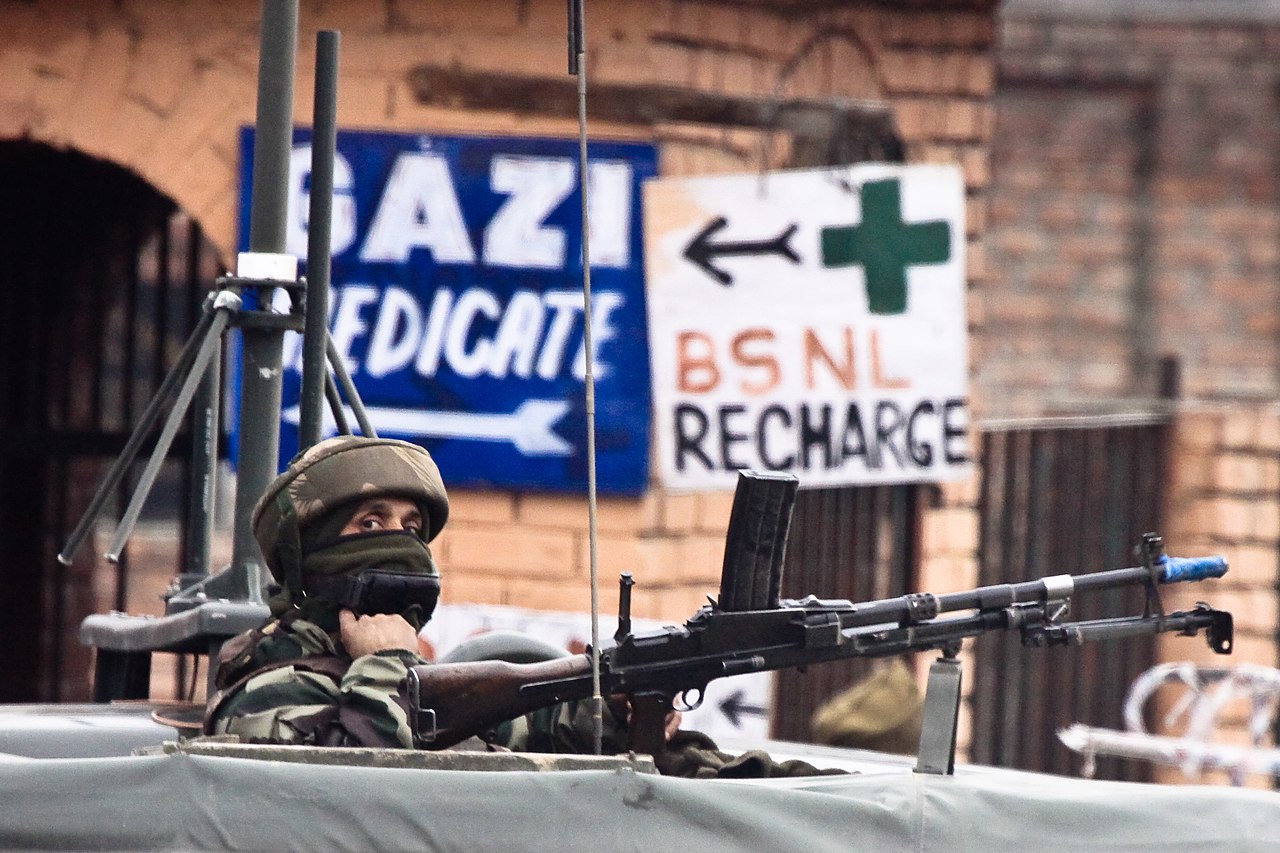
Los crímenes cometidos por las fuerzas estatales se cometen dentro del valle de Cachemira, que es la ubicación del conflicto actual. [484]
The 2010 Chatham House opinion poll of the people of Indian administered Jammu and Kashmir found that overall concern, in the entire state, over human rights abuses was 43%.[485] In the surveyed districts of the Muslim majority Kashmir Valley, where the desire for Independence is strongest,[486] there was a high rate of concern over human rights abuses. (88% in Baramulla, 87% in Srinagar, 73% in Anantnag and 55% in Badgam).[485] However, in the Hindu and Buddhist majority areas of the state, where pro-India sentiment is extremely strong,[486] concern over human rights abuses was low (only 3% in Jammu expressed concerns over human rights abuses).[485]
Several international agencies and the UN have reported human rights violations in Indian-administered Kashmir. In a 2008 press release the OHCHR spokesmen stated "The Office of the High Commissioner for Human Rights is concerned about the recent violent protests in Indian-administered Kashmir that have reportedly led to civilian casualties as well as restrictions to the right to freedom of assembly and expression."[267] A 1996 Human Rights Watch report accuses the Indian military and Indian-government backed paramilitaries of "committ[ing] serious and widespread human rights violations in Kashmir."[487] Jammu and Kashmir Coalition of Civil Society labels the happenings in Kashmir as war crimes and genocide and have issued a statement that those responsible should be tried in court of law.[488][489] Some of the massacres by security forces include Gawakadal massacre, Zakoora and Tengpora massacre and Handwara massacre. Another such alleged massacre occurred on 6 January 1993 in the town of Sopore. TIME magazine described the incident as such: "In retaliation for the killing of one soldier, paramilitary forces rampaged through Sopore's market, setting buildings ablaze and shooting bystanders. The Indian government pronounced the event 'unfortunate' and claimed that an ammunition dump had been hit by gunfire, setting off fires that killed most of the victims."[490] A state government inquiry into 22 October 1993 Bijbehara killings, in which the Indian military fired on a procession and killed 40 people and injured 150, found out that the firing by the forces was 'unprovoked' and the claim of the military that it was in retaliation was 'concocted and baseless'. However, the accused are still to be punished.[491] In its report of September 2006, Human Rights Watch stated:
Indian security forces claim they are fighting to protect Kashmiris from militants and Islamic extremists, while militants claim they are fighting for Kashmiri independence and to defend Muslim Kashmiris from an abusive Indian army. In reality, both sides have committed widespread and numerous human rights abuses and violations of international humanitarian law (or the laws of war).[492]
Many human rights organisations such as Amnesty International and Human Rights Watch (HRW) have condemned human rights abuses in Kashmir by Indians such as "extra-judicial executions", "disappearances", and torture.[493] Bans on religious gatherings are also reportedly enforced.[494] The "Armed Forces Special Powers Act" grants the military, wide powers of arrest, the right to shoot to kill, and to occupy or destroy property in counterinsurgency operations. Indian officials claim that troops need such powers because the army is only deployed when national security is at serious risk from armed combatants. Such circumstances, they say, call for extraordinary measures. Human rights organisations have also asked the Indian government to repeal[495] the Public Safety Act, since "a detainee may be held in administrative detention for a maximum of two years without a court order."[496] A 2008 report by the United Nations High Commissioner for Refugees determined that Indian Administered Kashmir was only 'partly free'.[497] A recent report by Amnesty International stated that up to 20,000 people have been detained under a law called AFSPA in Indian-administered Kashmir.[496][493][498][499]
Some human rights organisations have alleged that Indian Security forces have killed hundreds of Kashmiris through the indiscriminate use of force and torture, firing on demonstrations, custodial killings, encounters and detentions.[500][501][502][503] The government of India denied that torture was widespread[501] and stated that some custodial crimes may have taken place but that "these are few and far between".[501] According to cables leaked by the WikiLeaks website, US diplomats in 2005 were informed by the International Committee of the Red Cross (ICRC) about the use of torture and sexual humiliation against hundreds of Kashmiri detainees by the security forces.[504] The cable said Indian security forces relied on torture for confessions and that the human right abuses are believed to be condoned by the Indian government.[505] SHRC also accused Indian army of forced labour.[506]
There have been claims of disappearances by the police or the army in Kashmir by several human rights organisations.[507] Human rights groups in Kashmir have documented more than three hundred cases of "disappearances" since 1990 but lawyers believe the number to be far higher because many relatives of disappeared people fear reprisal if they contact a lawyer.[508][509][510] In 2016 Jammu and Kashmir Coalition of Civil Society said there are more than 8000 forced disappearances.[488] State Human Rights Commission (SHRC) has found 2,730 bodies buried into unmarked graves, scattered in three districts — Bandipora, Baramulla, and Kupwara — of North Kashmir, believed to contain the remains of victims of unlawful killings and enforced disappearances by Indian security forces.[511][512][513][514] SHRC stated that about 574 of these bodies have already been identified as those of disappeared locals.[515] In 2012, the Jammu and Kashmir State government stripped its State Information Commission (SIC) department of most powers after the commission asked the government to disclose information about the unmarked graves. This state action was reportedly denounced by the former National Chief Information Commissioner.[516] Amnesty International has called on India to "unequivocally condemn enforced disappearances" and to ensure that impartial investigations are conducted into mass graves in its Kashmir region. The Indian state police confirms as many as 331 deaths while in custody and 111 enforced disappearances since 1989.[497][496][493][498] A report from the Indian Central Bureau of Investigation (CBI) claimed that the seven people killed in 2000 by the Indian military, were innocent civilians.[517][518] The Indian Army has decided to try the accused in the General Court Martial.[519] It was also reported that the killings that were allegedly committed in "cold-blood" by the Army, were actually in retaliation for the murder of 36 civilians [Sikhs] by militants at Chattisingpora in 2000.[519] The official stance of the Indian Army was that, according to its own investigation, 97% of the reports about human rights abuses have been found to be "fake or motivated".[520] However, there have been at least one case where civilians have been killed in 'fake encounters' by Indian army personnel for cash rewards.[521] According to a report by Human Rights Watch:
Indian security forces have assaulted civilians during search operations, tortured and summarily executed detainees in custody and murdered civilians in reprisal attacks. Rape most often occurs during crackdowns, cordon-and-search operations during which men are held for identification in parks or schoolyards while security forces search their homes. In these situations, the security forces frequently engage in collective punishment against the civilian population, most frequently by beating or otherwise assaulting residents, and burning their homes. Rape is used as a means of targetting women whom the security forces accuse of being militant sympathizers; in raping them, the security forces are attempting to punish and humiliate the entire community.[522]
The allegation of mass rape incidents as well as forced disappearances are reflected in a Kashmiri short documentary film by an Independent Kashmiri film-maker, the Ocean of Tears produced by a non-governmental non-profit organisation called the Public Service Broadcasting Trust of India and approved by the Ministry of Information and Broadcasting (India). The film depicts mass rape incidents in Kunan Poshpora and Shopian as facts and alleges that Indian Security Forces were responsible.[523][524]
Médecins Sans Frontières conducted a research survey in 2005 that found 11.6% of the interviewees who took part had been victims of sexual abuse since 1989.[525][526] This empirical study found that witnesses to rape in Kashmir was comparatively far higher than the other conflict zones such as Sierra Leone and Sri Lanka. 63% of people had heard of rape and 13% of the people had witnessed a rape. Dr Seema Kazi holds the security forces more responsible for raping than militants due to rape by the former being larger in scale and frequency. In areas of militant activity the security forces use rape to destroy morale of Kashmiri resistance.[527] Dr Seema Kazi says these rapes cannot be ignored as rare occurrences nor should be ignored the documented acknowledgement of individual soldiers that they were ordered to rape.[528] Kazi explains rape in Kashmir as a cultural weapon of war:
In the particular context of Kashmir where an ethnic Muslim minority population is subject to the repressive dominance of a predominantly Hindu State, the sexual appropriation of Kashmiri women by State security forces exploits the cultural logic of rape whereby the sexual dishonour of individual women is coterminous with the subjection and subordination of Kashmiri men and the community at large.[529]
Former Chief Justice of Jammu and Kashmir High Court noted in his report on human rights in Kashmir: "It is hard to escape the conclusion that the security forces who are overwhelmingly Hindu and Sikh, see it as their duty to beat an alien population into submission."[530]
Some surveys have found that in the Kashmir region itself (where the bulk of separatist and Indian military activity is concentrated), popular perception holds that the Indian Armed Forces are more to blame for human rights violations than the separatist groups. Amnesty International criticized the Indian Military regarding an incident on 22 April 1996, when several armed forces personnel forcibly entered the house of a 32-year-old woman in the village of Wawoosa in the Rangreth district of Jammu and Kashmir. They reportedly molested her 12-year-old daughter and raped her other three daughters, aged 14, 16, and 18. When another woman attempted to prevent the soldiers from attacking her two daughters, she was beaten. Soldiers reportedly told her 17-year-old daughter to remove her clothes so that they could check whether she was hiding a gun. They molested her before leaving the house.[498]
According to an op-ed published in a BBC journal, the emphasis of the movement after 1989, ″soon shifted from nationalism to Islam.″ It also claimed that the minority community of Kashmiri Pandits, who have lived in Kashmir for centuries, were forced to leave their homeland.[531] Reports by the Indian government state 219 Kashmiri pandits were killed and around 140,000 migrated due to millitancy while over 3000 remained in the valley.[532][533] The local organisation of Pandits in Kashmir, Kashmir Pandit Sangharsh Samiti claimed that 399 Kashmiri Pandits were killed by insurgents.[534][535] Al Jazeera states that 650 Pandits were murdered by militants.[536] Human Rights Watch also blamed Pakistan for supporting militants in Kashmir, in same 2006 report it says, "There is considerable evidence that over many years Pakistan has provided Kashmiri militants with training, weapons, funding and sanctuary. Pakistan remains accountable for abuses committed by militants that it has armed and trained."[492][537][538]
Our people were killed. I saw a girl tortured with cigarette butts. Another man had his eyes pulled out and his body hung on a tree. The armed separatists used a chainsaw to cut our bodies into pieces. It wasn't just the killing but the way they tortured and killed.
— A crying old Kashmiri Hindu in refugee camps of Jammu to a BBC news reporter[531]
The violence was condemned and labelled as ethnic cleansing in a 2006 resolution passed by the United States Congress.[539] It stated that the Islamic terrorists infiltrated the region in 1989 and began an ethnic cleansing campaign to convert Kashmir into a Muslim state. According to the same resolution, since then nearly 400,000 Pandits were either murdered or forced to leave their ancestral homes.[540]
According to a Hindu American Foundation report, the rights and religious freedom of Kashmiri Hindus have been severely curtailed since 1989, when there was an organised and systematic campaign by Islamist militants to cleanse Hindus from Kashmir. Less than 4,000 Kashmiri Hindus remain in the valley, reportedly living with daily threats of violence and terrorism.[541] Sanjay Tickoo, who heads the KPSS, an organisation which looks after Pandits who remain in the Valley, says the situation is complex. On one hand the community did face intimidation and violence but on the other hand he says there was no genocide or mass murder as suggested by Pandits who are based outside of Kashmir.[536]
The displaced Pandits, many of whom continue to live in temporary refugee camps in Jammu and Delhi, are still unable to safely return to their homeland.[541] The lead in this act of ethnic cleansing was initially taken by the Jammu & Kashmir Liberation Front and the Hizbul Mujahideen. According to Indian media, all this happened at the instigation of Pakistan's Inter-Services Intelligence (ISI) by a group of Kashmiri terrorist elements who were trained, armed and motivated by the ISI. Reportedly, organisations trained and armed by the ISI continued this ethnic cleansing until practically all the Kashmiri Pandits were driven out after having been subjected to numerous indignities and brutalities such as rape, torture, forcible seizure of property etc.[542]
The separatists in Kashmir deny these allegations. The Indian government is also trying to reinstate the displaced Pandits in Kashmir. Tahir, the district commander of a separatist Islamic group in Kashmir, stated: "We want the Kashmiri Pandits to come back. They are our brothers. We will try to protect them." But the majority of the Pandits, who have been living in pitiable conditions in Jammu, believe that, until insurgency ceases to exist, return is not possible.[531] Mustafa Kamal, brother of Union Minister Farooq Abdullah, blamed security forces, former Jammu and Kashmir governor Jagmohan and PDP leader Mufti Sayeed for forcing the migration of Kashmiri Pandits from the Valley.[543] Jagmohan denies these allegations.[531] Pro-India politician Abdul Rashid says Pandits forced the migration on themselves so Muslims can be killed. He says the plan was to leave Muslims alone and bulldoze them freely.[544]
The CIA has reported that at least 506,000 people from Indian Administered Kashmir are internally displaced, about half of who are Hindu Pandits.[545][546] The United Nations Commission on Human Rights (UNCR) reports that there are roughly 1.5 million refugees from Indian-administered Kashmir, the bulk of who arrived in Pakistan-administered Kashmir and in Pakistan after the situation on the Indian side worsened in 1989 insurgency.[547]
Pakistan administered Kashmir
Azad Kashmir
The 2010 Chatham House opinion poll of Azad Kashmir's people found that overall concerns about human rights abuses in 'Azad Kashmir' was 19%.[485] The district where concern over human rights abuses was greatest was Bhimber where 32% of people expressed concern over human rights abuses.[485] The lowest was in the district of Sudanhoti where concern over human rights abuses was a mere 5%.[485]
Claims of religious discrimination and restrictions on religious freedom in Azad Kashmir have been made against Pakistan.[548] The country is also accused of systemic suppression of free speech and demonstrations against the government.[549][548] UNHCR reported that a number of Islamist militant groups, including al-Qaeda, operate from bases in Pakistani-administered Kashmir with the tacit permission of ISI[547][548] There have also been several allegations of human rights abuse.[547]
In 2006, Human Rights Watch accused ISI and the military of systemic torture with the purpose of "punishing" errant politicians, political activists and journalists in Azad Kashmir.[550] According to Brad Adams, the Asia director at Human Rights Watch, the problems of human rights abuses in Azad Kashmir were not "rampant" but they needed to be addressed, and that the severity of human rights issues in Indian-administered Kashmir were "much, much, much greater".[551] A report titled "Kashmir: Present Situation and Future Prospects", submitted to the European Parliament by Emma Nicholson, was critical of the lack of human rights, justice, democracy, and Kashmiri representation in the Pakistan National Assembly.[552] According to the Human Rights Commission of Pakistan, Pakistan's ISI operates in Pakistan-administered Kashmir and is accused of involvement in extensive surveillance, arbitrary arrests, torture, and murder.[548] The 2008 report by the United Nations High Commissioner for Refugees determined that Pakistan-administered Kashmir was 'not free'.[548] According to Shaukat Ali, chairman of the International Kashmir Alliance, "On one hand Pakistan claims to be the champion of the right of self-determination of the Kashmiri people, but she has denied the same rights under its controlled parts of Kashmir and Gilgit-Baltistan".[553]
After the 2011 elections, Azad Kashmir Prime Minister Sardar Attique Ahmad Khan stated that there were mistakes in the voters list which have raised questions about the credibility of the elections.[554]
In December 1993, the blasphemy laws of Pakistan were extended to Pakistan Administered Kashmir. The area is ruled directly through a chief executive Lt. Gen. Mohammed Shafiq, appointed by Islamabad with a 26-member Northern Areas Council.[555]
UNCR reports that the status of women in Pakistani-administered Kashmir is similar to that of women in Pakistan. They are not granted equal rights under the law, and their educational opportunities and choice of marriage partner remain "circumscribed". Domestic violence, forced marriage, and other forms of abuse continue to be issues of concern. In May 2007, the United Nations and other aid agencies temporarily suspended their work after suspected Islamists mounted an arson attack on the home of two aid workers after the organisations had received warnings against hiring women. However, honour killings and rape occur less frequently than in other areas of Pakistan.[547]
Scholar Sumantra Bose comments that the uprising remained restricted to the Indian side and did not spill over into Pakistani-administered Kashmir despite a lack of democratic freedoms on the Pakistani side. Bose offers a number of possible explanations for this. Azad Kashmir's strong pro-Pakistan allegiances and a relatively smaller population are suggested as reasons. But Bose believes that a stronger explanation was that Pakistan had itself been a military-bureaucratic state for most of its history without stable democratic institutions. According to Bose, the Kashmiri Muslims had higher expectations from India which turned out to be a "moderately successful" democracy and it was in this context that Kashmiri Muslim rage spilled over after the rigging of the elections in 1987.[556] The residents of Azad Kashmir are also mostly Punjabi, differing in ethnicity from Kashmiris in the Indian administered section of the state.[557]
Gilgit-Baltistan
The main demand of the people of Gilgit-Baltistan is constitutional status for the region as a fifth province of Pakistan.[558][559] However, Pakistan claims that Gilgit-Baltistan cannot be given constitutional status due to Pakistan's commitment to the 1948 UN resolution.[559][560] In 2007, the International Crisis Group stated that "Almost six decades after Pakistan's independence, the constitutional status of the Federally Administered Northern Areas (Gilgit and Baltistan), once part of the former princely state of Jammu and Kashmir and now under Pakistani control, remains undetermined, with political autonomy a distant dream. The region's inhabitants are embittered by Islamabad's unwillingness to devolve powers in real terms to its elected representatives, and a nationalist movement, which seeks independence, is gaining ground. The rise of sectarian extremism is an alarming consequence of this denial of basic political rights".[561] A two-day conference on Gilgit-Baltistan was held on 8–9 April 2008 at the European Parliament in Brussels under the auspices of the International Kashmir Alliance.[562] Several members of the European Parliament urged the government of Pakistan to establish democratic institutions and the rule of law in the area.[562][563]
In 2009, the Pakistani government implemented an autonomy package for Gilgit-Baltistan, which entails rights similar to those of Pakistan's other provinces.[558] Gilgit-Baltistan thus gains province-like status without actually being conferred such status constitutionally.[558][560] Direct rule by Islamabad has been replaced by an elected legislative assembly under a chief minister.[558][560] The 2009 reform has not satisfied locals who demand citizenship rights and it has continued to leave Gilgit Baltistan's constitutional status within Pakistan undefined; although it has added to the self-identification of the territory. According to Antia Mato Bouzas, the PPP-led Pakistani government had attempted a compromise between its official position on Kashmir and the demands of a population where the majority may have pro-Pakistan sentiments.[564]
There has been criticism and opposition to this move in Pakistan, India, and Pakistan-administered Kashmir.[565] The move has been dubbed a cover-up to hide the real mechanics of power, which allegedly are under the direct control of the Pakistani federal government.[566] The package was opposed by Pakistani Kashmiri politicians who claimed that the integration of Gilgit-Baltistan into Pakistan would undermine their case for the independence of Kashmir from India.[567] 300 activists from Kashmiri groups protested during the first Gilgit-Baltistan legislative assembly elections, with some carrying banners reading "Pakistan's expansionist designs in Gilgit-Baltistan are unacceptable"[559] In December 2009, activists from nationalist Kashmiri groups staged a protest in Muzaffarabad to condemn the alleged rigging of elections and the killing of an 18-year-old student.[568]
Map legality
As with other disputed territories, each government issues maps depicting their claims in Kashmir territory, regardless of actual control. Due to India's Criminal Law Amendment Act, 1961, it is illegal in India to exclude all or part of Kashmir from a map (or to publish any map that differs from those of the Survey of India).[569]
Statistics
Since 1989 and by 2006, over 50,000 people are claimed by Human Rights Watch to have died during the conflict,[492] with at least 20,000 of them civilian.[570] In 2008, authorities said that 43,000 people have been killed in the violence.[305] Data released in 2011 by Jammu and Kashmir government stated that, in the last 21 years, 43,460 people have been killed in the Kashmir insurgency. Of these, 21,323 are militants, 13,226 civilians killed by militants, 3,642 civilians killed by security forces, and 5,369 policemen killed by militants.[571]
According to the Government of India Home Ministry, 2008 was the year with the lowest civilian casualties in 20 years, with 89 deaths, compared to a high of 1,413 in 1996.[572] In 2008, 85 security personnel died compared to 613 in 2001, while 102 militants were killed. The human rights situation improved, with only one custodial death, and no custodial disappearances. Many analysts say Pakistan's preoccupation with jihadis within its own borders explains the relative calm.[573] In March 2009, Abdullah stated that only 800 militants were active in the state and out of these only 30% were Kashmiris.[574]
In 2016 Jammu and Kashmir Coalition of Civil Society said there had been 70,000 plus killings,[when?] a majority committed by the Indian armed forces.[488] The pro-Pakistan Hurriyat group has claimed a higher death toll of 80,000 including civilians, security forces and militants.[575]
Natural disaster diplomacy
The 2005 Kashmir earthquake, which killed over 80,000 people, led to India and Pakistan finalising negotiations for the opening of a road for disaster relief through Kashmir.[576] 2014 India–Pakistan floods was also followed by statements of cooperation by leaders of both countries.[577][578][579][580]
See also
- History of Kashmir
- India–Pakistan relations
- Indian White Paper on Jammu and Kashmir
- Indo-Pakistani wars and conflicts
- United Nations Military Observer Group in Kashmir
Notes
- ^ China's secondary role mentioned in various sources.[5][6][7][8][9][10]
- ^ Kashmiri leader Sheikh Abdullah noted in the UN Security Council in 1948: "the (plebiscite) offer (was) made by the Prime Minister of India when, I think, he had not the slightest need for making it, for Kashmir was in distress... The Government of India could have easily accepted the accession and said, 'All right, we accept your accession and we shall render this help.' There was no necessity for the Prime Minister of India to add the proviso while accepting the accession that 'India does not want to take advantage of the difficult situation in Kashmir.'[79]
- ^ Panigrahi, Jammu and Kashmir, the Cold War and the West (2009, p. 54) "According to Mir Qasim, Nehru was unwilling to send Indian army. He was insistent that the Government could not send its forces at the request of the Maharaja "although he wanted to accede to India," unless the accession was endorsed by the people of Kashmir... Sheikh Abduallah who was listening to the debate from an anteroom scribbled a note for Nehru requesting him to send the army to save Kashmir from the invaders."
- ^ Snedden, Kashmir The Unwritten History (2013, pp. 46–47): "[O]n 28 October [1947], The Times, while referring to the anti-Indian 'raiding forces', was still able to identify four elements among the 3,000 or so 'Muslim rebels and tribesmen' in J&K: 1) 'Muslim League agents and agitators from Pakistan'; 2) 'villagers who have raised the Pakistan flag and attacked Kashmir officials'; 3) 'Pathan [Pakhtoon] tribesmen'; 4) 'Muslim deserters from Kashmir State forces who have taken their arms with them'."
- ^ Snedden, Kashmir The Unwritten History (2013, p. 68): "Nehru informed [the Chief Ministers] that 'the actual tribesmen among the raiders are probably limited in numbers, the rest are ex-servicemen [of Poonch]'."
- ^ a b c Mīr Qāsim, Sayyid (1992). My Life and Times. Allied Publishers Limited. ISBN 9788170233558.
On the battlefield, the National Conference volunteers were working shoulder-to-shoulder with the Indian army to drive out the invaders....Sheikh Abdullah was not in favor of India seeking the UN intervention because he was sure the Indian army could free the entire State of the invaders.
- ^ George Cunningham, the Governor of NWFP, observed: "The tragedy is that Jinnah could, I believe, have got India's agreement to a plebiscite under impartial control, 10 days ago, but as the tribes were then in the ascendant for the time being he thought he would hold out a bit longer for better terms. It looks as if he may now have lost his chance."[95]
- ^ Brecher (1953, p. 92): 'India was "to begin to withdraw the bulk of their forces" only after "the Commission shall have notified (it) that the tribesmen and Pakistan nationals...have withdrawn...and further, that the Pakistan forces are being withdrawn." Moreover, the withdrawal of Indian forces was to be conducted "in stages to be agreed upon with the Commission," not with Pakistan.'
- ^ Korbel (1953, p. 502): "Though India accepted the resolution, Pakistan attached to its acceptance so many reservations, qualifications and assumptions as to make its answer 'tantamount to rejection'."
- ^ Korbel (1953, pp. 506–507): "When a further Security Council resolution urged the governments of India and Pakistan to agree within thirty days on the demilitarization of Kashmir, on the basis of Dr. Graham's recommendation, Pakistan once more accepted and India once more refused....Dr. Graham met the Indian request for retaining in Kashmir 21,000 men, but continued to propose 6,000 soldiers on the Azad side. Pakistan could not accept the first provision and India continued to insist on its stand concerning the Azad forces. The meeting, which ended in failure, was accompanied by bitter comments in the newspapers of both India and Pakistan about United Nations intervention in the Kashmir dispute."
- ^
- Korbel (1953, p. 507): "With the hindsight of six years, the Council's approach, though impartial and fair, appears to have been inadequate in that it did not reflect the gravity of the Kashmir situation.... The Security Council did not deal with either of these arguments [India's assumption of the legal validity of the accession and Pakistan's refusal to recognize its validity]. Nor did it consider the possibility of asking the International Court of Justice for an advisory opinion on the juridical aspect of the conflict under Article 96 of the Charter. Nor did it invoke any provisions of Chapter VII of the Charter, which deals with 'acts of aggression'."
- Subbiah (2004, p. 180): "From the beginning, the Security Council framed the problem as primarily a political dispute rather than looking to a major legal underpinning of the dispute: the Instrument of Accession's validity or lack thereof."
- ^
- Ankit (2013, p. 276): To Cadogan [Britain's permanent representative at the UN], irrespective of "whether forces in question are organised or disorganised or whether they are controlled by, or enjoy the convenience of, Government of Pakistan," India was entitled to take measures for self-defence: repelling invaders, pursuing invaders into Pakistan under Article 51 of the UN Charter and charging Pakistan as aggressor under Article 35.
- Ankit (2013, p. 279): Mountbatten, too, pleaded directly with Attlee along political as well as personal lines: "I am convinced that this attitude of the United States and the United Kingdom is completely wrong and will have far reaching results. Any prestige I may previously have had with my Government has of course been largely lost by my having insisted that they should make a reference to the United Nations with the assurance that they would get a square deal there."
- ^
- Choudhury, Golam (1968). Pakistan's Relations with India: 1947–1966. Praeger. pp. 178.
Indian leaders...continued to express the hope that partition would ultimately be undone; in particular they envisaged the possibility of annexing East Pakistan. Pakistan's resentment...was confined to a disputed area...when as a result of Indian intransigence the prospects of a peaceful solution of the Kashmir issue seemed bleak, there were outbursts of anti-Indian feelings in Pakistan...Alleged talk of 'holy war' or Jehad referred to the disputed territory of Kashmir. But in India, leaders, press and even scholars had no hesitation in expressing the hope of undoing the partition and thus annihilating Pakistan.
- Choudhury, Golam (1968). Pakistan's Relations with India: 1947–1966. Praeger. pp. 175.
Most of those quotations related to the period after the signing of the Liaquat-Nehru Agreement of April 8, 1950 under which India and Pakistan undertook not to permit propaganda in either country...seeking to incite war between the two countries. The government of Pakistan initiated twenty-seven complaints of flagrant violation of the Agreement by a number of influential Indian newspapers, but no effective action was taken by the Indian government, the plea being that its scope for action was limited by the India constitution. The Pakistan government pointed out that, if this were the position, the government of India should not have undertaken an international obligations which it was not in a position to carry out. The government of India made only eight complaints about alleged violation of the Agreement.
- Choudhury, Golam (1968). Pakistan's Relations with India: 1947–1966. Praeger. pp. 166.
Liaquat drew attention to the continuous and blatant propaganda for war against Pakistan, and indeed for the very liquidation of Pakistan, carried on by the Indian press, prominent leaders and political parties which openly adopted as an article of creed the undoing of partition.- which meant nothing but liquidation of Pakistan. No doubt there had been talk of Jehad or liberation of the Muslim population of Kashmir in Pakistan but...Pakistan's grievances have always been confined to Kashmir which...is a disputed territory. It was wrong to construe expressions giving vent to feelings of frustration over the failure of peaceful methods of solution in Kashmir as a desire for war against India. But, in India, the creation of Pakistan itself is still regarded as a tragic mistake which ought to be corrected.
- Choudhury, Golam (1968). Pakistan's Relations with India: 1947–1966. Praeger. pp. 178.
- ^ Varshney, Three Compromised Nationalisms (1992, p. 216): Independent observers could get no evidence of it. The New York Times found that "most of the prisoners captured thus far do not speak the Kashmiri dialect. They speak... Punjabi and other dialects."... The Washington Post remarked: "The Moslem Pakistanis, led by President Ayub, had expected the infiltrators to be able to produce a general uprising and this is Ayub's first disappointment."... Once again, it seemed clear that whatever the state of their relationship with India, Kashmiris did not wish to embrace Pakistan.
- ^ Gilgit Baltistan was not included in the survey
Citations
- ^ Yahuda, Michael (2 June 2002). "China and the Kashmir crisis". BBC. Retrieved 22 March 2019.
- ^ Chang, I-wei Jennifer (9 February 2017). "China's Kashmir Policies and Crisis Management in South Asia". United States Institute of Peace. Retrieved 22 March 2019.
- ^ a b Slater, Christopher L.; Hobbs, Joseph J. (2003). Essentials of World Regional Geography (4 ed.). Brooks/Cole Thomson Learning. p. 312. ISBN 9780534168100. LCCN 2002106314 – via Internet Archive.
India now holds about 55% of the old state of Kashmir, Pakistan 30%, and China 15%.
- ^ Malik, V. P. (2010). Kargil from Surprise to Victory (paperback ed.). HarperCollins Publishers India. p. 54. ISBN 9789350293133.
- ^ a b "Signing with the Red Chinese". Time (magazine). 15 March 1963. Archived from the original on 22 December 2008. Retrieved 28 October 2019.
- ^ "Kashmir: region, Indian subcontinent". Encyclopædia Britannica. Retrieved 16 July 2016.
- ^ "Jammu & Kashmir". European Foundation for South Asian Studies (EFSAS). Retrieved 4 May 2020.
- ^ Snow, Shawn (19 September 2016). "Analysis: Why Kashmir Matters". The Diplomat. Retrieved 4 May 2020.
- ^ Hobbs, Joseph J. (March 2008). World Regional Geography. CengageBrain. p. 314. ISBN 978-0495389507.
- ^ Margolis, Eric (2004). War at the Top of the World: The Struggle for Afghanistan, Kashmir and Tibet (paperback ed.). Routledge. p. 56. ISBN 9781135955595.
- ^ Copland, Ian (2003). "Review of War and Diplomacy in Kashmir: 1947-48. By C. Dasgupta". Pacific Affairs. 76 (1): 144–145. ISSN 0030-851X. JSTOR 40024025.
As is well known, this Hindu-ruled Muslim majority state could conceivably have joined either India or Pakistan, but procrastinated about making a choice until a tribal invasion - the term is not contentious - forced the ruler's hand.
- ^ Lyon, Peter (2008). Conflict Between India and Pakistan: An Encyclopedia. ABC-Clio. p. 80. ISBN 9781576077122.
- ^ "Kashmir | History, People, & Conflict". Encyclopedia Britannica. Archived from the original on 30 April 2015.
- ^ Bose, Sumantra (2003), Kashmir: Roots of Conflict, Paths to Peace, Harvard University Press, p. 76, ISBN 0-674-01173-2,
The intervening years [between 1958 and 1962] were notable for China's entry into the international politics of the Kashmir conflict. China's relations with India deteriorated precipitously after the Chinese annexation of Tibet in 1959, and rising tensions flared into a military conflict in late 1962 at a number of disputed border flashpoints stretching in an east-west arc along the Himalayan ranges, including a desolate area called Aksai Chin on Ladakh's frontier with Tibet and China's Xinjiang province.
- ^ "Simla Agreement". Bilateral/Multilateral Documents. Ministry of External Affairs, Government of India. Retrieved 27 September 2013.
- ^ Fortna, Virginia (2004). Peace time: cease-fire agreements and the durability of peace. Princeton University Press. ISBN 978-0-691-11512-2.
- ^ MacDonald, Myra (2017). Defeat is an Orphan: How Pakistan Lost the Great South Asian War. Oxford University Press. pp. 27, 53, 64, 66, 67. ISBN 978-1-84904-858-3.
p. 27: It was not so much that India won the Great South Asian War but that Pakistan lost it.p. 53: The story of the Kargil War—Pakistan's biggest defeat by India since 1971 —is one that goes to the heart of why it lost the Great South Asian War.p. 64: Afterwards, Musharraf and his supporters would claim that Pakistan won the war militarily and lost it diplomatically. In reality, the military and diplomatic tides turned against Pakistan in tandem.p. 66: For all its bravado, Pakistan had failed to secure even one inch of land. p. 66-67:Less than a year after declaring itself a nuclear-armed power, Pakistan had been humiliated diplomatically and militarily.
- ^ Ganguly 2016, p. 10: "In December I989, an indigenous, ethno-religious insurgency erupted in the Indian-controlled portion of the disputed state of Jammu and Kashmir. The internal dimensions of this crisis, like that in the Punjab, also stemmed primarily from various shortcomings in India's federal order.".
- ^ Metcalf & Metcalf 2006, p. 273: "The year 1989 marked the beginning of a continuing insurgency, fuelled by covert support from Pakistan. The uprising had its origins in Kashmiri frustration at the state’s treatment by Delhi. The imposition of leaders chosen by the centre, with the manipulation of local elections, and the denial of what Kashmiris felt was a promised autonomy boiled over at last in the militancy of the Jammu and Kashmir Liberation Front, a movement devoted to political, not religious, objectives.".
- ^ Hussain 2018, p. 104: "In the late 1980s, a small group of Kashmiris who had lost faith in Indian democracy decided to take the long-standing conflict between India and Pakistan to a new level. These individuals, mostly jailed MUF political activists, collectively decided to go to Pakistani-administered Kashmir in search of training and weapons. Inspired by the ideology of the Jammu Kashmir Liberation Front (JKLF), a party that advocated for an independent Kashmir, these individuals, with the support of Pakistan intelligence agencies, initiated an armed rebellion in the Valley and popularized the slogan of aazadi (Khan, 1992, 131–41).".
- ^ Mathur, Shubh (2016). The Human Toll of the Kashmir Conflict: Grief and Courage in a South Asian Borderland. Palgrave Macmillan US. pp. 21–. ISBN 978-1-137-54622-7.
writers like Baba (2014), Bose (2005), Schofield (2010) and Robinson (2013) see it as an indigenous Kashmiri response to the decades of political repression and the denial of the Kashmiri right to self-determination.
- ^ Chowdhary 2016, pp. 111–112: "As militancy gained ground, there was mushrooming of militant organisations with different ideologies and different objectives. While India remained the common target for all these organisations, there were lot of internal differences. The difference was not merely represented by the ultimate objectives of JKLF (complete independence of erstwhile princely state of Jammu and Kashmir from both India and Pakistan) and Hizb (merger with Pakistan) but also with regard to the role of religion in the movement. A number of outfits like Allah Tigers were keen on enforcing ‘Islamic’ code on the people as well. It ‘went about smashing Srinagar’s bars, closing down cinema halls, video parlours and beauty parlours, saying that they were un-Islamic. It was decreed that all women would wear the burqa, and dress according to Islamic tradition’ (Sidhva, 1992: 40–2). There were others who saw armed militancy in Kashmir as part of the Pan-Islamic struggle being waged at the global level. These were jehadis who entered the scenario of militancy quite early. Lashkar-e-Toiba, according to Sikand, entered Kashmir in 1990 and intensified its activities in 1993.".
- ^ Hussain 2021, (p. 324) "Pakistani support gave a religious tone to the armed insurgency in Kashmir, overshadowing the nationalist vision of an independent and united state of Jammu and Kashmir. ... Fearful that the independent ideology of the JKLF would sideline their interests in the Valley, Pakistan abandoned the JKLF and supported militant groups that would advocate Kashmir’s accession to Pakistan." (p. 325) "After the intervention of Pakistan in Kashmir post 1989, the Jamaat saw Kashmir as a part of the worldwide Muslim community, and its incorporation into the Muslim state of Pakistan as the first step toward eventual unity of all Muslims. Thereafter, the party provided a religious rationale for advocating Kashmir’s accession to Pakistan, and defined the armed struggle against India as a holy war—a jihad. ... In the early 1990s, the Jamaat took center stage in the militant movement, and its armed wing, the Hizbul Mujahideen (HM), gave the jihad a practical shape. This powerful group, funded and supported by Pakistan’s intelligence services, molded the insurgency to suit Pakistan’s interests." (p. 326) "Pakistan also nurtured several small Valley Islamist groups like the Allah Tigers, Al-Umar, and the Muslim Mujahedeen to fragment the support base of the JKLF and popularize the idea of waging an armed struggle along Islamic lines. ... The JKLF’s increasing marginalization in the Valley was accompanied by the suppression of the organization in Pakistan-administered Kashmir.".
- ^ Warikoo 2011, p. 78: "During the first phase of militancy in Kashmir which started in 1989, the Islamist militant groups strived to “bring structural changes at cultural levels of Kashmir society”, seeking to Islamicize the socio-political set-up in the Valley to bring it in tune with the Islamic state of Pakistan and the Muslim Ummah. Though militancy in Kashmir was launched initially by the Jammu and Kashmir Liberation Front (JKLF) ostensibly to achieve azadi (independence), within a few months a number of militant groups emerged advocating Nizam-e-Mustafa as the objective of their struggle. Now the term azadi gave way to jihad. Various Islamist groups like Jamaat-e-Islami and its militant wing Hizbul Mujahideen, women’s wing Dukhtaran-e-Millat, Jamiat- ul-Mujahideen, Allah Tigers, Jamiat-ul-Ulemma Islam, Al Badr, Al Jihad Force, Al Umar Mujahideen, Muslim Mujahideen, Islamic Students League, Zia Tigers etc. proclaimed the objective of their struggle as Islamicization of socio-political and economic set-up, merger of Kashmir with Pakistan, unification of Ummah and establishment of an Islamic Caliphate.".
- ^ Webb 2012, p. 44: "The first wave of militancy from 1988 through to 1991 was very much an urban, middle-class affair dominated by the secular, pro-independence Jammu and Kashmir Liberation Front (JKLF) (Schofield 1996: 240). Much of the fighting was concentrated in Srinagar, and also certain rural centers such as Anantnag, Baramulla and Kupwara, while most of the militants were unemployed university graduates who had campaigned for the MUF in the 1987 election. ... Gradually the number of militant groups began to increase, with the JKLF losing its position of dominance to the Islamist, pro-Pakistan Hizbul-Mujahideen in the early 1990s (Jones 2008; Kumar 2002). The rise of Islamic, pro-Pakistan groups is frequently associated with a shift to a more rural-based militancy (Howard 1999: 40).".
- ^ Chowdhary 2016, p. 112: "According to [Sikand], after the Mujahideen victory in Afghanistan in 1992, ‘numerous jihadist outfits in Pakistan began turning their attention towards Kashmir. By the late 1990s, these Pakistani jihadists were playing a key role in the fighting in Kashmir, eclipsing even local Kashmiri groups’ (Sikand, 2001: 222). Harkat-ul-Ansar, Al-Faran, Harkat-ul-Mujahideen and Jaish-e-Mohammed were such organisations that dominated the scenario of militancy at different points in time. The increased number of foreign militants in the period after mid-1990s gets reflected from the large percentage of the killing of these militants by Indian security forces as compared to the local militants – from 5.7 per cent foreign militants killed in 1995, the percentage was increased to 53.9 per cent in 2000 and 69.38 per cent in 2003 (Routray, 2012: 182).".
- ^ Behera 2006, 155: "With the Hazratbal siege and surrender of JKLF militants in April 1993, the insurgency took a new course. It became increasingly difficult for the Hizb-ul-Mujahideen to recruit members of the Kashmiri cadre. Attributing this to fatigue, Pakistan decided to push more Afghan veterans, Pakistani nationals, and foreign mercenaries into the Valley. This trend gathered momentum in 1996, when the Taliban marched into Kabul.".
- ^ Kumar & Puri 2009, p. 268: "By the end of the 1990s, there were more Pakistanis than Kashmiris amongst the mujahideen. The Lashkar’s list of ‘martyred commanders’, for example, named men from all over Pakistan. The mujahideen had more sophisticated arms, communications and planning, and they inflicted much greater damage in raids on army and police posts, convoys and barracks, government buildings and civilians. Within Kashmir, conflict spread from the Kashmir valley to the Muslim majority districts of Jammu, where Hindus and nomads began to be targeted in the border villages.".
- ^ Bhatia 2020, p. 8: "Insurgency originated in Kashmir as an indigenous secessionist movement. However, by the time it spread widely to various parts of Jammu, it had turned extremist and ruthlessly violent in character due to the involvement of non-Kashmiri militants sneaking in from across the India–Pakistan borders. For around a decade, insurgency was at its peak in various parts of Jammu, resulting in public killings due to frequent incidents of blasts and attacks by militants in and around Jammu city.".
- ^ Bose 2021, p. 100: "With the help of the renegades, the Indian forces were able to reassert control over most of the Kashmir Valley. Guerrilla activity moved out to remote, forested parts of the Valley, and in the late 1990s a new, deadly theatre of insurgency opened up in the Jammu region’s Rajouri and Poonch districts (on which more below), in addition to the Doda-Kishtwar zone.".
- ^ Bhatia 2021, p. 84: "That being so, when Kashmir-based insurgency spread to parts of Jammu in the late 1990s and early 2000, many Muslim youth of these districts joined insurgency alongside Kashmiris and many extremist Pakistan-backed groups. Insurgency, thus, took a brutal shape when it hit these regions and many communal killings have been recorded during those periods. Hindus were targeted and killed in a few villages, during marriage ceremonies and while travelling in buses (Swami, 1998, Puri, 2008). In these districts, the responses of the Hindu communities was also extreme, as many vehemently endorsed the right-wing politics.".
- ^ Zutshi 2019, p. 133: "Far from desiring autonomy from India, Jammu and Ladakhi politics was based on demands for autonomy from Kashmir and its repressive governments instead, and greater integration with India. … The insurgency, thus, widened the divides among the sub-regions of Kashmir, the long-term repercussions of which on state politics are only recently becoming clearer.".
- ^ Snedden 2021, pp. 5–6: "The JKLF’s stance was popular with Muslim Kashmiris, many of whom thought that independence was ‘just around the corner’. However, this possibility was not popular with all J&K-ites: Hindu Kashmiris (called Pandits), some Muslim Kashmiris, and many people located in Jammu or Ladakh strongly wanted J&K to be with India. Some Muslims in the Kashmir Valley and in Jammu wanted J&K to join Pakistan.".
- ^ Behera 2006, (p. 115) "The winter of 1989–90 marked the onset of the Kashmiri insurgency … while the Ladakhi Buddhists began their violent agitation for status as a union territory in August 1989. The next few years witnessed a growing communalization of the political idiom, strategies, and goals of various political movements in the state. Where the Kashmiris cast their demand for secession in terms of a Hindu-Muslim divide, especially after the Pandit exodus in 1990, the Buddhists mobilized against the Kashmiris on the basis of a Buddhist-Muslim divide, which they also extended to the Shias of Leh, who are almost all of Balti stock and ethnically similar to Ladakhi Buddhists." (p. 122) "After suffering political and economic neglect at the hands of successive state governments, Jammu began making demands again as well. These ranged from a separate state of Jammu to regional autonomy and a regional council. Significantly, the proposals were all rooted in Jammu’s regional aspirations, while the religious (Hindu) identity remained dormant.".
- ^ Metcalf & Metcalf 2006, p. 273–274: "Upwards of 100,000 of [Kashmiri Hindus] left the state during the early 1990s; their cause was quickly taken up by the Hindu right. As the government sought to locate ‘suspects’ and weed out Pakistani ‘infiltrators’, the entire population was subjected to a fierce repression. By the end of the 1990s, the Indian military presence had escalated to approximately one soldier or paramilitary policeman for every five Kashmiris, and some 30,000 people had died in the conflict. Subsequent years saw a reduction in violence coupled with widespread participation in Indian elections, and a consequent lowering of troop strength despite the absence of a settlement. The general consensus is that the Kashmiris seek a degree of regional autonomy, not a union with Pakistan.".
- ^ Zutshi 2019, pp. 132–133: "The insurgency and counter-insurgency as well as the criminal elements that proliferated as law and order disintegrated and guns became readily available had a devastating impact on Kashmiri society. Violence engulfed the Valley, with targeted assassinations and kidnappings of important political and academic figures by Kashmiri insurgents; bombings and other attacks by external groups; thefts and killings by local criminal gangs; and reprisals by Indian security forces. Kashmir became inhabitable for most Kashmiris as any semblance of community, civil society, and normalcy was replaced by terror, lawlessness, rumour, and suspicion. Many Kashmiris were forced to leave the Valley and the mass exodus in the first few years of the insurgency of Kashmiri Pandits, the minority community of Hindus—which felt increasingly targeted by local and external groups—further polarized Kashmiri society, this time along lines of religion. These developments subverted the popular nature of the insurgency, tarnishing the very real political grievances that underlay it with the brush of criminality and Islamic radicalism.".
- ^ Kumar & Puri 2009, p. 268: "The Indian government adopted increasingly draconian measures in response, and civilians were frequently trapped in the battle between Indian troops and the Islamic militias. The counter-insurgency policy of using erstwhile mujahideen to fight present ones worsened an already fragile law and order infrastructure, letting in revenge killings. By the end of the decade, more than 35,000 people had been killed, the vast majority Muslim, and families who had lost one member at the hands of Islamic militias and another at the hands of the security forces were more a norm than exceptions in the Kashmir valley.".
- ^ Webb 2012, p. 45: "The Islamization and internationalization of militancy in Kashmir was also accompanied by its criminalization (Schofield 1996: 267–8). Initially the militants enjoyed wide popular support; however, as people became increasingly war-weary from the steadily mounting number of casualties, this support gradually began to evaporate. Consequently, the militants were forced to resort to tactics such as kidnapping to extort money and food from the local population (Ganguly 1997: 139; Baweja 1995: 19–25). This, however, only further alienated the militants from common Kashmiris and initiated a vicious cycle of increasing resentment and violence perpetrated both by the militants and Indian security forces, who increasingly engaged in torture, rape and extra-judicial killings (Amnesty International 1995; Asia Watch and Physicians for Human Rights 1993). Indian apologists claim that such allegations are usually false or grossly exaggerated and point out that the militants themselves are guilty of the same crimes (Kumar n.d.: 136). That both sides of the conflict are guilty of human rights abuses is undeniable, as is the fact that most victims of the violence are innocent civilians. Various estimates of the number killed since 1989 range from 20,000 to 50,000, while some 200,000, mostly Hindu, Kashmiris have fled the Valley and live as refugees in Jammu and elsewhere in India (Wirsing 1998: 126).".
- ^ Bose 2021, pp. 131–132: "That new phase of the Kashmir conflict came to be symbolised not by the gun-wielding insurgent – armed militancy did not revive significantly – but by the stone-pelter. Mass stone-pelting at the enforcers of the state-of-exception regime revived a decades-old tradition of protest in the Valley, which had been temporarily displaced by the Kalashnikov-carrying insurgents from 1990 to the mid-2000s. Major stone-pelting uprisings led by a new generation of youth born in the 1990s broke out in the Kashmir Valley in 2010 and again in 2016, and during the decade the stone replaced the AK-47s wielded by the previous generation as the weapon of everyday struggle.".
- ^ Webb 2012, p. 49: "Since mid-2010, Srinagar and other areas of the Valley have been regularly shut down by violent protests, strikes and curfews, as a new generation of Kashmiris who have grown up surrounded by political violence continue to press the claim for separation from India.".
- ^ Snedden 2021, p. 280: "In 2010, over 120 ‘unarmed’ Kashmiris were killed by police in protests that followed the security forces’ alleged staged killings of three Kashmiri civilians in Kupwara District.75 (Six Army personnel were later court martialled and sentenced to life imprisonment, but were bailed in 2017 pending a retrial.) One of the protesters was a young Kashmiri whose death further enraged Kashmiris.".
- ^ Chowdhary 2016, p. 151: "However, it was in 2010 that Kashmir witnessed massive resistance politics. For five months of summer, the normal political processes came to a halt and whole of Kashmir was overtaken by separatist upsurge. The background to this upsurge was provided by the continuous eruption over the incidents of human rights violations by the security forces. Though there were other protests in the early months of 2010, it was the case of the killing of three civilians in Machail sector that resulted in massive protests. The killing of 17-year-old boy Tufail Mattoo during these protests led to further protests. In a cycle of protests and killing during the protests around 110 people were killed. The protests with each killing became intensified.".
- ^ Kazi 2018, pp. 173–174: "In 2016 Kashmir witnessed an extraordinary revolt in the aftermath of the extrajudicial murder of Burhan Wani, a young militant commander, in an encounter with the army and the police in Pulwama. Unlike previous protests that spread from urban to rural areas, Wani’s death prompted a spontaneous mass revolt across Kashmir, especially in rural areas of southern Kashmir that had been relatively pacified. The Indian state sought to contain the uprising through a brutal, punitive response, resulting in a spate of killings, the blinding of civilians through the use of pellet guns, the destruction of civilian property, violence and assault against women by security forces, the arrest and/or disappearance of protesting youths, and a blockade of civil supplies amid an undeclared albeit formidable siege across Kashmir Valley.".
- ^ "Pakistan warns India against attacking". BBC News. 19 February 2019.
- ^ Iqbal, Sajid; Hossain, Zoheb; Mathur, Shubh (2014). "Reconciliation and truth in Kashmir: a case study". Race & Class. 56 (2): 51–65. doi:10.1177/0306396814542917. ISSN 0306-3968. S2CID 147586397.
- ^ Kazi, Rape, Impunity and Justice in Kashmir 2014, pp. 14–46.
- ^ "India: "Denied": Failures in accountability for human rights violations by security force personnel in Jammu and Kashmir". Amnesty International. 30 June 2015. Retrieved 4 July 2015.
- ^ Essa, Azad (10 September 2015). "India 'covering up abuses' in Kashmir: report". Al Jazeera. Retrieved 13 November 2021.
- ^ Asian Legal Resource Centre (27 August 2010). "Pakistan: Thousands Of Persons Remain Missing". Scoop. Archived from the original on 4 October 2012. Retrieved 10 March 2012.
- ^ Adams, Brad (21 September 2006). "Pakistan: 'Free Kashmir' Far From Free". Human Rights Watch. Archived from the original on 14 March 2013. Retrieved 8 August 2012.
- ^ Snedden, Christopher (2015). Understanding Kashmir and Kashmiris. Oxford University Press. ISBN 9781849043427.
- ^ Bose, Kashmir Roots of Conflict 2003, pp. 27–28.
- ^ Mridu Rai, Hindu Rulers, Muslim Subjects 2004.
- ^ John L. Esposito, ed. (2004). "Kashmir". The Islamic World: Past and Present. Oxford University Press. Archived from the original on 19 June 2018. Retrieved 16 March 2017.
Muslims, however, suffered under Hindu rule.
- ^ Menon, Vapal Pangunni (8 December 2015). Transfer of Power in India. Sangam Books. p. 519. ISBN 978-8125008842.
- ^ "Indian Independence Act 1947". UK Legislation. The National Archives. Retrieved 14 September 2015.
- ^ Ankit, Rakesh (April 2010), "Pandit Ramchandra Kak: The Forgotten Premier of Kashmir", Epilogue, 4 (4), Epilogue -Jammu Kashmir: 36–39
- ^ a b Ankit, Rakesh (May 2010). "Henry Scott: The forgotten soldier of Kashmir". Epilogue. 4 (5): 44–49. Archived from the original on 10 May 2017. Retrieved 20 April 2016.
- ^ a b Raghavan, War and Peace in Modern India 2010, p. 106.
- ^ Raghavan, War and Peace in Modern India 2010, pp. 31, 34–35, 105.
- ^ Copland, Ian (February 1991), "The Princely States, the Muslim League, and the Partition of India in 1947", The International History Review, 13 (1): 38–69, doi:10.1080/07075332.1991.9640572, JSTOR 40106322
- ^ Copland, State, Community and Neighbourhood in Princely India 2005, p. 143.
- ^ Raghavan, War and Peace in Modern India 2010, pp. 105–106.
- ^ Nawaz, The First Kashmir War Revisited 2008, pp. 120–121.
- ^ Chattha, Partition and its Aftermath 2009, pp. 179–180.
- ^ Snedden, Kashmir The Unwritten History 2013, pp. 48–57.
- ^ Snedden, Kashmir The Unwritten History 2013, p. 45.
- ^ Raghavan, War and Peace in Modern India 2010, p. 105.
- ^ Jha, The Origins of a Dispute 2003, p. 47.
- ^ Raghavan, War and Peace in Modern India 2010, p. 108.
- ^ Jha, The Origins of a Dispute 2003, p. 69.
- ^ Jha, Prem Shankar. "V P Menon turned around and said, 'Sam we've got the Accession': An interview with Field Marshal Sam Manekshaw". Rediff.com. Retrieved 24 May 2012.
- ^ Varshney, Three Compromised Nationalisms 1992, p. 194.
- ^ Khan, Nyla Ali (2010). Islam, Women, and Violence in Kashmir: Between India and Pakistan. Palgrave Macmillan. pp. 30–. ISBN 978-0-230-11352-7.
- ^ Varshney, Three Compromised Nationalisms 1992, p. 195.
- ^ Panigrahi, Jammu and Kashmir, the Cold War and the West 2009, p. 54.
- ^ Guha, India after Gandhi 2008, p. xx.
- ^ Khan Bangash, Yaqoob (2010). "Three Forgotten Accessions: Gilgit, Hunza and Nagar". The Journal of Imperial and Commonwealth History. 38 (1): 132. doi:10.1080/03086530903538269. S2CID 159652497.
- ^ Schofield, Kashmir in Conflict 2003, pp. 63–64.
- ^ Bangash, Yaqoob Khan (2010), "Three Forgotten Accessions: Gilgit, Hunza and Nagar", The Journal of Imperial and Commonwealth History, 38 (1): 117–143, doi:10.1080/03086530903538269, S2CID 159652497,
Alam replied [to the locals], as recorded by Brown: 'you are a crowd of fools led astray by a madman. I shall not tolerate this nonsense for one instance... And when the Indian Army starts invading you there will be no use screaming to Pakistan for help, because you won't get it.'... The provisional government faded away after this encounter with Alam Khan, clearly reflecting the flimsy and opportunistic nature of its basis and support.
- ^ Khan Bangash, Yaqoob (2010). "Three Forgotten Accessions: Gilgit, Hunza and Nagar". The Journal of Imperial and Commonwealth History. 38 (1): 137. doi:10.1080/03086530903538269. S2CID 159652497.
- ^ Bangash, Yaqoob Khan (9 January 2016). "Gilgit-Baltistan—part of Pakistan by choice". The Express Tribune. Retrieved 5 January 2017.
Nearly 70 years ago, the people of the Gilgit Wazarat revolted and joined Pakistan of their own free will, as did those belonging to the territories of Chilas, Koh Ghizr, Ishkoman, Yasin and Punial; the princely states of Hunza and Nagar also acceded to Pakistan. Hence, the time has come to acknowledge and respect their choice of being full-fledged citizens of Pakistan.
- ^ Zutshi, Chitralekha (2004). Languages of Belonging: Islam, Regional Identity, and the Making of Kashmir. C. Hurst & Co. Publishers. pp. 309–. ISBN 978-1-85065-700-2.
- ^ Sokefeld, Martin (November 2005), "From Colonialism to Postcolonial Colonialism: Changing Modes of Domination in the Northern Areas of Pakistan" (PDF), The Journal of Asian Studies, 64 (4): 939–973, doi:10.1017/S0021911805002287, S2CID 161647755
- ^ Schofield, Kashmir in Conflict 2003, pp. 65–67.
- ^ Fair, Militant Challenge in Pakistan 2011, pp. 107–108.
- ^ Raghavan, War and Peace in Modern India (2010, pp. 110–111); Noorani, The Kashmir Dispute (2014, pp. 13–14); See also Khurshid, Tooba (Spring 2014), "The Kashmir Dispute: 1947-2012 by A.G. Noorani (review)", Strategic Studies, 34 (1): 121–124, JSTOR 48527560
- ^ Prasad, Sri Nandan; Pal, Dharm (1987). Operations in Jammu & Kashmir, 1947–48. History Division, Ministry of Defence, Government of India. pp. 49–50 – via Internet Archive.
- ^ Gupta, Jammu and Kashmir 2012, p. 97.
- ^ Schofield, Kashmir in Conflict 2003, p. 61.
- ^ a b Raghavan, War and Peace in Modern India 2010, p. 111.
- ^ Schofield, Kashmir in Conflict 2003, pp. 67–68.
- ^ Noorani, A.G. (8 January 2017). "Plebiscite in Kashmir: Stillborn or Killed?- Part 1". Greater Kashmir. Archived from the original on 14 November 2021. Retrieved 14 November 2021.
- ^ Siddiqi, Muhammad Ali (15 June 2014). "Cover Story: The Kashmir Dispute: 1947–2012 by A.G. Noorani". Dawn.
- ^ Schofield, Kashmir in Conflict 2003, pp. 68–69.
- ^ "Plebiscite Conundrum". Kashmirlibrary.org. 5 January 1949. Archived from the original on 2 February 2020. Retrieved 11 November 2012.
- ^ Schofield, Kashmir in Conflict 2003, p. 70.
- ^ Varshney, Three Compromised Nationalisms 1992, p. 211.
- ^ Schofield, Kashmir in Conflict 2003, pp. 70–71.
- ^ Schofield, Kashmir in Conflict 2003, pp. 71–72.
- ^ Schofield, Kashmir in Conflict 2003, pp. 82–85.
- ^ Varshney, Three Compromised Nationalisms 1992, p. 212.
- ^ McMahon, Robert J. (June 2010). The Cold War on the Periphery: The United States, India, and Pakistan. Columbia University Press. pp. 34–. ISBN 978-0-231-51467-5.
- ^ Gupta, Jammu and Kashmir 2012, pp. 156–: "At the next meeting the Security Council appointed Sir Owen Dixon as the U.N. representative for India and Pakistan on 12 April 1950. He was to implement the McNaughton proposals for the demilitarization of the State."
- ^ Josef Korbel (8 December 2015). Danger in Kashmir. Princeton University Press. pp. 168–. ISBN 978-1-4008-7523-8.
It called upon India and Pakistan 'to prepare and execute within a period of five months from the date of this resolution a programme of demilitarization on the basis of principles 2 of General McNaughton's proposal.; It further decided to replace the United Nations Commission by a representative entrusted with arbitrary powers 'to interpret the agreements reached by the parties for demilitarization,' in case they should agree in this most important matter. It also requested this representative to make any suggestions which would in his opinion expedite and offer an enduring solution to the Kashmir dispute.
- ^ Victoria Schofield (30 May 2010). Kashmir in Conflict: India, Pakistan and the Unending War. I.B.Tauris. pp. 101–. ISBN 978-0-85773-078-7.
On 27 May 1950 the Australian jurist, Sir Owen Dixon, arrived in the sub-continent, as the one man successor to UNCIP...Patel wrote to Nehru that Dixon was working to bring about an agreement on the question of demilitarisation.
- ^ Gupta, Jammu and Kashmir 2012, p. 160–: "He summed up his impressions in very strong language, sharply taking India to task for its negative attitude towards the various alternative demilitarization proposals."
- ^ Snedden, Christopher (2005), "Would a plebiscite have resolved the Kashmir dispute?", South Asia: Journal of South Asian Studies, 28 (1): 64–86, doi:10.1080/00856400500056145, S2CID 145020726
- ^ Gupta, Jammu and Kashmir 2012, pp. 161–: "In any case, Pakistan turned down the proposal on the ground that India's commitment for a plebiscite in the whole of Jammu and Kashmir should not be departed from."
- ^ Josef Korbel (8 December 2015). Danger in Kashmir. Princeton University Press. pp. 173–. ISBN 978-1-4008-7523-8.
India, Pakistan insisted, was committed to a plebiscite in the State of Jammu and Kashmir as a whole.
- ^ Hilal, A.Z. (1997). "Kashmir dispute and UN mediation efforts: An historical perspective". Small Wars & Insurgencies. 8 (2): 75.
This time it was Pakistan who refused to accept his proposal, arguing that Pakistan considered it a breach of India's agreement that: 'The destination of the state....as a whole should be decided by a single plebiscite taken over the entire state'.
- ^ Snedden, Christopher (2005). "Would a plebiscite have resolved the Kashmir dispute?". South Asia: Journal of South Asian Studies. 28: 64–86. doi:10.1080/00856400500056145. S2CID 145020726.
- ^ Gupta, Jammu and Kashmir 2012, pp. 161–162: "Troops of both countries were to be excluded from the limited plebiscite area...On 16 August 1950 the Indian Prime Minister rejected the plan for limited plebiscite on the following grounds:...4)The security of the State necessitated the presence of Indian troops and the exclusion of the Pakistani troops from the plebiscite area. India would not depart from that principle. Sir Owen Dixon disagreed with the Indian position. He aired his views that a neutral administration was necessary for a fair plebiscite, that the exclusion of Indian troops...were essential prerequisites of the same."
- ^ Bradnock, Robert W. (998), "Regional geopolitics in a globalising world: Kashmir in geopolitical perspective", Geopolitics, 3 (2): 11, doi:10.1080/14650049808407617,
More importantly, Dixon concluded that it was impossible to get India's agreement to any reasonable terms. 'In the end I became convinced that India's agreement would never be obtained to demilitarisation in any such form, or to provisions governing the period of the plebiscite of any such character, as would in my opinion permit of the plebiscite being conducted in conditions sufficiently guarding against intimidation and other forms of influence and abuse by which the freedom and fairness of the plebiscite might be imperilled.
- ^ Victoria Schofield (2000). Kashmir in Conflict: India, Pakistan and the Unending War. I.B.Tauris. pp. 83–. ISBN 978-1-86064-898-4.
Yet again the question of demilitarisation was the sticking point, causing Dixon to conclude: 'In the end I became convinced that India's agreement would never be obtained to demilitarisation in any such form, or to provisions governing the period of the plebiscite of any such character, as would in my opinion permit of the plebiscite being conducted in conditions sufficiently guarding against intimidation and other forms of influence and abuse by which the freedom and fairness of the plebiscite might be imperilled'. Without such demilitarisation, the local 'Azad' and regular Pakistani forces were not prepared to withdraw from the territory they had retained.
- ^ Schaffer, The Limits of Influence 2009, pp. 30–: "The failure of the Dixon mission seems to have sharpened even further Ambassador Henderson's already deep suspicions of Indian motives and good faith. He concluded that growing resentment in India about the allegedly pro-Pakistan attitude of the United States on Kashmir—which he reported had been quietly stimulated by Nehru himself-made it desirable to have Britain and other commonwealth countries take the lead in working out a solution...Washington appears to have heeded the ambassador's advice."
- ^ Brecher 1953, p. 119.
- ^ Brecher 1953, p. 120.
- ^ Brecher 1953, p. 121.
- ^ Brecher 1953, p. 122.
- ^ Brecher 1953, p. 123.
- ^ Victoria Schofield (30 May 2010). Kashmir in Conflict: India, Pakistan and the Unending War. I.B.Tauris. pp. 102–. ISBN 978-0-85773-078-7.
The issue was briefly taken up by the Commonwealth, when, in January 1951, at a meeting of Commonwealth prime ministers, Robert Menzies, the Australian prime minister, suggested that Commonwealth troops should be stationed in Kashmir; that a joint Indo–Pakistani force should be stationed there, and to entitle the plebiscite administrator to raise local troops. Pakistan agreed to the suggestions, but India rejected them.
- ^ Schofield, Kashmir in Conflict 2003, pp. 83–86.
- ^ Josef Korbel (8 December 2015). Danger in Kashmir. Princeton University Press. pp. 178–180. ISBN 978-1-4008-7523-8.
Pakistan accepted the resolution. India rejected it, principally because of the new proposal for arbitration. Pandit Nehru and his followers in Kashmir declared that they would not permit the fate of four million people to be decided by a third person. But this was overclouding the issue. It had never been recommended, nor can one seriously believe that Nehru actually thought it had been, that the final fate of Kashmir should be decided by a tribunal...It was only the extent and procedure of the state's demilitarization which was to be submitted to arbitration, should the parties again fail to agree. At this point India cannot escape criticism...On one occasion Nehru had thoroughly endorsed a policy proposed by the Indian National Congress...to have all disputes concerning Hindu-Muslim relationship, ″referred to arbitration to the League of Nations...or any other impartial body mutually agreed upon.″ When, however, Liaquat Ali Khan made the more concrete proposal that the Kashmir dispute be arbitrated...Nehru replied that the Kashmir dispute was ″a non-justiciable and political issue and cannot be disposed of by reference to a judicial tribunal.″
- ^ Zutshi, Languages of Belonging 2004, p. 321.
- ^ a b c d Raghavan, War and Peace in Modern India 2010, p. 225.
- ^ a b c d Shankar, Nehru's Legacy in Kashmir 2016, pp. 6–7.
- ^ Rizvi, India, Pakistan and the Kashmir Problem 1992, p. 57.
- ^ Schaffer, The Limits of Influence 2009, p. 38.
- ^ Rizvi, India, Pakistan and the Kashmir Problem 1992, p. 58.
- ^ Rizvi, India, Pakistan and the Kashmir Problem 1992, pp. 58–59.
- ^ Schaffer, The Limits of Influence 2009, p. 43.
- ^ Schaffer, The Limits of Influence 2009, pp. 46–: "He was not moved by Eisenhower's assurances of U.S. action against Pakistan should it misuse American-supplied arms or by the president's offer to entertain an Indian request for U.S. military aid."
- ^ Sumit Ganguly (5 January 2002). Conflict Unending: India-Pakistan Tensions Since 1947. Columbia University Press. pp. 25–. ISBN 978-0-231-50740-0.
- ^ Shankar, Nehru's Legacy in Kashmir 2016, pp. 12–13.
- ^ Shankar, Nehru's Legacy in Kashmir 2016, p. 12.
- ^ Shankar, Nehru's Legacy in Kashmir 2016, p. 6.
Scholars have similarly pointed to Nehru's occasional expression of skepticism about the wisdom and practicality of holding a plebiscite. Noorani, for instance, points to a missive from Nehru to Sheikh Abdullah in August 1952 in which the former admitted to having "ruled out the plebiscite for all practical purposes".
- ^ Noorani, A. G. (1996), "Partition of Kashmir (Book review of Pauline Dawson, The Peacekeepers of Kashmir: The UN Military Observer Group in India)", Economic and Political Weekly, 32 (5): 271–273, JSTOR 4403745
- ^ Crocker, Walter (20 November 2011), Nehru: A Contemporary's Estimate, Random House India, pp. 48–, ISBN 978-81-8400-213-3
- ^ Zachariah, Benjamin (2004), Nehru, Routledge, p. 180, ISBN 978-1-134-57740-8
- ^ A. G. Noorani wondered whether India "seriously contemplated" plebiscite even in 1948.[142] Australian diplomat Walter Crocker believed that Nehru was never seriously intent on holding a plebiscite and was determined to get out of it.[143] Historian Benjamin Zachariah states that Nehru abandoned the idea of plebiscite by late 1948, but supported it in public till 1954.[144]
- ^ Talbot & Singh, The Partition of India (2009, p. 136); Singh, Ethnic Conflict in India (2000, p. 203): "Thereafter India's response...was to cloak its integrationist intent under the pretext of the Cold War threat emanating from the US policy of encirclement which included a military alliance with Pakistan."
- ^ Schofield, Kashmir in Conflict 2003, pp. 85, 257.
- ^ Wilcox, Wayne (1968). "China's strategic alternatives in South Asia". In Bingdi He; Tang Tsou (eds.). China in Crisis, Volume 2: China's Policies in Asia and America's Alternatives. University of Chicago Press. pp. 397–398. ISBN 978-0-226-81519-0.
- ^ "Viewpoint: Why mass funerals spur violence in Kashmir". BBC News. 4 September 2016. Retrieved 13 June 2022.
- ^ Verma, Virendra Sahai (2006). "Sino-Indian Border Dispute At Aksai Chin – A Middle Path For Resolution" (PDF). Journal of Development Alternatives and Area Studies. 25 (3): 6–8. ISSN 1651-9728. Retrieved 30 August 2013.
- ^ Retzlaff, R. J. (1963). "India: A Year of Stability and Change". Asian Survey. 3 (2): 97. doi:10.2307/3023681. JSTOR 3023681.
- ^ Fisher, M. W.; Rose, L. E. (1962). "Ladakh and the Sino-Indian Border Crisis". Asian Survey. 2 (8): 31. doi:10.2307/3023601. JSTOR 3023601.
- ^ Pillalamarri, Akhilesh (7 June 2014). "What India Gets Wrong About China". The Diplomat. Retrieved 11 November 2018.
- ^ Easen, Nick (24 May 2002). "Aksai Chin: China's disputed slice of Kashmir". CNN. Retrieved 2 February 2010.
- ^ Fair, Militant Challenge in Pakistan 2011, pp. 109–111.
- ^ Faruqui, Ahmad. "Remembering 6th of September 1965". Pakistan Link. Archived from the original on 30 September 2007. Retrieved 8 July 2007.
- ^ Paul, Asymmetric Conflicts 1994, p. 107.
- ^ Paul, Asymmetric Conflicts 1994, pp. 115–116.
- ^ Mankekar, D. R. (1967). Twentytwo fateful days: Pakistan cut to size. Manaktalas. pp. 62–63, 67. Retrieved 8 November 2011.
- ^ Ganguly, Crisis in Kashmir 1999, p. 60.
- ^ a b Dixit, India-Pakistan in War and Peace 2003, pp. 228–229.
- ^ Ganguly, Crisis in Kashmir 1999, pp. 60–63.
- ^ Dixit, India-Pakistan in War and Peace (2003, pp. 228–229); Haqqani, Pakistan Between Mosque and Military (2010, pp. 98–99); Subramaniam, India's Wars (2016, Chapter 27); Ganguly, Crisis in Kashmir (1999, pp. 60–63)
- ^ Cohen, Stephen Philip (2002), "India, Pakistan and Kashmir", Journal of Strategic Studies, 25 (4): 32–60, doi:10.1080/01402390412331302865, S2CID 154265853
- ^ See:
- Roberts, Adam; Welsh, Jennifer (2010), The United Nations Security Council and War: The Evolution of Thought and Practice Since 1945, Oxford University Press, p. 340, ISBN 978-0-19-958330-0
- Cheema, Zafar Iqbal (2009), "The strategic context of the Kargil conflict: A Pakistani perspective", in Peter René Lavoy (ed.), Asymmetric Warfare in South Asia: The Causes and Consequences of the Kargil Conflict, Cambridge University Press, p. 47, ISBN 978-0-521-76721-7
- Schaffer, The Limits of Influence (2009, pp. 122–123)
- Cohen, Stephen Philip (2002), "India, Pakistan and Kashmir", Journal of Strategic Studies, 25 (4): 32–60, doi:10.1080/01402390412331302865, S2CID 154265853
- Kux, Dennis (1992), India and the United States: Estranged Democracies, 1941–1991, DIANE Publishing, p. 434, ISBN 978-0-7881-0279-0
- Lyon, Peter (2008), Conflict Between India and Pakistan: An Encyclopedia, ABC-CLIO, p. 166, ISBN 978-1-57607-712-2
- ^ Guha, India after Gandhi 2008, Sec. 20.VII.
- ^ Behera, Demystifying Kashmir 2007, p. 16.
- ^ Guha, Opening a Window in Kashmir 2004, p. 80.
- ^ Puri, Across the Line of Control 2013, p. 16.
- ^ Schofield, Kashmir in Conflict 2003, p. 21.
- ^ a b Snedden, Kashmir The Unwritten History 2013, p. 23.
- ^ Copland, Ian (18 June 1991). "The Abdullah Factor: Kashmiri Muslims and the Crisis of 1947". In Low, D. A. (ed.). Political Inheritance of Pakistan. Palgrave Macmillan UK. pp. 226–. ISBN 978-1-349-11556-3.
- ^ Behera, Demystifying Kashmir 2007, p. 19.
- ^ Snedden, Christopher (15 September 2015). Understanding Kashmir and Kashmiris. Hurst. pp. 133–. ISBN 978-1-84904-621-3.
- ^ Puri, Across the Line of Control 2013, pp. 16–17.
- ^ Behera, Navnita (2007). Demystifying Kashmir. Pearson Education India. p. 107. ISBN 9788131708460.
- ^ Schofield, Kashmir in Conflict 2003, pp. 22–23.
- ^ a b Snedden, Kashmir The Unwritten History 2013, p. 24.
- ^ Zutshi, Languages of Belonging 2004, p. 299.
- ^ Schofield, Kashmir in Conflict 2003, p. 24.
- ^ Snedden, Kashmir The Unwritten History 2013, p. 25.
- ^ Puri, The Question of Accession 2010, p. 4.
- ^ a b Jaffrelot, Religion, Caste and Politics 2011, pp. 288, 301.
- ^ Jaffrelot, Hindu Nationalist Movement 1996, pp. 149–150.
- ^ Puri, The Question of Accession 2010, pp. 4–5.
- ^ Gupta, Jammu and Kashmir 2012, pp. 194–195.
- ^ Gupta, Jammu and Kashmir 2012, p. 195.
- ^ a b Ray, Jayanta Kumar (2007). Aspects of India's International Relations, 1700 to 2000: South Asia and the World. Pearson Education India. p. 208. ISBN 978-81-317-0834-7.
- ^ Wynbrandt, James (2009). A Brief History of Pakistan. Infobase Publishing. p. 167. ISBN 978-0-8160-6184-6.
- ^ Kashmir: Roots of Conflict, Paths to Peace; by Sumatra Bose. Harvard University Press. 2009. pp. 55–57. ISBN 9780674028555.
- ^ a b Ved Bhasin (3 October 2009). "Riots changed J&K politics". Kashmir Life.
- ^ Raghavan, War and Peace in Modern India 2010, pp. 190–191.
- ^ Ved Bhasin (3 October 2009). "Riots changed J&K politics". Kashmir Life.
Senior Jammu journalist Ved Bhasin has said: "That(Abdullah's) government was not a democratic government. They did not behave in a democratic manner. Corruption had started. [...]he denied democratic rights to people. He did not tolerate any opposition. He crushed the freedom of press. He and other NC leaders did not tolerate any voice of dissent. He acted as an authoritarian ruler. The constituent assembly elections of 1951 were totally rigged. [...]Within the state, freedom was curbed, civil liberties were denied, there was no freedom for public meetings, demonstrations."
- ^ Zutshi, Chitralekha (2004). Languages of Belonging: Islam, Regional Identity, and the Making of Kashmir. Hurst. p. 314. ISBN 9781850657002.
- ^ Gupta, Jammu and Kashmir 2012, pp. 195, 196.
- ^ a b Gupta, Jammu and Kashmir 2012, pp. 197–203.
- ^ Qayoom, Advocate Mian Abdul (22 September 2016). "What Delhi Agreement of 1952 is all about". Kashmir Reader. Archived from the original on 16 March 2017.
- ^ "Kashmir References". www.kashmirlibrary.org.
- ^ South Asian Politics and Religion; By Donald Eugene Smith. Princeton University Press. 8 December 2015. pp. 86, 87. ISBN 978-1-4008-7908-3.
- ^ Ved Bhasin (3 October 2009). "Riots changed J&K politics". Kashmir Life.
Ved Bhasin has remarked: "Obviously, Abdullah was more concerned in absolute power. His struggle was for greater autonomy, maximum powers, which he tried to concentrate in his own hands. He was interested in absolute power, and if India gave him absolute power, he was willing for it. It is not that for people he was interested. Initially he supported accession with India."
- ^ "International Conspiracies Behind the J&K Imbroglio". Archived from the original on 23 February 2017.
In 1953, Mr Adlai Stevenson the then Governor of Illinois (USA) met Sheikh Abdullah in Sri Nagar. Commenting on this meeting, Manchester Guardian disclosed in August 1953, that he (Mr Stevenson) "seems to have listened to suggestions that the best status for Kashmir could be independence from both India and Pakistan" and that Sheikh Abdullah had been encouraged by Adlai Stevenson. "Sheikh was suspected of planning a session of the constituent Assembly which instead of ratifying the accession to India, would declare the vale of Kashmir, independent." According to New York Times July, 1953 "Kashmir valley would gain independence, possibly guaranteed by both countries and the rest of the state would be partitioned between them roughly along the present cease-fire line. It was said that John Foster Dulles, U.S Secretary of State supported a solution of this nature"
- ^ Abdullah, Atish-e-Chinar 1985, pp. 593–607.
- ^ Bimal Prasad (ed.), Selected Works of Jayaprakash Narayan; Vol. 7; Manohar; page 115, quoted in A. G. Noorani, "The Dixon Plan", Frontline, 12 October 2002.
- ^ Gupta, Jammu and Kashmir 2012, pp. 209–212.
- ^ Ali, Muddasir (5 November 2015). "JK ready to defend Article 35-A in Supreme Court". Greater Kashmir. Archived from the original on 23 March 2017. Retrieved 22 March 2017.
- ^ Bhadoriya, Rakesh Singh (4 December 2016). "Origin of Jammu and Kashmir: Analysis of Article 370 in Present Scenario". LexHindustan. Archived from the original on 12 October 2017. Retrieved 22 March 2017.
- ^ The Longest August: The Unflinching Rivalry Between India and Pakistan By Dilip Hiro. Nation Books. 24 February 2015. p. 151. ISBN 9781568585031.
Led by him (Bakshi Ghulam Muhammad), 64 of 74-strong Constituent Assembly members ratified the state's accession to India on February 15, 1954. "We are today taking the decision of final and irrevocable accession to India and no power on earth could change it", declared Bakshi Muhammad.
- ^ "Kashmir's accession". The Hindu. 17 February 2004. Archived from the original on 10 March 2019.
The report of the Drafting Committee "ratifying the accession" of the Jammu and Kashmir State to India was adopted by the Constituent Assembly in Jammu on February 15 before it was adjourned sine die. Earlier, Premier Bakshi Ghulam Mohammed, speaking on the report, declared amidst cheers: "We are today taking the decision of final and irrevocable accession to India and no power on earth could change it."
- ^ a b c Noorani, A. G. (16 September 2000). "Article 370: Law and Politics". Frontline.
- ^ "Kashmir, UN Security Council Resolution 122". Archived from the original on 12 November 2014. Retrieved 5 December 2014 – via Mount Holyoke College.
- ^ Snedden, Christopher (2013). Kashmir: The Unwritten History. India: Harper Collins Publishers. ISBN 978-9350298978.
- ^ Dar, Masrook A (5 August 2010). "Negotiations on Kashmir: A concealed story". Foreign Policy Journal.
- ^ Puri, Balraj (1993). Kashmir: Towards Insurgency. Orient Longman. pp. 18, 19. ISBN 9780863113840.
- ^ Abdullah, Atish-e-Chinar 1985, pp. 752–786.
- ^ Abdullah, Atish-e-Chinar 1985, pp. 817–825.
- ^ Bose, Sumantra (2009). Kashmir: Roots of Conflict, Paths to Peace. Harvard University Press. pp. 81, 82. ISBN 9780674028555.
- ^ a b c d Bose, Kashmir Roots of Conflict (2003, pp. 84–85)
- ^ Mehdi, Tahir (16 June 2015). "GB's aspirations". Dawn. Archived from the original on 12 June 2021. Retrieved 24 June 2021.
- ^ Abdullah, Atish-e-Chinar 1985, pp. 827–838.
- ^ Abdullah, Atish-e-Chinar 1985, pp. 860–882.
- ^ Rashid, Mehmood ur (14 March 2015). "Recalling 1975 Accord". Greater Kashmir. Archived from the original on 3 June 2020.
- ^ Mukhopadhyay, Nilanjan (30 October 2014). "Poke Me: BJP mustn't play the 'Jammu card' in next month's J&K elections". The Economic Times.
- ^ a b c Weaver, Mary Anne (10 June 1983). "Strategic Kashmiris divided by conflicting loyalties". The Christian Science Monitor. Srinagar, India.
- ^ a b Mridu Rai, Hindu Rulers, Muslim Subjects 2004, p. 289.
- ^ Sikand 2002, pp. 745.
- ^ Sikand 2002, pp. 705–751 (746).
- ^ a b c Praveen Swami; India, Pakistan and the Secret Jihad 2007, p. 157.
- ^ Sikand, Yoginder (2002). "The Emergence and Development of the Jama'at-i-Islami of Jammu and Kashmir (1940s-1990)". Modern Asian Studies. 36 (3): 705–751. doi:10.1017/S0026749X02003062. ISSN 0026-749X. JSTOR 3876651. S2CID 145586329.
- ^ Sikand 2002, p. 746.
- ^ Sikand 2002, pp. 744–745.
- ^ Verma, P. S. (1994). Jammu and Kashmir at the Political Crossroads. Vikas Publishing House. p. 214. ISBN 9780706976205.
- ^ Tikoo, Colonel Tej K. (2013). Kashmir: Its Aborigines and Their Exodus. Lancer Publishers. pp. 397–. ISBN 978-1-935501-58-9.
- ^ Aiyar, Mani Shankar (2006), Confessions of a Secular Fundamentalist, Penguin Books India, pp. 148–, ISBN 978-0-14-306205-9
- ^ Praveen Swami; India, Pakistan and the Secret Jihad 2007, p. 158.
- ^ Schofield, Victoria (2000). Kashmir in Conflict: India, Pakistan and the Unending War. I.B.Tauris. p. 136. ISBN 978-1-86064-898-4.
- ^ Muslim United Front. Oxford University Press. Archived from the original on 12 March 2017.
- ^ Amin, Tahir; Schofield, Victoria. "Kashmir". The Oxford Encyclopedia of the Islamic World. Oxford University Press. Archived from the original on 5 November 2018.
Culturally, a growing emphasis on secularism generated a backlash, contributing to the popularity of Islamic political parties, especially the Jamāʿat-i Islāmī (established in 1953) and the Islāmī Jamʿīyat-i T‥ulabā, its allied student body.
- ^ Schofield (2003). Kashmir in Conflict: India, Pakistan and the Unending War. Bloomsbury Academic. p. 137. ISBN 9781860648984.
- ^ Arshad, Sameer (22 November 2014). "History of electoral fraud has lessons for BJP in J&K". The Times of India. Retrieved 23 November 2014.
- ^ Prakash, Smita (17 November 2014). "Elections in Kashmir". Mid Day. Archived from the original on 10 August 2020.
- ^ Jahangir, Majid (29 April 2014). "PDP's Karra blames NC for 'tyrannical' policies, killing of youths". The Tribune India.
- ^ a b Donthi, Praveen (23 March 2016). "How Mufti Mohammad Sayeed Shaped the 1987 Elections in Kashmir". The Caravan.
- ^ Brass, Paul R. (1994). The Politics of India Since Independence. Cambridge University Press. pp. 222–. ISBN 978-0-521-45970-9.
- ^ Bose, Sumantra (16 September 2013). Transforming India. Harvard University Press. ISBN 9780674728202.
- ^ Hussain, Altaf (14 September 2002). "Kashmir's flawed elections". BBC.
- ^ Levy & Scott-Clark, Deception (2010, Chapter 13): "Undaunted, Musharraf had in 1988 been called on by General Beg to put down a Shia riot in Gilgit, in the north of Pakistan. Rather than get the Pakistan army bloodied, he inducted a tribal band of Pashtun and Sunni irregulars, many from the SSP which had recently put out a contract on Bhutto, led by the mercenary Osama bin Laden (who had been hired by Hamid Gul to do the same four years earlier)."
- ^ Guha, India after Gandhi 2008, p. 654.
- ^ "1989 Insurgency". Kashmirlibrary.org. Archived from the original on 12 February 2020. Retrieved 6 January 2013.
{{cite web}}: CS1 maint: unfit URL (link) - ^ Noorani, A. G. (30 September – 13 October 2000). "Contours of militancy". Frontline, The Hindu. Archived from the original on 2 June 2002.
{{cite web}}: CS1 maint: unfit URL (link) - ^ a b Rajeev Agarwal (27 October 2021). "Don't Overhype India's Kashmir Security Problem". The Diplomat. Archived from the original on 1 February 2022.
- ^ a b "India Pakistan- Troubled Relations. Timeline of the conflict". BBC News. Retrieved 6 January 2013.
- ^ Swami, Praveen (25 January 2006). "PMO in secret talks with secessionists". The Hindu. Archived from the original on 22 May 2006.
- ^ "Malik Under Fire, Rebels Call For 'less Autocratic' JKLF". The Indian Express. 23 December 2005.
- ^ Huey, Caitlin (28 March 2011). "Amnesty International Cites Human Rights Abuse in Kashmir". Usnews.com. Archived from the original on 30 April 2013. Retrieved 6 January 2013.
- ^ a b c d "Kashmir graves: Human Rights Watch calls for inquiry". BBC News. 25 August 2011. Retrieved 30 July 2012.
- ^ "Annual Report 2012. Asia Pacific. Human Rights by region". Amnesty International. Archived from the original on 18 February 2015.
- ^ Rahul Bedi (5 October 2001). Kashmir insurgency is being 'Talibanised'. Jane's Information Group, 5 October 2001. Archived 4 December 2008 at the Wayback Machine.
- ^ a b Brahma Chellaney (29 September 2019). "China, India, Pakistan: who's really pulling the strings in Jammu and Kashmir?". South China Morning Post. Archived from the original on 31 March 2022.
- ^ "Pakistani militants 'hijacking' Kashmir cause". BBC News. 28 September 2010. Retrieved 13 June 2022.
- ^ "Kashmiri militant groups still recruiting in Pakistan". BBC News. 8 November 2010. Retrieved 13 June 2022.
- ^ Reddy, B. Muralidhar (12 March 2006). "Foreign militants creating mayhem in Kashmir: Omar Abdullah". The Hindu. Archived from the original on 23 May 2006.
- ^ a b Trofimov, Yaroslav (15 December 2008). "A New Tack in Kashmir". The Wall Street Journal. Archived from the original on 13 June 2022. Retrieved 2 February 2010.
- ^ Kashmir and Balochistan: Will Pakistan own up to rights abuses? | UpFront (Full), Al Jazeera, 6 December 2019
- ^ "Zardari expects world to come up with $100bn". Dawn. 5 October 2008. Retrieved 13 September 2015.
- ^ "Fury over Zardari Kashmir comment". BBC News. 6 October 2008. Retrieved 2 February 2010.
- ^ a b Wax, Emily (28 August 2008). "Peaceful Protests in Kashmir Alter Equation for India". The Washington Post. Retrieved 23 November 2010.
- ^ a b c "OHCHR calls for restraint in Indian-administered Kashmir". Office of the United Nations High Commissioner for Human Rights. 27 August 2008. Archived from the original on 3 June 2012. Retrieved 3 August 2012.
- ^ "Human rights in Kashmir: report of a mission". International Commission of Jurists. 1995. p. 94.
- ^ William Goodhart; Dalmo de Abreu Dallari; Florence Butegwa; Vitit Muntarbhorn (1995). Human rights in Kashmir: Report of a Mission. International Commission of Jurists. p. 97. ISBN 9290370882.
- ^ Waldman, Amy (25 March 2003). "Kashmir Massacre May Signal the Coming of Widespread Violence". The New York Times.
- ^ Din, Zahir-ud (20 January 2016). "On 'Holocaust' day, Kashmiris seek probe into Pandit exodus". Greater Kashmir. Srinagar. Archived from the original on 1 July 2018. Retrieved 14 August 2018.
- ^ Din, Zahir-ud (1 April 2016). "Probe the Exodus". Kashmir Ink. Greater Kashmir. Archived from the original on 1 July 2018. Retrieved 14 August 2018.
- ^ "The Persecution of Kashmir's Minority Hindus". The Diplomat. 19 January 2016.
- ^ Gupta, Kanchan (19 January 2005). "19/01/90: When Kashmiri Pandits fled Islamist terror". Rediff. Archived from the original on 26 January 2017. Retrieved 10 December 2015.
- ^ Schofield, Victoria. Kashmir in Conflict: India, Pakistan and the Unending War. London: I.B. Tauris, 2003, p.148.
- ^ Ehsan, Mir (1 May 2005). "Kashmir's first blood". The Indian Express. Retrieved 20 November 2021.
- ^ Dalrymple, William (1 May 2008). "Kashmir: The Scarred and the Beautiful". The New York Review. ISSN 0028-7504. Retrieved 20 November 2021.
- ^ Mirza, Waheed (16 August 2007). "Growing up in Kashmir's war zone". BBC. Retrieved 20 November 2021.
- ^ Everyone Lives in Fear: Patterns of Impunity in Jammu and Kashmir. "Human Rights Watch." 2006. Archived on 9 December 2013.
- ^ Singh, Devinder (21 November 2014). "Reinventing Agency, Sacred Geography and Community Formation: The Case of Displaced Kashmiri Pandits in India". The Changing World Religion Map. Dordrecht: Springer Netherlands. pp. 397–414. doi:10.1007/978-94-017-9376-6_20. ISBN 9789401793759.
- ^ "Protection Aspects of Unhcr Activities on Behalf of Internally Displaced Persons". Refugee Survey Quarterly. 14 (1–2): 176–191. 1995. doi:10.1093/rsq/14.1-2.176. ISSN 1020-4067.:The mass exodus began on 1 March 1990, when about 250,000 of the 300,000 Kashmiri Pandits fled the State
- ^ Yong, Amos (2011). "Constructing China's Jerusalem: Christians, Power, and Place in Contemporary Wenzhou - By Nanlai Cao". Religious Studies Review. 37 (3): 236. doi:10.1111/j.1748-0922.2011.01544_1.x. ISSN 0319-485X.
- ^ Casimir, Michael J.; Lancaster, William; Rao, Aparna (1 June 1997). "Editorial". Nomadic Peoples. 1 (1): 3–4. doi:10.3167/082279497782384668. ISSN 0822-7942.:From 1947 on, Kashmir's roughly 700,000 Hindus felt increasingly uneasy and discriminated against, and youth ... from a variety of sources such as Islamist organizations, Islamic countries, Kashmiri Muslim fund raisers in the West, and migrant labor from Azad Kashmir in the …
- ^ Sarkaria, Mallika Kaur (2009). "Powerful Pawns of the Kashmir Conflict: Kashmiri Pandit Migrants". Asian and Pacific Migration Journal. 18 (2): 197–230. doi:10.1177/011719680901800202. ISSN 0117-1968. S2CID 145137184.:… of the Centre of Central Asian Studies, Kashmir University, and member of Panun Kashmir (a Pandit … the Valley in 1990, believes "it could be anything between 300,000 to 600,000 people"
- ^ "24 Hindus are Shot Dead". The New York Times. 24 March 2003.
- ^ Ali, Tariq (19 April 2001). "Bitter Chill of Winter". London Review of Books. Archived from the original on 1 October 2009. Retrieved 20 May 2009.
- ^ Nanda, Colonel Ravi (1999). Kargil: A Wake Up Call. Vedams Books. ISBN 978-81-7095-074-5. Online summary of the Book Archived 28 September 2007 at the Wayback Machine
- ^ Osama bin Laden (24 November 2002). "Full text: bin Laden's 'letter to America'". The Guardian. Retrieved 29 August 2017.
- ^ Zaffar Abbas (13 June 2002). "Analysis: Is al-Qaeda in Kashmir?". BBC News. Retrieved 29 August 2017.
- ^ "Rumsfeld offers US technology to guard Kashmir border". The Sydney Morning Herald. Agence France-Presse; The Telegraph, London. 14 June 2002. Retrieved 29 August 2017.
- ^ Philip Smucker (2 July 2002). "Al Qaeda thriving in Pakistani Kashmir". The Christian Science Monitor. Retrieved 29 August 2017.
- ^ Michael Smith (23 February 2002). "SAS joins Kashmir hunt for bin Laden". The Daily Telegraph. Archived from the original on 11 January 2022. Retrieved 29 August 2017.
- ^ John Diamond (29 May 2002). "Taliban, al-Qaeda linked to Kashmir". USA Today. Retrieved 29 August 2017.
- ^ Jamal Afridi (9 July 2009). "Kashmir Militant Extremists". Council on Foreign Relations. Retrieved 29 August 2017.
- ^ Amelia Gentleman (13 July 2006). "Al-Qaeda claim of Kashmir link worries India". The New York Times. Retrieved 29 August 2017.
- ^ "No Al Qaeda presence in Kashmir: Army". The Hindu. Chennai, India. 18 June 2007. Retrieved 29 August 2017.
- ^ "Al Qaeda could provoke new India-Pakistan war: Gates". Dawn. 20 January 2010. Archived from the original on 23 January 2010. Retrieved 29 August 2017.
- ^ US drones killed two terrorist leaders in Pak, Dawn, 17 September 2009 Archived 23 September 2009 at the Wayback Machine
- ^ Chicago Man Pleads Not Guilty in Terror Cases, The New York Times, 25 January 2010
- ^ Al Qaeda's American Mole Archived 24 September 2011 at the Wayback Machine, Brookings Institution, 15 December 2009
- ^ Ilyas Kashmiri alive, lays out future terror strategy Archived 1 March 2016 at the Wayback Machine, Daily Times (Pakistan), 15 October 2009
- ^ "Ilyas Kashmiri had planned to attack COAS". The News. 18 September 2009. Retrieved 25 November 2017.
- ^ US charges Ilyas Kashmiri in Danish newspaper plot, Dawn, 15 January 2010 Archived 19 January 2010 at the Wayback Machine
- ^ "Farman Shinwari: New Al Qaeda leader, Kashmir jihad expert". Rediff.com. 18 July 2012. Retrieved 8 January 2013.
- ^ a b c Ahmad, Mukhtar (23 March 2008). "Five dead after Kashmir gun battle". CNN. Retrieved 2 February 2010.
- ^ Bose, Sumantra (22 August 2008). "Kashmir - missed chances for peace". BBC News. Retrieved 2 February 2010.
- ^ a b c Thottam, Jyoti (4 September 2008). "Valley of Tears". Time. Archived from the original on 16 September 2008. Retrieved 2 February 2010.
- ^ Arney, George (14 October 2008). "Non-violent protest in Kashmir". BBC. Retrieved 2 February 2010.
- ^ "Top Kashmir separatists detained". BBC News. 5 September 2008. Retrieved 2 February 2010.
- ^ Roy, Arundhati (21 August 2008). "Arundhati Roy asks what would independence mean to the people of Kashmir?". The Guardian. Retrieved 21 December 2021.
- ^ "Mirwaiz warns of violent upsurge". Dawn. 8 September 2008. Retrieved 14 September 2015.
- ^ Ghosh, Avijit (17 August 2008). "In Kashmir, there's azadi in air". The Times of India. Retrieved 28 January 2009.
- ^ "India to develop Waqf properties for Muslim welfare". Daily News and Analysis. 27 February 2014. Retrieved 10 April 2015.
- ^ "Wakf Board to get 123 plots in capital's prime locations". The Indian Express. 3 March 2014. Retrieved 10 April 2015.
- ^ Jameel, Yusuf (24 December 2008). "Big Turnout, Amid Protests, in Kashmir Vote". Time. Retrieved 10 April 2015.
- ^ "Kashmiris vote despite boycott call". Al Jazeera. 18 November 2008. Archived from the original on 2 December 2008. Retrieved 2 February 2010.
- ^ Puri, Balraj (20 July 2010). "Changing Character of Kashmir Movement By Balraj Puri". www.aljazeerah.info. Al-Jazeerah: Cross-Cultural Understanding. Retrieved 21 December 2021.
- ^ Malik, Javaid (5 July 2013). "Chief Minister censures Army 'impunity'. Says Machil Fake Encounter Triggered 2010 Agitation". Greater Kashmir. Archived from the original on 8 July 2013.
- ^ Duff, Gordon. "Hurriyat (G) Launches 'Quit Kashmir' Stir With Hartal". Kashmirobserver.net. Archived from the original on 6 March 2012. Retrieved 6 January 2013.
- ^ Yardley, Jim; Kumar, Hari (11 September 2010). "Buildings Are Set Ablaze During Protests in Kashmir". The New York Times. Retrieved 28 September 2010.
- ^ Pohlgren, Lydia (4 August 2010). "Kashmiris Storm the Street, Defying Curfew". The New York Times. Retrieved 23 September 2010.
- ^ "India to free protesters in Kashmir peace move". Reuters. 30 September 2010. Archived from the original on 2 October 2010. Retrieved 29 September 2010.
- ^ "Paying ministers nothing new in J&K, former Army chief Gen VK Singh". The Times of India. 24 September 2013. Archived from the original on 10 October 2013. Retrieved 9 October 2013.
- ^ Ali, Muddasir (24 September 2013). "JK ministers on Army payroll: Gen Singh". Greater Kashmir. Archived from the original on 28 September 2013. Retrieved 9 October 2013.
- ^ "Army has paid all ministers in J&K for 'stabilising' the state,says V K Singh". The Indian Express. 24 September 2013. Retrieved 22 December 2021.
- ^ "India and Pakistan exchange fire in Kashmir border clashes". The Guardian. 8 October 2014. Retrieved 11 October 2014.
- ^ Verma, Priyarag (3 December 2014). "Syed Ali Shah Geelani's J&K election boycott call resonates in his hometown Sopore". IBNLive. Archived from the original on 4 December 2014. Retrieved 10 April 2015.
- ^ "Jammu and Kashmir registers highest voter turnout in 25 years, Jharkhand breaks records". Deccan Chronicle. 23 December 2014. Retrieved 10 April 2015.
- ^ "J&K polls: 76 per cent voter turnout recorded in the final phase". IBNLive. Archived from the original on 15 March 2015. Retrieved 10 April 2015.
- ^ "Jammu and Kashmir Registers Highest Voter Turnout in 25 Years, Jharkhand Breaks Records". NDTV. 20 December 2014. Retrieved 10 April 2015.
- ^ "turnout in J&K from November 17", Rediff India, 2008-10-19, accessed on 30 December 2008
- ^ J&K assembly polls: Voters defy separatists' election boycott call, 71.28% turnout in first phase, Rediff India, 24 December 2008
- ^ "71% voting recorded in 2nd phase of Jammu & Kashmir poll". The Times Of India. 2 December 2014.
- ^ "Polls in the Shadow of Terror: 58% People Vote in Jammu and Kashmir". NDTV. Retrieved 9 December 2014.
- ^ "Braving bullets 58% cast ballot in Jammu and Kashmir, 61% voting in Jharkhand in third phase of elections". dna India. 9 December 2014. Retrieved 9 December 2014.
- ^ a b The Office of MEP Kosma Zlotowski (10 December 2014). "The European Parliament Welcomes the Elections in Jammu & Kashmir". PR Newswire. Retrieved 10 April 2015.
- ^ "EU hails huge turnout in J&K". Daily Excelsior. 11 December 2014. Retrieved 10 April 2015.
- ^ "J&K: More civilians, security forces injured in 2016 than in 2010". The Economic Times. PTI. 13 July 2018.
- ^ Umar, Baba (13 July 2016). "Kashmir on Fire". The Diplomat. Retrieved 21 December 2021.
- ^ Shah, Fahad (14 July 2016). "Burhan Wani's Killing Brings Kashmir to a Crossroads". The Diplomat. Retrieved 21 December 2021.
- ^ Masoodi, Nazir (18 July 2016). "PDP Legislator Injured After His Vehicle, Attacked By Crowd, Turns Over". NDTV. Retrieved 19 July 2016.
- ^ "17 Indian soldiers killed in attack on Kashmir base". Al-Jazeera. 18 September 2016. Retrieved 24 October 2016.
- ^ "SAARC summit "postponed indefinitely"". The Hindu. 30 September 2016. ISSN 0971-751X. Retrieved 21 December 2021.
- ^ Bedi, Rahul (5 October 2016). "Russia presses on with first ever joint exercise with Pakistan". IHS Jane's Defence Weekly. 53 (40).
- ^ Shinde, Shalaka (12 October 2016). "India Asks Russia to Stop Military Cooperation With Pakistan". TheQuint. Retrieved 21 December 2021.
- ^ Razvi, Sabika (30 September 2016). "We Must Completely Black out Indian Content: Pak Reacts to Ban". TheQuint. Retrieved 21 December 2021.
- ^ Safi, Michael (18 September 2016). "Seventeen Indian soldiers and four militants killed in Kashmir attack". The Guardian. Retrieved 24 October 2016.
- ^ "Pulwama terror attack today: 40 CRPF jawans martyred in IED blast in Jammu and Kashmir's Pulwama | India News - Times of India". The Times of India. 16 February 2019.
- ^ Abi-Habib, Maria; Ramzy, Austin (25 February 2019). "Indian Jets Strike in Pakistan in Revenge for Kashmir Attack". The New York Times.
- ^ Shah, Aamir; Kumar, Sanjay (27 February 2019). "Imran Khan calls for talks after India and Pakistan shoot down jets". Arab News.
- ^ Rajesh Roy in New Delhi and Saeed Shah in Islamabad (26 February 2019). "India Bombs Pakistan in Response to Kashmir Terrorist Attack". Wall Street Journal.
- ^ Lazarus, Neville; Hope, Russell (26 February 2019). "Pakistan threatens India with retaliation after airstrike on militants". Sky News.
- ^ Michael Safi; Mehreen Zahra-Malik; Azhar Farooq in Srinagar (27 February 2019). "'Get ready for our surprise': Pakistan warns India it will respond to airstrikes". The Guardian. Retrieved 21 December 2021.
- ^ Kasuri, Khurshid; Kumar, Radha (24 March 2021). "There is hope for Pakistan-India peace process". Dawn. Retrieved 21 December 2021.
- ^ Kunwar, Col Nilesh (6 April 2021). "Pakistan's peace offer came with fine print. Optimistic Indians failed to read it". ThePrint. Retrieved 21 December 2021.
- ^ Gettleman, Jeffrey; Schultz, Kai; Raj, Suhasini; Kumar, Hari (5 August 2019). "India Revokes Kashmir's Special Status, Raising Fears of Unrest". The New York Times. Retrieved 5 August 2019.
- ^ "India revokes disputed Kashmir's special status with rush decree". Al Jazeera. 5 August 2019. Retrieved 5 August 2019.
- ^ "India restores 4G internet services in two districts of Kashmir". www.aljazeera.com. Retrieved 9 November 2020.
- ^ Hussain, Aijaz (21 August 2019). "At Least 2,300 People Have Been Detained During the Lockdown in Kashmir". Time. Archived from the original on 21 August 2019. Retrieved 20 October 2021.
- ^ Abhinav Pandya (October 2019). J&K: Review of Developments Post the Abrogation of Article 370. Vivekananda International Foundation. Retrieved on 20 October 2021.
- ^ Bukhari, Fayaz; Naqash, Abu Arqam (13 November 2020). "Indian and Pakistani troops exchange fire, at least 15 dead". Reuters. Retrieved 21 December 2021.
- ^ Hashim, Asad (16 December 2020). "Pakistan says two soldiers killed by Indian shelling in Kashmir". Al Jazeera. Retrieved 21 December 2021.
- ^ "BBC NEWS". news.bbc.co.uk.
- ^ a b Korbel, Danger in Kashmir 1966, p. 153.
- ^ "The World Factbook". CIA. Archived from the original on 18 April 2015.
- ^ a b Hardgrave, Robert. "India: The Dilemmas of Diversity", Journal of Democracy, pp. 54–65.
- ^ "BJP challenges PM on Kashmir autonomy issue". 11 August 2010.
- ^ "BJP questions PM's Kashmir autonomy remark". The Times of India. 11 August 2010. Archived from the original on 12 July 2012.
- ^ a b "Ministry of External Affairs, India – Kashmir Issue". Meaindia.nic.in. Archived from the original on 16 June 2008. Retrieved 2 February 2010.
- ^ a b "Kashmir: The true story, Ministry of External Affairs, India" (PDF). Archived from the original (PDF) on 6 January 2007. Retrieved 2 February 2010.
- ^ "Excerpted from Kashmir 1947, Rival Versions of History, by Prem Shankar Jha, Oxford University Press, 1996 – An interview of Sam Manekshaw, the first field marshal in the Indian army, then chosen to accompany V P Menon on his historic mission to Kashmir". Retrieved 19 May 2010.
- ^ a b "Rediff On The NeT Special: The Real Kashmir Story". www.rediff.com.
- ^ "The Kashmir Story, M. L. Kotru". Kashmir Information Network. Archived from the original on 26 July 2011. Retrieved 22 May 2011.
- ^ Territorial Disputes and Conflict Management: The Art of Avoiding War By Rongxing Guo page 68
- ^ "Full Text of Resolution 1172" (PDF). Archived from the original (PDF) on 27 March 2009. Retrieved 2 February 2010.
- ^ "A brief history of Kashmir conflict". The Daily Telegraph. London. 24 September 2001. Archived from the original on 11 January 2022. Retrieved 2 February 2010.
- ^ "Indian Embassy, Washington, D.C. – A Comprehensive note on Jammu & Kashmir". Indianembassy.org. Archived from the original on 17 November 2009. Retrieved 2 February 2010.
- ^ "Foreign Minister of Pakistan, on the role of the Security Council in the Pacific Settlement of Disputes". Pakun.org. Retrieved 2 February 2010.
- ^ Ahmad, Shamshad (5 August 2004). "Kashmir policy: an overview". Dawn. Retrieved 13 September 2015.
- ^ M.J. Akbar Monday (30 September 2002). "Exerting Moral Force". Time. Archived from the original on 1 September 2009. Retrieved 2 February 2010.
- ^ "Ministry of External Affairs, India – Simla Agreement". Meaindia.nic.in. Archived from the original on 20 June 2008. Retrieved 2 February 2010.
- ^ "Pakistan, India meet on Kashmir". CNN. 18 April 2005. Retrieved 2 February 2010.
- ^ World: South Asia Vajpayee: Pakistan a 'terrorist' state, BBC, 9 August 1999
- ^ "India Renews Call for U.S. to Declare Pakistan a Terrorist State", The New York Times, 17 July 2002
- ^ COMMENTARY: Qualifying as a terrorist state, Asia Times Online, 5 February 2002
- ^ "Congress wants Pakistan declared terror state". Dawn. 8 February 2009. Retrieved 14 September 2015.
- ^ a b "Pakistan'S Anti-India Propaganda". Indianembassy.org. Archived from the original on 17 January 2010. Retrieved 2 February 2010.
- ^ "Pak media being anti-India: J&K CM". The Indian Express. 13 April 2006. Archived from the original on 12 March 2012. Retrieved 2 February 2010.
- ^ STATEMENT BY MR. V.K. NAMBIAR, PERMANENT REPRESENTATIVE, ON THREATS OF INTERNATIONAL PEACE AND SECURITY CAUSED BY TERRORIST ACTS AT THE SECURITY COUNCIL ON MARCH 4, 2004, United Nations, 4 March 2004 Archived 27 March 2009 at the Wayback Machine
- ^ UN Security Council Resolution 1373 (2001), United States Department of State
- ^ Statement by Mr. Kamalesh Sharma, Permanent Representative on Threats to International Peace and Security Caused by Terrorist Acts in the Security Council on January 18, 2002. United Nations. 18 January 2002 Archived 27 March 2009 at the Wayback Machine
- ^ "No freedom in PoK: Human Rights Watch". The Hindu. Chennai, India. 24 September 2006. Archived from the original on 6 November 2006. Retrieved 2 February 2010.
- ^ "A Comprehensive Note on Jammu & Kashmir THE NORTHERN AREAS". Indianembassy.org. Archived from the original on 27 November 2009. Retrieved 2 February 2010.
- ^ Sharma, Arun (23 October 2010). "Karan echoes Omar, but 'J&K part of India'". The Indian Express. Retrieved 24 May 2012.
- ^ a b "87 pct in Kashmir Valley want independence – poll". Reuters.
- ^ Singh, Baljit (August 1965), "Pundits and Panchsheela: Indian Intellectuals and Their Foreign Policy", Background, 9 (2), Wiley on behalf of The International Studies Association: 127–136, doi:10.2307/3013665, JSTOR 3013665
- ^ "India revises Kashmir death toll to 47,000". Hindustan Times. Reuters. 21 November 2008.
- ^ Jaiswal, Sheo (6 February 2017). "Not J&K, Pakistan needs referendum: Rajnath Singh". The Times of India.
- ^ "Kashmir jugular vein of Pakistan: Durrani". Dawn. 16 December 2006. Retrieved 9 April 2018.
- ^ Ahmed, Adeel (20 July 2016). "Who said what about Kashmir in the last one year". Dawn. Retrieved 9 April 2018.
- ^ "Kashmir is 'jugular vein' of Pakistan: President". The Times of India. PTI. 23 March 2016. Retrieved 9 April 2018.
- ^ "Azad Kashmir Regiment". Pakistanarmy.gov.pk. 15 August 1947. Archived from the original on 4 April 2010. Retrieved 2 February 2010.
- ^ Schofield, Victoria (16 January 2002). "Kashmir: The origins of the dispute". BBC News. Retrieved 2 February 2010.
- ^ "Pakistan Ministry of Foreign Affairs". Mofa.gov.pk. Archived from the original on 5 January 2010. Retrieved 2 February 2010.
- ^ Suliman, Anver (24 March 2000). "Cry and Anguish for Freedom in Kashmir". Media Monitors Network. Archived from the original on 4 February 2015. Retrieved 2 February 2010.
- ^ Hashmi, Syed Junaid (31 March 2007). "Conflict Rape Victims: Abandoned And Forgotten By Syed Junaid Hashmi". Countercurrents.org. Retrieved 2 February 2010.
- ^ "Human Rights Watch World Report 2001: India: Human Rights Developments". Human Rights Watch. Retrieved 2 February 2010.
- ^ Kashmiris want accession to Pakistan: Attique Archived 8 May 2016 at the Wayback Machine
- ^ Schofield, Victoria (17 January 2002). "South Asia | Kashmir's forgotten plebiscite". BBC News. Retrieved 2 February 2010.
- ^ Endrst, Jeff (8 September 1965). "Kashmir Old Headache For U.N". The Pittsburgh Press. Retrieved 8 February 2016.
- ^ Wright, Colin. "General view at Srinagar". www.bl.uk. Archived from the original on 4 March 2016. Retrieved 9 January 2023.
- ^ "South Asia | Kashmir's extra-judicial killings". BBC News. 8 March 2007. Retrieved 2 February 2010.
- ^ Brad Adams, Asia director at Human Rights Watch (31 January 2007). "India: Prosecute Police for Killings in Jammu and Kashmir". Human Rights Watch. Retrieved 2 February 2010.
- ^ Carter, Judy; Irani, George; Volkan, Vamik D (2 July 2015). Regional and Ethnic Conflicts: Perspectives from the Front Lines. Routledge. p. 49. ISBN 9781317344667.
- ^ Brad Adams, Asia director at Human Rights Watch. (9 February 2009). "India: Hold Abusers in Kashmir Accountable". Human Rights Watch. Retrieved 6 January 2013.
- ^ "Kashmir's extra-judicial killings". BBC News. 8 March 2007. Retrieved 27 March 2010.
- ^ Sengupta, Somini (6 February 2007). "Indian Army and Police Tied to Kashmir Killings". The New York Times. Retrieved 27 March 2010.
- ^ "The Future of Kasmir? Scenario seven: The Chenab formula". BBC News. Retrieved 2 February 2010.
- ^ a b "Pakistan needs to incite those fighting in Kashmir: Musharraf". The Express Tribune. 16 October 2014. Retrieved 10 April 2015.
- ^ a b "Pakistan needs to 'incite' those 'fighting' in Kashmir: Musharraf". The Times of India. Retrieved 10 April 2015.
- ^ a b "Pak wishes to have 3rd party mediation on Kashmir: Aziz". Kashmir Times. 25 October 2015. Retrieved 25 October 2015.
- ^ "China says opposed to 'unilateral actions' to resolve Kashmir issue". The Times of India. 6 February 2022.
- ^ "Kashmir (region, Indian subcontinent) :: The Kashmir problem". Encyclopædia Britannica. Retrieved 2 February 2010.
- ^ Joshi, Anik (16 June 2020). "India Has Handed China a Way to Interfere in Kashmir". Foreign Policy. Archived from the original on 12 June 2022. Retrieved 17 June 2022.
- ^ Whitehead, Andrew (Autumn 2004), "Kashmir's Conflicting Identities (Book Reviews)", History Workshop Journal, 58: 335–340, doi:10.1093/hwj/58.1.335, JSTOR 25472773, S2CID 154896059
- ^ Noorani, A. G. "Is It Constitutional to Ban Demand for Plebiscite in Kashmir?" Economic and Political Weekly, vol. 29, no. 13, 1994, pp. 719–720.
- ^ "87 pct in Kashmir Valley want independence – poll". Reuters. 13 August 2007. Retrieved 10 February 2017.
Nearly 90 percent of people living in Indian Kashmir's summer capital want their troubled and divided state to become an independent country, according to a poll in an Indian newspaper on Monday.
- ^ Schaffer, The Limits of Influence 2009, p. 3.
- ^ Noorani. "Plebiscite in Kashmir: Stillborn or Killed?- Part 1".
Ask any Kashmiri what he wants and his answer will be "azadi". Ask how does he seek to secure that and he will reply "through a plebiscite".
- ^ Zutshi, Languages of Belonging 2004, p. 309.
- ^ Lamb, Alastair (1994). "The Indian claim to Jammu & Kashmir: Conditional accession, plebiscites and the reference to the United Nations". Contemporary South Asia. 3: 67–72. doi:10.1080/09584939408719728.
- ^ Noorani, A. G. (29 January 2016). "UN Resolutions on Kashmir – I: How relevant are they?". Greater Kashmir. Archived from the original on 11 February 2017. Retrieved 10 February 2017.
- ^ Noorani, A. G. (6 December 2013). "Kashmir's Accession to India is strictly "conditional"". Greater Kashmir. Retrieved 10 February 2017.
- ^ Abbas, Hassan (2002), "U.S. is key to durable peace in South Asia", Tufts Journal, retrieved 10 February 2017
- ^ Parvez, Ayesha (13 December 2014). "Interpreting the Kashmiri vote". The Hindu. Retrieved 10 February 2017.
- ^ a b Schofield, Kashmir in Conflict 2003, p. 168.
- ^ Kazi, Seema. Kashmir, Gender and Militarization in. Oxford University Press. Archived from the original on 11 February 2017.
Tens of thousands of Kashmiri civilians were killed in security operations or went missing even as a substantial part of Kashmir's population remained permanently scarred by violence, dispossession and psychological trauma. India's military occupation inflicts daily violence, humiliation, and indignity on the local population… In this respect the motive and intent of rape in Kashmir was no different from the Balkans and Rwanda, where rape functioned as a cultural weapon of war against women and against the community at large (Kesic, 2000)…Rape and sexual abuse is an integral part of the Indian counteroffensive in Kashmir… A Médicins Sans Frontières empirical study documented the extraordinarily high incidence of rape and sexual abuse since the outbreak of armed conflict in Kashmir: according to the report the number of people that had actually witnessed a rape since 1989 was much higher in comparison to other conflict zones in the world.
- ^ Kazi, Seema. Kashmir, Gender and Militarization in. Oxford University Press. Archived from the original on 11 February 2017.
The absence of a popular mandate underwriting the accession, India's reneging of its promise to hold a plebiscite allowing the people of Kashmir to determine their own political future, its violation of constitutional provisions protecting Jammu and Kashmir's autonomy, and repeated subversion of the democratic process in Kashmir by successive central governments in New Delhi produced simmering resentment and eventually mass rebellion in 1989–1990.
- ^ Mridu Rai, Hindu Rulers, Muslim Subjects 2004, p. 288.
- ^ Markandey Katju (6 June 2020). "OPINION: Why 'azadi' for Kashmiris will greatly harm them". The Week. Retrieved 11 June 2020.
- ^ "India-Pakistan reunification only solution to Kashmir, says Katju". The Hindu. 8 December 2012. Retrieved 11 June 2020.
- ^ Balagopal, K. (1996). "Kashmir: Self-Determination, Communalism and Democratic Rights". Economic and Political Weekly. 31 (44): 2916–2917. JSTOR 4404738.
- ^ "Proferssor Balgopal statement on kashmir issue". 16 July 2016.
- ^ Siddiqi, Ayesha (1 August 2011). "Kashmir and the politics of water". Al Jazeera. Retrieved 24 May 2012.
- ^ Kurr, Nikolis (2015). "Solutions to the Conflict in Kashmir". International ResearchScape Journal. 3. doi:10.25035/irj.03.01.05.
- ^ a b Guha, Opening a Window in Kashmir 2004, p. 87.
- ^ a b "New Moves Pressed to Settle Kashmir; Nehru and Ayub Welcome Abdullah's Attempt to Act As a Mediator in Long-Standing Dispute". The New York Times. 24 May 1964. ISSN 0362-4331. Retrieved 2 January 2022.
- ^ Hussain, Masood (1 June 2015). "Those 4 Days". Kashmir Life. Retrieved 2 January 2022.
- ^ The Indus Equation Report, Strategic Foresight Group
- ^ "South Asia | Musharraf pushes Kashmir proposal". BBC News. 5 December 2006. Retrieved 2 February 2010.
- ^ "Musharraf's Bold Initiative on Kashmir". Arabnews.com. Retrieved 2 February 2010.
- ^ Parashar, Sachin (3 September 2011). "Manmohan Singh, Musharraf came close to striking Kashmir deal: WikiLeaks". The Times of India. Retrieved 2 January 2022.
- ^ Baweja, Harinder (15 October 2015). "Almost had Kashmir deal with Pakistan: Ex-PM's envoy Lambah". Hindustan Times. Retrieved 2 January 2022.
- ^ Raza, Maroof (12 August 2002). "Kickstart Kashmir". The Times of India. Archived from the original on 28 June 2013. Retrieved 22 December 2021.
- ^ "Plebiscite not in Kashmiris' interest: EU report". Outlook India. 28 November 2006. Archived from the original on 22 December 2021. Retrieved 22 December 2021.
- ^ Committee on Foreign Affairs; Baroness Nicholson of Winterbourne (25 April 2007). "Report on Kashmir: present situation and future prospects" (PDF). European Parliament. Sixth European Parliament. Retrieved 22 December 2021.
- ^ Bhagat, Rasheeda (1 July 2003). "'Plebiscite no longer an option; Kashmir row must be resolved within two years' — — Hurriyat Conference Chairman, Mr Abdul Gani Bhat". The Hindu Business Line. Retrieved 22 December 2021.
- ^ "MORI Survey in Jammu and Kashmir". South Asian Terrorism Portal. Institute for Conflict Management, New Delhi. 30 May 2002. Retrieved 22 December 2021.
- ^ "87 pct in Kashmir Valley Want Independence". Reuters. 13 August 2007. Retrieved 2 February 2010.
- ^ Bradnock, Robert W. (May 2010). Kashmir: Paths to Peace: 6: Options for the political future (PDF). Chatham House. p. 15. ISBN 9781862032330. Archived from the original (PDF) on 28 June 2013. Retrieved 6 January 2013.
- ^ Chalk, Peter (1 September 2001). "Pakistan's Role in the Kashmir Insurgency". Jane's Intelligence Review. RAND Corporation. Retrieved 22 December 2021.
- ^ Hasan, Syed Shoaib (3 March 2010). "Why Pakistan is 'boosting Kashmir militants'". BCC News. Retrieved 22 December 2021.
- ^ "Kashmir militants 'regrouping' in Pakistan". BBC News. 14 May 2010. Retrieved 14 May 2010.
- ^ Swami, Praveen (20 July 2011). "ISI paid millions to influence U.S. on Kashmir". The Hindu. Chennai, India. Retrieved 20 July 2011.
- ^ Lavoy, Peter (April 2006). "Pakistan's Kashmir Policy after the Bush Visit to South Asia". Strategic Insights. V (4). Archived from the original on 9 August 2006 – via Center on Contemporary Conflict.
- ^ a b "SPIEGEL Interview with Pervez Musharraf: 'Pakistan is Always Seen as the Rogue' – SPIEGEL ONLINE". Der Spiegel. 4 October 2010. Retrieved 11 November 2012.
- ^ "Remarks by President Obama and Prime Minister Singh in Joint Press Conference in New Delhi, India | The White House". whitehouse.gov. 8 November 2010. Retrieved 6 January 2013 – via National Archives.
- ^ Nelson, Dean (8 July 2009). "Pakistani president Asif Zardari admits creating terrorist groups". The Daily Telegraph. London. Archived from the original on 11 January 2022.
- ^ "Links between ISI, militant groups: Straw". Rediff.com. 11 June 2002. Retrieved 6 January 2013.
- ^ Shoaib, Syed (3 March 2010). "Why Pakistan is 'boosting Kashmir militants'". BBC News. Retrieved 6 January 2013.
- ^ Pakistan Reportedly Aiding Kashmir Rebels – Despite Assurances To U.S., Military Fueling India Conflict. The Washington Post.
- ^ a b Camp, Dick (2011). Boots on the Ground: The Fight to Liberate Afghanistan from Al-Qaeda and the Taliban, 2001–2002. Zenith. p. 38. ISBN 978-0760341117.
- ^ Caldwell, Dan; Robert Williams (2011). Seeking Security in an Insecure World (2nd ed.). Rowman & Littlefield. pp. 103–104. ISBN 978-1442208032.
- ^ a b Pike, John (25 July 2002). "Directorate for Inter-Services Intelligence Archived 11 June 2014 at the Wayback Machine". Federation of American Scientists. Retrieved 25 June 2012.
- ^ Juan Cole (15 February 2009). Does Obama understand his biggest foreign-policy challenge?, Salon, 12 December 2008 Archived 15 February 2009 at the Wayback Machine
- ^ a b Oppel, Richard A. Jr.; Masood, Salman (1 January 2009). "Pakistani Militants Admit Role in Siege, Official Says". The New York Times. ISSN 0362-4331. Retrieved 29 December 2021.
- ^ Ashley J. Tellis (11 March 2010). "Bad Company – Lashkar-e-Tayyiba and the Growing Ambition of Islamist Militancy in Pakistan" (PDF). Carnegie Endowment for International Peace. Archived from the original (PDF) on 16 May 2012.
- ^ "BBC News – Musharraf admits Kashmir militants trained in Pakistan". BBC. 5 October 2010. Retrieved 11 November 2012.
- ^ "Freedom in the World 2006. Selected data from Freedom House's annual global survey of political rights and civil liberties" (PDF). Freedom House. Archived from the original (PDF) on 23 October 2011. Retrieved 27 July 2006.
- ^ "Indian Kashmir: Freedom in the World 2024 Country Report". Freedom House. Retrieved 2 March 2024.
- ^ "Pakistani Kashmir: Freedom in the World 2024 Country Report". Freedom House. Retrieved 2 March 2024.
- ^ "India: Freedom in the World 2024 Country Report". Freedom House. Retrieved 2 March 2024.
- ^ "Pakistan: Freedom in the World 2024 Country Report". Freedom House. Retrieved 2 March 2024.
- ^ Kazi, Rape, Impunity and Justice in Kashmir 2014, p. 14.
- ^ a b c d e f W. Bradnock, Robert (May 2010). "Kashmir:Paths to Peace" (PDF). Chatham House: 7. Archived from the original (PDF) on 7 March 2016. Retrieved 9 February 2016.
- ^ a b W.Bradnock, Robert (May 2010). "Kashmir:Paths to Peace" (PDF). Chatham House: 17. Archived from the original (PDF) on 7 March 2016. Retrieved 9 February 2016.
- ^ [1] Archived 1 November 2008 at the Wayback Machine
- ^ a b c "Like Karadzic, Prosecute All Accused of HR Violations in Kashmir: JKCCS". Kashmir Observer. Archived from the original on 16 October 2017.
- ^ Vltchek. "Genocide In Kashmir: India's Shame".
- ^ "Blood Tide Rising". Time. 18 January 1993. Archived from the original on 10 December 2008. Retrieved 2 February 2010.
- ^ "Bijbehara massacre: Guilty yet to be punished even after 19 years". Kashmir Times. Retrieved 11 November 2012.
- ^ a b c Brad Adams, Asia director at Human Rights Watch (13 September 2006). "India: Impunity Fuels Conflict in Jammu and Kashmir". Human Rights Watch. Retrieved 3 August 2012.
- ^ a b c "Behind the Kashmir Conflict – Abuses in the Kashmir Valley". Human Rights Watch. 20 April 1998. Retrieved 2 February 2010.
- ^ Indian forces clash with Kashmir Muslims marking holy month, AFP News Agency, 31 August 2020
- ^ "India: Repeal the Armed Forces Special Powers Act". Human Rights Watch. 20 November 2007. Retrieved 2 February 2010.
- ^ a b c "Behind the Kashmir Conflict: Undermining the Judiciary (Human Rights Watch Report: July 1999)". Human Rights Watch. Retrieved 2 February 2010.
- ^ a b "Thousands lost in Kashmir mass graves". Amnesty International. 18 April 2008. Retrieved 2 February 2010.
- ^ a b c "India: High Time to Put an End to Impunity in Jammu and Kashmir". 15 May 1997. Retrieved 8 January 2010.
- ^ "Amnesty International criticises 'tough' Kashmir law". BBC News. 21 March 2011.
- ^ "Continuing Repression in Kashmir – Abuses Rise as International Pressure on India Eases" (PDF) (Press release). August 1994. Retrieved 3 August 2012.
- ^ a b c "Document – India: Torture continues in Jammu and Kashmir". Amnesty International. November 1995. Retrieved 3 August 2012.
- ^ United Nations High Commissioner for Refugees (1 January 1996). "Refworld | Amnesty International Report 1996 – India". UNHCR. Archived from the original on 16 April 2013. Retrieved 3 August 2012.
- ^ "The Kashmir tinderbox". Human Rights Watch. 20 August 2008. Retrieved 3 August 2012.
- ^ Jason Burke in Delhi (16 December 2010). "WikiLeaks cables: India accused of systematic use of torture in Kashmir | World news". The Guardian. London. Retrieved 3 August 2012.
- ^ Allen, Nick (17 December 2010). "WikiLeaks: India 'systematically torturing civilians in Kashmir'". The Daily Telegraph. London. Archived from the original on 11 January 2022. Retrieved 3 August 2012.
- ^ GreaterKashmir.com (Greater Service) (16 October 2012). "Army Challenges SHRC Jurisdiction". Greaterkashmir.com. Archived from the original on 3 October 2013. Retrieved 11 November 2012.
- ^ "India". State.gov. 6 March 2007. Retrieved 2 February 2010.
- ^ "Behind the Kashmir Conflict – Abuses in the Kashmir Valley (Human Rights Watch Report, July 1999)". Human Rights Watch. Retrieved 3 August 2012.
- ^ Brad Adams, Asia director at Human Rights Watch. (9 February 2009). "India: Hold Abusers in Kashmir Accountable". Human Rights Watch. Retrieved 3 August 2012.
- ^ "India". State.gov. 6 March 2007. Retrieved 3 August 2012.
- ^ Bukhari, Shujaat. "Mass graves found in North Kashmir containing 2,900 unmarked bodies". The Hindu. Retrieved 8 March 2017.
- ^ "India must investigate unidentified graves – Amnesty International Australia". Amnesty.org.au. 8 April 2008. Archived from the original on 30 August 2008. Retrieved 3 August 2012.
- ^ "Thousands lost in Kashmir mass graves". Amnesty International. 18 April 2008. Retrieved 3 August 2012.
- ^ Cathy Scott-Clark (9 July 2012). "The mass graves of Kashmir | World news". The Guardian. London. Retrieved 3 August 2012.
- ^ Asia and the Pacific. "Amnesty International | Working to Protect Human Rights". Amnesty International. Retrieved 3 August 2012.
- ^ Maqbool, Umer (10 September 2012). "Wajahat expresses displeasure". Greater Kashmir. Archived from the original on 4 October 2012. Retrieved 11 November 2012.
- ^ "Pathribal encounter 'cold blooded murder', CBI tells SC". The Indian Express. 19 March 2012. Retrieved 20 March 2012.
- ^ "Pathribal encounter is cold-blooded murder, CBI tells court". The Hindu. Chennai, India. Press Trust of India. 20 March 2012. Archived from the original on 21 March 2012. Retrieved 20 March 2012.
- ^ a b "Pathribal case: Army decides to try 5 accused officers in GCM". Zee News. PTI. 30 June 2012. Retrieved 2 August 2012.
- ^ Kashani, Sarwar (20 November 2011). "Why Kashmiris want the hated AFSPA to go". Daily News & Analysis. Archived from the original on 25 January 2012. Retrieved 29 August 2012.
- ^ Jaleel, Muzamil (29 May 2010). "Fake encounter at LoC: 3 arrested, probe ordered". The Indian Express. Retrieved 11 November 2012.
- ^ Rape in Kashmir – A Crime of War by Asia Watch, Human Rights Watch and Physicians for Human Rights
- ^ Bhat, Bilal (31 December 2012). "A documentary movie on Kashmir lands in controversy". english.samaylive.com. Archived from the original on 30 December 2012. Retrieved 19 December 2012.
- ^ Billal A. Jan (Director) (2012). Ocean of Tears (Excerpt) (Youtube). Jammu and Kashmir: PSBTIndia. Archived from the original on 9 May 2013.
- ^ "Médecins Sans Frontières – Kashmir: Violence and Health" (PDF). Archived from the original (PDF) on 8 November 2013. Retrieved 6 January 2013.
- ^ Wailing Woes, Combat Law, 10 October 2007
- ^ Kazi, Rape, Impunity and Justice in Kashmir 2014, pp. 22–23.
- ^ Kazi, Rape, Impunity and Justice in Kashmir 2014, p. 29.
- ^ Kazi, Rape, Impunity and Justice in Kashmir 2014, p. 27.
- ^ Kazi, Rape, Impunity and Justice in Kashmir 2014, p. 26.
- ^ a b c d Paradise lost. BBC News.
- ^ "Front Page : "219 Kashmiri Pandits killed by militants since 1989"". The Hindu. Chennai, India. 24 March 2010. Archived from the original on 25 March 2010. Retrieved 3 August 2012.
- ^ "219 Pandits Killed in J&K Since 1989". news.outlookindia.com. Archived from the original on 30 April 2013. Retrieved 3 August 2012.
- ^ Azad Essa. "Kashmiri Pandits: Why we never fled Kashmir – Kashmir: The forgotten conflict". Al Jazeera. Retrieved 3 August 2012.
- ^ GreaterKashmir.com (Greater Service) (20 June 2011). "399 Pandits killed since 1990 KPSS Lastupdate:- Mon, 20 Jun 2011 18:30:00 GMT". Greaterkashmir.com. Archived from the original on 18 March 2016. Retrieved 24 May 2012.
- ^ a b Essa, Azad. "Kashmiri Pandits: Why we never fled Kashmir". www.aljazeera.com. Retrieved 19 March 2016.
- ^ "Behind Kashmir Conflict". hrw.org. Human Rights Watch. 1 July 1999. Retrieved 28 April 2015.
- ^ "Everyone Lives in Fear". hrw.org. Human Rights Watch. 12 September 2006. Retrieved 28 April 2015.
- ^ Expressing the sense of Congress that the Government of the Republic of India and the State Government of Jammu and Kashmir should take immediate steps to remedy the situation of the Kashmiri Pandits and should act to ensure the physical, political, and economic security of this embattled community. HR Resolution 344 Archived 13 January 2016 at the Wayback Machine, United States House of Representatives, 15 February 2006
- ^ "Pallone Introduces Resolution Condemning Human Rights Violations Against Kashmiri Pandits". U.S. House of Representatives. Archived from the original on 1 August 2012. Retrieved 30 August 2012.
- ^ a b "Human Rights Issues by Country – Currently viewing issues for India". Hindu American Foundation. Archived from the original on 2 June 2012. Retrieved 3 August 2012.
- ^ "23 years on, Kashmiri Pandits remain refugees in their own nation". Rediff News. 19 January 2012. Retrieved 3 August 2012.
- ^ "Forces, Jagmohan, Mufti Sayeed drove Pandits out: Farooq's brother - Indian Express". archive.indianexpress.com.
- ^ Bazaz, Junaid Nabi (21 January 2016). "Pandits imposed migration on themselves so Muslims can be killed: Rashid". Kashmir Reader. Archived from the original on 7 April 2017. Retrieved 9 March 2017.
- ^ "CIA – The World Factbook". Cia.gov. Retrieved 3 August 2012.
- ^ Hawaii, Ka Leo O. "Ka Leo". Ka Leo O Hawaii. Archived from the original on 26 September 2011.
- ^ a b c d United Nations High Commissioner for Refugees (2 July 2008). "Refworld | Freedom in the World 2008 – Kashmir [Pakistan]". UNHCR. Retrieved 2 February 2010.
- ^ a b c d e Freedom in the World 2008 – Kashmir (Pakistan), United Nations High Commissioner for Refugees, 2 July 2008
- ^ Hashim, Asad (4 March 2019). "In Pakistan-administered Kashmir, a shrinking pro-freedom space". Al Jazeera.
- ^ Human Rights Watch: "With Friends Like These..." (PDF). Human Rights Watch. p. 51.
- ^ "HRW alleges abuses in AJK Tariq Azim rejects report". The News. 22 September 2006. Archived from the original on 7 May 2017. Retrieved 7 May 2017.
- ^ EU Report Rattles Pakistan, Outlook, 8 December 2006
- ^ European Parliamentarians express concern for Gilgit-Baltistan Archived 11 July 2011 at the Wayback Machine, German Information Center, New Delhi, 12 April 2008
- ^ Sharma, Rajeev (24 June 2011). "Sham Elections in Pakistan Occupied Kashmir – Analysis". Eurasia review. Retrieved 1 August 2012.
- ^ Kotru, M. L. "Chapter 5: Pakistan-Occupied-Kashmir, Tashkent & The Shimla Agreement". Kashmir story. Archived from the original on 17 October 2012. Retrieved 1 August 2012.
- ^ Bose, Sumantra (June 2009). Kashmir: Roots of Conflict, Paths to Peace. Harvard University Press. pp. 99–100. ISBN 9780674028555.
- ^ Coakley, John (2 August 2004). The Territorial Management of Ethnic Conflict. Routledge. p. 153. ISBN 9781135764425.
- ^ a b c d Nadeem (21 September 2009). "Gilgit-Baltistan: A question of autonomy". Retrieved 6 January 2013.
- ^ a b c Shigri, Manzar (12 November 2009). "Pakistan's disputed Northern Areas go to polls". Reuters. Retrieved 6 January 2013.
- ^ a b c "DAWN: Gilgit-Baltistan autonomy". Dawn. Pakistan. 9 September 2009. Archived from the original on 1 June 2012. Retrieved 6 January 2013.
- ^ Political unrest in Gilgit-Baltistan, Dawn, 26 July 2009 Archived 31 July 2009 at the Wayback Machine
- ^ a b European MPs concerned at rights violations in Pakistani Kashmir Archived 30 July 2018 at the Wayback Machine, Thaindian News, 13 April 2008
- ^ European Parliament concerned on Gilgit-Baltistan, The Indian Express, 20 December 2009
- ^ Mato Bouzas, Antia (2012). "Mixed Legacies in Contested Borderlands: Skardu and the Kashmir Dispute". Geopolitics. 17 (4): 874. doi:10.1080/14650045.2012.660577. S2CID 73717097.
- ^ Gilgit-Baltistan package termed an eyewash, Dawn, 30 August 2009 Archived 1 June 2012 at the Wayback Machine
- ^ Discontents in Gilgit-Baltistan, Daily Times (Pakistan), 21 April 2010 Archived 2 October 2013 at the Wayback Machine
- ^ Shigri, Manzar (12 November 2009). "Pakistan's disputed Northern Areas go to polls". Reuters. Retrieved 6 January 2013.
- ^ Naqash, Tariq (27 December 2009). "Killing of youth in GB by-polls condemned". Dawn. Retrieved 29 December 2021.
- ^ The Criminal Law Amendment Act, 1961, Vakilno1.com Archived 15 November 2011 at the Wayback Machine
- ^ Everyone Lives in Fear: Patterns of Impunity in Jammu and Kashmir (PDF) (Report). Human Rights Watch. September 2006. p. 1.
- ^ Nandal, Randeep Singh (20 June 2011). "State data refutes claim of 1 lakh killed in Kashmir". The Times of India. Retrieved 28 April 2015.
- ^ "|| getexpi ||". www.thestatesman.net. Archived from the original on 27 December 2008.
- ^ "Level of violence in Kashmir dips". The Washington Times. 28 March 2008. Retrieved 2 February 2010.
- ^ 800 ultras active in state: Omar Archived 6 March 2009 at the Wayback Machine, The Tribune, 2 March 2009
- ^ Sumantra Bose (2003), Kashmir : roots of conflict, paths to peace, Harvard University Press, p. 4, ISBN 0-674-01173-2
- ^ "Pakistan, India agree to open five LoC points". DAWN. 30 October 2005. Archived from the original on 12 October 2021. Retrieved 22 December 2021.
- ^ Agarwal, Vibhuti (8 September 2014). "India, Pakistan Engage in Flood-Aid Diplomacy". The Wall Street Journal. ISSN 0099-9660. Retrieved 22 December 2021.
- ^ Tharoor, Ishaan (8 September 2014). "Kashmir's epic floods link India and Pakistan in disaster". Washington Post. ISSN 0190-8286. Archived from the original on 28 February 2021. Retrieved 22 December 2021.
- ^ Ravishankar, Siddharth (9 January 2015). "Cooperation between India And Pakistan after Natural Disasters - Pakistan". ReliefWeb. United Nations Office for the Coordination of Humanitarian Affairs (OCHA). Retrieved 22 December 2021.
- ^ Kelman, Ilan; Field, Jessica; Suri, Kavita; Bhat, Ghulam M. (1 October 2018). "Disaster diplomacy in Jammu and Kashmir". International Journal of Disaster Risk Reduction. 31: 1132–1140. Bibcode:2018IJDRR..31.1132K. doi:10.1016/j.ijdrr.2018.02.007. ISSN 2212-4209. S2CID 158363838.
Bibliography
- Abdullah, Sheikh; Taing, M. Y. (1985), Atish-e-Chinar [Flames of the Chinar] (in Urdu), Srinagar: Shaukat Publications. Often referred to as Sheikh Abdullah's autobiography. It has not been copyrighted in deference to Sheikh Abdullah's wishes.
- Ankit, Rakesh (2016), The Kashmir Conflict: From Empire to the Cold War, 1945–66, Routledge, ISBN 978-1-317-22525-6
- Ankit, Rakesh (2014), Kashmir, 1945–66: From Empire to the Cold War (phd), University of Southampton
- Ankit, Rakesh (2013), "Britain and Kashmir, 1948: "The Arena of the UN"", Diplomacy & Statecraft, 24 (2): 273–290, doi:10.1080/09592296.2013.789771, S2CID 154021048
- Behera, Navnita Chadha (2006), Demystifying Kashmir, Brookings Institution Press, ISBN 978-0-8157-0860-5
- Behera, Navnita Chadha (2007), Demystifying Kashmir, Pearson Education India, ISBN 978-8131708460
- Bagchi, Sanjoy (6 July 2002), "The First War with Pakistan", Economic and Political Weekly, 37 (27): 2709–2712, JSTOR 4412323
- Bose, Sumantra (2003). Kashmir: Roots of Conflict, Paths to Peace. Harvard University Press. ISBN 978-0-674-01173-1.
- Bose, Sumantra (2021), Kashmir at the Crossroads: Inside a 21st-Century Conflict, Yale University Press, ISBN 978-0-300-26271-1
- Bhatia, Mohita (2020), Rethinking Conflict at the Margins: Dalits and Borderland Hindus in Jammu and Kashmir, Cambridge University Press, ISBN 978-1-108-83602-9
- Bhatia, Mohita (2021), "Secularization and desecularization in Jammu: interrogating the canonical approaches", in Tremblay, Reeta Chowdhari; Bhatia, Mohita (eds.), Religion and Politics in Jammu and Kashmir, Routledge, ISBN 978-0-367-51068-8
- Brecher, Michael (1953). The Struggle for Kashmir. Oxford University Press.
- Chattha, Ilyas (2011), Partition and Locality: Violence, Migration and Development in Gujranwala and Sialkot 1947–1961, Oxford University Press, ISBN 9780199061723
- Chattha, Ilyas Ahmad (September 2009), Partition and Its Aftermath: Violence, Migration and the Role of Refugees in the Socio-Economic Development of Gujranwala and Sialkot Cities, 1947–1961 (PDF), University of Southampton, archived from the original (PDF) on 28 April 2016, retrieved 16 February 2016
- Chowdhary, Rekha (2016), Jammu and Kashmir: Politics of Identity and Separatism, Routledge, ISBN 978-1-138-92195-5
- Copland, Ian (2005), State, Community and Neighbourhood in Princely India, c. 1900–1950, Palgrave Macmillan, ISBN 978-0230005983
- Gupta, Jyoti Bhusan Das (2012), Jammu and Kashmir, Springer, ISBN 978-94-011-9231-6
- Dasgupta, Chandrashekhar (2002), War and Diplomacy in Kashmir,1947–48, SAGE Publications, ISBN 978-0-7619-9588-3
- Dasgupta, Chandrashekhar (2005), "Jammu and Kashmir in the Indian Union: The Politics of Autonomy", in Rafiq Dossani; Henry S. Rowen (eds.), Prospects for Peace in South Asia, Stanford University Press, pp. 239–260, ISBN 978-0-8047-5085-1
- Dixit, J. N. (2003), India-Pakistan in War and Peace, Routledge, ISBN 978-1-134-40758-3
- Fair, C. Christine (January 2011), "The Militant Challenge in Pakistan", Asia Policy, 11: 105–137, doi:10.1353/asp.2011.0010, S2CID 155007730
- Šumit Ganguly (1999), The Crisis in Kashmir: Portents of War, Hopes of Peace, Cambridge University Press, ISBN 978-0-521-65566-8
- Ganguly, Sumit (2016), Deadly Impasse: Kashmir and Inda-Pakistani Relations at the Dawn of a New Century, Cambridge University Press, ISBN 978-0-521-76361-5
- Guha, Ramachandra (28 August 2004), "Opening a Window in Kashmir", Economic and Political Weekly, 39 (35): 3905–3913, JSTOR 4415473
- Guha, Ramachandra (2008), India after Gandhi: The History of the World's Largest Democracy, Pan Macmillan, ISBN 978-0330396110
- Haqqani, Husain (2010), Pakistan: Between Mosque and Military, Carnegie Endowment, ISBN 978-0-87003-285-1
- Ishaq Khan, Mohammad (1996), "Kashmiri Muslims: Social and Identity Consciousness", Comparative Studies of South Asia, Africa and the Middle East, XVI (2): 25–38, doi:10.1215/1089201x-16-2-25
- Hussain, Shahla (2018), "Kashmiri Visions of Freedom: The Past and the Present", in Zutshi, Chitralekha (ed.), Kashmir: History, Politics, Representation, Cambridge University Press, ISBN 978-1-107-18197-7
- Hussain, Shahla (2021), Kashmir in the Aftermath of Partition, Cambridge University Press, ISBN 978-1-108-49046-7
- Jaffrelot, Christophe (1996), The Hindu Nationalist Movement and Indian Politics, C. Hurst & Co. Publishers, ISBN 978-1850653011
- Jaffrelot, Christophe (2011), Religion, Caste, and Politics in India, C Hurst & Co, ISBN 978-1849041386
- Jha, Prem Shankar (2003), The Origins of a Dispute: Kashmir 1947, Oxford University Press, ISBN 978-0-19-566486-7
- Kazi, Seema (2014), "Rape, Impunity and Justice in Kashmir" (PDF), Socio-Legal Review, 10, The National Law School of India University, Bangalore: 14–46, doi:10.55496/ZCWJ8096, ISSN 0973-5216, archived from the original (PDF) on 18 November 2016, retrieved 21 July 2017
- Kazi, Seema (2018), "Sexual Crimes and the Struggle for Justice in Kashmir", in Haley Duschinski; Mona Bhan; Ather Zia; Cynthia Mahmood (eds.), Resisting Occupation in Kashmir, University of Pennsylvania Press, ISBN 978-0-8122-9496-5
- Korbel, Josef (1953), "The Kashmir dispute after six years", International Organization, 7 (4), Cambridge University Press: 498–510, doi:10.1017/s0020818300007256, JSTOR 2704850, S2CID 155022750
- Korbel, Josef (1966) [1954], Danger in Kashmir (second ed.), Princeton University Press, ISBN 9781400875238
- Kumar, Radha; Puri, Ellora (2009), "Jammu and Kashmir: Frameworks for a Settlement", in Kumar, Radha (ed.), Negotiating Peace in Deeply Divided Societies: A Set of Simulations, SAGE, ISBN 978-81-7829-882-5
- Levy, Adrian; Scott-Clark, Catherine (2010), Deception: Pakistan, the United States, and the Secret Trade in Nuclear Weapons, Bloomsbury Publishing, ISBN 978-0-8027-1860-0
- Metcalf, Barbara; Metcalf, Thomas R. (2006), A Concise History of Modern India, Cambridge Concise Histories, Cambridge and New York: Cambridge University Press, ISBN 978-0-521-68225-1
- Nawaz, Shuja (May 2008), "The First Kashmir War Revisited", India Review, 7 (2): 115–154, doi:10.1080/14736480802055455, S2CID 155030407
- Noorani, A. G. (2014) [first published in 2013 by Tulika Books], The Kashmir Dispute, 1947–2012, Oxford University Press, ISBN 978-0-19-940018-8
- Panigrahi, D. N. (2009), Jammu and Kashmir, the Cold War and the West, Routledge, ISBN 978-1-136-51751-8
- Paul, T. V. (1994), Asymmetric Conflicts: War Initiation by Weaker Powers, Cambridge University Press, ISBN 978-0-521-46621-9
- Puri, Balraj (November 2010), "The Question of Accession", Epilogue, 4 (11): 4–6
- Puri, Luv (2013), Across the Line of Control: Inside Azad Kashmir, Columbia University Press, ISBN 978-0-231-80084-6
- Raghavan, Srinath (2010), War and Peace in Modern India, Palgrave Macmillan, ISBN 978-1-137-00737-7
- Rai, Mridu (2004). Hindu Rulers, Muslim Subjects: Islam, Rights, and the History of Kashmir. C. Hurst & Co. ISBN 978-1850656616.
- Rizvi, Gowher (1992), "India, Pakistan and the Kashmir Problem", in Raju G. C. Thomas (ed.), Perspectives on Kashmir: the roots of conflict in South Asia, Westview Press, pp. 47–79, ISBN 978-0-8133-8343-9
- Sarila, Narendra Singh (2007), The Shadow of the Great Game: The Untold Story of India's Partition, Constable, ISBN 978-1-84529-588-2
- Schaffer, Howard B. (2009), The Limits of Influence: America's Role in Kashmir, Brookings Institution Press, ISBN 978-0-8157-0370-9
- Schofield, Victoria (2003) [2000], Kashmir in Conflict, London and New York: I. B. Taurus & Co, ISBN 978-1860648984
- Shankar, Mahesh (2016), "Nehru's Legacy in Kashmir: Why a plebiscite never happened", India Review, 15 (1): 1–21, doi:10.1080/14736489.2016.1129926, S2CID 155701436
- Snedden, Christopher (2013) [first published as The Untold Story of the People of Azad Kashmir, 2012], Kashmir: The Unwritten History, HarperCollins India, ISBN 978-9350298985
- Snedden, Christopher (2021), Independent Kashmir: An incomplete aspiration, Manchester University Press, ISBN 978-1-5261-5614-3
- Singh, Gurharpal (2000), Ethnic Conflict in India: A Case Study of Punjab, Palgrave Macmillan UK, ISBN 978-0-333-98177-1
- Subbiah, Sumathi (2004), "Security Council Mediation and the Kashmir Dispute: Reflections on Its Failures and Possibilities for Renewal", Boston College International and Comparative Law Review, 27 (1): 173–185
- Subramaniam, Arjun (2016), India's Wars: A Military History, 1947–1971, HarperCollins India, ISBN 978-9351777496
- Swami, Praveen (2006), India, Pakistan and the Secret Jihad: The Covert War in Kashmir, 1947–2004, Routledge, ISBN 978-1-134-13752-7
- Talbot, Ian; Singh, Gurharpal (2009), The Partition of India, Cambridge University Press, ISBN 978-0-521-85661-4
- Varshney, Ashutosh (1992). "Three Compromised Nationalisms: Why Kashmir has been a Problem" (PDF). In Raju G. C. Thomas (ed.). Perspectives on Kashmir: the roots of conflict in South Asia. Westview Press. pp. 191–234. ISBN 978-0-8133-8343-9. Archived from the original (PDF) on 3 October 2018.
- Warikoo, Kulbhushan (2011), "Islamist extremism in Kashmir", in Warikoo, K. Chowdhari (ed.), Religion and Security in South and Central Asia, Routledge, ISBN 978-0-415-57590-4
- Webb, Mathew J. (2012), Kashmir's Right to Secede: A critical examination of contemporary theories of secession, Routledge, ISBN 978-0-415-66543-8
- Zutshi, Chitralekha (2004), Languages of Belonging: Islam, Regional Identity, and the Making of Kashmir, C. Hurst & Co. Publishers, ISBN 978-1-85065-700-2
- Zutshi, Chitralekha (2019), Kashmir, Oxford India Short Introductions, ISBN 978-0-19-099046-6
Further reading
Pre-independence history
- Drew, Federic. 1877. The Northern Barrier of India: a popular account of the Jammoo and Kashmir Territories with Illustrations.&;#8221; 1st edition: Edward Stanford, London. Reprint: Light & Life Publishers, Jammu. 1971.
Partition and post-independence
- Hussain, Shahla. 2021. Kashmir in the Aftermath of Partition. Cambridge University Press.
- Webb, Matthew J. Kashmir's right to secede: A critical examination of contemporary theories of secession. Vol. 54. Routledge, 2012
- Howard B. Schaffer Chester Bowles: New Dealer in the Cold War. Harvard University Press. 1993 ISBN 978-0-674-11390-9.
- Bradnock, Robert W (1998). "Regional geopolitics in a globalising world: Kashmir in geopolitical perspective". Geopolitics. 3 (2): 1–29. doi:10.1080/14650049808407617.
- Heymann, Karen (2003). "Earned Sovereignty for Kashmir: The Legal Methodology to Avoiding a Nuclear Holocaust". Am. U. Int'l L. Rev. 19: 153.
- Malik, Iftikhar H. "The Kashmir Dispute: A Cul-De-Sac in Indo-Pakistan Relations?." Perspectives on Kashmir (1992): 299–318.
- Malik, Iftikhar H (1992). "Ethnicity and contemporary South Asian politics: The Kashmir conflict as a case study". The Round Table. 81 (322): 203–214. doi:10.1080/00358539208454099.
- Malik, Iftikhar H (1992). "Indo-Pakistani relations: A historical reappraisal: Lost case or turning-point?". Contemporary South Asia. 1 (1): 127–142. doi:10.1080/09584939208719672.
- Garner, George (2013). "Chechnya and Kashmir: The jihadist evolution of nationalism to jihad and beyond". Terrorism and Political Violence. 25 (3): 419–434. doi:10.1080/09546553.2012.664202. S2CID 143798822.
- Dr. Ijaz Hussain, 1998, Kashmir Dispute: An International Law Perspective, National Institute of Pakistan Studies
- Alastair Lamb, Kashmir: A Disputed Legacy 1846–1990 (Hertingfordbury, Herts: Roxford Books, 1991)
- Kashmir Study Group, 1947–1997, the Kashmir dispute at fifty : charting paths to peace (New York, 1997)
- Jaspreet Singh, Seventeen Tomatoes– an unprecedented look inside the world of an army camp in Kashmir (Vehicle Press; Montreal, Canada, 2004)
- Navnita Behera, Demystifying Kashmir (Washington, D.C.: Brooking Institute Press, 2006).
- Navnita Behera, State, identity and violence : Jammu, Kashmir and Ladakh (New Delhi: Manohar, 2000)
- Sumit Ganguly, The Crisis in Kashmir (Washington, D.C.: Woodrow Wilson Center Press; Cambridge : Cambridge U.P., 1997)
- Sumantra Bose, The challenge in Kashmir : democracy, self-determination and a just peace (New Delhi: Sage, 1997)
- Robert Johnson, A Region in Turmoil (London and New York, Reaktion, 2005)
- Hans Köchler, The Kashmir Problem between Law and Realpolitik. Reflections on a Negotiated Settlement. Keynote speech delivered at the "Global Discourse on Kashmir 2008." European Parliament, Brussels, 1 April 2008.
- Prem Shankar Jha, Kashmir, 1947: Rival Versions of History (New Delhi : Oxford University Press, 1996)
- Manoj Joshi, The Lost Rebellion (New Delhi: Penguin India, 1999)
- Alexander Evans, "Why Peace Won't Come to Kashmir", Current History (Vol 100, No 645) April 2001 p170-175.
- Surinder Mohan, "Transforming the Line of Control: Bringing the 'Homeland' Back In", Asian Politics & Policy (Vol 5, No 1) January 2013 p51-75.
- Younghusband, Francis and Molyneux, E. 1917. Kashmir. A. & C. Black, London.
- Victoria Schofield, Kashmir in the Crossfire, I.B. Tauris, London.
- Andrew Whitehead, A Mission in Kashmir, Penguin India, 2007
- Muhammad Ayub, An Army; Its Role & Rule (A History of the Pakistan Army from Independence to Kargil 1947–1999). Rosedog Books, Pittsburgh, Pennsylvania USA. 2005. ISBN 0-8059-9594-3; Web sources
- Kashmir Conflict, Homepage Washington Post.
- The UN Security Council Resolution on Kashmir Archived 11 April 2021 at the Wayback Machine Capt Samarth Singh.
External links
- Christine Fair Explains the Pakistan Army's Way of War, School of Public Policy at Central European University, 7 April 2015, archived from the original on 30 October 2021 (video on YouTube)
- "The Future of Kashmir", Matthew A. Rosenstein et al., ACDIS Swords and Ploughshares 16:1 (winter 2007–2008), Program in Arms Control, Disarmament, and International Security (ACDIS) at the University of Illinois at Urbana-Champaign (archived 21 April 2009).
- "CCC Research: Asymmetric Conflict in South Asia—The Cause and Consequences of the 1999 Limited War in Kargil" (archived 23 November 2005)
- BBC articles on Kashmir
- The Political Economy of the Kashmir Conflict Archived 16 April 2015 at the Wayback Machine, US Institute of Peace Report, June 2004
- "The Kashmir dispute—cause or symptom?" (archived 4 July 2003)
- An outline of the history of Kashmir (Archived 24 November 2020 at the Wayback Machine)
- News Coverage of Kashmir (archived 1 December 2005)
- Accession Document
- Timeline since April 2003 (archived 26 July 2009)
- Kashmir resolution of the European Parliament, 24 May 2007
- "Election in Kashmir Begins Amid Boycott Calls"
- Disputed territories of India