 Hispanopedia Wiki
La institución legal de la esclavitud humana , que comprendía la esclavización principalmente de africanos y afroamericanos , prevaleció en los Estados Unidos de América desde su fundación en 1776 hasta 1865, predominantemente en el sur . La esclavitud se estableció a lo largo de la colonización europea en las Américas . Desde 1526, durante el período colonial temprano , se practicó en lo que se convirtieron en las colonias británicas , incluidas las Trece Colonias que formaron los Estados Unidos. Según la ley, una persona esclavizada era tratada como una propiedad que podía comprarse, venderse o regalarse. La esclavitud perduró en aproximadamente la mitad de los estados de EE. UU. hasta su abolición en 1865, y las cuestiones relacionadas con la esclavitud se filtraron en todos los aspectos de la política nacional, la economía y las costumbres sociales. [1] En las décadas posteriores al final de la Reconstrucción en 1877, muchas de las funciones económicas y sociales de la esclavitud continuaron a través de la segregación , la aparcería y el arrendamiento de convictos .
En la época de la Guerra de la Independencia de los Estados Unidos (1775-1783), el estatus de las personas esclavizadas se había institucionalizado como una casta racial asociada con la ascendencia africana. [2] Durante e inmediatamente después de la Revolución, se aprobaron leyes abolicionistas en la mayoría de los estados del Norte y se desarrolló un movimiento para abolir la esclavitud. El papel de la esclavitud en la Constitución de los Estados Unidos (1789) fue el tema más polémico durante su redacción. La Cláusula de las Tres Quintas Partes de la Constitución dio a los estados esclavistas un poder político desproporcionado, [3] mientras que la Cláusula del Esclavo Fugitivo ( Artículo IV, Sección 2, Cláusula 3 ) disponía que, si un esclavo escapaba a otro estado, el otro estado no podía impedir la devolución del esclavo a la persona que afirmaba ser su dueño. Todos los estados del Norte habían abolido la esclavitud en algún grado en 1805, a veces con la finalización en una fecha futura, a veces con un estatus intermedio de sirviente contratado no remunerado.
La abolición fue en muchos casos un proceso gradual. Algunos propietarios de esclavos, principalmente en el Alto Sur , liberaron a sus esclavos, y grupos caritativos compraron y liberaron a otros. El comercio atlántico de esclavos fue ilegalizado por estados individuales a partir de la Revolución Americana. El comercio de importación fue prohibido por el Congreso en 1808 , aunque el contrabando fue común a partir de entonces, [4] [5] momento en el que el Servicio de Guardacostas de los EE. UU . comenzó a hacer cumplir la ley en alta mar. [6] Se ha estimado que antes de 1820 la mayoría de los congresistas en servicio poseían esclavos, y que aproximadamente el 30 por ciento de los congresistas que nacieron antes de 1840 (algunos de los cuales sirvieron hasta el siglo XX) en algún momento de sus vidas, fueron dueños de esclavos. [7]
La rápida expansión de la industria del algodón en el Sur Profundo después de la invención de la desmotadora de algodón aumentó enormemente la demanda de mano de obra esclava, y los estados del Sur continuaron como sociedades esclavistas. Estados Unidos, dividido en estados esclavistas y libres , se polarizó cada vez más sobre el tema de la esclavitud. Impulsado por las demandas laborales de las nuevas plantaciones de algodón en el Sur Profundo , el Alto Sur vendió más de un millón de esclavos que fueron llevados al Sur Profundo. La población total de esclavos en el Sur finalmente alcanzó los cuatro millones. [8] [ página necesaria ] [9] A medida que Estados Unidos se expandió, los estados del Sur intentaron extender la esclavitud a los nuevos territorios occidentales para permitir que las fuerzas proesclavistas mantuvieran el poder en el Congreso. Los nuevos territorios adquiridos por la Compra de Luisiana y la Cesión Mexicana fueron objeto de importantes crisis políticas y compromisos. [10] La esclavitud fue defendida en el Sur como un "bien positivo" , y las denominaciones religiosas más grandes se dividieron sobre el tema de la esclavitud en organizaciones regionales del Norte y el Sur.
En 1850, el Sur, ahora rico y productor de algodón, amenazó con separarse de la Unión . Estallaron sangrientas luchas por la esclavitud en el Territorio de Kansas . Cuando Abraham Lincoln ganó las elecciones de 1860 con la promesa de detener la expansión de la esclavitud, los estados esclavistas se separaron para formar la Confederación . Poco después, comenzó la Guerra Civil cuando las fuerzas confederadas atacaron el Fuerte Sumter del Ejército de los EE. UU. en Charleston, Carolina del Sur. Durante la guerra, algunas jurisdicciones abolieron la esclavitud y, debido a medidas de la Unión como las Leyes de Confiscación y la Proclamación de Emancipación , la guerra terminó efectivamente con la esclavitud en la mayoría de los lugares. Después de la victoria de la Unión, la Decimotercera Enmienda a la Constitución de los Estados Unidos fue ratificada el 6 de diciembre de 1865, prohibiendo "la esclavitud [y] la servidumbre involuntaria, excepto como castigo por un delito". [11]
Fondo

Durante la mayor parte del período colonial británico, la esclavitud existió en todas las colonias. Las personas esclavizadas en el Norte generalmente trabajaban como sirvientes domésticos, artesanos, trabajadores manuales y artesanos, con el mayor número en las ciudades. Muchos hombres trabajaban en los muelles y en el transporte marítimo. En 1703, más del 42 por ciento de los hogares de la ciudad de Nueva York tenían personas esclavizadas en cautiverio, la segunda proporción más alta de cualquier ciudad en las colonias, solo detrás de Charleston, Carolina del Sur . [12] Las personas esclavizadas también fueron utilizadas como trabajadores agrícolas en comunidades agrícolas, especialmente en el Sur , pero también en el norte del estado de Nueva York y Long Island , Connecticut y Nueva Jersey . En 1770, había 397.924 negros de una población de 2,17 millones en lo que pronto se convertiría en los Estados Unidos. Los esclavos de la era colonial estaban distribuidos de manera desigual: 14.867 vivían en Nueva Inglaterra , donde eran el tres por ciento de la población; 34.679 vivían en las colonias del Atlántico medio , donde eran el seis por ciento de la población; y 347.378 en las cinco colonias del sur , donde eran el 31 por ciento de la población. [13]
El Sur desarrolló una economía agrícola dependiente de los cultivos básicos . Sus plantadores adquirieron rápidamente un número y una proporción significativamente mayores de personas esclavizadas en la población general, ya que sus cultivos básicos requerían mucha mano de obra. [14] Al principio, las personas esclavizadas en el Sur trabajaban principalmente en granjas y plantaciones de cultivo de índigo , arroz y tabaco ( el algodón no se convirtió en un cultivo importante hasta después de la década de 1790). En 1720, alrededor del 65 por ciento de la población de Carolina del Sur estaba esclavizada. [15] Los plantadores (definidos por los historiadores en el Alto Sur como aquellos que tenían 20 o más esclavos) usaban trabajadores esclavizados para cultivar cultivos básicos. También trabajaban en los oficios artesanales en grandes plantaciones y en muchas ciudades portuarias del Sur. La ola posterior de colonos en el siglo XVIII que se estableció a lo largo de los Montes Apalaches y el interior del país eran agricultores de subsistencia de la zona rural , y rara vez tenían personas esclavizadas.

A principios de la segunda mitad del siglo XVIII, surgió un debate sobre la continua importación de esclavos africanos a las colonias americanas. Muchos en las colonias, incluida la esclavocracia sureña , se opusieron a una mayor importación de esclavos debido al temor de que desestabilizaría las colonias y conduciría a más rebeliones de esclavos . En 1772, los virginianos prominentes presentaron una petición a la Corona , solicitando que se aboliera el comercio de esclavos a Virginia; fue rechazada. [17] Rhode Island prohibió la importación de esclavos en 1774. Las influyentes Resoluciones revolucionarias de Fairfax exigieron el fin del comercio de esclavos del Atlántico "malvado, cruel y antinatural". [18] Todas las colonias prohibieron las importaciones de esclavos durante la Guerra de la Independencia. [19]
La esclavitud en la Revolución Americana y los primeros tiempos de la República

La esclavitud había existido durante miles de años en todo el mundo. En Estados Unidos y en muchas partes del mundo era una práctica legal y se había arraigado social y económicamente en muchas sociedades. Los ideales y principios promovidos en la Ilustración y la Revolución estadounidense ayudaron a poner la esclavitud y el deseo de su abolición en la agenda política. Como dijo el historiador Christopher L. Brown, la esclavitud "nunca había estado en la agenda de manera seria antes", pero la Revolución estadounidense "la obligó a convertirse en una cuestión pública de ahí en adelante". [20] [21] [22] [23] [24]
Después de que la nueva nación se independizara, la esclavitud fue un tema de controversia en la Convención Constitucional de 1787. Muchos de los Padres Fundadores de los Estados Unidos eran dueños de plantaciones que poseían grandes cantidades de trabajadores esclavizados; la Constitución original preservaba su derecho a poseer esclavos, y además obtuvieron una ventaja política al poseer esclavos. Aunque los esclavos de la República temprana eran considerados propiedad sensible, no se les permitía votar y no tenían derechos de los que hablar, debían ser enumerados en los censos de población y contabilizados como tres quintas partes de una persona a los efectos de la representación en la legislatura nacional, el Congreso de los Estados Unidos .
Esclavos y negros libres que apoyaron al Ejército Continental

Los rebeldes comenzaron a ofrecer la libertad como incentivo para motivar a los esclavos a luchar de su lado. Washington autorizó la liberación de los esclavos que lucharon con el Ejército Continental estadounidense . Rhode Island comenzó a alistar esclavos en 1778 y prometió una compensación a los propietarios cuyos esclavos se alistaran y sobrevivieran para obtener la libertad. [26] [27] Durante el curso de la guerra, aproximadamente una quinta parte del ejército del Norte era negro. [28] En 1781, el barón Closen, un oficial alemán del Regimiento Real Deux-Ponts francés en la Batalla de Yorktown , estimó que el ejército estadounidense estaba compuesto aproximadamente por una cuarta parte de negros. [29] Estos hombres incluían tanto a antiguos esclavos como a negros nacidos libres. Miles de negros libres en los estados del Norte lucharon en las milicias estatales y el Ejército Continental. En el Sur, ambos bandos ofrecieron la libertad a los esclavos que realizaran el servicio militar. Aproximadamente 20.000 esclavos lucharon en la Revolución estadounidense. [25] [30] [31] [32] [33]
Leales negros

Después de que estallara la Guerra de la Independencia, los británicos se dieron cuenta de que carecían de la mano de obra necesaria para llevar adelante la guerra. En respuesta, los comandantes británicos comenzaron a emitir proclamas a los esclavos propiedad de los patriotas, ofreciéndoles la libertad si huían a las líneas británicas y ayudaban al esfuerzo bélico británico. [34] Dichas proclamas se emitieron repetidamente a lo largo del conflicto, lo que dio lugar a que hasta 100.000 esclavos estadounidenses huyeran a las líneas británicas. [35] Los esclavos autoemancipados que llegaron a las líneas británicas se organizaron en una variedad de unidades militares, que sirvieron en todos los teatros de la guerra. Las mujeres y los niños que anteriormente habían sido esclavos, en lugar de realizar el servicio militar, trabajaron como trabajadores y sirvientes domésticos. Al final de la guerra, los esclavos liberados en las líneas británicas fueron evacuados a otras colonias británicas o a la propia Gran Bretaña, fueron esclavizados nuevamente por los estadounidenses victoriosos o huyeron al campo. [36]
A principios de 1775, el gobernador real de Virginia , Lord Dunmore , escribió al conde de Dartmouth sobre su intención de liberar a los esclavos propiedad de los patriotas estadounidenses en caso de que organizaran una rebelión. [37] [38] El 7 de noviembre de 1775, Dunmore emitió la Proclamación de Dunmore , que prometía la libertad a cualquier esclavo de los patriotas estadounidenses que abandonara a sus amos y se uniera a las fuerzas británicas. [39] Los historiadores coinciden en que la proclamación fue diseñada principalmente por razones prácticas más que morales, y los esclavos propiedad de los leales estadounidenses no se vieron afectados por la proclamación. Alrededor de 1.500 esclavos propiedad de patriotas escaparon y se unieron a las fuerzas de Dunmore. Un total de 18 esclavos huyeron de la plantación de George Washington , uno de los cuales, Harry, sirvió en el regimiento lealista totalmente negro de Dunmore llamado "los Pioneros Negros". [40] Los fugitivos que se unieron a Dunmore tenían "Libertad para los esclavos" cosido en sus chaquetas. [41] La mayoría murió de enfermedades antes de poder luchar, pero trescientos de estos esclavos liberados lograron llegar a la libertad en Gran Bretaña. [42] La historiadora Jill Lepore escribe que "entre ochenta y cien mil (casi uno de cada cinco esclavos negros) abandonaron sus hogares... apostando por la victoria británica", pero Cassandra Pybus afirma que entre 20.000 y 30.000 es un número más realista de esclavos que desertaron al lado británico durante la guerra. [40]
Muchos esclavos aprovecharon la interrupción de la guerra para escapar de sus plantaciones hacia las líneas británicas o para desvanecerse entre la población general. Al ver por primera vez los barcos británicos, miles de esclavos en Maryland y Virginia huyeron de sus dueños. [43] : 21 En todo el Sur, las pérdidas de esclavos fueron altas, muchas de ellas debido a fugas. [44] Los esclavos también escaparon por toda Nueva Inglaterra y el Atlántico medio, y muchos se unieron a los británicos que habían ocupado Nueva York. [40] En los últimos meses de la guerra, los británicos evacuaron a los libertos y también se llevaron a los esclavos propiedad de los leales. Alrededor de 15.000 leales negros se fueron con los británicos, la mayoría de ellos acabaron como personas libres en Inglaterra o sus colonias. [45] Washington contrató a un cazador de esclavos durante la guerra y, al final de la misma, presionó a los británicos para que devolvieran los esclavos a sus amos. [40] Con los certificados británicos de libertad en sus pertenencias, los leales negros, incluido el esclavo de Washington, Harry, navegaron con sus homólogos blancos desde el puerto de Nueva York hacia Nueva Escocia . [40] Más de 3.000 fueron reasentados en Nueva Escocia, donde finalmente se les concedió tierra y formaron la comunidad de los negros de Nueva Escocia .
El abolicionismo temprano en Estados Unidos

En las dos primeras décadas posteriores a la Revolución estadounidense, las legislaturas estatales y los individuos tomaron medidas para liberar a los esclavos. Los estados del norte aprobaron nuevas constituciones que contenían lenguaje sobre la igualdad de derechos o abolían específicamente la esclavitud; algunos estados, como Nueva York y Nueva Jersey, donde la esclavitud estaba más extendida, aprobaron leyes a fines del siglo XVIII para abolirla gradualmente. En 1804, todos los estados del norte habían aprobado leyes que proscribían la esclavitud, ya sea de inmediato o con el tiempo. En Nueva York, los últimos esclavos fueron liberados en 1827 (celebrado con un gran desfile el 5 de julio). La servidumbre por contrato , que había sido generalizada en las colonias (la mitad de la población de Filadelfia había sido sirvienta por contrato ), disminuyó drásticamente y desapareció en 1800. Sin embargo, todavía había sirvientes por contrato forzoso en Nueva Jersey en 1860. Ningún estado del Sur abolió la esclavitud, pero algunos propietarios individuales, más de un puñado, liberaron a sus esclavos por decisión personal, a menudo previendo la manumisión en testamentos, pero a veces presentando escrituras o documentos judiciales para liberar a los individuos. Numerosos propietarios de esclavos que liberaron a sus esclavos citaron ideales revolucionarios en sus documentos; otros liberaron a los esclavos como una recompensa prometida por el servicio. De 1790 a 1810, la proporción de negros libres en los Estados Unidos aumentó del 8 al 13,5 por ciento, y en el Alto Sur de menos del uno a casi el diez por ciento como resultado de estas acciones. [46] [47] [48]
A partir de 1777, los rebeldes prohibieron la importación de esclavos estado por estado. Todos actuaron para poner fin al comercio internacional, pero, después de la guerra, se reabrió en Carolina del Norte (abierto hasta 1794), Georgia (abierto hasta 1798) y Carolina del Sur (abierto hasta 1787, y luego reabierto nuevamente en 1803). [49] En 1807, el Congreso de los Estados Unidos actuó siguiendo el consejo del presidente Thomas Jefferson y, sin controversia, convirtió la importación de esclavos del extranjero en un delito federal, que entró en vigencia el primer día que la Constitución de los Estados Unidos permitió esta prohibición: el 1 de enero de 1808. [50]
Durante la Revolución y en los años siguientes, todos los estados al norte de Maryland (la línea Mason-Dixon ) tomaron medidas para abolir la esclavitud. En 1777, la República de Vermont , que todavía no era reconocida por los Estados Unidos, aprobó una constitución estatal que prohibía la esclavitud . La Sociedad de Abolición de Pensilvania , liderada en parte por Benjamin Franklin , se fundó en 1775, y Pensilvania comenzó la abolición gradual en 1780. En 1783, el Tribunal Supremo Judicial de Massachusetts dictaminó en Commonwealth v. Jennison que la esclavitud era inconstitucional según la nueva constitución del estado de 1780 . New Hampshire comenzó la emancipación gradual en 1783, mientras que Connecticut y Rhode Island siguieron su ejemplo en 1784. La Sociedad de Manumisión de Nueva York , dirigida por John Jay , Alexander Hamilton y Aaron Burr , se fundó en 1785. El estado de Nueva York comenzó la emancipación gradual en 1799, y Nueva Jersey hizo lo mismo en 1804.
Poco después de la Revolución, Manasseh Cutler y Rufus Putnam (que había sido el ingeniero jefe de George Washington) fundaron el Territorio del Noroeste . Tanto Cutler como Putnam procedían de la Nueva Inglaterra puritana , que creía firmemente que la esclavitud era moralmente incorrecta. Su influencia en la cuestión de la esclavitud fue duradera y la Revolución le dio un impulso mucho mayor. El Territorio del Noroeste (que se convirtió en Ohio, Michigan, Indiana, Illinois, Wisconsin y parte de Minnesota) duplicó el tamaño de los Estados Unidos y se estableció por insistencia de Cutler y Putnam como "suelo libre", sin esclavitud. Esto resultó crucial unas décadas más tarde. Si esos estados hubieran sido estados esclavistas y sus votos electorales hubieran ido al principal oponente de Abraham Lincoln, Lincoln no habría sido presidente. La Guerra Civil no se habría librado. Incluso si finalmente se hubiera librado, el Norte bien podría haber perdido. [51] [52] [53] [54] [55]
Constitución de los Estados Unidos
.jpg/1280px-Oney_Judge_Runaway_Ad_(cropped).jpg)
La esclavitud fue un tema polémico durante la redacción y aprobación de la Constitución de los Estados Unidos . [56] Las palabras "esclavo" y "esclavitud" no aparecían en la Constitución tal como se adoptó originalmente, aunque varias disposiciones se referían claramente a los esclavos y a la esclavitud. Hasta la adopción de la 13.ª Enmienda en 1865, la Constitución no prohibía la esclavitud. [57]
La Sección 9 del Artículo I prohibía al gobierno federal prohibir la importación de esclavos, descritos como "aquellas personas que cualquiera de los Estados ahora existentes considere apropiado admitir", durante veinte años después de la ratificación de la Constitución (hasta el 1 de enero de 1808). La Ley de Prohibición de la Importación de Esclavos de 1807 , aprobada por el Congreso y firmada como ley por el presidente Thomas Jefferson (quien había pedido su promulgación en su discurso sobre el Estado de la Unión de 1806), entró en vigor el 1 de enero de 1808, la fecha más temprana en la que la importación de esclavos podía prohibirse bajo la Constitución. [58]
Los delegados aprobaron la Cláusula de Esclavos Fugitivos de la Constitución ( Artículo IV, Sección 2, Cláusula 3 ), que prohibía a los estados liberar a aquellos "obligados a trabajar o prestar servicios" (es decir, esclavos, trabajadores contratados y aprendices) que huyeran de otro estado hacia ellos y exigía que fueran devueltos a sus dueños. [59] La Ley de Esclavos Fugitivos de 1793 y la Ley de Esclavos Fugitivos de 1850 dieron efecto a la Cláusula de Esclavos Fugitivos. [60] Salmon P. Chase consideró que las Leyes de Esclavos Fugitivos eran inconstitucionales porque "la Cláusula de Esclavos Fugitivos era un pacto entre los estados, no una concesión de poder al gobierno federal". [61]
Compromiso de las tres quintas partes
.jpg/1280px-George_Washington_by_John_Trumbull_(1780).jpg)
En una sección negociada por James Madison de Virginia, la Sección 2 del Artículo I designó que "otras personas" (esclavos) se agregarían al total de la población libre del estado, a razón de tres quintos de su número total, para establecer la población oficial del estado para los fines de la distribución de la representación en el Congreso y los impuestos federales. [62] El "Compromiso de los Tres Quintos" se alcanzó después de un debate en el que los delegados de los estados del Sur (esclavistas) argumentaron que los esclavos deberían contarse en el censo al igual que todas las demás personas, mientras que los delegados de los estados del Norte (libres) respondieron que los esclavos no deberían contarse en absoluto. El compromiso fortaleció el poder político de los estados del Sur, ya que tres quintos de la población esclava (sin derecho a voto) se contabilizaron para la distribución en el Congreso y en el Colegio Electoral , aunque no fortaleció a los estados del Sur tanto como lo habría hecho si la Constitución hubiera previsto contar a todas las personas, ya fueran esclavas o libres, por igual.
Además, muchas partes del país estaban vinculadas a la economía del Sur. Como señaló el historiador James Oliver Horton, los políticos esclavistas prominentes y los cultivos comerciales del Sur tuvieron una fuerte influencia en la política y la economía de los Estados Unidos. Horton dijo:
En los 72 años transcurridos entre la elección de George Washington y la elección de Abraham Lincoln, 50 de esos años [tuvieron] un esclavista como presidente de los Estados Unidos , y, durante todo ese período de tiempo, nunca hubo una persona elegida para un segundo mandato que no fuera esclavista. [63]
El poder de los estados sureños en el Congreso perduró hasta la Guerra Civil , afectando las políticas nacionales, la legislación y los nombramientos. [63] Un resultado de ello fue que la mayoría de los jueces designados para la Corte Suprema eran dueños de esclavos. La élite de los plantadores dominó las delegaciones del Congreso del Sur y la presidencia de los Estados Unidos durante casi cincuenta años. [63]
La esclavitud en el siglo XIX

La esclavitud en los Estados Unidos era algo variable, en "constante cambio, impulsado por la búsqueda violenta de ganancias cada vez mayores". [64] Según los cálculos demográficos de J. David Hacker de la Universidad de Minnesota, aproximadamente cuatro de cada cinco de todos los esclavos que alguna vez vivieron en los Estados Unidos o en el territorio que se convirtió en los Estados Unidos (a partir de 1619 e incluyendo todas las colonias que fueron finalmente adquiridas o conquistadas por los Estados Unidos) nacieron o fueron importados a los Estados Unidos en el siglo XIX. [65] Los esclavos eran la fuerza laboral del Sur, pero la propiedad de esclavos también fue la base sobre la que se construyó la supremacía blanca estadounidense. El historiador Walter Johnson sostiene que "una de las muchas cosas milagrosas que un esclavo podía hacer era convertir una casa en blanca...", lo que significa que el valor de la blancura en Estados Unidos se medía de alguna manera por la capacidad de comprar y mantener esclavos negros. [66]
Harriet Beecher Stowe describió la esclavitud en los Estados Unidos en 1853: [67]
¿Qué es, entonces, la esclavitud estadounidense, tal como la hemos visto en la legislación y en las decisiones de los tribunales? Empecemos por decir lo que no es:
1. No es un aprendizaje.
2. No es tutela.
3. No es en ningún sentido un sistema de educación de una raza más débil por una más fuerte.
4. La felicidad de los gobernados no es en ningún sentido su objeto.
5. La mejora temporal o el bienestar eterno de los gobernados no es en ningún sentido su objeto.
El objeto de la misma ha sido claramente expresado en una frase por el juez Ruffin : "El fin es el beneficio del amo, su seguridad y la seguridad pública".
La esclavitud, entonces, es despotismo absoluto, en su forma más cruda.
Justificaciones en el Sur

La esclavitud americana como “un mal necesario”
En el siglo XIX, los defensores de la esclavitud solían defender la institución como un "mal necesario". En aquella época, se temía que la emancipación de los esclavos negros tuviera consecuencias sociales y económicas más dañinas que la continuación de la esclavitud. El 22 de abril de 1820, Thomas Jefferson , uno de los Padres Fundadores de los Estados Unidos , escribió en una carta a John Holmes que con la esclavitud,
Tenemos al lobo agarrado por la oreja y no podemos sujetarlo ni dejarlo ir con seguridad. La justicia está en una balanza y la autoconservación en la otra. [71]
El escritor y viajero francés Alexis de Tocqueville , en su influyente Democracia en América (1835), expresó su oposición a la esclavitud al tiempo que observaba sus efectos en la sociedad estadounidense. Consideraba que una sociedad multirracial sin esclavitud era insostenible, ya que creía que el prejuicio contra los negros aumentaba a medida que se les concedían más derechos (por ejemplo, en los estados del Norte). Creía que las actitudes de los sureños blancos y la concentración de la población negra en el Sur estaban llevando a las poblaciones blanca y negra a un estado de equilibrio y eran un peligro para ambas razas. Debido a las diferencias raciales entre amo y esclavo, creía que este último no podía emanciparse. [72]
En una carta a su esposa fechada el 27 de diciembre de 1856, en reacción a un mensaje del presidente Franklin Pierce , Robert E. Lee escribió:
Creo que hay pocos en esta época ilustrada que no reconozcan que la esclavitud como institución es un mal moral y político. Es inútil extenderse en sus desventajas. Creo que es un mal mayor para los blancos que para la raza de color. Si bien mis sentimientos están fuertemente en favor de estos últimos, mis simpatías están más profundamente comprometidas con los primeros. Los negros están inconmensurablemente mejor aquí que en África, moral, física y socialmente. La dolorosa disciplina a la que están siendo sometidos es necesaria para su posterior instrucción como raza y los preparará, espero, para cosas mejores. La Providencia misericordiosa sabe y ordena cuánto tiempo puede ser necesaria su servidumbre. [73] [74]
La esclavitud estadounidense como “un bien positivo”


Sin embargo, a medida que la agitación del movimiento abolicionista aumentó y el área desarrollada para las plantaciones se expandió, las apologías de la esclavitud se hicieron más débiles en el Sur. Los líderes describieron entonces la esclavitud como un esquema beneficioso de gestión laboral. John C. Calhoun , en un famoso discurso en el Senado en 1837, declaró que la esclavitud era "en lugar de un mal, un bien: un bien positivo". Calhoun apoyó su punto de vista con el siguiente razonamiento: en toda sociedad civilizada una parte de la comunidad debe vivir del trabajo de otra; el aprendizaje, la ciencia y las artes se basan en el ocio; el esclavo africano, tratado amablemente por su amo y su ama y cuidado en su vejez, está en mejor situación que los trabajadores libres de Europa; y bajo el sistema esclavista se evitan los conflictos entre el capital y el trabajo. Las ventajas de la esclavitud a este respecto, concluyó, "se volverán cada vez más manifiestas, si no se ven perturbadas por la interferencia externa, a medida que el país avance en riqueza y número". [79]

El oficial del ejército, plantador y ejecutivo ferroviario de Carolina del Sur, James Gadsden, calificó la esclavitud como "una bendición social" y a los abolicionistas como "la mayor maldición de la nación". [81] Gadsden estaba a favor de la secesión de Carolina del Sur en 1850 y fue un líder en los esfuerzos por dividir California en dos estados, uno esclavista y otro libre .
Otros escritores sureños que también comenzaron a retratar la esclavitud como algo positivo fueron James Henry Hammond y George Fitzhugh . Presentaron varios argumentos para defender la práctica de la esclavitud en el Sur. [82] Hammond, como Calhoun, creía que la esclavitud era necesaria para construir el resto de la sociedad. En un discurso ante el Senado el 4 de marzo de 1858, Hammond desarrolló su "Teoría del alféizar de lodo", defendiendo su visión sobre la esclavitud al afirmar: "Esa clase debe ser la que tenéis, o no tendríais esa otra clase que lidera el progreso, la civilización y el refinamiento. Constituye el mismo alféizar de lodo de la sociedad y del gobierno político; y es lo mismo que intentar construir una casa en el aire que construir una u otra, excepto sobre este alféizar de lodo". Hammond creía que en cada clase un grupo debe cumplir con todos los deberes serviles, porque sin ellos los líderes de la sociedad no podrían progresar. [82] Argumentó que los trabajadores contratados del Norte también eran esclavos: "La diferencia ... es que nuestros esclavos son contratados de por vida y bien compensados; no hay hambre, ni mendicidad, ni falta de empleo", mientras que los del Norte tenían que buscar empleo. [82]
George Fitzhugh utilizó suposiciones sobre la superioridad blanca para justificar la esclavitud, escribiendo que "el negro no es más que un niño adulto y debe ser gobernado como un niño". En La ley universal de la esclavitud , Fitzhugh sostiene que la esclavitud proporciona todo lo necesario para la vida y que el esclavo es incapaz de sobrevivir en un mundo libre porque es perezoso y no puede competir con la inteligente raza blanca europea. Afirma que "los esclavos negros del Sur son las personas más felices y, en cierto sentido, las más libres del mundo". [83] Sin el Sur, "él (el esclavo) se convertiría en una carga insufrible para la sociedad" y "la sociedad tiene derecho a evitarlo, y solo puede hacerlo sometiéndolo a la esclavitud doméstica". [83]
El 21 de marzo de 1861, Alexander Stephens , vicepresidente de la Confederación, pronunció su discurso fundamental . Explicó las diferencias entre la Constitución de los Estados Confederados y la Constitución de los Estados Unidos , expuso la causa de la Guerra Civil estadounidense, tal como la veía, y defendió la esclavitud: [84]
La nueva Constitución [confederada] ha puesto fin para siempre a todas las cuestiones conmovedoras relacionadas con nuestras instituciones peculiares –la esclavitud africana tal como existe entre nosotros–, el estatus apropiado del negro en nuestra forma de civilización. Esta fue la causa inmediata de la ruptura reciente y la revolución actual. Jefferson, en su pronóstico, había previsto esto como la "roca sobre la que se partiría la antigua Unión". Tenía razón. Lo que para él era una conjetura, ahora es un hecho realizado. Pero si comprendió plenamente la gran verdad sobre la que se sostenía y se sostiene esa roca, es dudoso. Las ideas predominantes que sostenían él y la mayoría de los estadistas principales en el momento de la formación de la antigua Constitución eran que la esclavitud de los africanos violaba las leyes de la naturaleza; que era incorrecta en principio, social, moral y políticamente. Era un mal con el que no sabían bien cómo lidiar; pero la opinión general de los hombres de esa época era que, de una manera u otra, por orden de la Providencia, la institución se desvanecería y desaparecería ... Esas ideas, sin embargo, eran fundamentalmente erróneas. Se basaron en la premisa de la igualdad de las razas, lo cual fue un error. Era una base sólida y la idea de un gobierno construido sobre ella, cuando “llegó la tormenta y sopló el viento, cayó”.
Nuestro nuevo gobierno [confederado] se basa exactamente en ideas opuestas; sus cimientos están puestos, su piedra angular descansa sobre la gran verdad de que el negro no es igual al hombre blanco; que la esclavitud, la subordinación a la raza superior, es su condición natural y moral. [84]
Esta visión de la "raza negra" estaba respaldada por la pseudociencia . [85] El investigador principal fue el Dr. Samuel A. Cartwright , un sureño e inventor de las enfermedades mentales de la drapetomanía (el deseo de un esclavo de escapar) y la disestesia aethiopica ("picardía"), ambas curadas, según él, mediante azotes. La Asociación Médica de Luisiana creó un comité, del que era presidente, para investigar "las enfermedades y peculiaridades físicas de la raza negra". Su informe, entregado por primera vez a la Asociación Médica en un discurso, se publicó en su revista en 1851, [86] y luego se reimprimió en parte en la DeBow's Review, de amplia circulación . [87]
Propuesta de expansión de la esclavitud
.png/1280px-Golden_Circle_(Proposed_Country).png)
La cuestión de si la esclavitud debía limitarse a los estados del Sur que ya la tenían o si debía permitirse en los nuevos estados creados a partir de las tierras de la Compra de Luisiana y la Cesión Mexicana fue un tema importante en las décadas de 1840 y 1850. Se abordó en el Compromiso de 1850 y durante el período del Kansas Sangrante .
También son relativamente conocidas las propuestas, incluido el Manifiesto de Ostende , de anexar Cuba como estado esclavista , así como la invasión de Cuba financiada con fondos privados por Narciso López . También se habló de convertir en estados esclavistas a México, Nicaragua (véase el caso Walker y la Guerra del Filibusterismo ) y otras tierras alrededor del llamado Círculo Dorado . Menos conocido hoy, aunque bien conocido en su momento, es que los sureños proesclavistas:
- Buscó activamente reabrir el comercio transatlántico de esclavos [88]
- Financiación de envíos ilegales de esclavos desde el Caribe y África, como el envío de esclavos Wanderer a Georgia en 1858 [89]
- Quería reintroducir la esclavitud en los estados del Norte, a través de una acción federal o una enmienda constitucional que legalizara la esclavitud en todo el país, anulando así las leyes estatales contra la esclavitud. [90] [91] (Véase Compromiso de Crittenden ). Esto fue descrito como "muy avanzado" en 1858. [92]
- Afirmaron abiertamente que la esclavitud no debía limitarse de ninguna manera a los negros, ya que en su opinión era beneficiosa. Los trabajadores blancos del Norte, que supuestamente ya eran " esclavos asalariados ", supuestamente tendrían una vida mejor si fueran esclavizados. [93]
Ninguna de estas ideas llegó muy lejos, pero alarmaron a los norteños y contribuyeron a la creciente polarización del país.
El abolicionismo en el Norte
La esclavitud es un volcán cuyos fuegos no pueden apagarse ni sus estragos controlarse. Ya sentimos sus convulsiones y, si nos quedamos sentados mirando ociosamente sus llamas, que se elevan cada vez más, nuestra feliz república quedará sepultada en ruinas bajo sus abrumadoras energías.

A partir de la Revolución y en las dos primeras décadas de la posguerra, todos los estados del Norte abolieron la esclavitud. Estas fueron las primeras leyes abolicionistas en el mundo atlántico . [95] [96] Sin embargo, la abolición de la esclavitud no significó necesariamente que los esclavos existentes se volvieran libres. En algunos estados se les obligó a permanecer con sus antiguos dueños como sirvientes contratados : libres solo de nombre, aunque no podían ser vendidos y, por lo tanto, las familias no podían dividirse, y sus hijos nacían libres. El fin de la esclavitud no llegó en Nueva York hasta el 4 de julio de 1827, cuando se celebró (el 5 de julio) con un gran desfile. [97] Sin embargo, en el censo de 1830 , el único estado sin esclavos era Vermont. En el censo de 1840 , todavía había esclavos en New Hampshire (1), Rhode Island (5), Connecticut (17), Nueva York (4), Pensilvania (64), Ohio (3), Indiana (3), Illinois (331), Iowa (16) y Wisconsin (11). No había ninguno en estos estados en el censo de 1850. [ 98]
La mayoría de los estados del norte aprobaron leyes para la abolición gradual, primero liberando a los niños nacidos de madres esclavas (y exigiéndoles que cumplieran largos contratos de servidumbre con los dueños de sus madres, a menudo hasta los 20 años como adultos jóvenes). En 1845, la Corte Suprema de Nueva Jersey recibió largos argumentos a favor de "la liberación de cuatro mil personas de la esclavitud". [99] Los últimos esclavos de Pensilvania fueron liberados en 1847, los de Connecticut en 1848, y aunque ni New Hampshire ni New Jersey tenían esclavos en el censo de 1850 , y New Jersey solo uno y New Hampshire ninguno en el censo de 1860 , la esclavitud nunca fue prohibida en ninguno de los dos estados hasta la ratificación de la 13.ª Enmienda en 1865 [100] (y New Jersey fue uno de los últimos estados en ratificarla).

Ninguno de los estados del Sur abolió la esclavitud antes de 1865, pero no era inusual que los propietarios de esclavos individuales en el Sur liberaran a numerosos esclavos, a menudo citando ideales revolucionarios, en sus testamentos. Los predicadores metodistas , cuáqueros y bautistas viajaron por el Sur, apelando a los propietarios de esclavos para que manumitieran a sus esclavos, y hubo "sociedades de manumisión" en algunos estados del Sur. Para 1810, el número y la proporción de negros libres en la población de los Estados Unidos había aumentado drásticamente. La mayoría de los negros libres vivían en el Norte, pero incluso en el Alto Sur, la proporción de negros libres pasó de menos del uno por ciento de todos los negros a más del diez por ciento, incluso cuando el número total de esclavos estaba aumentando a través de las importaciones. [101]

Los esclavos africanos llegaron a la Colonia de la Bahía de Massachusetts en la década de 1630, y la esclavitud fue sancionada legalmente por los puritanos en 1641. [102] Los residentes de Massachusetts participaron en el comercio de esclavos y se aprobaron leyes que regulaban el movimiento y el matrimonio entre esclavos. [102] En 1700, Samuel Sewall , abolicionista puritano y juez asociado del Tribunal Superior de Justicia de Massachusetts , escribió The Selling of Joseph , en el que condenó la esclavitud y el comercio de esclavos y refutó muchas de las justificaciones típicas de la época para la esclavitud. [103] [104] La influencia puritana en la esclavitud todavía era fuerte en la época de la Revolución estadounidense y hasta la Guerra Civil. De los primeros siete presidentes de Estados Unidos, los dos que no poseían esclavos, John Adams y su hijo John Quincy Adams , provenían de la Nueva Inglaterra puritana. Eran lo suficientemente ricos como para poseer esclavos, pero eligieron no hacerlo porque creían que era moralmente incorrecto hacerlo. En 1765, el líder colonial Samuel Adams y su esposa recibieron una esclava como regalo. La liberaron de inmediato. Justo después de la Revolución, en 1787, el Territorio del Noroeste (que se convirtió en los estados de Ohio, Michigan, Indiana, Illinois, Wisconsin y parte de Minnesota) se abrió a la colonización. Los dos hombres responsables de establecer este territorio fueron Manasseh Cutler y Rufus Putnam . Procedían de la Nueva Inglaterra puritana e insistieron en que este nuevo territorio, que duplicaba el tamaño de los Estados Unidos, iba a ser "suelo libre", sin esclavitud. Esto iba a resultar crucial en las décadas siguientes. Si esos estados se hubieran convertido en estados esclavistas y sus votos electorales hubieran ido al principal oponente de Abraham Lincoln , Lincoln no habría sido elegido presidente. [51] [52] [53]

En las décadas previas a la Guerra Civil, los abolicionistas, como Theodore Parker , Ralph Waldo Emerson , Henry David Thoreau y Frederick Douglass , utilizaron repetidamente la herencia puritana del país para reforzar su causa. El periódico antiesclavista más radical, The Liberator , invocó a los puritanos y los valores puritanos más de mil veces. Parker, al instar a los congresistas de Nueva Inglaterra a apoyar la abolición de la esclavitud, escribió que "El hijo del puritano ... es enviado al Congreso para defender la Verdad y el Derecho ..." [106] [107]
Los norteños predominaron en el movimiento hacia el oeste, hacia el territorio del Medio Oeste , después de la Revolución Americana; a medida que los estados se organizaban, votaron para prohibir la esclavitud en sus constituciones cuando alcanzaron la categoría de estado: Ohio en 1803, Indiana en 1816 e Illinois en 1818. Lo que se desarrolló fue un bloque norteño de estados libres unidos en una zona geográfica contigua que, en general, compartía una cultura antiesclavista. Las excepciones fueron las áreas a lo largo del río Ohio colonizadas por sureños: las partes meridionales de Indiana, Ohio e Illinois. Los residentes de esas áreas, en general, compartían la cultura y las actitudes sureñas. Además, estas áreas se dedicaron a la agricultura durante más tiempo que las partes norteñas de estos estados en proceso de industrialización, y algunos agricultores utilizaban mano de obra esclava. En Illinois, por ejemplo, si bien el comercio de esclavos estaba prohibido, era legal traer esclavos de Kentucky a Illinois y utilizarlos allí, siempre que los esclavos salieran de Illinois un día al año (estaban "de visita"). La emancipación de los esclavos en el Norte condujo al crecimiento de la población de negros libres del Norte, de varios cientos en la década de 1770 a casi 50.000 en 1810. [108]

Durante la primera mitad del siglo XIX, el abolicionismo, un movimiento para terminar con la esclavitud, creció en fuerza; la mayoría de las sociedades abolicionistas y sus partidarios estaban en el Norte. Trabajaron para crear conciencia sobre los males de la esclavitud y para generar apoyo para la abolición. Después de 1830, el abolicionista y editor de periódicos William Lloyd Garrison promovió la emancipación, caracterizando la posesión de esclavos como un pecado personal. Exigió que los dueños de esclavos se arrepintieran e iniciaran el proceso de emancipación. Su posición aumentó la actitud defensiva por parte de algunos sureños, que notaron la larga historia de la esclavitud en muchas culturas. Algunos abolicionistas, como John Brown , favorecieron el uso de la fuerza armada para fomentar levantamientos entre los esclavos, como intentó hacer en Harper's Ferry . La mayoría de los abolicionistas intentaron generar apoyo público para cambiar las leyes y desafiar las leyes esclavistas. Los abolicionistas fueron activos en el circuito de conferencias en el Norte y, a menudo, presentaron a esclavos fugitivos en sus presentaciones. El escritor y orador Frederick Douglass se convirtió en un importante líder abolicionista después de escapar de la esclavitud. La novela de Harriet Beecher Stowe, La cabaña del tío Tom (1852), fue un éxito de ventas internacional y, junto con la obra complementaria de no ficción A Key to Uncle Tom's Cabin , despertó el sentimiento popular contra la esclavitud. [109] También provocó la publicación de numerosas novelas anti-Tom por parte de los sureños en los años previos a la Guerra Civil estadounidense.

Esta lucha se desarrolló en medio de un fuerte apoyo a la esclavitud por parte de los sureños blancos, que se beneficiaban enormemente del sistema de trabajo esclavo. Pero la esclavitud estaba entrelazada con la economía nacional; por ejemplo, las industrias bancarias, navieras, de seguros y manufactureras de la ciudad de Nueva York tenían fuertes intereses económicos en la esclavitud, al igual que industrias similares en otras grandes ciudades portuarias del Norte. Las fábricas textiles del Norte en Nueva York y Nueva Inglaterra procesaban el algodón sureño y fabricaban ropa para vestir a los esclavos. En 1822, la mitad de las exportaciones de la ciudad de Nueva York estaban relacionadas con el algodón. [110]
Los propietarios de esclavos comenzaron a referirse a la esclavitud como la "institución peculiar" para diferenciarla de otros ejemplos de trabajo forzado . La justificaban como menos cruel que el trabajo libre del Norte.

Los principales organismos organizados para abogar por la abolición y las reformas antiesclavistas en el norte fueron la Sociedad Abolicionista de Pensilvania y la Sociedad de Manumisión de Nueva York . Antes de la década de 1830, los grupos antiesclavistas pedían una emancipación gradual. [111] A finales de la década de 1820, bajo el impulso de evangélicos religiosos como Beriah Green , surgió la sensación de que poseer esclavos era un pecado y el propietario tenía que liberarse inmediatamente de este grave pecado mediante la emancipación inmediata. [112]
Prohibir el comercio internacional

Según la Constitución, el Congreso no podía prohibir la importación de esclavos que se permitía en Carolina del Sur hasta 1808. Sin embargo, el tercer Congreso lo reguló en la Ley de Comercio de Esclavos de 1794 , que prohibía la construcción y el equipamiento de barcos estadounidenses para el comercio. Las leyes posteriores de 1800 y 1803 buscaron desalentar el comercio prohibiendo la inversión estadounidense en el comercio y el empleo estadounidense en los barcos en el comercio, así como prohibiendo la importación a los estados que habían abolido la esclavitud, que todos los estados excepto Carolina del Sur habían hecho en 1807. [114] [115] La Ley final de prohibición de la importación de esclavos se adoptó en 1807 y entró en vigor en 1808. Sin embargo, la importación ilegal de esclavos africanos (contrabando) era común. [4] El comercio de esclavos cubanos entre 1796 y 1807 estuvo dominado por los barcos esclavistas estadounidenses. A pesar de la Ley de 1794, los propietarios de barcos esclavistas de Rhode Island encontraron formas de seguir abasteciendo a los estados esclavistas. Se estima que en 1806 la flota total de barcos negreros de Estados Unidos era casi el 75% del tamaño de la británica. [116] : 63, 65
Después de que Gran Bretaña y Estados Unidos prohibieran el comercio internacional de esclavos en 1807, las actividades británicas de supresión del comercio de esclavos comenzaron en 1808 mediante esfuerzos diplomáticos y la formación del Escuadrón de África Occidental de la Marina Real en 1809. Estados Unidos negó a la Marina Real el derecho a detener y registrar los barcos estadounidenses sospechosos de ser barcos de esclavos, por lo que no solo los barcos estadounidenses no se vieron obstaculizados por las patrullas británicas, sino que los esclavistas de otros países enarbolaban la bandera estadounidense para tratar de evitar ser detenidos. La cooperación entre Estados Unidos y Gran Bretaña no fue posible durante la Guerra de 1812 ni en el período de malas relaciones de los años siguientes. En 1820, la Marina de los Estados Unidos envió el USS Cyane bajo el mando del capitán Edward Trenchard para patrullar las costas de esclavos de África Occidental. Cyane se apoderó de cuatro barcos de esclavos estadounidenses en su primer año en la base. Trenchard desarrolló un buen nivel de cooperación con la Marina Real. Cuatro buques de guerra estadounidenses adicionales fueron enviados a la costa africana en 1820 y 1821. Un total de 11 barcos de esclavos estadounidenses fueron capturados por la Marina de los EE. UU. durante este período. Luego, la actividad de aplicación de la ley estadounidense se redujo. Todavía no había un acuerdo entre los Estados Unidos y Gran Bretaña sobre un derecho mutuo a abordar a los presuntos traficantes de esclavos que navegaban bajo la bandera del otro. Los intentos de alcanzar tal acuerdo se estancaron en 1821 y 1824 en el Senado de los Estados Unidos . Una presencia de la Marina de los EE. UU., aunque esporádica, dio como resultado que los esclavistas estadounidenses navegaran bajo la bandera española, pero aún así como un comercio extenso. El Tratado Webster-Ashburton de 1842 estableció un nivel mínimo garantizado de actividad de patrullaje por parte de la Marina de los EE. UU. y la Marina Real, y formalizó el nivel de cooperación que había existido en 1820. Sus efectos, sin embargo, fueron mínimos [b] mientras que las oportunidades para una mayor cooperación no se aprovecharon. El comercio transatlántico de esclavos en Estados Unidos no fue reprimido de manera efectiva hasta 1861, durante la presidencia de Lincoln, cuando se firmó un tratado con Gran Bretaña cuyas disposiciones incluían permitir a la Marina Real abordar, registrar y arrestar a los esclavistas que operaban bajo la bandera estadounidense. [116] : 399–400, 449, 1144, 1149 [117]
Guerra de 1812

Durante la Guerra de 1812 , los comandantes de la flota de bloqueo de la Marina Real Británica recibieron instrucciones de ofrecer libertad a los esclavos estadounidenses desertores, como lo había hecho la Corona durante la Guerra de la Independencia. Miles de esclavos fugitivos se unieron a la Corona con sus familias. [118] Se reclutaron hombres en el Cuerpo de Marines Coloniales en la isla Tangier ocupada , en la bahía de Chesapeake . Muchos esclavos estadounidenses liberados fueron reclutados directamente en regimientos antillanos existentes o en unidades del ejército británico recién creadas . Más tarde, los británicos reasentaron a unos pocos miles de esclavos liberados en Nueva Escocia. Sus descendientes, junto con los descendientes de los negros reasentados allí después de la Revolución, han establecido el Museo del Patrimonio Leal Negro. [119]
Los propietarios de esclavos, principalmente en el Sur, sufrieron una considerable "pérdida de propiedad" ya que miles de esclavos escaparon a las líneas o barcos británicos en busca de libertad, a pesar de las dificultades. [119] La complacencia de los plantadores sobre la "satisfacción" de los esclavos se sorprendió al ver que los esclavos arriesgarían tanto para ser libres. [119] Después, cuando algunos esclavos liberados se habían establecido en Bermudas , los propietarios de esclavos como el Mayor Pierce Butler de Carolina del Sur intentaron persuadirlos de que regresaran a los Estados Unidos, sin éxito.
Los estadounidenses protestaron porque el hecho de que Gran Bretaña no devolviera a todos los esclavos violaba el Tratado de Gante . Tras un arbitraje por parte del zar de Rusia , los británicos pagaron 1.204.960 dólares en concepto de daños y perjuicios (unos 32,4 millones de dólares en dinero actual) a Washington, que reembolsó el dinero a los propietarios de esclavos. [120]
Rebeliones de esclavos

Según Herbert Aptheker, "hubo pocas fases de la vida y la historia del Sur anteriores a la guerra que no estuvieran de algún modo influenciadas por el miedo a la acción militante concertada de los esclavos o por el estallido real de ésta". [121]
Los historiadores del siglo XX identificaron entre 250 y 311 levantamientos de esclavos en la historia de Estados Unidos y de las colonias. [122] Entre los que ocurrieron después de 1776 se incluyen:
- La conspiración de Gabriel (1800)
- Fuga de esclavos y suicidio en masa de Igbo Landing (1803)
- Rebelión de Chatham Manor (1805)
- Levantamiento de la costa alemana de 1811 , (1811) [123]
- Rebelión de George Boxley (1815)
- Dinamarca La conspiración de Vesey (1822)
- La rebelión de Nat Turner (1831)
- Rebelión de los esclavos seminolas negros (1835-1838) [124]
- Toma de la Amistad (1839) [125]
- Rebelión de esclavos de 1842 en la Nación Cherokee [126]
- Rebelión de esclavos en los asilos de Charleston (1849)
En 1831, Nat Turner , un esclavo alfabetizado que afirmaba tener visiones espirituales , organizó una rebelión de esclavos en el condado de Southampton, Virginia ; a veces se la llamó la Insurrección de Southampton. Turner y sus seguidores mataron a casi sesenta habitantes blancos, en su mayoría mujeres y niños. Muchos de los hombres de la zona asistían a un evento religioso en Carolina del Norte. [127] Finalmente, Turner fue capturado con otros 17 rebeldes, que fueron sometidos por la milicia. [127] Turner y sus seguidores fueron ahorcados , y el cuerpo de Turner fue desollado . En un frenesí de miedo y represalias, la milicia mató a más de 100 esclavos que no habían participado en la rebelión. Los plantadores azotaron a cientos de esclavos inocentes para asegurarse de que la resistencia fuera sofocada. [127]
Esta rebelión llevó a Virginia y a otros estados esclavistas a aprobar más restricciones para los esclavos y las personas de color libres, controlando su movimiento y exigiendo una mayor supervisión blanca de las reuniones. En 1835, Carolina del Norte retiró el derecho al voto a las personas de color libres, y estas perdieron su derecho al voto.
Se conocen cuatro motines en barcos involucrados en el comercio costero de esclavos: Decatur (1826), Governor Strong (1826), Lafayette (1829) y Creole (1841). [128]
Manumisiones sureñas posteriores a la revolución

Aunque Virginia, Maryland y Delaware eran estados esclavistas, estos dos últimos ya contaban con una elevada proporción de negros libres cuando estalló la guerra. Tras la Revolución, las tres legislaturas facilitaron la manumisión , permitiéndola mediante escritura o testamento. Los ministros cuáqueros y metodistas, en particular, instaron a los propietarios de esclavos a liberar a sus esclavos. El número y la proporción de esclavos liberados en estos estados aumentó drásticamente hasta 1810. Más de la mitad del número de negros libres en los Estados Unidos se concentraba en el Alto Sur. La proporción de negros libres entre la población negra en el Alto Sur aumentó de menos del 1 por ciento en 1792 a más del 10 por ciento en 1810. [101] En Delaware, casi el 75 por ciento de los negros eran libres en 1810. [129]
En Estados Unidos en su conjunto, el número de negros libres alcanzó 186.446, o el 13,5 por ciento de toda la población negra en 1810. [130] Después de ese período, pocos esclavos fueron liberados, ya que el desarrollo de plantaciones de algodón de fibra corta en el sur profundo impulsó la demanda interna de esclavos en el comercio doméstico de esclavos y los altos precios que se pagaban por ellos. [131]
Carolina del Sur hizo más difícil la manumisión, requiriendo la aprobación legislativa de cada una de ellas. [ cita requerida ] Alabama prohibió a los negros libres entrar al estado a partir de 1834; las personas libres de color que cruzaran la frontera estatal estaban sujetas a la esclavitud. [132] Los negros libres en Arkansas después de 1843 tuvieron que comprar un bono de buena conducta de $500, y ninguna persona negra no esclavizada tenía permitido legalmente mudarse al estado. [133]
Dueñas de esclavas

Las mujeres ejercían su derecho a poseer y controlar la propiedad humana sin la interferencia o el permiso de sus maridos, y eran participantes activas en el comercio de esclavos. [134] Por ejemplo, en Carolina del Sur, el 40% de los contratos de compraventa de esclavos desde el siglo XVIII hasta la actualidad incluían una compradora o vendedora femenina. [135] Las mujeres también gobernaban a sus esclavos de una manera similar a los hombres, participando en los mismos niveles de disciplina física. Al igual que los hombres, presentaban demandas contra aquellos que ponían en peligro su propiedad sobre sus esclavos. [136]
Propietarios de esclavos negros
A pesar de la existencia de una línea divisoria racial en los Estados Unidos desde hacía mucho tiempo, algunos afroamericanos eran dueños de esclavos, algunos en las ciudades y otros como propietarios de plantaciones en el campo. [137] La posesión de esclavos significaba riqueza y un mayor estatus social. [137] Sin embargo, los dueños de esclavos negros eran poco comunes, ya que "de los dos millones y medio de afroamericanos que vivían en los Estados Unidos en 1850, la gran mayoría [eran] esclavizados". [137]
Propietarios de esclavos nativos americanos
Después de 1800, algunos de los cherokees y otras cuatro tribus civilizadas del sudeste comenzaron a comprar y utilizar esclavos negros como mano de obra. Continuaron con esta práctica después de su traslado al Territorio Indio en la década de 1830, cuando se llevaron consigo a unos 15.000 negros esclavizados. [138]
La naturaleza de la esclavitud en la sociedad Cherokee a menudo reflejaba la de la sociedad esclavista blanca. La ley prohibía los matrimonios mixtos entre cherokees y afroamericanos esclavizados, pero los hombres cherokee se unían con mujeres esclavizadas, lo que daba como resultado hijos de raza mixta. [139] [140] Los cherokees que ayudaban a los esclavos eran castigados con cien latigazos en la espalda. En la sociedad Cherokee, a las personas de ascendencia africana se les prohibía ocupar cargos públicos incluso si también eran racial y culturalmente cherokees. También se les prohibía portar armas y poseer propiedades. Los cherokees prohibían que se enseñara a los afroamericanos a leer y escribir. [141] [142]
Por el contrario, los seminolas acogieron en su nación a los afroamericanos que habían escapado de la esclavitud ( seminolas negros ). Históricamente, los seminolas negros vivían principalmente en bandas distintas cerca de los seminolas nativos americanos. Algunos fueron retenidos como esclavos por líderes seminolas particulares. La práctica seminola en Florida había reconocido la esclavitud, aunque no el modelo de esclavitud de bienes muebles común en otros lugares. De hecho, era más como la dependencia feudal y los impuestos. [143] [144] [145] La relación entre los negros seminolas y los nativos cambió después de su reubicación en la década de 1830 a un territorio controlado por los creek que tenían un sistema de esclavitud de bienes muebles. La presión pro esclavitud de los creek y los seminolas pro creek y las incursiones esclavistas llevaron a muchos seminolas negros a escapar a México. [146] [147] [148] [149] [150]
Alta demanda y contrabando

La Constitución de los Estados Unidos , adoptada en 1787, impidió al Congreso prohibir por completo la importación de esclavos hasta 1808, aunque el Congreso reguló la trata en la Ley de Comercio de Esclavos de 1794 y en leyes posteriores en 1800 y 1803. [114] [151] Durante y después de la Revolución, los estados aprobaron individualmente leyes contra la importación de esclavos. Por el contrario, los estados de Georgia y Carolina del Sur reabrieron su comercio debido a la demanda de sus plantadores de las tierras altas, que estaban desarrollando nuevas plantaciones de algodón: Georgia desde 1800 hasta el 31 de diciembre de 1807, y Carolina del Sur desde 1804. En ese período, los comerciantes de Charleston importaron alrededor de 75.000 esclavos, más de los que se trajeron a Carolina del Sur en los 75 años anteriores a la Revolución. [152] Aproximadamente 30.000 fueron importados a Georgia.
El 1 de enero de 1808, cuando el Congreso prohibió más importaciones , Carolina del Sur era el único estado que aún permitía la importación de esclavos. El comercio interno se volvió extremadamente rentable a medida que la demanda aumentó con la expansión del cultivo de algodón y caña de azúcar en el sur profundo. La esclavitud en los Estados Unidos se volvió, más o menos, autosuficiente por el aumento natural entre los esclavos actuales y sus descendientes. Maryland y Virginia se veían a sí mismos como productores de esclavos, y veían que "producir esclavos" se parecía a la cría de animales. Los trabajadores, incluidos muchos niños, fueron reubicados a la fuerza del sur superior al sur inferior.
A pesar de la prohibición, las importaciones de esclavos continuaron a través de contrabandistas que los llevaban a Carolina del Sur, pasando por encima de la Patrulla de Comercio de Esclavos Africanos de la Marina de los EE. UU., y por tierra desde Texas y Florida, ambos lugares bajo control español. [153] El Congreso aumentó el castigo asociado con la importación de esclavos, clasificándolo en 1820 como un acto de piratería, y los contrabandistas estaban sujetos a duras penas, incluida la muerte si eran atrapados. Después de eso, "es poco probable que más de 10.000 [esclavos] fueran desembarcados con éxito en los Estados Unidos". [154] Pero, cierto contrabando de esclavos a los Estados Unidos continuó hasta poco antes del comienzo de la Guerra Civil.
Movimiento de colonización


A principios del siglo XIX se fundaron otras organizaciones para tomar medidas sobre el futuro de los estadounidenses negros. Algunas abogaban por expulsar a los negros libres de los Estados Unidos y llevarlos a lugares donde disfrutarían de mayor libertad; algunas apoyaban la colonización en África, mientras que otras abogaban por la emigración , generalmente a Haití. Durante las décadas de 1820 y 1830, la Sociedad Americana de Colonización (ACS) fue la principal organización que implementó el "retorno" de los estadounidenses negros a África. [155] La ACS estaba formada principalmente por cuáqueros y propietarios de esclavos, y encontraron un terreno común incómodo en apoyo de lo que se llamó incorrectamente "repatriación". Sin embargo, en ese momento, la mayoría de los estadounidenses negros habían nacido en el país y no querían emigrar, diciendo que no eran más africanos que los estadounidenses blancos eran británicos. En cambio, querían plenos derechos en los Estados Unidos, donde sus familias habían vivido y trabajado durante generaciones.
En 1822, la ACS y las sociedades estatales afiliadas establecieron lo que se convertiría en la colonia de Liberia , en África occidental. [156] La ACS ayudó a miles de libertos y negros libres (con límites legislados) a emigrar allí desde los Estados Unidos. Muchos blancos consideraron que esto era preferible a la emancipación en los Estados Unidos. Henry Clay , uno de los fundadores y un destacado político esclavista de Kentucky, dijo que los negros se enfrentaban a:
... debido a los prejuicios invencibles que les genera su color, nunca podrían fusionarse con los blancos libres de este país. Por lo tanto, era deseable, ya que se los respetaba a ellos y al resto de la población del país, expulsarlos. [157]
La deportación también sería una forma de prevenir represalias contra los antiguos propietarios de esclavos y los blancos en general, como había ocurrido en la masacre de Haití de 1804 , que había contribuido a generar un temor generalizado entre los blancos a la violencia negra retributiva, una fobia denominada haitianismo .
Trata interna de esclavos y migración forzada


La Constitución de los Estados Unidos prohibió al gobierno federal prohibir la importación de esclavos durante veinte años. Varios estados aprobaron prohibiciones al comercio internacional de esclavos durante ese período; en 1808, el único estado que aún permitía la importación de esclavos africanos era Carolina del Sur. Después de 1808, la importación legal de esclavos cesó, aunque hubo contrabando a través de la Florida española y la disputada Costa del Golfo al oeste. [158] : 48–49 [159] : 138 Esta ruta prácticamente terminó después de que Florida se convirtiera en territorio estadounidense en 1821 (pero véase los barcos esclavistas Wanderer y Clotilda ).
El reemplazo de la importación de esclavos del extranjero fue el aumento de la producción interna. Virginia y Maryland tenían poco desarrollo agrícola nuevo y su necesidad de esclavos era principalmente para reemplazar a los fallecidos. La reproducción normal los cubría con creces: Virginia y Maryland tenían excedentes de esclavos. Sus plantaciones de tabaco estaban "agotadas" [160] y el clima no era adecuado para el algodón o la caña de azúcar. El excedente era aún mayor porque se alentaba a los esclavos a reproducirse (aunque no podían casarse ). El virginiano proesclavista Thomas Roderick Dew escribió en 1832 que Virginia era un "estado que criaba negros", es decir, Virginia "producía" esclavos. [161] Según él, en 1832 Virginia exportaba "más de 6.000 esclavos" por año, "una fuente de riqueza para Virginia". [162] : 198 Un periódico de 1836 da la cifra de 40.000, lo que le reportaba a Virginia unos ingresos estimados de 24.000.000 de dólares por año. [163] [162] : 201 La demanda de esclavos fue más fuerte en lo que entonces era el suroeste del país: Alabama, Mississippi y Luisiana, y, más tarde, Texas, Arkansas y Missouri. Allí había abundante tierra adecuada para la agricultura de plantación, que hombres jóvenes con cierto capital establecieron. Esto fue una expansión de la población blanca y adinerada: hombres jóvenes en busca de fortuna.
El cultivo más valioso que se podía cultivar en una plantación en ese clima era el algodón. Ese cultivo requería mucha mano de obra y los trabajadores menos costosos eran los esclavos. La demanda de esclavos excedía la oferta en el suroeste; por lo tanto, los esclavos, que nunca eran baratos si eran productivos, se vendían por un precio más alto. Como se retrata en La cabaña del tío Tom (la cabaña "original" estaba en Maryland), [164] "vender al Sur" era muy temido. Un ejemplo recientemente (2018) publicitado de la práctica de "vender al Sur" es la venta en 1838 por parte de los jesuitas de 272 esclavos de Maryland a plantaciones en Luisiana, para beneficiar a la Universidad de Georgetown , que ha sido descrita como "deb[er] su existencia" a esta transacción. [165] [166] [167]
La creciente demanda internacional de algodón llevó a muchos propietarios de plantaciones a buscar tierras adecuadas más al oeste. Además, la invención de la desmotadora de algodón en 1793 permitió el procesamiento rentable del algodón de fibra corta, que podía cultivarse fácilmente en las tierras altas. La invención revolucionó la industria del algodón al aumentar cincuenta veces la cantidad de algodón que se podía procesar en un día. Al final de la guerra de 1812 , se producían menos de 300.000 fardos de algodón a nivel nacional. En 1820, la cantidad de algodón producido había aumentado a 600.000 fardos, y en 1850 había llegado a 4.000.000. Hubo un crecimiento explosivo del cultivo de algodón en todo el sur profundo y aumentó enormemente la demanda de mano de obra esclava para apoyarlo. [168] Como resultado, las manumisiones disminuyeron drásticamente en el sur. [169]
La mayoría de los esclavos vendidos desde el Alto Sur provenían de Maryland , Virginia y las Carolinas , donde los cambios en la agricultura redujeron la necesidad de su mano de obra y la demanda de esclavos. Antes de 1810, los principales destinos de los esclavos que se vendían eran Kentucky y Tennessee , pero, después de 1810, los estados del Sur Profundo de Georgia , Alabama , Misisipi , Luisiana y Texas recibieron la mayor cantidad de esclavos. Aquí es donde el algodón se convirtió en "rey". [170] Mientras tanto, los estados del Alto Sur de Kentucky y Tennessee se unieron a los estados exportadores de esclavos.
En 1815, el comercio interno de esclavos se había convertido en una actividad económica importante en los Estados Unidos; perduró hasta la década de 1860. [171] Entre 1830 y 1840, casi 250.000 esclavos fueron llevados a través de las fronteras estatales. [171] En la década de 1850, más de 193.000 personas esclavizadas fueron transportadas, y los historiadores estiman que casi un millón en total participaron en la migración forzada de este nuevo "Pasaje Medio". En 1860, la población esclava en los Estados Unidos había alcanzado los cuatro millones. [171] De las 1.515.605 familias libres en los quince estados esclavistas en 1860, casi 400.000 tenían esclavos (aproximadamente una de cada cuatro, o el 25%), [172] lo que representa el 8% de todas las familias estadounidenses. [173]
.jpg/1280px-Ashley's_Sack_(Slave_Sack_c._mid-19th_century).jpg)
El historiador Ira Berlin llamó a esta migración forzada de esclavos el "Segundo Paso Medio" porque reprodujo muchos de los mismos horrores del Paso Medio (el nombre dado al transporte de esclavos desde África a Norteamérica). Estas ventas de esclavos rompieron muchas familias y causaron muchas penurias. Al caracterizarla como el "acontecimiento central" en la vida de un esclavo entre la Revolución Americana y la Guerra Civil, Berlin escribió que, ya sea que los esclavos fueran desarraigados directamente o vivieran con el miedo de que ellos o sus familias fueran trasladados involuntariamente, "la deportación masiva traumatizó a los negros, tanto esclavos como libres". [174] Los individuos perdieron su conexión con las familias y los clanes. Sumado a los primeros colonos que combinaban esclavos de diferentes tribus, muchos africanos étnicos perdieron su conocimiento de los diversos orígenes tribales en África. La mayoría descendían de familias que habían estado en los Estados Unidos durante muchas generaciones. [171]
La firma Franklin and Armfield era líder en este comercio. En la década de 1840, se transportaron casi 300.000 esclavos, de los cuales Alabama y Mississippi recibieron 100.000 cada uno. Durante cada década entre 1810 y 1860, al menos 100.000 esclavos fueron trasladados desde su estado de origen. En la última década antes de la Guerra Civil, se transportaron 250.000. Michael Tadman escribió en Speculators and Slaves: Masters, Traders, and Slaves in the Old South (1989) que entre el 60 y el 70% de las migraciones interregionales fueron resultado de la venta de esclavos. En 1820, un niño esclavo en el Alto Sur tenía un 30 por ciento de posibilidades de ser vendido al Sur; en 1860. [175] La tasa de mortalidad de los esclavos en camino a su nuevo destino a través del Sur de Estados Unidos era menor que la que sufrían los cautivos enviados a través del Océano Atlántico, pero la mortalidad, sin embargo, era más alta que la tasa de mortalidad normal.
Los traficantes de esclavos transportaron dos tercios de los esclavos que se trasladaron al Oeste. [176] Sólo una minoría se trasladó con sus familias y su amo actual. Los traficantes de esclavos tenían poco interés en comprar o transportar familias de esclavos intactas; en los primeros años, los plantadores sólo exigían los esclavos varones jóvenes necesarios para el trabajo pesado. Más tarde, con el interés de crear una "fuerza de trabajo autorreproductiva", los plantadores compraron cantidades casi iguales de hombres y mujeres. Berlin escribió:
El comercio interno de esclavos se convirtió en la mayor actividad del Sur fuera de las plantaciones, y probablemente la más avanzada en el uso de medios de transporte, finanzas y publicidad modernos. La industria del comercio de esclavos desarrolló su propio lenguaje , y términos como "manos de obra de primera", "ganados", "mujeres de cría" y "chicas elegantes" pasaron a ser de uso común. [177]
La expansión del comercio interestatal de esclavos contribuyó a la "reactivación económica de los estados costeros que antes estaban deprimidos", ya que la demanda aceleró el valor de los esclavos que estaban sujetos a venta. [178] Algunos comerciantes trasladaban sus "bienes muebles" por mar, siendo Norfolk a Nueva Orleans la ruta más común, pero la mayoría de los esclavos se vieron obligados a caminar por tierra. Otros fueron enviados río abajo desde mercados como Louisville en el río Ohio y Natchez en el Mississippi. Los comerciantes crearon rutas de migración regulares servidas por una red de corrales, patios y almacenes necesarios como alojamiento temporal para los esclavos. Además, otros vendedores proporcionaban ropa, comida y suministros para los esclavos. A medida que avanzaba la travesía, algunos esclavos fueron vendidos y se compraron otros nuevos. Berlin concluyó: "En total, el comercio de esclavos, con sus centros regionales, sus espolones y circuitos, llegó a todos los rincones de la sociedad sureña. Pocos sureños, negros o blancos, quedaron intactos". [179]
Una vez finalizado el viaje, los esclavos se enfrentaban a una vida en la frontera muy diferente a la de la mayoría de los trabajadores del Alto Sur. Talar árboles y sembrar en campos vírgenes era un trabajo duro y agotador. Una combinación de nutrición inadecuada, agua en mal estado y agotamiento tanto por el viaje como por el trabajo debilitaba a los esclavos recién llegados y producía bajas. Las nuevas plantaciones se ubicaban en las orillas de los ríos para facilitar el transporte y los viajes. Los mosquitos y otros problemas ambientales propagaban enfermedades que acababan con la vida de muchos esclavos. Habían adquirido solo inmunidades limitadas a las enfermedades de las tierras bajas en sus hogares anteriores. La tasa de mortalidad era tan alta que, en los primeros años de creación de una plantación en el desierto, algunos plantadores preferían, siempre que era posible, utilizar esclavos alquilados en lugar de los suyos propios. [180]
Las duras condiciones en la frontera aumentaron la resistencia de los esclavos y llevaron a los propietarios y capataces a recurrir a la violencia para controlarlos. Muchos de los esclavos eran nuevos en los campos de algodón y no estaban acostumbrados al "trabajo en grupo desde el amanecer hasta el anochecer" que exigía su nueva vida. Los esclavos eran obligados a trabajar mucho más que cuando se dedicaban al cultivo de tabaco o trigo en el Este. Los esclavos tenían menos tiempo y oportunidades para mejorar su calidad de vida criando su propio ganado o cuidando huertas, ya sea para su propio consumo o para el comercio, como podían hacerlo en el Este. [181]

En Luisiana , los colonos franceses habían establecido plantaciones de caña de azúcar y exportaban azúcar como principal cultivo. Después de la Compra de Luisiana en 1803, los estadounidenses entraron en el estado y se unieron al cultivo de azúcar. Entre 1810 y 1830, los plantadores compraron esclavos del Norte y el número de esclavos aumentó de menos de 10.000 a más de 42.000. Los plantadores preferían a los varones jóvenes, que representaban dos tercios de las compras de esclavos. Tratar con la caña de azúcar era incluso más exigente físicamente que cultivar algodón. La fuerza de trabajo esclava, en su mayoría hombres jóvenes y solteros, hizo que la dependencia de la violencia por parte de los propietarios fuera "especialmente salvaje". [182]
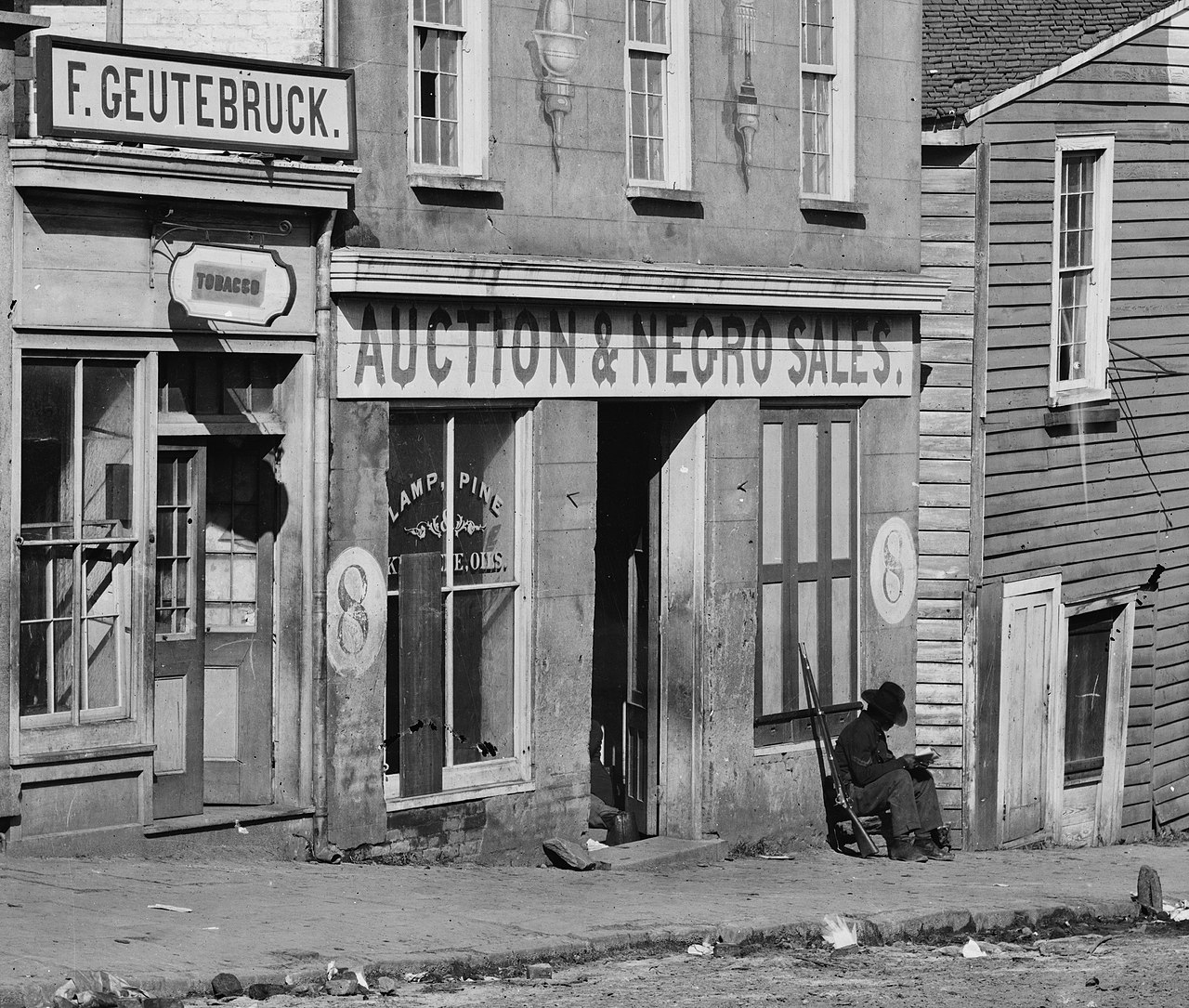
Nueva Orleans adquirió importancia nacional como mercado y puerto de esclavos, ya que desde allí se enviaban esclavos río arriba en barcos de vapor a plantaciones en el río Misisipi; también vendía esclavos que habían sido enviados río abajo desde mercados como Louisville. En 1840, el mercado de esclavos de Nueva Orleans era el más grande de América del Norte. Se convirtió en la ciudad más rica y la cuarta más grande de la nación, basada principalmente en el comercio de esclavos y los negocios asociados. [66] La temporada comercial era de septiembre a mayo, después de la cosecha. [183]
La noción de que los traficantes de esclavos eran parias sociales de baja reputación, incluso en el Sur, fue promulgada inicialmente por sureños defensivos y más tarde por figuras como el historiador Ulrich B. Phillips . [184] El historiador Frederic Bancroft , autor de Slave-Trading in the Old South (1931) encontró -al contrario de la posición de Phillips- que muchos traficantes eran miembros estimados de sus comunidades. [185] El investigador contemporáneo Steven Deyle sostiene que "la posición del traficante en la sociedad no estaba exenta de problemas y los propietarios que trataban con el traficante sentían la necesidad de asegurarse de que actuaban honorablemente", mientras que Michael Tadman sostiene que "el 'traficante como paria' operaba a nivel de propaganda", mientras que los dueños de esclavos blancos profesaban casi universalmente la creencia de que los esclavos no eran humanos como ellos, y por lo tanto descartaban las consecuencias del comercio de esclavos como algo que no merecía consideración. [184] De manera similar, el historiador Charles Dew leyó cientos de cartas a los traficantes de esclavos y no encontró prácticamente ninguna evidencia narrativa de culpa, vergüenza o arrepentimiento por el comercio de esclavos: "Si se comienza con la creencia absoluta en la supremacía blanca (incuestionable superioridad blanca/incuestionable inferioridad negra), todo encaja perfectamente: el africano es una raza inferior que vive en pecado, ignorancia, barbarie y paganismo en el "Continente Negro" hasta que es esclavizado... La esclavitud se convierte así milagrosamente en una forma de "elevación" para esta raza supuestamente ignorante y brutal. Y una vez que las nociones de supremacía blanca e inferioridad negra se establecen en el sur de Estados Unidos, se transmiten de una generación a la siguiente con toda la certeza e inevitabilidad de un rasgo genético". [186]
En las elecciones presidenciales de 1828 , el candidato Andrew Jackson fue fuertemente criticado por sus oponentes como un traficante de esclavos que realizaba transacciones con esclavos desafiando los estándares modernos o la moralidad. [187]
Tratamiento

El trato que recibían los esclavos en Estados Unidos variaba mucho según las condiciones, la época y el lugar, pero en general era brutal, especialmente en las plantaciones. Los azotes y las violaciones eran rutinarios. Las relaciones de poder de la esclavitud corrompieron a muchos blancos que tenían autoridad sobre los esclavos, y los niños mostraban su propia crueldad. Los amos y los capataces recurrían a los castigos físicos para imponer su voluntad. Los esclavos eran castigados con azotes, grilletes, ahorcamientos, palizas, quemas, mutilaciones, marcas y encarcelamientos. El castigo se aplicaba con mayor frecuencia en respuesta a la desobediencia o a infracciones percibidas, pero a veces se cometían abusos para reafirmar el dominio del amo o el capataz del esclavo. [191] El trato era generalmente más duro en las grandes plantaciones, que a menudo estaban gestionadas por capataces y eran propiedad de esclavistas ausentes, condiciones que permitían los abusos.
William Wells Brown , que escapó a la libertad, informó que en una plantación, los hombres esclavos debían recoger ochenta libras por día de algodón, mientras que las mujeres debían recoger setenta libras; si algún esclavo no alcanzaba su cuota, estaba sujeto a latigazos por cada libra que le faltara. El poste de azotes estaba al lado de las balanzas de algodón. [192] Un hombre de Nueva York que asistió a una subasta de esclavos a mediados del siglo XIX informó que al menos tres cuartas partes de los esclavos varones que vio en la venta tenían cicatrices en la espalda por los azotes. [193] Por el contrario, las pequeñas familias propietarias de esclavos tenían relaciones más estrechas entre los propietarios y los esclavos; esto a veces daba como resultado un entorno más humano, pero no era un hecho. [194]
El historiador Lawrence M. Friedman escribió: "Diez códigos sureños convertían en delito maltratar a un esclavo ... Según el Código Civil de Luisiana de 1825 (art. 192), si un amo era "condenado por trato cruel", el juez podía ordenar la venta del esclavo maltratado, presumiblemente a un mejor amo. [195] Los amos y capataces rara vez eran procesados bajo estas leyes. Ningún esclavo podía dar testimonio en los tribunales.

Según la investigación de Adalberto Aguirre, 1.161 esclavos fueron ejecutados en los Estados Unidos entre las décadas de 1790 y 1850. [196] Las ejecuciones rápidas de esclavos inocentes, así como de sospechosos, generalmente seguían a cualquier intento de rebelión de esclavos, ya que las milicias blancas reaccionaban exageradamente con asesinatos generalizados que expresaban sus temores de rebeliones o sospechas de rebeliones.
Aunque la mayoría de los esclavos tenían vidas muy restringidas en términos de sus movimientos y capacidad de acción, existían excepciones a prácticamente todas las generalizaciones; por ejemplo, también había esclavos que tenían una libertad considerable en su vida diaria: esclavos a los que se les permitía alquilar su trabajo y que podían vivir independientemente de su amo en las ciudades, esclavos que empleaban a trabajadores blancos y médicos esclavos que trataban a pacientes blancos de clase alta. [197] Después de 1820, en respuesta a la incapacidad de importar nuevos esclavos de África y en parte a las críticas abolicionistas, algunos esclavistas mejoraron las condiciones de vida de sus esclavos, para alentarlos a ser productivos y tratar de evitar fugas. [198] Era parte de un enfoque paternalista en la era anterior a la guerra civil que fue alentado por los ministros que intentaban usar el cristianismo para mejorar el tratamiento de los esclavos. Los esclavistas publicaron artículos en revistas agrícolas del Sur para compartir las mejores prácticas en el tratamiento y la gestión de los esclavos; pretendían demostrar que su sistema era mejor que las condiciones de vida de los trabajadores industriales del norte.
La atención médica a los esclavos era limitada en términos de los conocimientos médicos disponibles para cualquiera. Generalmente era proporcionada por otros esclavos o por miembros de la familia de los dueños de esclavos, aunque a veces los "médicos de las plantaciones", como J. Marion Sims , eran llamados por los dueños para proteger su inversión tratando a los esclavos enfermos. Muchos esclavos poseían habilidades médicas necesarias para atenderse entre sí y usaban remedios populares traídos de África. También desarrollaron nuevos remedios basados en plantas y hierbas americanas. [199]
Se estima que un nueve por ciento de los esclavos eran discapacitados debido a una condición física, sensorial, psicológica, neurológica o del desarrollo. Sin embargo, a menudo se describía a los esclavos como discapacitados si no podían trabajar o tener hijos, y a menudo eran sometidos a un trato severo como resultado de ello. [200]
Según Andrew Fede, un propietario podría ser considerado penalmente responsable por matar a un esclavo solo si el esclavo que mató era "completamente sumiso y estaba bajo el control absoluto del amo". [201] Por ejemplo, en 1791 la Asamblea General de Carolina del Norte definió el asesinato intencional de un esclavo como asesinato criminal , a menos que se hiciera por resistencia o bajo corrección moderada (es decir, castigo corporal). [202]

Si bien las condiciones de vida de los esclavos eran malas según los estándares modernos, Robert Fogel sostuvo que todos los trabajadores, libres o esclavos, durante la primera mitad del siglo XIX estaban sujetos a penurias. [203] Sin embargo, a diferencia de los individuos libres, las personas esclavizadas tenían muchas más probabilidades de estar desnutridas, ser castigadas físicamente, abusadas sexualmente o asesinadas, sin ningún recurso, legal o de otro tipo, contra quienes perpetraban estos crímenes contra ellas.
Mercantilización del tejido humano
En un sentido muy sombrío, la mercantilización del cuerpo humano era legal en el caso de los esclavos africanos, ya que no se los consideraba legalmente completamente humanos. El medio más popular de mercantilizar los tejidos de los esclavos era a través de la experimentación médica. Los esclavos eran utilizados rutinariamente como especímenes médicos y se los obligaba a participar en cirugías experimentales, amputaciones, investigación de enfermedades y desarrollo de técnicas médicas. [204] En muchos casos, los cadáveres de los esclavos se utilizaban en demostraciones y mesas de disección, [205] lo que a menudo daba como resultado la venta de sus tejidos para obtener ganancias. Con el fin de castigar a los esclavos, decorarlos o expresarse personalmente, en muchos casos se permitía que la piel de los esclavos se convirtiera en cuero para muebles, accesorios y ropa, [206] un ejemplo famoso de lo cual era el de la clientela adinerada que enviaba piel de cadáver a los curtidores y zapateros bajo la apariencia de cuero animal. [207] El pelo de los esclavos podía afeitarse y usarse para rellenar almohadas y muebles. En algunos casos, el tejido corporal interno de los esclavos (grasa, huesos, etc.) podía transformarse en jabón, trofeos y otros productos. [208]
Abuso sexual, explotación reproductiva y granjas de cría
Debido a las relaciones de poder en el trabajo, las mujeres esclavas en los Estados Unidos corrían un alto riesgo de violación y abuso sexual. [209] [210] Sus hijos les fueron arrebatados repetidamente y vendidos como animales de granja; por lo general, nunca se volvían a ver. Muchos esclavos se defendieron contra los ataques sexuales y algunos murieron resistiéndose. Otros llevaron cicatrices psicológicas y físicas de los ataques. [211] El abuso sexual de esclavos estaba parcialmente arraigado en una cultura sureña patriarcal que trataba a las mujeres negras como propiedad o bienes muebles. [210] La cultura sureña vigilaba fuertemente contra las relaciones sexuales entre mujeres blancas y hombres negros sobre la supuesta base de la pureza racial, pero, a fines del siglo XVIII, los muchos esclavos y niños esclavos de raza mixta mostraron que los hombres blancos a menudo se habían aprovechado de las mujeres esclavas. [210] Los viudos ricos de plantadores, en particular John Wayles y su yerno Thomas Jefferson , tomaron mujeres esclavas como concubinas ; Cada uno tuvo seis hijos con su pareja: Elizabeth Hemings y su hija Sally Hemings (la media hermana de la difunta esposa de Jefferson), respectivamente. Tanto Mary Chesnut como Fanny Kemble , esposas de plantadores, escribieron sobre este tema en el Sur antes de la guerra civil en las décadas anteriores a la Guerra Civil. A veces, los plantadores usaban esclavos mestizos como sirvientes domésticos o artesanos favoritos porque eran sus hijos u otros parientes. [212] Aunque se oponía públicamente a la mezcla de razas, en sus Notas sobre el estado de Virginia publicadas en 1785, Jefferson escribió: "La mejora de los negros en cuerpo y mente, en el primer caso de su mezcla con los blancos, ha sido observada por todos, y prueba que su inferioridad no es el efecto meramente de su condición de vida". [213] Los historiadores estiman que el 58% de las mujeres esclavizadas en los EE. UU. de entre 15 y 30 años fueron agredidas sexualmente por sus dueños de esclavos y otros hombres blancos. [214] Como resultado de siglos de esclavitud y de tales relaciones, los estudios de ADN han demostrado que la gran mayoría de los afroamericanos también tienen ascendencia europea histórica, generalmente a través de líneas paternas. [215] [216]
Las representaciones de los hombres negros como hipersexuales y salvajes, junto con los ideales de protección de las mujeres blancas, predominaron durante esta época [217] y enmascararon las experiencias de violencia sexual que enfrentaban los esclavos negros, especialmente las mujeres blancas. Sujetos no solo a violación y explotación sexual, los esclavos enfrentaban violencia sexual en muchas formas. Un hombre negro podía ser obligado por su dueño a violar a otro esclavo o incluso a una mujer negra libre. [218] Los emparejamientos forzados con otros esclavos, incluida la crianza forzada, que ninguno de los esclavos podía desear, eran comunes. [218] A pesar de las prohibiciones explícitas de la homosexualidad y la sodomía, no era raro que los esclavos varones y los niños fueran acosados y agredidos sexualmente por sus amos en secreto. [219] A través del abuso sexual y reproductivo, los dueños de esclavos podían imponer aún más su control sobre sus esclavos.
La prohibición de la importación de esclavos a los Estados Unidos después de 1808 limitó la oferta de esclavos en el país. Esto se produjo en un momento en que la invención de la desmotadora de algodón permitió la expansión del cultivo de algodón de fibra corta en las tierras altas, lo que llevó a despejar tierras para cultivar algodón en grandes áreas del sur profundo, especialmente el Cinturón Negro . La demanda de mano de obra en la zona aumentó drásticamente y condujo a una expansión del mercado interno de esclavos. Al mismo tiempo, el Alto Sur tenía un exceso de esclavos debido a un cambio hacia la agricultura de cultivos mixtos, que requería menos mano de obra que el tabaco. Para aumentar la oferta de esclavos, los propietarios de esclavos consideraban la fertilidad de las mujeres esclavas como parte de su productividad y, de forma intermitente, obligaban a las mujeres a tener una gran cantidad de hijos. Durante este período de tiempo, los términos "criadores", "esclavos reproductores", "mujeres en edad fértil", "período de reproducción" y "demasiado mayores para reproducirse" se volvieron familiares. [220]

A medida que se hizo popular en muchas plantaciones la cría de esclavos para aumentar su fuerza, fertilidad o trabajo extra, surgieron muchos casos documentados de " granjas de cría " en los Estados Unidos. Los esclavos eran obligados a concebir y dar a luz tantos nuevos esclavos como fuera posible. Las granjas más grandes estaban ubicadas en Virginia y Maryland. [221] Debido a que la industria de la cría de esclavos surgió de un deseo de un crecimiento demográfico de esclavos mayor que el natural, los propietarios de esclavos a menudo recurrieron a prácticas sistemáticas para crear más esclavos. Las esclavas "eran sometidas a violaciones repetidas o relaciones sexuales forzadas y quedaban embarazadas una y otra vez", [222] incluso por incesto . En relatos horribles de antiguos esclavos, algunos afirmaron que se les colocaban capuchas o bolsas sobre la cabeza para evitar que supieran con quién se les obligaba a tener relaciones sexuales. El periodista William Spivey escribió: "Podría ser alguien que conocieran, tal vez una sobrina, una tía, una hermana o su propia madre. Los criadores solo querían un niño que pudiera venderse". [223]
En los Estados Unidos, a principios del siglo XIX, los dueños de esclavas podían utilizarlas libremente y legalmente como objetos sexuales . Esto se debe a que las tripulaciones utilizaban libremente a las esclavas en los barcos negreros. [224] : 83
El dueño de esclavos tiene el poder de violar la castidad de sus esclavos, y no son pocos los que son lo bastante bestiales como para ejercer tal poder. Por eso sucede que en algunas familias es difícil distinguir a los hijos libres de los esclavos. A veces sucede que la mayor parte de los hijos del amo no nacen de su esposa, sino de las esposas e hijas de sus esclavos, a quienes ha prostituido y esclavizado vilmente. [225] : 38
"Este vicio, esta plaga de la sociedad, se ha vuelto ya tan común, que apenas se lo considera una desgracia." [226]

"Fancy" era una palabra clave que indicaba que la niña o la joven era adecuada o estaba entrenada para el uso sexual. [228] : 56 En algunos casos, los niños también eran abusados de esta manera. Está documentada la venta de una niña de 13 años "casi una fantasía". [229] Zephaniah Kingsley, Jr. , compró a su esposa cuando tenía 13 años. [230] : 191
Además, a las mujeres esclavizadas que tenían edad suficiente para tener hijos se las alentaba a procrear, lo que aumentaba su valor como esclavas, ya que sus hijos eventualmente proporcionarían trabajo o serían vendidos, enriqueciendo a los dueños. A las mujeres esclavizadas a veces se las trataba médicamente para permitir o estimular su fertilidad. [231] Las variaciones en el color de la piel encontradas en los Estados Unidos hacen evidente la frecuencia con la que las mujeres negras eran embarazadas por blancos. [232] Por ejemplo, en el censo de 1850, el 75,4% de los "negros libres" en Florida fueron descritos como mulatos , de raza mixta. [233] Sin embargo, solo muy recientemente, con estudios de ADN , se puede proporcionar algún tipo de número confiable, y la investigación solo ha comenzado. Las niñas de piel clara, que contrastaban con las trabajadoras del campo más oscuras, eran preferidas. [229] [234]
Como dijo Caroline Randall Williams en The New York Times : "¿Quieres un monumento confederado? Mi cuerpo es un monumento confederado". "Tengo la piel del color de la violación", añadió. [235]
El uso sexual de esclavos negros por parte de los dueños de esclavos o de aquellos que podían comprar los servicios temporales de un esclavo adoptaba diversas formas. Un dueño de esclavos, o su hijo adolescente, podía ir a la zona de los esclavos de la plantación y hacer lo que quisiera, con un mínimo de privacidad, si es que la tenía. Era común que una mujer de la "casa" (ama de llaves, criada, cocinera, lavandera o niñera ) fuera violada por uno o más miembros de la familia. Las casas de prostitución en todos los estados esclavistas estaban atendidas en gran parte por esclavas que brindaban servicios sexuales, para beneficio de sus dueños. Había un pequeño número de mujeres negras libres que se dedicaban a la prostitución o al concubinato, especialmente en Nueva Orleans. [228] : 41
Los dueños de esclavos que mantenían relaciones sexuales con esclavas "pertenecían a menudo a la élite de la comunidad. No tenían por qué preocuparse por el desprecio público". Estas relaciones "parecen haber sido toleradas y en algunos casos incluso aceptadas en silencio". "Las mujeres sureñas ... no se preocupan por ello". [236] Franklin y Armfield, que sin duda formaban parte de la élite de la comunidad, bromeaban con frecuencia en sus cartas sobre las mujeres y niñas negras que violaban. Nunca se les ocurrió que hubiera algo malo en lo que estaban haciendo. [237]
Las jóvenes de piel clara eran vendidas abiertamente para uso sexual; su precio era mucho más alto que el de un peón de campo. [228] : 38, 55 [238] Existían mercados especiales para el comercio de muchachas elegantes en Nueva Orleans [228] : 55 y Lexington, Kentucky . [239] [240] El historiador Philip Shaw describe una ocasión en la que Abraham Lincoln y Allen Gentry presenciaron tales ventas en Nueva Orleans en 1828:
Gentry recordaba vívidamente un día en Nueva Orleans cuando él y Lincoln, de diecinueve años, llegaron a un mercado de esclavos. Al detenerse a observar, Gentry recordó haber mirado las manos de Lincoln y haber visto que "apretaba los puños con fuerza; sus nudillos se pusieron blancos". Hombres con abrigos negros y sombreros blancos compran a jornaleros, "negros y feos", por 500 a 800 dólares. Y entonces comienza el verdadero horror: "Cuando comenzó la venta de "chicas elegantes", Lincoln, "incapaz de soportarlo más", le murmuró a Gentry: "Allen, eso es una vergüenza. Si alguna vez le doy un puñetazo a esa cosa, le daré fuerte". [241]
Las muchachas que eran “consideradas educadas y refinadas, eran compradas por los clientes más ricos, generalmente dueños de plantaciones, para convertirse en compañeras sexuales personales”. “Había una gran demanda en Nueva Orleans de ‘chicas elegantes’”. [242]
El tema que se planteó con frecuencia fue la amenaza de las relaciones sexuales entre hombres negros y mujeres blancas. Así como se consideraba que las mujeres negras tenían "un rastro de África, que supuestamente incitaba la pasión y el desenfreno sexual", [228] : 39 los hombres eran vistos como salvajes, incapaces de controlar su lujuria si se les daba la oportunidad. [243]
Another approach to the question was offered by Quaker and Florida planter Zephaniah Kingsley, Jr. He advocated, and personally practiced, deliberate racial mixing through marriage, as part of his proposed solution to the slavery issue: racial integration, called "amalgamation" at the time. In an 1829 Treatise, he stated that mixed-race people were healthier and often more beautiful, that interracial sex was hygienic, and slavery made it convenient.[230]: 190 Because of these views, tolerated in Spanish Florida, he found it impossible to remain long in Territorial Florida, and moved with his slaves and multiple wives to a plantation, Mayorasgo de Koka, in Haiti (now in the Dominican Republic). There were many others who less flagrantly practiced interracial, common-law marriages with slaves (see Partus sequitur ventrem).
Slave codes


To help regulate the relationship between slave and owner, including legal support for keeping the slave as property, states established slave codes, most based on laws existing since the colonial era. The code for the District of Columbia defined a slave as "a human being, who is by law deprived of his or her liberty for life, and is the property of another".[244]
While each state had its own slave code, many concepts were shared throughout the slave states.[245] According to the slave codes, some of which were passed in reaction to slave rebellions, teaching a slave to read or write was illegal. This prohibition was unique to American slavery, believed to reduce slaves forming aspirations that could lead to escape or rebellion.[246] Informal education occurred when white children taught slave companions what they were learning; in other cases, adult slaves learned from free artisan workers, especially if located in cities, where there was more freedom of movement.
In Alabama, slaves were not allowed to leave their master's premises without written consent or passes. This was a common requirement in other states as well, and locally run patrols (known to slaves as pater rollers) often checked the passes of slaves who appeared to be away from their plantations. In Alabama slaves were prohibited from trading goods among themselves. In Virginia, a slave was not permitted to drink in public within one mile of his master or during public gatherings. Slaves were not permitted to carry firearms in any of the slave states.
Slaves were generally prohibited by law from associating in groups, with the exception of worship services (a reason why the Black Church is such a notable institution in black communities today). Following Nat Turner's rebellion in 1831, which raised white fears throughout the South, some states also prohibited or restricted religious gatherings of slaves, or required that they be officiated by white men. Planters feared that group meetings would facilitate communication among slaves that could lead to rebellion.[247] Slaves held private, secret "brush meetings" in the woods.
In Ohio, an emancipated slave was prohibited from returning to the state in which he or she had been enslaved. Other Northern states discouraged the settling of free blacks within their boundaries. Fearing the influence of free blacks, Virginia and other Southern states passed laws to require blacks who had been freed to leave the state within a year (or sometimes less time) unless granted a stay by an act of the legislature.
Religion

Africans brought their religions with them from Africa, including Islam,[248] Catholicism,[249] and traditional religions.
Prior to the American Revolution, masters and revivalists spread Christianity to slave communities, including Catholicism in Spanish Florida and California, and in French and Spanish Louisiana, and Protestantism in English colonies, supported by the Society for the Propagation of the Gospel. In the First Great Awakening of the mid-18th century, Baptists and Methodists from New England preached a message against slavery, encouraged masters to free their slaves, converted both slaves and free blacks, and gave them active roles in new congregations.[250] The first independent black congregations were started in the South before the Revolution, in South Carolina and Georgia. Believing that, "slavery was contrary to the ethics of Jesus", Christian congregations and church clergy, especially in the North, played a role in the Underground Railroad, especially Wesleyan Methodists, Quakers and Congregationalists.[251][252]
Over the decades and with the growth of slavery throughout the South, some Baptist and Methodist ministers gradually changed their messages to accommodate the institution. After 1830, white Southerners argued for the compatibility of Christianity and slavery, with a multitude of both Old and New Testament citations.[253] They promoted Christianity as encouraging better treatment of slaves and argued for a paternalistic approach. In the 1840s and 1850s, the issue of accepting slavery split the nation's largest religious denominations (the Methodist, Baptist and Presbyterian churches) into separate Northern and Southern organizations (see Methodist Episcopal Church, South, Southern Baptist Convention, and Presbyterian Church in the Confederate States of America).[254] Schisms occurred, such as that between the Wesleyan Methodist Church and the Methodist Episcopal Church.[255]
Southern slaves generally attended their masters' white churches, where they often outnumbered the white congregants. They were usually permitted to sit only in the back or in the balcony. They listened to white preachers, who emphasized the obligation of slaves to keep in their place, and acknowledged the slave's identity as both person and property.[253] Preachers taught the master's responsibility and the concept of appropriate paternal treatment, using Christianity to improve conditions for slaves, and to treat them "justly and fairly" (Col. 4:1). This included masters having self-control, not disciplining under anger, not threatening, and ultimately fostering Christianity among their slaves by example.[253]
Slaves also created their own religious observances, meeting alone without the supervision of their white masters or ministers. The larger plantations with groups of slaves numbering 20, or more, tended to be centers of nighttime meetings of one or several plantation slave populations.[253] These congregations revolved around a singular preacher, often illiterate with limited knowledge of theology, who was marked by his personal piety and ability to foster a spiritual environment. African Americans developed a theology related to Biblical stories having the most meaning for them, including the hope for deliverance from slavery by their own Exodus. One lasting influence of these secret congregations is the African American spiritual.[256]
Mandatory illiteracy
In a feature unique to American slavery, legislatures across the South enacted new laws to curtail the already limited rights of African Americans. For example, Virginia prohibited blacks, free or slave, from practicing preaching, prohibited them from owning firearms, and forbade anyone to teach slaves or free blacks how to read.[127] It specified heavy penalties for both student and teacher if slaves were taught, including whippings or jail.[257]
[E]very assemblage of negroes for the purpose of instruction in reading or writing, or in the night time for any purpose, shall be an unlawful assembly. Any justice may issue his warrant to any office or other person, requiring him to enter any place where such assemblage may be, and seize any negro therein; and he, or any other justice, may order such negro to be punished with stripes.[258]
Slave owners saw literacy as a threat to the institution of slavery and their financial investment in it; as a North Carolina statute passed in 1830-1831 stated, "Teaching slaves to read and write, tends to excite dissatisfaction in their minds, and to produce insurrection and rebellion."[259][260] Literacy enabled the enslaved to read the writings of abolitionists, which discussed the abolition of slavery and described the slave revolution in Haiti of 1791–1804 and the end of slavery in the British Empire in 1833. It also allowed slaves to learn that thousands of enslaved individuals had escaped, often with the assistance of the Underground Railroad. Literacy also was believed to make the enslaved unhappy at best, insolent and sullen at worst. As put by prominent Washington lawyer Elias B. Caldwell in 1822:
The more you improve the condition of these people, the more you cultivate their minds, the more miserable you make them, in their present state. You give them a higher relish for those privilegies which they can never attain, and turn what we intend for a blessing [slavery] into a curse. No, if they must remain in their present situation, keep them in the lowest state of degradation and ignorance. The nearer you bring them to the condition of brutes, the better chance do you give them of possessing their apathy.[261]
Unlike in the South, slave owners in Utah were required to send their slaves to school.[262] Black slaves did not have to spend as much time in school as Indian slaves.[263]
Freedom suits and Dred Scott

With the development of slave and free states after the American Revolution, and far-flung commercial and military activities, new situations arose in which slaves might be taken by masters into free states. Most free states not only prohibited slavery, but ruled that slaves brought and kept there illegally could be freed. Such cases were sometimes known as transit cases.[265] Dred Scott and his wife Harriet Scott each sued for freedom in St. Louis after the death of their master, based on their having been held in a free territory (the northern part of the Louisiana Purchase from which slavery was excluded under the terms of the Missouri Compromise). (Later the two cases were combined under Dred Scott's name.) Scott filed suit for freedom in 1846 and went through two state trials, the first denying and the second granting freedom to the couple (and, by extension, their two daughters, who had also been held illegally in free territories). For 28 years, Missouri state precedent had generally respected laws of neighboring free states and territories, ruling for freedom in such transit cases where slaves had been held illegally in free territory. But in the Dred Scott case, the Missouri Supreme Court ruled against the slaves.[266]
After Scott and his team appealed the case to the U.S. Supreme Court, Chief Justice Roger B. Taney, in a sweeping decision, denied Scott his freedom. The 1857 decision, decided 7–2, held that a slave did not become free when taken into a free state; Congress could not bar slavery from a territory; and people of African descent imported into the United States and held as slaves, or their descendants, could never be citizens and thus had no status to bring suit in a U.S. court. A state could not bar slaveowners from bringing slaves into that state. Many Republicans, including Abraham Lincoln, considered the decision unjust and evidence that the Slave Power had seized control of the Supreme Court. Anti-slavery groups were enraged and slave owners encouraged, escalating the tensions that led to civil war.[267]
1850 to the firing on Fort Sumter


In 1850, Congress passed the Fugitive Slave Act, as part of the Compromise of 1850, which required law enforcement and citizens of free states to cooperate in the capture and return of slaves. This met with considerable overt and covert resistance in free states and cities such as Philadelphia, New York, and Boston. Refugees from slavery continued to flee the South across the Ohio River and other parts of the Mason–Dixon line dividing North from South, to the North and Canada via the Underground Railroad. Some white Northerners helped hide former slaves from their former owners or helped them reach freedom in Canada.[268]
As part of the Compromise of 1850, Congress abolished the slave trade (though not the ownership of slaves) in the District of Columbia; fearing this would happen, Alexandria, regional slave trading center and port, successfully sought its removal from the District of Columbia and devolution to Virginia. After 1854, Republicans argued that the "Slave Power", especially the pro-slavery Democratic Party in the South, controlled two of the three branches of the Federal government.[269]
The abolitionists, realizing that the total elimination of slavery was unrealistic as an immediate goal, worked to prevent the expansion of slavery into the western territories that eventually would become new states. The Missouri Compromise, the Compromise of 1850, and the Bleeding Kansas period dealt with whether new states would be slave or free, or how that was to be decided. Both sides were anxious about effects of these decisions on the balance of power in the Senate.
After the passage of the Kansas–Nebraska Act in 1854, border fighting broke out in the Kansas Territory, where the question of whether it would be admitted to the Union as a slave or free state was left to the inhabitants. Migrants from both free and slave states moved into the territory to prepare for the vote on slavery. Abolitionist John Brown, the most famous of the anti-slavery immigrants, was active in the fighting in "Bleeding Kansas", but so too were many white Southerners (many from adjacent Missouri) who opposed abolition.
Abraham Lincoln's and the Republicans' political platform in 1860 was to stop slavery's expansion. Historian James M. McPherson says that in his famous "House Divided" speech in 1858, Lincoln said American republicanism can be purified by restricting the further expansion of slavery as the first step to putting it on the road to 'ultimate extinction.' Southerners took Lincoln at his word. When he won the presidency, they left the Union to escape the 'ultimate extinction' of slavery."[270]
The divisions became fully exposed with the 1860 presidential election. The electorate split four ways. The Southern Democrats endorsed slavery, while the Republican Party denounced it. The Northern Democrats said democracy required the people to decide on slavery locally, state by state and territory by territory. The Constitutional Union Party said the survival of the Union was at stake and everything else should be compromised.[271]
Lincoln, the Republican, won with a plurality of popular votes and a majority of electoral votes. Lincoln, however, did not appear on the ballots of ten southern slave states. Many slave owners in the South feared that the real intent of the Republicans was the abolition of slavery in states where it already existed, and that the sudden emancipation of four million slaves would be disastrous for the slave owners and for the economy that drew its greatest profits from the labor of people who were not paid. The slave owners feared that ending the balance could lead to the domination of the federal government by the northern free states. This led seven southern states to secede from the Union. When the Confederate Army attacked a U.S. Army installation at Fort Sumter, the American Civil War began and four additional slave states seceded. Northern leaders had viewed the slavery interests as a threat politically, but with secession, they viewed the prospect of a new Southern nation, the Confederate States of America, with control over the Mississippi River and parts of the West, as politically unacceptable. Most of all, they could not accept this repudiation of American nationalism.[272]
Civil War and emancipation


American Civil War
The consequent American Civil War, beginning in 1861, led to the end of chattel slavery in America. Not long after the war broke out, through a legal maneuver by Union General Benjamin F. Butler, a lawyer by profession, slaves who fled to Union lines were considered "contraband of war". General Butler ruled that they were not subject to return to Confederate owners as they had been before the war. "Lincoln and his Cabinet discussed the issue on May 30 and decided to support Butler's stance".[273] Soon word spread, and many slaves sought refuge in Union territory, desiring to be declared "contraband". Many of the "contrabands" joined the Union Army as workers or troops, forming entire regiments of the U.S. Colored Troops. Others went to refugee camps such as the Grand Contraband Camp near Fort Monroe or fled to northern cities. General Butler's interpretation was reinforced when Congress passed the Confiscation Act of 1861, which declared that any property used by the Confederate military, including slaves, could be confiscated by Union forces.

At the beginning of the war, some Union commanders thought they were supposed to return escaped slaves to their masters. By 1862, when it became clear that this would be a long war, the question of what to do about slavery became more general. The Southern economy and military effort depended on slave labor. It began to seem unreasonable to protect slavery while blockading Southern commerce and destroying Southern production. As Congressman George W. Julian of Indiana put it in an 1862 speech in Congress, the slaves "cannot be neutral. As laborers, if not as soldiers, they will be allies of the rebels, or of the Union."[274] Julian and his fellow Radical Republicans put pressure on Lincoln to rapidly emancipate the slaves, whereas moderate Republicans came to accept gradual, compensated emancipation and colonization.[275] Copperheads, the border states and War Democrats opposed emancipation, although the border states and War Democrats eventually accepted it as part of total war needed to save the Union.
Emancipation Proclamation
The Emancipation Proclamation was an executive order issued by President Abraham Lincoln on January 1, 1863. In a single stroke it changed the legal status, as recognized by the U.S. government, of three million slaves in designated areas of the Confederacy from "slave" to "free". It had the practical effect that as soon as a slave escaped the control of his or her owner, by running away or through advances of federal troops, the slave's proclaimed freedom became actual. Plantation owners, realizing that emancipation would destroy their economic system, sometimes moved their slaves as far as possible out of reach of the Union army. By June 1865, the Union Army controlled all of the Confederacy and had liberated all of the designated slaves.[276]
In 1861, Lincoln expressed the fear that premature attempts at emancipation would mean the loss of the border states. He believed that "to lose Kentucky is nearly the same as to lose the whole game."[277] At first, Lincoln reversed attempts at emancipation by Secretary of War Simon Cameron and Generals John C. Frémont (in Missouri) and David Hunter (in South Carolina, Georgia and Florida) to keep the loyalty of the border states and the War Democrats.
.jpg/1280px-Contrabands_accompanying_the_line_of_Sherman's_march_through_Georgia_(Frank_Leslie's_Illustrated_News).jpg)
On July 22, 1862, Lincoln told his cabinet of his plan to issue a preliminary Emancipation Proclamation. Secretary of State William H. Seward advised Lincoln to wait for a victory before issuing the proclamation, as to do otherwise would seem like "our last shriek on the retreat".[278] On September 17, 1862, the Battle of Antietam provided this opportunity, and on September 22, 1862, Lincoln issued his preliminary Emancipation Proclamation, which provided that enslaved people in the states in rebellion against the United States on January 1, 1863, "shall be then, thenceforward, and forever free".[279] On September 24 and 25, the War Governors' Conference added support for the proclamation.[280] Lincoln issued his final Emancipation Proclamation on January 1, 1863. In his letter to Albert G. Hodges, Lincoln explained his belief that
If slavery is not wrong, nothing is wrong ... And yet I have never understood that the Presidency conferred upon me an unrestricted right to act officially upon this judgment and feeling ... I claim not to have controlled events, but confess plainly that events have controlled me.[281]
Lincoln's Emancipation Proclamation promised freedom for slaves in the Confederate states and authorized the enlistment of African Americans in the Union Army. The Emancipation Proclamation did not free slaves in the border states, which were the slaveholding states that that remained in the Union. As a practical matter, the proclamation freed only those slaves who escaped to Union lines. But the proclamation made the abolition of slavery an official war goal and was implemented as the Union took territory from the Confederacy. According to the Census of 1860, this policy would free nearly four million slaves, or over 12 percent of the total population of the United States.
Because the Emancipation Proclamation was issued under the president's war powers, it might not have continued in force after the war ended. Therefore, Lincoln played a leading role in getting the constitutionally required two-thirds majority of both houses of Congress to vote for the Thirteenth Amendment,[282] which made emancipation universal and permanent.

Enslaved African Americans had not waited for Lincoln before escaping and seeking freedom behind Union lines. From the early years of the war, hundreds of thousands of African Americans escaped to Union lines, especially in Union-controlled areas such as Norfolk and the Hampton Roads region in 1862 Virginia, Tennessee from 1862 on, and the line of Sherman's march. So many African Americans fled to Union lines that commanders created camps and schools for them, where both adults and children learned to read and write. The American Missionary Association entered the war effort by sending teachers south to such contraband camps, for instance, establishing schools in Norfolk and on nearby plantations.
In addition, nearly 200,000 African-American men served with distinction in the Union forces as soldiers and sailors; most were escaped slaves. The Confederacy was outraged by armed black soldiers and refused to treat them as prisoners of war. They murdered many, as at the Fort Pillow massacre, and re-enslaved others.[283]
On February 24, 1863, the Arizona Organic Act abolished slavery in the newly formed Arizona Territory. Tennessee and all of the border states (except Kentucky and Delaware) abolished slavery by early 1865. Thousands of slaves were freed by the operation of the Emancipation Proclamation as Union armies marched across the South. Emancipation came to the remaining Southern slaves after the surrender of all the Confederate troops in spring 1865.
In spite of the South's shortage of manpower, until 1865, most Southern leaders opposed arming slaves as soldiers. However, a few Confederates discussed arming slaves. Finally, in early 1865, General Robert E. Lee said that black soldiers were essential, and legislation was passed. The first black units were in training when the war ended in April.[284]
End of slavery

Booker T. Washington remembered Emancipation Day in early 1863, when he was a boy of nine in Virginia:[285]
As the great day drew nearer, there was more singing in the slave quarters than usual. It was bolder, had more ring, and lasted later into the night. Most of the verses of the plantation songs had some reference to freedom. ... Some man who seemed to be a stranger (a United States officer, I presume) made a little speech and then read a rather long paper – the Emancipation Proclamation, I think. After the reading we were told that we were all free, and could go when and where we pleased. My mother, who was standing by my side, leaned over and kissed her children, while tears of joy ran down her cheeks. She explained to us what it all meant, that this was the day for which she had been so long praying, but fearing that she would never live to see.

The war ended on June 22, 1865, and following that surrender, the Emancipation Proclamation was enforced throughout remaining regions of the South that had not yet freed the slaves. Slavery officially continued for a couple of months in other locations.[286] Federal troops arrived in Galveston, Texas, on June 19, 1865, to enforce the emancipation. The commemoration of that event, Juneteenth National Independence Day, has been declared a national holiday in 2021.[287]
The Thirteenth Amendment, abolishing slavery except as punishment for a crime, had been passed by the Senate in April 1864, and by the House of Representatives in January 1865.[288]

The amendment did not take effect until it was ratified by three-fourths of the states, which occurred on December 6, 1865, when Georgia ratified it. On that date, the last 40,000–45,000 enslaved Americans in the remaining two slave states of Kentucky and Delaware, as well as the 200 or so perpetual apprentices in New Jersey left from the very gradual emancipation process begun in 1804, were freed.[289] The last Americans known to have been born into legal slavery died in the 1970s.
Reconstruction to the present

Journalist Douglas A. Blackmon reported in his Pulitzer Prize-winning book Slavery By Another Name that many black persons were virtually enslaved under convict leasing programs, which started after the Civil War. Most Southern states had no prisons; they leased convicts to businesses and farms for their labor, and the lessee paid for food and board. Incentives for abuse were present.
The continued involuntary servitude took various forms, but the primary forms included convict leasing, peonage and sharecropping, with the latter eventually encompassing poor whites as well. By the 1930s, whites constituted most of the sharecroppers in the South. Mechanization of agriculture had reduced the need for farm labor, and many black people left the South in the Great Migration. Jurisdictions and states created fines and sentences for a wide variety of minor crimes and used these as an excuse to arrest and sentence black people. Under convict-leasing programs, African-American men, often guilty of petty crimes or even no crime at all, were arrested, compelled to work without pay, repeatedly bought and sold, and coerced to do the bidding of the leaseholder. Sharecropping, as it was practiced during this period, often involved severe restrictions on the freedom of movement of sharecroppers, who could be whipped for leaving the plantation. Both sharecropping and convict leasing were legal and tolerated by both the North and South. However, peonage was an illicit form of forced labor. Its existence was ignored by authorities while thousands of African Americans and poor white Americans were subjugated and held in bondage until the mid-1960s to the late 1970s. With the exception of cases of peonage, beyond the period of Reconstruction, the federal government took almost no action to enforce the Thirteenth Amendment until December 1941, when President Franklin Delano Roosevelt summoned his attorney general. Five days after the attack on Pearl Harbor, at the request of the President, Attorney General Francis Biddle issued Circular No. 3591 to all federal prosecutors, instructing them to investigate actively and try any case of involuntary servitude or slavery. Several months later, convict leasing was officially abolished. But aspects have persisted in other forms. Historians argue that other systems of penal labor were all created in 1865, and convict leasing was simply the most oppressive form. Over time, a large civil rights movement arose to bring full civil rights and equality under the law to all Americans. [290]
Convict leasing

.jpg/1280px-Picking_cotton,_Angola_State_Farm_(circa_1900).jpg)
With emancipation a legal reality, white Southerners were concerned with both controlling the newly freed slaves and keeping them in the labor force at the lowest level. The system of convict leasing began during Reconstruction and was fully implemented in the 1880s, officially ending in the last state, Alabama, in 1928. It persisted in various forms until it was abolished in 1942 by President Franklin D. Roosevelt during World War II, several months after the attack on Pearl Harbor involved the U.S. in the conflict. This system allowed private contractors to purchase the services of convicts from the state or local governments for a specific time period. African Americans, due to "vigorous and selective enforcement of laws and discriminatory sentencing", made up the vast majority of the convicts leased.[294] Writer Douglas A. Blackmon writes of the system:
It was a form of bondage distinctly different from that of the antebellum South in that for most men, and the relatively few women drawn in, this slavery did not last a lifetime and did not automatically extend from one generation to the next. But it was nonetheless slavery – a system in which armies of free men, guilty of no crimes and entitled by law to freedom, were compelled to labor without compensation, were repeatedly bought and sold, and were forced to do the bidding of white masters through the regular application of extraordinary physical coercion.[295]
The constitutional basis for convict leasing is that the Thirteenth Amendment, while abolishing slavery and involuntary servitude generally, expressly permits it as a punishment for crime.
Educational issues
Historian Mark Summers Wahlgren notes that the estimated literacy rate among formerly enslaved southern blacks at the time of emancipation was five to 10 percent, but had reached a baseline of 40 to 50 percent (and higher in cities) by the turn of the century, representing a "great advance".[296] As W. E. B. Du Bois noted, the black colleges were not perfect, but "in a single generation they put thirty thousand black teachers in the South" and "wiped out the illiteracy of the majority of black people in the land".[297]

Northern philanthropists continued to support black education in the 20th century, for example of a major donor to Hampton Institute and Tuskegee was George Eastman, who also helped fund health programs at colleges and in communities.[298]
Apologies
In the 21st century, various legislative bodies have issued public apologies for slavery in the United States.
Political legacy
A 2016 study, published in The Journal of Politics, finds that "[w]hites who currently live in Southern counties that had high shares of slaves in 1860 are more likely to identify as a Republican, oppose affirmative action, and express racial resentment and colder feelings toward blacks." The study contends that "contemporary differences in political attitudes across counties in the American South in part trace their origins to slavery's prevalence more than 150 years ago. "[299] The authors argue that their findings are consistent with the theory that "following the Civil War, Southern whites faced political and economic incentives to reinforce existing racist norms and institutions to maintain control over the newly freed African American population. This amplified local differences in racially conservative political attitudes, which in turn have been passed down locally across generations."[299]

A 2017 study in the British Journal of Political Science argued that the British American colonies without slavery adopted better democratic institutions to attract migrant workers to their colonies.[300]
An article published in the Journal of Economic History in 2022 finds that former slave owners remained politically dominant long after the abolition of slavery. Using data from Texas, the authors find that "[i]n 1900, still around 50 percent of all state legislators came from a slave-owning background."[301]
Economics

Robert Fogel and Stanley Engerman, in their 1974 book Time on the Cross, argued that the rate of return of slavery at the market price was close to ten percent, a number close to investment in other assets. The transition from indentured servants to slaves is cited to show that slaves offered greater profits to their owners. A qualified consensus among economic historians and economists is that "Slave agriculture was efficient compared with free agriculture. Economies of scale, effective management, and intensive utilization of labor and capital made southern slave agriculture considerably more efficient than nonslave southern farming",[303] and it is the near-universal consensus among economic historians and economists that slavery was not "a system irrationally kept in existence by plantation owners who failed to perceive or were indifferent to their best economic interests".[304]
The relative price of slaves and indentured servants in the antebellum period did decrease. Indentured servants became more costly with the increase in the demand of skilled labor in England.[305] At the same time, slaves were mostly supplied from within the United States and thus language was not a barrier, and the cost of transporting slaves from one state to another was relatively low. However, as in Brazil and Europe, slavery at its end in the United States tended to be concentrated in the poorest regions of the United States,[306] with a qualified consensus among economists and economic historians concluding that the "modern period of the South's economic convergence to the level of the North only began in earnest when the institutional foundations of the southern regional labor market were undermined, largely by federal farm and labor legislation dating from the 1930s."[307]
In the decades preceding the Civil War, the black population of the United States experienced a rapid natural increase.[308] Unlike the trans-Saharan slave trade with Africa, the slave population transported by the Atlantic slave trade to the United States was sex-balanced.[309] The slave population multiplied nearly fourfold between 1810 and 1860, despite the passage of the Act Prohibiting Importation of Slaves signed into law by President Thomas Jefferson in 1807 banning the international slave trade.[310] Thus, it is also the universal consensus among modern economic historians and economists that slavery in the United States was not "economically moribund on the eve of the Civil War".[311] In the 2010s, several historians, among them Edward E. Baptist, Sven Beckert, Walter Johnson and Calvin Schermerhorn, have posited that slavery was integral in the development of American capitalism.[312][313][314][315] Johnson wrote in River of Dark Dreams (2013): "The cords of credit and debt—of advance and obligation—that cinched the Atlantic economy together were anchored with the mutually defining values of land and slaves: without land and slaves, there was no credit, and without slaves, land itself was valueless. Promises made in the Mississippi Valley were backed by the value of slaves and fulfilled in their labor."[314] Other economic historians have rejected that thesis.[316][317][318][319][320]
A 2023 study estimates that prior to the onset of the US Civil War, the enslaved population produced 12.6% of US national product.[321]
Slavery had a long-lasting impact on wealth and racial inequality in the United States. Black families whose ancestors were freed before the start of the Civil War have substantially better socio-economic outcomes than families who were freed in the Civil War.[322]
Efficiency of slaves

Scholars disagree on how to quantify the efficiency of slavery. In Time on the Cross Fogel and Engerman equate efficiency to total factor productivity (TFP), the output per average unit of input on a farm. Using this measurement, Southern farms that enslaved black people using the gang system were 35% more efficient than Northern farms, which used free labor. Under the gang system, groups of slaves perform synchronized tasks under the constant vigilance of an overseer. Each group was like a part of a machine. If perceived to be working below his capacity, a slave could be punished. Fogel argues that this kind of negative enforcement was not frequent and that slaves and free laborers had a similar quality of life; however, there is controversy on this last point.[324] A critique of Fogel and Engerman's view was published by Paul A. David in 1976.[325]
In 1995, a random survey of 178 members of the Economic History Association sought to study the views of economists and economic historians on the debate. The study found that 72 percent of economists and 65 percent of economic historians would generally agree that "Slave agriculture was efficient compared with free agriculture. Economies of scale, effective management, and intensive utilization of labor and capital made southern slave agriculture considerably more efficient than nonslave southern farming." 48 percent of the economists agreed without provisos, while 24 percent agreed when provisos were included in the statement. On the other hand, 58 percent of economic historians and 42 percent of economists disagreed with Fogel and Engerman's "proposition that the material (not psychological) conditions of the lives of slaves compared favorably with those of free industrial workers in the decades before the Civil War".[303]
Prices of slaves
The U.S. has a capitalist economy so the price of slaves was determined by the law of supply and demand. For example, following bans on the import of slaves after the UK's Slave Trade Act 1807 and the American 1807 Act Prohibiting Importation of Slaves, the prices for slaves increased. The markets for the products produced by slaves also affected the price of slaves (e.g. the price of slaves fell when the price of cotton fell in 1840). Anticipation of slavery's abolition also influenced prices. During the Civil War the price for slave men in New Orleans dropped from $1,381 in 1861 to $1,116 by 1862 (the city was captured by U.S. forces in the Spring of 1862).[326]

Controlling for inflation, prices of slaves rose dramatically in the six decades prior to the Civil War, reflecting demand due to commodity cotton, as well as use of slaves in shipping and manufacturing. Although the prices of slaves relative to indentured servants declined, both got more expensive. Cotton production was rising and relied on the use of slaves to yield high profits. Fogel and Engeman initially argued that if the Civil War had not happened, the slave prices would have increased even more, an average of more than fifty percent by 1890.[324]: 96
Prices reflected the characteristics of the slave; such factors as sex, age, nature, and height were all taken into account to determine the price of a slave. Over the life-cycle, the price of enslaved women was higher than their male counterparts up to puberty age, as they would likely bear children who their masters could sell as slaves and could be used as slave laborers. Men around the age of 25 were the most valued, as they were at the highest level of productivity and still had a considerable life-span.[citation needed] If slaves had a history of fights or escapes, their price was lowered reflecting what planters believed was risk of repeating such behavior. Slave traders and buyers would examine a slave's back for whipping scars; a large number of injuries would be seen as evidence of laziness or rebelliousness, rather than the previous master's brutality, and would lower the slave's price.[193] Taller male slaves were priced at a higher level, as height was viewed as a proxy for fitness and productivity.[324]
Effects on Southern economic development

While slavery brought profits in the short run, discussion continues on the economic benefits of slavery in the long run. In 1995, a random anonymous survey of 178 members of the Economic History Association found that out of the forty propositions about American economic history that were surveyed, the group of propositions most disputed by economic historians and economists were those about the postbellum economy of the American South (along with the Great Depression). The only exception was the proposition initially put forward by historian Gavin Wright that the "modern period of the South's economic convergence to the level of the North only began in earnest when the institutional foundations of the southern regional labor market were undermined, largely by federal farm and labor legislation dating from the 1930s." 62 percent of economists (24 percent with and 38 percent without provisos) and 73 percent of historians (23 percent with and 50 percent without provisos) agreed with this statement.[328][307] Wright has also argued that the private investment of monetary resources in the cotton industry, among others, delayed development in the South of commercial and industrial institutions. There was little public investment in railroads or other infrastructure. Wright argues that agricultural technology was far more developed in the South, representing an economic advantage of the South over the North of the United States.[329]
In Democracy in America, Alexis de Tocqueville noted that "the colonies in which there were no slaves became more populous and more rich than those in which slavery flourished".[330] In 1857, in The Impending Crisis of the South: How to Meet It, Hinton Rowan Helper made the same point.[331] Economists Peter H. Lindert and Jeffrey G. Williamson, in a pair of articles published in 2012 and 2013, found that, despite the American South initially having per capita income roughly double that of the North in 1774, incomes in the South had declined 27% by 1800 and continued to decline over the next four decades, while the economies in New England and the Mid-Atlantic states vastly expanded. By 1840, per capita income in the South was well behind the Northeast and the national average (Note: this is also true in the early 21st century).[332][333]
_Cotton_of_the_United_States_by_Yves_Henry_02.jpg/1280px-Le_coton_aux_%C3%89tats-Unis_(1903)_Cotton_of_the_United_States_by_Yves_Henry_02.jpg)
Lindert and Williamson argue that this antebellum period is an example of what economists Daron Acemoglu, Simon Johnson, and James A. Robinson call "a reversal of fortune".[334] In his essay "The Real History of Slavery", economist Thomas Sowell reiterated and augmented the observation made by de Tocqueville by comparing slavery in the United States to slavery in Brazil. He notes that slave societies reflected similar economic trends in those and other parts of the world, suggesting that the trend Lindert and Williamson identify may have continued until the American Civil War:
Both in Brazil and in the United States – the countries with the two largest slave populations in the Western Hemisphere – the end of slavery found the regions in which slaves had been concentrated poorer than other regions of these same countries. For the United States, a case could be made that this was due to the Civil War, which did so much damage to the South, but no such explanation would apply to Brazil, which fought no Civil War over this issue. Moreover, even in the United States, the South lagged behind the North in many ways even before the Civil War. Although slavery in Europe died out before it was abolished in the Western Hemisphere, as late as 1776 slavery had not yet died out all across the continent when Adam Smith wrote in The Wealth of Nations that it still existed in some eastern regions. But, even then, Eastern Europe was much poorer than Western Europe. The slavery of North Africa and the Middle East, over the centuries, took more slaves from sub-Saharan Africa than the Western Hemisphere did ... But these remained largely poor countries until the discovery and extraction of their vast oil deposits.[306]

Sowell also notes in Ethnic America: A History, citing historians Clement Eaton and Eugene Genovese, that three-quarters of Southern white families owned no slaves at all.[335] Most slaveholders lived on farms rather than plantations,[336] and few plantations were as large as the fictional ones depicted in Gone with the Wind.[337] In "The Real History of Slavery", Sowell also notes in comparison to slavery in the Arab world and the Middle East (where slaves were seldom used for productive purposes) and China (where the slaves consumed the entire output they created), Sowell observes that many commercial slaveowners in the antebellum South tended to be spendthrift and many lost their plantations due to creditor foreclosures, and in Britain, profits by British slave traders only amounted to two percent of British domestic investment at the height of the Atlantic slave trade in the 18th century.[338][339] Sowell draws the following conclusion regarding the macroeconomic value of slavery:
In short, even though some individual slaveowners grew rich and some family fortunes were founded on the exploitation of slaves, that is very different from saying that the whole society, or even its non-slave population as a whole, was more economically advanced than it would have been in the absence of slavery. What this means is that, whether employed as domestic servants or producing crops or other goods, millions suffered exploitation and dehumanization for no higher purpose than the ... aggrandizement of slaveowners.[340]
Eric Hilt noted that, while some historians have suggested slavery was necessary for the Industrial Revolution (on the grounds that American slave plantations produced most of the raw cotton for the British textiles market and the British textiles market was the vanguard of the Industrial Revolution), it is not clear if this is actually true; there is no evidence that cotton could not have been mass-produced by yeoman farmers rather than slave plantations if the latter had not existed (as their existence tended to force yeoman farmers into subsistence farming) and there is some evidence that they certainly could have. The soil and climate of the American South were excellent for growing cotton, so it is not unreasonable to postulate that farms without slaves could have produced substantial amounts of cotton; even if they did not produce as much as the plantations did, it could still have been enough to serve the demand of British producers.[341] Similar arguments have been made by other historians.[342]
Sexual economy of American slavery

Scholar Adrienne Davis articulates how the economics of slavery also can be defined as a sexual economy, specifically focusing on how black women were expected to perform physical, sexual and reproductive labor to provide a consistent enslaved workforce and increase the profits of white slavers. Davis writes that black women were needed for their "sexual and reproductive labor to satisfy the economic, political, and personal interest of white men of the elite class"[343] articulating that black women's reproductive capacity was important in the maintenance of the system of slavery due to its ability to perpetuate an enslaved workforce. She is also drawing attention to black women's labor being needed to maintain the aristocracy of a white ruling class, due to the intimate nature of reproduction and its potential for producing more enslaved peoples.
Due to the institution of partus sequitur ventrem, black women's wombs became the site where slavery was developed and transferred,[344] meaning that black women were not only used for their physical labor, but for their sexual and reproductive labor as well.
"The rule that the children's status follows their mothers' was a foundational one for our economy. It converted enslaved women's reproductive capacity into market capital"[345]

This articulation by Davis illustrates how black women's reproductive capacity was commodified under slavery, and that an analysis of the economic structures of slavery requires an acknowledgment of how pivotal black women's sexuality was in maintaining slavery's economic power. Davis writes how black women performed labor under slavery, writing: "[black women were] male when convenient and horrifically female when needed".[346] The fluctuating expectations of black women's gendered labor under slavery disrupted the white normative roles that were assigned to white men and white women. This ungendering black women received under slavery contributed to the systemic dehumanization experienced by enslaved black women, as they were unable to receive the expectations or experiences of either gender within the white binary.
Davis's arguments address the fact that, under slavery, black women's sexuality became linked to the economic and public sphere, making their intimate lives into public institutions. Black women's physical labor was gendered as masculine under slavery when they were needed to yield more profit, but their reproductive capacities and sexual labor were equally as important in maintaining white power over black communities and perpetuating an enslaved workforce.[346]
Geography and demography

Slave importation
About 600,000 slaves were transported to the United States, or five percent of the 12 million slaves taken from Africa. About 310,000 of these persons were imported into the Thirteen Colonies before 1776: 40 percent directly, and the rest from the Caribbean.
The great majority of enslaved Africans were transported to sugar plantations in the Caribbean and to Portuguese Brazil. As life expectancy was short, their numbers had to be continually replenished. Life expectancy was much higher in the United States, and the enslaved population was successful in reproduction, which was called "natural increase" by enslavers. The population of enslaved people in the United States grew to 4 million by the 1860 census. Historian J. David Hacker conducted research that estimated that the cumulative number of slaves in colonial America and the United States (1619–1865) was 10 million.[349]
Origins of American slaves
Distribution of slaves
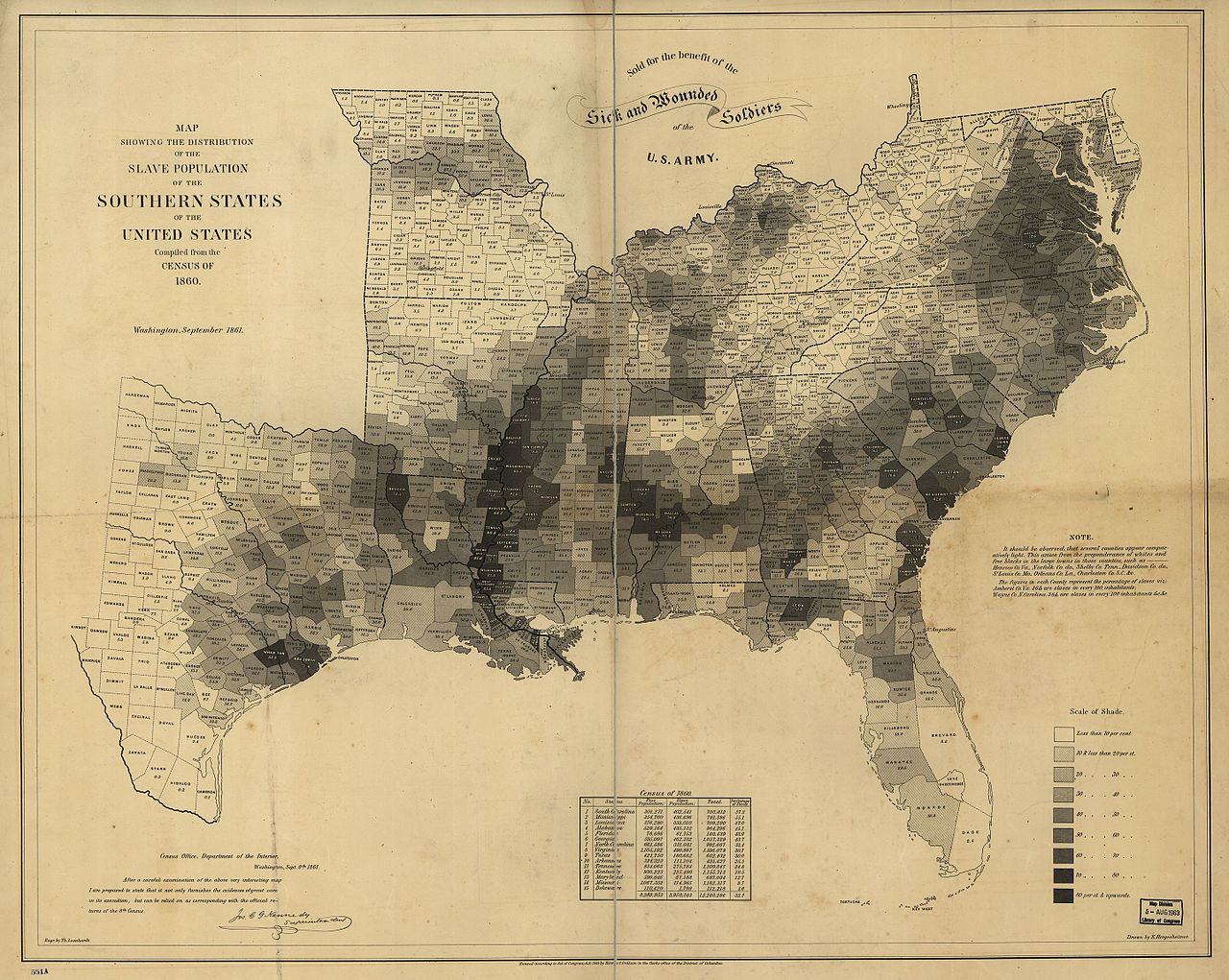

For various reasons, the census did not always include all of the slaves, especially in the West. California was admitted as a free state and reported no slaves. However, there were many slaves that were brought to work in the mines during the California Gold Rush.[355] Some Californian communities openly tolerated slavery, such as San Bernardino, which was mostly made up of transplants from the neighboring slave territory of Utah.[356] New Mexico Territory never reported any slaves on the census, yet sued the government for compensation for 600 slaves that were freed when Congress outlawed slavery in the territory.[357] Utah was actively trying to hide its slave population from Congress[358][359] and did not report slaves in several communities.[360] Additionally, the census did not traditionally include Native Americans, and hence did not include Native American slaves or Native African slaves owned by Native Americans. There were hundreds of Native American slaves in California,[361] Utah[362] and New Mexico[357] that were never recorded in the census.
Distribution of slaveholders

As of the 1860 census, one may compute the following statistics on slaveholding:[363]
- Enumerating slave schedules by county, 393,975 named persons held 3,950,546 unnamed slaves, for an average of about ten slaves per holder. As some large holders held slaves in multiple counties and are thus multiply counted, this slightly overestimates the number of slaveholders.
- Excluding slaves, the 1860 U.S. population was 27,167,529; therefore, approximately 1.45% of free persons (roughly one in 69) was a named slaveholder (393,975 named slaveholders among 27,167,529 free persons). By counting only named slaveholders, this approach does not acknowledge people who benefited from slavery by being in a slaveowning household, e.g., the wife and children of an owner; in 1850, there was an average of 5.55 people per household,[364] so on average, around 8.05% of free persons lived in a slave-owning household. In the South, 33% of families owned at least one slave.[citation needed] According to historian Joseph Glatthaar, the number of soldiers of the Confederacy's Army of Northern Virginia who either owned slaves or came from slave owning households is "almost one of every two 1861 recruits". In addition he notes that, "Untold numbers of enlistees rented land from, sold crops to, or worked for slaveholders. In the final tabulation, the vast majority of the volunteers of 1861 had a direct connection to slavery."[365]
- It is estimated by the transcriber Tom Blake, that holders of 200 or more slaves, constituting less than 1% of all U.S. slaveholders (fewer than 4,000 persons, one in 7,000 free persons, or 0.015% of the population) held an estimated 20–30% of all slaves (800,000 to 1,200,000 slaves). Nineteen holders of 500 or more slaves have been identified.[366] The largest slaveholder was Joshua John Ward, of Georgetown, South Carolina, who in 1850 held 1,092 slaves,[367] and whose heirs in 1860 held 1,130 or 1,131 slaves[366][367] – he was dubbed "the king of the rice planters",[367] and one of his plantations is now part of Brookgreen Gardens.
- The percentage of families that owned slaves in 1860 in various groupings of states was as follows:[368]
Historiography

The historian Peter Kolchin, writing in 1993, noted that until the latter decades of the 20th century, historians of slavery had primarily concerned themselves with the culture, practices and economics of the slaveholders, not with the slaves. This was in part due to the circumstance that most slaveholders were literate and left behind written records, whereas slaves were largely illiterate and not in a position to leave written records. Scholars differed as to whether slavery should be considered a benign or a "harshly exploitive" institution.[369]
Much of the history written prior to the 1950s had a distinctive racist slant to it.[369] By the 1970s and 1980s, historians were using archaeological records, black folklore and statistical data to develop a much more detailed and nuanced picture of slave life. Individuals were shown to have been resilient and somewhat autonomous in many of their activities, within the limits of their situation and despite its precariousness. Historians who wrote in this era include John Blassingame (Slave Community), Eugene Genovese (Roll, Jordan, Roll), Leslie Howard Owens (This Species of Property), and Herbert Gutman (The Black Family in Slavery and Freedom).[370]
See also


- Abolition of slavery timeline
- American Descendants of Slavery (ADOS)
- Glossary of American slavery
- Historiography of the United States § Slavery and black history
- List of slave owners
- Lists of United States public officials who owned slaves
- Category:American slave owners
- Reparations for slavery debate in the United States
- Slave insurance in the United States
- Slave narrative § North American slave narratives
- Slavery and Slaving in World History: A Bibliography
- Slavery at American colleges and universities
- Indian removal
- Triangular trade
Histories of slavery in the Western Hemisphere
- Slavery in the Spanish New World colonies
- Slavery in the British and French Caribbean
- Slavery in Cuba
- Slavery in Brazil
- Slavery in Latin America
- Slavery in Canada
Notes
- ^ Slaves were considered personal property in all slave states except Louisiana, which deemed them real estate.[77]
- ^ The United States continued to prohibit Royal Navy ships from investigating U.S.-flagged vessels – even in instances when the U.S. flag was being used fraudulently. The British still insisted on the right to impress (i.e. force to serve in the Royal Navy) British citizens found on American ships – something that was a continued cause of grievance. Despite the intent of the treaty, the opportunity for additional co-operation was missed.
References
- ^ Abzug, Robert H. (1980). Passionate Liberator. Theodore Dwight Weld and the Dilemma of Reform. Oxford University Press. p. 87. ISBN 0-19-502771-X.
- ^ Wood, Peter (2003). "The Birth of Race-Based Slavery". Slate. (May 19, 2015): Reprinted from Strange New Land: Africans in Colonial America by Peter H. Wood with permission from Oxford University Press. 1996, 2003.
- ^ Douglass, Frederick (1849). "The Constitution and Slavery".
- ^ a b Smith, Julia Floyd (1973). Slavery and Plantation Growth in Antebellum Florida, 1821–1860. Gainesville: University of Florida Press. pp. 44–46. ISBN 978-0-8130-0323-8.
- ^ McDonough, Gary W. (1993). The Florida Negro. A Federal Writers' Project Legacy. University Press of Mississippi. p. 7. ISBN 978-0-87805-588-3.
- ^ Chronology of U.S. Coast Guard history on the USCG official history website.
- ^ Weil, Julie Zauzmer; Blanco, Adrian; Dominguez, Leo (January 10, 2022). "More than 1,700 congressmen once enslaved Black people. This is who they were, and how they shaped the nation". The Washington Post. Retrieved January 11, 2022.
- ^ Appiah, Anthony; Gates, Henry Louis (1999). Africana: the encyclopedia of the African and African American experience. Internet Archive. New York : Basic Civitas Books. ISBN 978-0-465-00071-5.
- ^ Introduction – Social Aspects of the Civil War Archived July 14, 2007, at the Wayback Machine, National Park Service.
- ^ "[I]n 1854, the passage of the Kansas-Nebraska Act ... overturned the policy of containment [of slavery] and effectively unlocked the gates of the Western territories (including both the old Louisiana Purchase lands and the Mexican Cession) to the legal expansion of slavery...." Guelzo, Allen C., Abraham Lincoln as a Man of Ideas, Carbondale: Southern Illinois University Press (2009), p. 80.
- ^ "The 13th Amendment of the U.S. Constitution". National Constitution Center – The 13th Amendment of the U.S. Constitution. Retrieved March 1, 2022.
- ^ "Slavery in New York", The Nation, November 7, 2005
- ^ Ira Berlin, Generations of Captivity: A History of African-American Slaves, 2003. ISBN 0674010612[page needed]
- ^ "The First Black Americans" Archived February 2, 2011, at the Wayback Machine, Hashaw, Tim; U.S. News & World Report, 1/21/07
- ^ "South Carolina - African-Americans - Slave Population". www.sciway.net. Retrieved December 29, 2022.
- ^ Mehr, Emmanuel (November 18, 2023). "City of Brick: Bricks and Early Baltimore". Baltimore Histories Weekly. Retrieved July 12, 2024.
- ^ Smith, Howard W. (1978). Riley, Edward M. (ed.). Benjamin Harrison and the American Revolution. Williamsburg: Virginia Independence Bicentennial Commission. OCLC 4781472.
- ^ Foner, Eric; Garraty, John A. (2014). The Reader's Companion to American History. Houghton Mifflin. p. 705. ISBN 978-0-547-56134-9. Archived from the original on July 7, 2021. Retrieved July 4, 2021.
- ^ Morison and Commager: Growth of the American Republic, pp. 212–220.
- ^ Brown, Christopher. PBS Video "Liberty! The American Revolution", Episode 6, "Are We to be a Nation?", Twin Cities Public Television, Inc., 1997.
- ^ Brown, Christopher Leslie (2006). Moral Capital: Foundations of British Abolitionism, pp. 105–106, Chapel Hill: University of North Carolina Press. ISBN 978-0-8078-3034-5.
- ^ Mackaman, Tom. "An Interview with Historian Gordon Wood on the New York Times "1619 Project," World Socialist Web Site, wsws.org, November 28, 2019.
- ^ Bailyn, Bernard. Faces of the Revolution: Personalities and Themes in the Struggle for American Independence, pp. 221-4, Vintage Books, New York, New York, 1992. ISBN 0-679-73623-9.
- ^ Wood, Gordon S. The Radicalism of the American Revolution, pp. 3-8, Alfred A. Knopf, New York, New York, 1992. ISBN 0-679-40493-7.
- ^ a b Hubbard, Robert Ernest (2017). Major General Israel Putnam: Hero of the American Revolution, p. 98, McFarland & Company, Inc., Jefferson, NC. ISBN 978-1-4766-6453-8.
- ^ Nell, William C. (1855). "IV, Rhode Island". The Colored Patriots of the American Revolution. Robert F. Wallcut. ISBN 978-0-557-53528-6.
- ^ Foner, Eric (2010). The Fiery Trial: Abraham Lincoln and American Slavery. New York: W.W. Norton & Company, Inc. p. 205.
- ^ Liberty! The American Revolution (Documentary), Episode II:Blows Must Decide: 1774–1776. 1997 Twin Cities Public Television, Inc. ISBN 1-4157-0217-9
- ^ "The Revolution's Black Soldiers". www.americanrevolution.org. Retrieved December 29, 2022.
- ^ Hoock, Holger. Scars of Independence: America's Violent Birth, pp. 95, 300–303, 305, 308–310, Crown Publishing Group, New York, 2017. ISBN 978-0-8041-3728-7.
- ^ O'Reilly, Bill and Dugard, Martin. Killing England: The Brutal Struggle for American Independence, pp. 96, 308, Henry Holt and Company, New York, 2017. ISBN 978-1-62779-064-2.
- ^ Ayres, Edward. "African Americans and the American Revolution", Jamestown Settlement and American Revolution Museum at Yorktown website. Retrieved October 21, 2020.
- ^ "Digital History". www.digitalhistory.uh.edu. Retrieved December 29, 2022.
- ^ "Tracing the lives and letters of the Black Loyalists – Part 1 The Journey to Sierra Leone - Untold lives blog".
- ^ "Black Loyalists in British North America".
- ^ Gilbert, Alan (March 19, 2012). Black Patriots and Loyalists: Fighting for Emancipation in the War for Independence. University of Chicago Press. ISBN 978-0-226-29309-7.
- ^ Selig, Robert A. "The Revolution's Black Soldiers". AmericanRevolution.org. Retrieved October 18, 2007.
- ^ Frey, Sylvia R. (1991). Water From the Rock: Black Resistance in a Revolutionary Age. Princeton, New Jersey: Princeton University Press. p. 63.
- ^ Scribner, Robert L. (1983). Revolutionary Virginia, the Road to Independence. University of Virginia Press. p. xxiv. ISBN 978-0-8139-0748-2.
- ^ a b c d e "George Washington's Runaway Slave, Harry". PBS. Retrieved March 29, 2023.
- ^ Hartmann, Thom (2019). The Hidden History of Guns and the Second Amendment. Berrett-Koehler Publishers. p. 48.
- ^ Roark, James L.; et al. (2008). The American Promise, Volume I: To 1877: A History of the United States. Macmillan. p. 206. ISBN 978-0-312-58552-5.
- ^ Clavin, Matthew J. (2019). The Battle of Negro Fort. The rise and fall of a fugitive slave community. New York: New York University Press. ISBN 978-1-4798-1110-6.
- ^ Peter Kolchin, American Slavery: 1619–1877, New York: Hill and Wang, 1994, p. 73.
- ^ Finkelman, Paul (2012). Slavery in the United States. Duke University School of Law. p. 116.
- ^ Painter, Nell Irvin (2007). Creating Black Americans: African-American History and Its Meanings, 1619 to the Present. p. 72.
- ^ "An interview with historian Gordon Wood on the New York Times' 1619 Project". World Socialist Web Site. November 28, 2019. Retrieved December 29, 2022.
- ^ "Interview with Gordon Wood on the American Revolution". World Socialist Web Site. March 3, 2015. Retrieved December 29, 2022.
- ^ O'Malley, Gregory E. (2009). "Beyond the Middle Passage: Slave Migration from the Caribbean to North America, 1619–1807". The William and Mary Quarterly. 66 (1): 145, 150.
- ^ Finkelman, Paul (2007). "The Abolition of The Slave Trade". New York Public Library. Retrieved June 25, 2014.
- ^ a b c Hubbard, Robert Ernest. General Rufus Putnam: George Washington's Chief Military Engineer and the "Father of Ohio", pp. 1–4, 105–106, McFarland & Company, Inc., Jefferson, North Carolina, 2020. ISBN 978-1-4766-7862-7.
- ^ a b c McCullough, David. The Pioneers: The Heroic Story of the Settlers Who Brought the American Ideal West, pp. 11, 13, 29–30, Simon & Schuster, New York, 2019. ISBN 978-1-5011-6868-0.
- ^ a b McCullough, David. John Adams, pp. 132–133, Simon & Schuster, New York, 2001. ISBN 0-684-81363-7.
- ^ Bennett, William J. America: The Last Best Hope, Vol. I, p. 110, Tomas Nelson, Inc., Nashville, Tennessee, 2006. ISBN 978-1-59555-111-5.
- ^ Gradert, Kenyon. Puritan Spirits in the Abolitionist Imagination, pp. 1-3, 26, 74-5, University of Chicago Press, Chicago, Illinois, 2020. ISBN 978-0-226-69402-3
- ^ Keith L. Dougherty, and Jac C. Heckelman. "Voting on slavery at the Constitutional Convention." Public Choice 136.3–4 (2008): 293.
- ^ Mason, Matthew (2006). "Slavery and the Founding". History Compass. 4 (5): 943–955. doi:10.1111/j.1478-0542.2006.00345.x. ISSN 1478-0542.
- ^ Joseph R. Conlin, The American Past: A Survey of American History (Cengage Learning, 2008)
- ^ Baker, H. Robert (2012). "The Fugitive Slave Clause and the Antebellum Constitution". Law and History Review. 30 (4): 1133–1174. doi:10.1017/s0738248012000697. S2CID 145241006.
- ^ "Fugitive Slave Laws". Encyclopedia Virginia. Retrieved February 19, 2022.
- ^ Stahr, Walter, Salmon P. Chase: Lincoln's Vital Rival, New York: Simon & Schuster, 2021, p. 67.
- ^ Section 2 of Article I provides in part: "Representatives and direct taxes shall be apportioned among the several states ...by adding to the whole number of free persons, including those bound to service for a term of years, and excluding Indians not taxed, three-fifths of all other persons."
- ^ a b c "Interview: James Oliver Horton: Exhibit Reveals History of Slavery in New York City" Archived December 23, 2013, at the Wayback Machine, PBS Newshour, January 25, 2007. Retrieved February 11, 2012.
- ^ Regan, Joe (September 1, 2020). "The large Irish enslavers of antebellum Louisiana". American Nineteenth Century History. 21 (3): 211–235. doi:10.1080/14664658.2020.1841939. ISSN 1466-4658. S2CID 228097042.
- ^ Hacker, J. David (October 1, 2020). "From '20. and odd' to 10 million: the growth of the slave population in the United States". Slavery & Abolition. 41 (4): 840–855. doi:10.1080/0144039X.2020.1755502. ISSN 0144-039X. PMC 7716878. PMID 33281246.
- ^ a b Walter Johnson, Soul by Soul: Life Inside the Antebellum Slave Market, Cambridge, Massachusetts: Harvard University Press, 1999. pages=90 ("miraculous things"), 228 (property law status)
- ^ Stowe, Harriet Beecher (1853). A key to Uncle Tom's cabin: presenting the original facts and documents upon which the story is founded. Boston: J. P. Jewett & Co. pp. 291–292. LCCN 02004230. OCLC 317690900. OL 21879838M.
- ^ Ford, Lacy K. Jr. (November 1, 2009), "Chapter Five Paternalism Emerges", Deliver Us from Evil: The Slavery Question in the Old South, Oxford University PressNew York, pp. 143–172, doi:10.1093/acprof:oso/9780195118094.003.0006, ISBN 978-0-19-511809-4, retrieved August 22, 2023
- ^ Broussard, Joyce L. (2018). "Paternalism". Mississippi Encyclopedia. Retrieved August 22, 2023.
- ^ Cole, Josh. "THE EXCUSE OF PATERNALISM IN THE ANTEBELLUM SOUTH: IDEOLOGY OR PRACTICE?" (PDF).
- ^ Jefferson, Thomas. "Like a fire bell in the night". Library of Congress. Retrieved October 24, 2007.
- ^ de Tocqueville, Alexise (2007). "Chapter XVIII: Future Condition Of Three Races In The United States". Democracy in America (Volume 1). Digireads.com. ISBN 978-1-4209-2910-2.
- ^ Lee, Robert E. "Robert E. Lee's opinion regarding slavery". Shotgun's Home of the American Civil War. Retrieved October 24, 2007.
- ^ Thomas, Emory M. (1997). Robert E. Lee. W. W. Norton & Co. p. 173. ISBN 978-0-393-31631-5.
- ^ McCauley, Byron. "The Confederacy was about preserving slavery. The proof? It's on the money". The Enquirer. Retrieved August 24, 2023.
- ^ Levin, Kevin M. (April 21, 2016). "When Dixie Put Slaves on the Money". The Daily Beast. Retrieved August 24, 2023.
- ^ Johnson, Soul by Soul
- ^ Schermerhorn, Calvin (2020). "Chapter 2: 'Cash for Slaves' The African American Trail of Tears". In Bond, Beverly Greene; O'Donovan, Susan Eva (eds.). Remembering the Memphis Massacre: An American Story. University of Georgia Press. ISBN 978-0-8203-5649-5.
- ^ Beard, Charles A.; Beard, Mary R. (1921). History of the United States. New York: The Macmillan Company. p. 316.
- ^ McInnis, Maurie D. (Fall 2013). "Mapping the slave trade in Richmond and New Orleans". Building & Landscapes. 20 (2): 102–125. doi:10.5749/buildland.20.2.0102. JSTOR 10.5749/buildland.20.2.0102. S2CID 160472953.
- ^ Richards, Leonard L. (2007). The California Gold Rush and the Coming of the Civil War. New York: Alfred A. Knopf. p. 125. ISBN 978-0-307-26520-3.
- ^ a b c Hammond, James Henry (March 4, 1858). "The 'Mudsill' Theory". PBS. Retrieved December 10, 2017.
- ^ a b Fitzhugh, George. "The Universal Law of Slavery". PBS. Retrieved December 10, 2017.
- ^ a b Schott, Thomas E. Alexander H. Stephens of Georgia: A Biography, 1996, p. 334.
- ^ Davis, William C. (2002). "Men but Not Brothers". Look Away!: A History of the Confederate States of America. Simon & Schuster. pp. 130–162.
- ^ Cartwright, Samuel A. (May 1851). "Report on the Diseases and Physical Peculiarities of the Negro Race". New Orleans Medical and Surgical Journal: 691–715. Retrieved May 15, 2018.
- ^ Cartwright, Samuel A. (1851). "Diseases and Peculiarities of the Negro Race". DeBow's Review. XI. Retrieved November 16, 2011.
- ^ "The Slave Trade Meeting". Charleston Daily Courier (Charleston, South Carolina). October 22, 1859. p. 1 – via newspapers.com.
- ^ Wells, Tom Henderson (2009). The Slave Ship Wanderer. University of Georgia Press. ISBN 9-780-8203-3457-8.
- ^ Rabun, James (October 1970). "Review of The Slave Power Conspiracy and the Paranoid Style, by David Brion Davis". Florida Historical Quarterly. 49 (2): 174–175. JSTOR 30140388.
- ^ Sanborn, Franklin Benjamin (c. 1900). John Brown and His Friends. p. 2.
- ^ Grimké, Archibald (February 1909). "Abraham Lincoln and the Fruitage of his Proclamation". American Missionary. 63 (2): 51–53.
- ^ Nye, Russel B. (Summer 1946). "The Slave Power Conspiracy: 1830–1860". Science & Society. 10 (3): 262–274. JSTOR 40399768.
- ^ Williams, James (1838). Narrative of James Williams, an American slave: who was for several years a driver on a cotton plantation in Alabama. Authentic narrative of James Williams, an American slave. Isaac Knapp coordinated the publication. Boston: Published by the American Anti-Slavery Society. p. iv.
- ^ Arthur Zilversmit, The First Emancipation: The Abolition of Slavery in the North (1967).
- ^ Rodriguez, Junius P., ed. (2015). Encyclopedia of Emancipation and Abolition in the Transatlantic World. Routledge. pp. 34–35. ISBN 978-1-317-47180-6.
- ^ David Nathaniel Gellman, Emancipating New York: The politics of slavery and freedom, 1777-1827 (LSU Press, 2006) pp. 1–11.
- ^ J. D. B. DeBow, Superintendent of the United States Census (1854). "Slave Population of the United States" (PDF). Statistical View of the United States. United States Senate. p. 82.
- ^ Stewart, Alvan (1845). A legal argument before the Supreme court of the state of New Jersey, at the May term, 1845, at Trenton, for the deliverance of four thousand persons from bondage. New York: Finch & Weed.
- ^ Miller, Randall M.; Smith, John David (1997). "Gradual abolition". Dictionary of Afro-American Slavery. Greenwood Publishing Group. p. 471. ISBN 978-0-275-95799-5.
- ^ a b Peter Kolchin (1993), American Slavery, pp. 77–78, 81.
- ^ a b "Massachusetts Constitution and the Abolition of Slavery". Mass.gov. Retrieved February 8, 2024.
- ^ Sewall, Samuel. The Selling of Joseph, pp. 1–3, Bartholomew Green & John Allen, Boston, Massachusetts, 1700.
- ^ McCullough, David. John Adams, pp. 132–133, Simon & Schuster, New York, 2001. ISBN 0-684-81363-7.
- ^ "The House Censured Rashida Tlaib for Political Speech Plain and Simple". Esquire. Retrieved November 10, 2023.
- ^ Gradert, Kenyon. Puritan Spirits in the Abolitionist Imagination, pp. 1–3, 14–15, 24, 29–30, University of Chicago Press, Chicago, and London, 2020. ISBN 978-0-226-69402-3.
- ^ Commager, Henry Steele. Theodore Parker, pp. 206, 208–209, 210, The Beacon Press, Boston, Massachusetts, 1947.
- ^ Berlin, Generations of Captivity, p. 104.
- ^ Reynolds, David S. Mightier Than the Sword: Uncle Tom's Cabin and the Battle for America. New York: W. W. Norton & Company, 2011.
- ^ "New York Divided: King Cotton". nydivided.org. Retrieved December 29, 2022.
- ^ Gilbert Hobbs Barnes, The antislavery impulse: 1830–1844 (1933)
- ^ Loveland, Anne C. (1966). "Evangelicalism and "Immediate Emancipation" in American Antislavery Thought". The Journal of Southern History. 32 (2): 172–188. doi:10.2307/2204556. JSTOR 2204556.
- ^ Kelley, Sean M. (2018). "American Rum, African Consumers, and the Transatlantic Slave Trade". African Economic History. 46 (2): 1–29. doi:10.1353/aeh.2018.0004. ISSN 2163-9108.
- ^ a b "Regulation of the Trade". New York Public Library. Archived from the original on July 8, 2018. Retrieved June 23, 2014.
- ^ Finkelman, Paul (2004). "Suppressing American Slave Traders in the 1790s". OAH Magazine of History. Vol. 18, no. 3. pp. 51–55. ISSN 0882-228X.
- ^ a b Grindal, Peter (2016). Opposing the Slavers. The Royal Navy's Campaign against the Atlantic Slave Trade (Kindle ed.). London: I.B. Tauris & Co. Ltd. ISBN 978-0-85773-938-4.
- ^ "Potomac Books – University of Nebraska Press – University of Nebraska Press". Archived from the original on October 15, 2007.
- ^ Gene Allen Smith, The Slaves' Gamble: Choosing Sides in the War of 1812 (St. Martin's Press, 2013) pp. 1–11.
- ^ a b c Schama, Simon (2006). "Endings, Beginnings". Rough Crossings: Britain, the Slaves and the American Revolution. New York: HarperCollins. pp. 406–407. ISBN 978-0-06-053916-0.
- ^ Lindsay, Arnett G. (1920). "Diplomatic Relations Between the United States and Great Britain Bearing on the Return of Negro Slaves, 1783–1828". Journal of Negro History. 5 (4): 391–419. doi:10.2307/2713676. JSTOR 2713676. S2CID 149894983.
- ^ Aptheker, Herbert (1993), American Negro Slave Revolts (50th Anniversary ed.), New York: International Publishers, p. 368, ISBN 978-0-7178-0605-8
- ^ Gates, Henry Louis (January 12, 2013). "The Five Greatest Slave Rebellions in the United States | African American History Blog | The African Americans: Many Rivers to Cross". The African Americans: Many Rivers to Cross. WTTW. Retrieved October 11, 2016.
- ^ Rasmussen, Daniel (2011). American Uprising: The Untold Story of America's Largest Slave Revolt. HarperCollins. p. 288. ISBN 978-0-06-199521-7.
- ^ J.B. Bird. "The slave rebellion the country tried to forget". John Horse. Retrieved October 4, 2013.
- ^ "Unidentified Young Man". World Digital Library. 1839–1840. Retrieved July 28, 2013.
- ^ "Slave Revolt of 1842 | The Encyclopedia of Oklahoma History and Culture". www.okhistory.org.
- ^ a b c d Foner, Eric (2009). Give Me Liberty. London: Seagull Edition. pp. 406–407.
- ^ Williams, Jennie K. (April 2, 2020). "Trouble the water: The Baltimore to New Orleans coastwise slave trade, 1820–1860". Slavery & Abolition. 41 (2): 275–303. doi:10.1080/0144039X.2019.1660509. ISSN 0144-039X. S2CID 203494471.
- ^ Kolchin (1993), American Slavery, p. 78.
- ^ Peter Kolchin (1993), American Slavery, p. 81.
- ^ Kolchin (1993), American Slavery, p. 87.
- ^ MADEO. "Jan. 17, 1834 | Alabama Legislature Bans Free Black People from Living in the State". calendar.eji.org. Retrieved August 22, 2023.
- ^ Cathey, Clyde W. (1944). "Slavery in Arkansas". The Arkansas Historical Quarterly. 3 (1): 66–90. doi:10.2307/40027465. ISSN 0004-1823. JSTOR 40027465.
- ^ Jones-Rogers, Stephanie E. (2019). They Were Her Property: White Women as Slave Owners in the American South. New Haven London: Yale University Press. pp. 37, 134. ISBN 978-0-300-25183-8.
"Throughout the antebellum period, married women consistently asserted their rights to own and control human property without their husband's interference, and they exercised those rights as well." "White women were not anomalies at local slave auctions, either, and no group could testify more powerfully to white women's presence at and involvement in slave auctions than the enslaved people who were there.
- ^ McDonald, Soraya Nadia (March 15, 2019). "In 'They Were Her Property,' a historian shows that white women were deeply involved in the slave economy". Andscape. Retrieved July 14, 2020.
South Carolina has bills of sale for property transactions from the 1700s to pretty recently. I looked at a sample of 3,000 bills of sale involving enslaved people being purchased or sold. Close to 40 percent of the bills of sale included either a female buyer or a female seller.
- ^ Jones-Rogers, Stephanie E. (2019). They Were Her Property: White Women as Slave Owners in the American South. New Haven London: Yale University Press. pp. xv–xvi. ISBN 978-0-300-25183-8.
When we listen to what enslaved people had to say about white women and slave mastery, we find that articulated quite clearly their belief that slave-owning women governed their slaves in the same ways that white men did, sometimes they were more effective at slave management or they used more brutal methods of discipline than their husbands did...White southern women conducted transactions with slave traders...and they were not meek in their bargaining...slave-owning women brought legal suits against individuals, both male and female, who jeopardized their claims to human property, and others sued them in kind. They bought and sold slaves for profit, and, on rare occasions owned slave yards.
- ^ a b c "Class". Encyclopedia of African American History, 1619–1895: From the Colonial Period to the Age of Frederick Douglass. January 1, 2006. doi:10.1093/acref/9780195167771.001.0001. ISBN 978-0-19-516777-1.
- ^ A history of the descendants of the slaves of Cherokee can be found at Sturm, Circe (1998). "Blood Politics, Racial Classification, and Cherokee National Identity: The Trials and Tribulations of the Cherokee Freedmen". American Indian Quarterly. 22 (1/2): 230–258. JSTOR 1185118. In 1835, 7.4% of Cherokee families held slaves. In comparison, nearly one-third of white families living in Confederate states owned slaves in 1860. Further analysis of the 1835 Federal Cherokee Census can be found in McLoughlin, W. G.; Conser, W. H. (1977). "The Cherokees in Transition: a Statistical Analysis of the Federal Cherokee Census of 1835". The Journal of American History. 64 (3): 678–703. doi:10.2307/1887236. JSTOR 1887236. A discussion on the total number of Slave holding families can be found in Olsen, Otto H. (December 2004). "Historians and the extent of slave ownership in the Southern United States". Civil War History. Archived from the original on July 20, 2007. Retrieved June 8, 2007.
{{cite web}}: CS1 maint: unfit URL (link) - ^ Perdue, Theda (1979). Slavery and the Evolution of Cherokee Society, 1540–1866. University of Tennessee Press. p. 207. ISBN 978-0-87049-530-4.
- ^ Katz, William Loren (January 3, 2012). Black Indians: A Hidden Heritage. Simon and Schuster. p. 254. ISBN 978-1-4424-4637-3. Retrieved March 1, 2019.
black indians.
- ^ Duncan, J. W. (1928). "Interesting ante-bellum laws of the Cherokee, now Oklahoma history". Chronicles of Oklahoma. 6 (2): 178–180. Archived from the original on December 19, 2007. Retrieved July 13, 2007.
- ^ Davis, J. B. (1933). "Slavery in the Cherokee nation". Chronicles of Oklahoma. 11 (4): 1056–1072. Archived from the original on March 10, 2015. Retrieved July 13, 2007.
- ^ Jennison, Watson W. (2012). Cultivating Race: The Expansion of Slavery in Georgia, 1750–1860. University Press of Kentucky. p. 132. ISBN 978-0-8131-4021-6.
- ^ McCall, George A. (1868). Letters from the Frontiers. Philadelphia: J.B. Lippincott. p. 160. ISBN 978-1-4290-2158-6.
- ^ Mulroy, Kevin (2016). The Seminole Freedmen: A History. University of Oklahoma Press. p. 25. ISBN 978-0-8061-5588-3.
- ^ Deloria, Philip; Salisbury, Neal (2008). A Companion to American Indian History. John Wiley & Sons. pp. 348–349. ISBN 978-1-4051-4378-3.
- ^ Trigger, Bruce G.; Washburn, Wilcomb E. (1996). The Cambridge History of the Native Peoples of the Americas. Cambridge University Press. p. 525. ISBN 978-0-521-57392-4.
- ^ Binder, Wolfgang (1987). Westward Expansion in America (1803–1860). Palm & Enke. p. 147. ISBN 978-3-7896-0171-2.
- ^ James Shannon Buchanan (1955). Chronicles of Oklahoma. Oklahoma Historical Society. p. 522.
- ^ Mulroy, Kevin (2007). The Seminole Freedmen: A History. University of Oklahoma Press. p. 79. ISBN 978-0-8061-3865-7.
- ^ Finkelman, Paul (2004). "Suppressing American Slave Traders in the 1790s". OAH Magazine of History. Vol. 18, no. 3. pp. 51–55. ISSN 0882-228X.
- ^ James A. McMillin, The Final Victims: Foreign Slave Trade to North America, 1783–1810, Volume 2, Univ of South Carolina Press, 2004, p. 86
- ^ Thomas, Hugh (1997). The Slave Trade. The Story of the Atlantic Slave Trade: 1440–1870. New York: Simon and Schuster. p. 568. ISBN 978-0-684-81063-8.
- ^ Finkelman, Paul (2007). "The Abolition of the Slave Trade". New York Public Library. Retrieved February 14, 2012.
- ^ "Background on Conflict in Liberia". Archived from the original on January 8, 2011. Paul Cuffe, a successful New England black shipping man, financed and captained a voyage for American blacks in 1815–1816 to British-ruled Sierra Leone. Cuffe believed that African Americans could more easily "rise to be a people" in Africa than in the United States because of the latter's slavery, racial discrimination, and limits on black rights. Although Cuffee died in 1817, his early efforts encouraged the ACS to promote further settlements. The Quakers opposed slavery, but they believed that blacks would face better chances for freedom in Africa than in the United States. Slaveholders opposed abolition, but they wanted to get rid of freedmen, whom they saw as potential leaders of rebellions and people who encouraged slaves to run away.
- ^ "Map of Liberia, West Africa". World Digital Library. 1830. Retrieved June 3, 2013.
- ^ Sale, Maggie Montesinos (1997). The Slumbering Volcano: American Slave Ship Revolts and the Production of Rebellious Masculinity. Duke University Press. p. 45. ISBN 978-0-8223-1992-4.
- ^ Hall, Robert L. (1995). "African Religious Retentions in Florida". In Colburn, David R.; Landers, Jane L. (eds.). The African American Heritage of Florida. University Press of Florida. pp. 42–70. ISBN 978-0-8130-1332-9.
- ^ Wasserman, Adam (2010). A People's History of Florida 1513–1876. How Africans, Seminoles, Women, and Lower Class Whites Shaped the Sunshine State (Revised 4th ed.). Adam Wasserman. ISBN 978-1-4421-6709-4.
- ^ Sweig, Donald (October 2014). "Alexandria to New Orleans: The Human Tragedy of the Interstate Slave Trade" (PDF). Alexandria Gazette-Packet. Retrieved February 13, 2018.
- ^ Dew, Charles B. (2016). The Making of a Racist. University of Virginia Press. p. 2. ISBN 978-0-8139-3887-5.
- ^ a b Curry, Richard O.; Cowden, Joanna Dunlop (1972). Slavery in America: Theodore Weld's American Slavery As It Is. Itasca, Illinois: F. E. Peacock. OCLC 699102217.
- ^ "(Untitled)". South Branch Intelligencer. Romney, West Virginia. December 10, 1836. p. 2 – via newspapers.com.
- ^ Elliot, Debbie (February 4, 2006). "A Visit to the Real 'Uncle Tom's Cabin'". All Things Considered. NPR. Retrieved February 28, 2018.
- ^ Swarns, Rachel (February 14, 2018). "272 Slaves Were Sold to Save Georgetown. What Does It Owe Their Descendants?". The New York Times. Archived from the original on April 16, 2016. Retrieved February 15, 2018.
- ^ Swarns, Rachel L. (March 12, 2017). "A Glimpse Into the Life of a Slave Sold to Save Georgetown". The New York Times. Archived from the original on March 12, 2017.
- ^ Hassan, Adeel (April 12, 2019). "Georgetown Students Agree to Create Reparations Fund". The New York Times. Archived from the original on April 12, 2019.
- ^ The People's Chronology, 1994, by James Trager.
- ^ Kolchin p. 96. Through the domestic slave trade, about one million enslaved African Americans were forcibly removed from the Upper South to the Deep South, with some transported by ship in the coastwise trade. In 1834, Alabama, Mississippi, and Louisiana grew half the nation's cotton; by 1859, along with Georgia, they grew 78%. By 1859, cotton growth in the Carolinas had fallen to just 10% of the national total. Berlin p. 166.
- ^ Berlin, Generations of Captivity, pp. 168–169. Kolchin p. 96.
- ^ a b c d Morgan, Marcyliena (July 4, 2002). Language, Discourse and Power in African American Culture. Cambridge University Press. ISBN 978-0-521-00149-6.
- ^ "Gun Reviews Archives". TheGunZone. Retrieved December 29, 2022.
- ^ "American Civil War Census Data". Civil-war.net. Archived from the original on March 22, 2016. Retrieved May 27, 2014.
- ^ Berlin, Generations of Captivity, pp. 161–162.
- ^ Berlin, Generations of Captivity, pp. 168–169. Kolchin p. 96. Kolchin notes that Fogel and Engerman maintained that 84% of slaves moved with their families but "most other scholars assign far greater weight ... to slave sales." Ransome (p. 582) notes that Fogel and Engerman based their conclusions on the study of some counties in Maryland in the 1830s and attempted to extrapolate that analysis as reflective of the entire South over the entire period.
- ^ Kulikoff, Allan (1992). The Agrarian Origins of American Capitalism. Charlottesville: University of Virginia Press. pp. 226–269. ISBN 978-0-8139-1388-9.
- ^ Berlin, Generations of Captivity, pp. 166–169.
- ^ Kolchin, p. 98.
- ^ Berlin, Generations of Captivity, pp. 168–171.
- ^ Berlin, Generations of Captivity, p. 174.
- ^ Berlin, Generations of Captivity, pp. 175–177.
- ^ Berlin, Generations of Captivity, pp. 179–180.
- ^ Johnson (1999), Soul by Soul, p. 2.
- ^ a b Tadman, Michael (September 18, 2012). Smith, Mark M.; Paquette, Robert L. (eds.). Internal Slave Trades. Vol. 1. Oxford University Press. doi:10.1093/oxfordhb/9780199227990.013.0029.
- ^ "Frederic Bancroft, Slave-Trading in the Old South". The Journal of Negro History. 16 (2): 240–241. April 1931. doi:10.2307/2714086. ISSN 0022-2992. JSTOR 2714086. S2CID 153885388.
- ^ Dew, Charles B. (2016). The making of a racist: a southerner reflects on family, history, and the slave trade. Charlottesville: University of Virginia Press. p. 154. ISBN 978-0-8139-3888-2. LCCN 2015043815. OCLC 956713856.
- ^ "Frontiersman or Southern Gentleman? Newspaper Coverage of Andrew Jackson during the 1828 Presidential Campaign | Readex". www.readex.com. Retrieved December 29, 2022.
- ^ Bostonian (December 3, 1863) [1863-11-12]. "The Realities of Slavery: To the Editor of the N.Y. Tribune". New-York Tribune. p. 4. ISSN 2158-2661. Retrieved July 27, 2023 – via Newspapers.com.
- ^ Dickman, Michael (2015). Honor, Control, and Powerlessness: Plantation Whipping in the Antebellum South (Thesis). Boston College. hdl:2345/bc-ir:104219.
- ^ Collins, Kathleen (January 9, 1985). "The Scourged Back". The New York Times. pp. 43–45.
- ^ Moore, p. 114.
- ^ Clinton, Catherine, Scholastic Encyclopedia of the Civil War, New York: Scholastic Inc., 1999, p. 8.
- ^ a b McInnis, Maurie D. (2011). Slaves Waiting for Sale: Abolitionist Art and the American Slave Trade. University of Chicago Press. pp. 129–. ISBN 978-0-226-55933-9.
- ^ Moore, p. 118.
- ^ Lawrence M. Friedman (2005). A History of American Law: Third Edition. Simon and Schuster, p. 163. ISBN 0-7432-8258-2
- ^ A. Aguirre, Jr., "Slave executions in the United States", The Social Science Journal, vol. 36, issue 1 (1999), pp. 1–31.
- ^ Davis, p. 124.
- ^ Christian, Charles M., and Bennet, Sari, Black Saga: The African American Experience: A Chronology, Basic Civitas Books, 1998, p. 90.
- ^ Burke, p. 155.
- ^ Barclay, J. L. (2021). The Mark of Slavery: Disability, Race, and Gender in Antebellum America. University of Illinois Press.
- ^ Andrew Fede (2012). People Without Rights (Routledge Revivals): An Interpretation of the Fundamentals of the Law of Slavery in the U.S. South. Routledge, p. 79. ISBN 1-136-71610-6
- ^ Morris, Thomas D. (1999). Southern Slavery and the Law, 1619–1860. University of North Carolina Press. p. 172. ISBN 978-0-8078-6430-2.
- ^ Thomas Weiss, Review: Time on the Cross: The Economics of American Negro Slavery Archived December 20, 2011, at the Wayback Machine, Project 2001: Significant Works in Economic History, EH.net (Economic History.net)
- ^ Kenney, Stephen (March 2015). "Power, opportunism, racism: Human experiments under American slavery". Endeavour. 39 (1): 10–20. doi:10.1016/j.endeavour.2015.02.002. PMID 25824012.
- ^ Savitt, Todd (August 1982). "The Use of Blacks for Medical Experimentation and Demonstration in the Old South". The Journal of Southern History. 48 (3): 331–348. doi:10.2307/2207450. JSTOR 2207450. PMID 11645888.
- ^ Berry, Daina (October 18, 2016). "Nat Turner's Skull and My Student's Purse of Skin". The New York Times. Retrieved October 16, 2022.
- ^ "Leather Made From Human Skin". Philadelphia News. The Mercury. March 17, 1888. Retrieved October 16, 2022.
- ^ Plaisance, Patrick (September 2, 1998). "A Museum for Nat Turner". Daily Press. Retrieved October 16, 2022.
- ^ Davis, Floyd James (2001). Who Is Black?: One Nation's Definition. Penn State Press. p. 38. ISBN 978-0-271-04463-7.
- ^ a b c Moon, p. 234.
- ^ Marable, p. 74.
- ^ "Memoirs of Madison Hemings". PBS Frontline.
- ^ Higginbotham, A. Leon (1980). In the Matter of Color: Race and the American Legal Process. The Colonial Period. p. 10.
- ^ Prather, C.; Fuller, T. R.; Jeffries Wl, I. V.; Marshall, K. J.; Howell, A. V.; Belyue-Umole, A.; King, W. (2018). "Racism, African American Women, and Their Sexual and Reproductive Health: A Review of Historical and Contemporary Evidence and Implications for Health Equity". Health Equity. 2 (1). National Institutes of Health (NIH): 249–259. doi:10.1089/heq.2017.0045. PMC 6167003. PMID 30283874.
- ^ Bryc, Katarzyna; Durand, Eric Y.; Macpherson, J. Michael; Reich, David; Mountain, Joanna L. (January 8, 2015). "The Genetic Ancestry of African Americans, Latinos, and European Americans across the United States". The American Journal of Human Genetics. 96 (1): 37–53. doi:10.1016/j.ajhg.2014.11.010. PMC 4289685. PMID 25529636.
- ^ Zakharia, Fouad; Basu, Analabha; Absher, Devin; Assimes, Themistocles L; Go, Alan S; Hlatky, Mark A; Iribarren, Carlos; Knowles, Joshua W; Li, Jun; Narasimhan, Balasubramanian; Sidney, Steven; Southwick, Audrey; Myers, Richard M; Quertermous, Thomas; Risch, Neil; Tang, Hua (2009). "Characterizing the admixed African ancestry of African Americans". Genome Biology. 10 (R141): R141. doi:10.1186/gb-2009-10-12-r141. PMC 2812948. PMID 20025784.
- ^ Reis, Elizabeth, ed. (2012). American sexual histories. Blackwell readers in American social and cultural history (2. ed.). Malden, Mass.: Wiley-Blackwell. ISBN 978-1-4443-3929-1.
- ^ a b Berry, Daina Ramey; Harris, Leslie Maria (2018). Sexuality and slavery: reclaiming intimate histories in the Americas. Gender and slavery. Athens, Ga: University of Georgia Press. ISBN 978-0-8203-5403-3.
- ^ Woodard, Vincent; Joyce, Justin A.; McBride, Dwight A. (2014). The delectable Negro: human consumption and homoeroticism within U.S. slave culture. Sexual cultures. New York: New York University Press. ISBN 978-0-8147-9461-6.
- ^ Smith, Julia Floyd (1991) Slavery and Rice Culture in Low Country Georgia, 1750-1860 University of Tennessee Press, 104.
- ^ Sublette, Ned; Sublette, Constance (October 1, 2015). The American Slave Coast: A History of the Slave-Breeding Industry. Chicago Review Press. ISBN 978-1-61373-893-1. Retrieved October 15, 2022.
- ^ "Childbirth and Midwifery | Encyclopedia.com". www.encyclopedia.com. Retrieved May 22, 2023.
- ^ Spivey, William (January 23, 2023). "America's Breeding Farms: What History Books Never Told You". Medium. Retrieved May 22, 2023.
- ^ Schafer, Daniel L. (2013). Zephaniah Kingsley Jr. and the Atlantic World. Slave Trader, Plantation Owner, Emancipator. University Press of Florida. ISBN 978-0-8130-4462-0.
- ^ Rankin, John (1833). Letters on American slavery, addressed to Mr. Thomas Rankin, merchant at Middlebrook, Augusta County, Va. Boston: Garrison and Knapp.
- ^ Kenrick, John (1817). The Horrors of Slavery. Cambridge, Massachusetts. p. 44.
- ^ Commerce, D'Iberville/St Martin Chamber of. "D'Iberville/St. Martin Chamber of Commerce". D'Iberville/St. Martin Chamber of Commerce. Retrieved June 21, 2024.
- ^ a b c d e Manganelli, Kimberly Snyder (2012). Transatlantic spectacles of race: the tragic mulatta and the tragic muse. Rutgers University Press. ISBN 978-0-8135-4987-3.
- ^ a b Johnson, Walter (2000). "The Slave Trader, the White Slave, and the Politics of Racial Determination in the 1850s". The Journal of American History. 87 (1): 13–38. doi:10.2307/2567914. JSTOR 2567914. Retrieved May 25, 2018.
- ^ a b Allman, T.D. (2013). Finding Florida. The True History of the Sunshine State. Atlantic Monthly Press. ISBN 978-0-8021-2076-2.
- ^ Schwartz, Marie Jenkins (2004). Birthing a Slave: Motherhood and Medicine in the Antebellum South. Cambridge MA: Harvard University Press. pp. 10–11.
- ^ Phillips, Patrick (2016). Blood at the Root. A Racial Cleansing in America. W. W. Norton. pp. 78–79. ISBN 978-0-393-29301-2.
- ^ Kingsley, Zephaniah Jr.; Stowell, Daniel W. (2000). "Introduction". Balancing Evils Judiciously: The Proslavery Writings of Zephaniah Kingsley. University Press of Florida. p. 2. ISBN 978-0-8130-1733-4.[permanent dead link]
- ^ Guillory, Monique (1999), Some Enchanted Evening on the Auction Block: The Cultural Legacy of the New Orleans Quadroon Balls, PhD dissertation, New York University
- ^ Williams, Caroline Randall (June 26, 2020). "You Want a Confederate Monument? My Body Is a Confederate Monument. The black people I come from were owned and raped by the white people I come from. Who dares to tell me to celebrate them?". The New York Times. Archived from the original on June 26, 2020.
- ^ Dunn, Marvin (2016). A History of Florida through Black Eyes. CreateSpace Independent Publishing Platform. pp. 87–88. ISBN 978-1-5193-7267-3.
- ^ Natanson, Hannah (September 14, 2019). "They were once America's cruelest, richest slave traders. Why does no one know their names?". The Washington Post.
- ^ Bercaw, Nancy. "Clary and the Fancy Girl Trade, 1806". National Museum of African-American History and Culture. Retrieved May 15, 2018.
- ^ Eblen, Tom (February 1, 2012). "Without the Civil War, who knows when Lexington's slave trade might have ended?". Lexington Herald-Leader. Retrieved May 15, 2018.
- ^ Brandt, Nat (1990). The town that started the Civil War. Syracuse, New York: Syracuse University Press. p. 5. ISBN 978-0-8156-0243-9.
- ^ Paludan, Phillip Shaw (Summer 2006). "Lincoln and Negro Slavery: I Haven't Got Time for the Pain". Journal of the Abraham Lincoln Association. 27 (2): 1–23. hdl:2027/spo.2629860.0027.203.
- ^ Genovese, Eugene D. (1974). Roll, Jordan, Roll: The World the Slaves Made. Pantheon Books. p. 416.
- ^ Adler, Jeffrey S. (1995). "Black Violence in the New South. Patterns of Conflict in Late-Nineteenth-Century Tampa". In Colburn, David R.; Landers, Jane L. (eds.). The African Ameritage Heritage of Florida. University Press of Florida. pp. 207–239 [212–213]. ISBN 978-0-8130-1332-9.
- ^ "Slaves and the Courts, 1740–1860 Slave code for the District of Columbia, 1860."[permanent dead link] The Library of Congress. Retrieved July 19, 2008.
- ^ Foner, Eric (1971). Nat Turner. Englewood Cliffs, N.J., Prentice-Hall.
- ^ Rodriguez, pp. 616–617.
- ^ Morris, Thomas D. (1999). Southern Slavery and the Law, 1619–1860. University of North Carolina Press. p. 347. ISBN 978-0-8078-6430-2.
- ^ Gomez, Michael A. (1994). "Muslims in Early America". The Journal of Southern History. 60 (4): 671–710. doi:10.2307/2211064. ISSN 0022-4642. JSTOR 2211064.
- ^ Costello, Damian (September 1, 2020). "Pray with Our Lady of Stono to heal the wounds of slavery". U.S. Catholic magazine – Faith in Real Life. Retrieved October 12, 2020.
- ^ Frost, J. William (1998). "Christianity and Culture in America". In Kee, Howard Clark (ed.). Christianity: A Social and Cultural History. Upper Saddle River, NJ: Prentice Hall. p. 446. ISBN 978-0-13-578071-8.
- ^ Smedley, R. C. (2005). History of the Underground Railroad: In Chester and the Neighboring Counties of Pennsylvania. Stackpole Books. p. xvi. ISBN 978-0-8117-3189-8.
- ^ History of Salem Township, Washtenaw County, Michigan. Salem Area Historical Society. 1976. p. 56.
- ^ a b c d Frost, J. William (1998). "Christianity and Culture in America". In Kee, Howard Clark (ed.). Christianity: A Social and Cultural History. Upper Saddle River, NJ: Prentice Hall. p. 447. ISBN 978-0-13-578071-8.
- ^ Ahlstrom, Sydney E. (1972). A Religious History of the American People. New Haven, Connecticut: Yale University Press. pp. 648–649. ISBN 978-0-300-01762-5.
- ^ "Abolition and the Splintering of the Church". PBS. 2003. Retrieved May 11, 2021.
- ^ Frost (1998), Christianity, 448.
- ^ Basu, B.D. Chatterjee, R. (ed.). History of Education in India under the rule of the East India Company. Calcutta: Modern Review Office. pp. 3–4. Retrieved March 9, 2009.
- ^ The Code of Virginia. Richmond: William F. Ritchie. 1849. pp. 747–748.
- ^ "Slaves Are Prohibited to Read and Write by Law | North Carolina Law (1830-31)". www.historyisaweapon.com.
- ^ Jay, William (1835). An Inquiry Into the Character and Tendency of the American Colonization, and American Anti-slavery Societies (2nd ed.). New York: Leavitt, Lord & Co. p. 136.
- ^ Torrey, Jesse (1822). American slave trade; or, An Account of the Manner in which the Slave Dealers take Free People from some of the United States of America, and carry them away, and sell them as Slaves in other of the States; and of the horrible Cruelties practiced in the carrying on of this infamous Traffic: with Reflections on the Project for forming a Colony of American Blacks in Africa, and certain Documents respecting that Project. London: J[ohn] M[organ] Cobbett. p. 102.
- ^ "The Utah Territory Slave Code (1852) – The Black Past: Remembered and Reclaimed". www.blackpast.org. June 27, 2007. Retrieved August 28, 2017.
- ^ Acts, Resolutions, and Memorials Passed at the ... Annual, and Special Sessions, of the Legislative Assembly of the Territory of Utah. Brigham H. Young, Printers. 1866. pp. 87–88.
- ^ "Image 74 of Page view". Library of Congress, Washington, D.C. 20540 USA. Retrieved August 28, 2023.
- ^ Paul Finkelman, Dred Scott v. Sandford: A Brief History with Documents (Bedford Books, 1997).
- ^ Fehrenbacher, Don E. (1978). The Dred Scott Case: Its Significance in American Law and Politics. New York: Oxford University Press. ISBN 978-0-19-502403-6.
- ^ Fehrenbacher, The Dred Scott Case: Its Significance in American Law and Politics (2001).
- ^ Larry Gara, The Liberty Line: The Legend of the Underground Railroad (University Press of Kentucky, 2013).
- ^ Leonard L. Richards, The Slave Power: The Free North and Southern Domination, 1780–1860 (LSU Press, 2000).
- ^ McPherson, James M. (1992). Abraham Lincoln and the Second American Revolution. Oxford University Press. p. 134. ISBN 978-0-19-976270-5.
- ^ David M. Potter, The Impending Crisis: America Before the Civil War, 1848–1861 (Harper & Row, 1976).
- ^ Potter, pp. 448–554.
- ^ Stahr, Walter, Samuel Chase: Lincoln's Vital Rival. New York: Simon & Schuster, 2021, p. 342.
- ^ McPherson, Battle Cry of Freedom, p. 495.
- ^ McPherson, Battle Cry, pp. 355, 494–496, quote from George Julian on 495.
- ^ Litwack, Leon F. (1979). Been in the Storm So Long: The Aftermath of Slavery. New York: Knopf. ISBN 978-0-394-50099-7.
- ^ Lincoln's letter to O. H. Browning, September 22, 1861.
- ^ Stephen B. Oates, Abraham Lincoln: The Man Behind the Myths, page 106.
- ^ "The Preliminary Emancipation Proclamation, 1862". www.archives.gov.
- ^ Images of America: Altoona, by Sr. Anne Francis Pulling, 2001, 10.
- ^ Lincoln, Abraham (June 15, 1953). Collected Works of Abraham Lincoln. Volume 7 [Nov. 5, 1863-Sept. 12, 1864].
- ^ James McPherson, "Drawn With the Sword", from the article "Who Freed the Slaves?"
- ^ Doyle, Robert C. C. (2010). The Enemy in Our Hands: America's Treatment of Prisoners of War from the Revolution to the War on Terror. University Press of Kentucky. p. 76. ISBN 978-0-8131-3961-6.
- ^ Bruce C. Levine, Confederate Emancipation: Southern Plans to Free and Arm Slaves during the Civil War (2007).
- ^ Up from Slavery (1901), pp. 19–21.
- ^ "History of Juneteenth". Juneteenth World Wide Celebration. Archived from the original on May 27, 2007. Retrieved March 9, 2014.
- ^ President Biden Signs the Juneteenth National Independence Day Act Into Law. The White House. June 17, 2021. Archived from the original on February 4, 2023. Retrieved May 11, 2024 – via YouTube.
{{cite AV media}}: CS1 maint: bot: original URL status unknown (link) - ^ "America's Founding Documents". National Archives. October 30, 2015.
- ^ E. Merton Coulter. The Civil War and Readjustment in Kentucky (1926), pp. 268–270; James J. Gigantino, The Ragged Road to Abolition; Slavery and Freedom in New Jersey, 1775–1865.
- ^ Thomas C. Holt, ed. Major Problems in African-American History: From Freedom to "Freedom Now", 1865–1990s (2000),
- ^ Huebner, Timothy S. (March 2023). "Taking Profits, Making Myths: The Slave Trading Career of Nathan Bedford Forrest". Civil War History. 69 (1): 42–75. doi:10.1353/cwh.2023.0009. ISSN 1533-6271. S2CID 256599213.
- ^ "Convict Labor in Georgia and Tennessee". The Daily Memphis Avalanche. May 16, 1877. p. 2. Retrieved August 24, 2023.
- ^ Brockell, Gillian (November 10, 2022). "La. voters keep 'slavery' at Angola prison, once and still a plantation". Washington Post. ISSN 0190-8286. Retrieved August 24, 2023.
- ^ Litwack (1998), p. 271.
- ^ Blackmon (2008), p. 4.
- ^ The Ordeal of the Reunion: A New History of Reconstruction (Littlefield History of the Civil War Era) by Mark Wahlgren Summers, 978-1-4696-1758-9, page=397
- ^ Anderson, James D. (1988). The Education of Blacks in the South, 1860–1935. Chapel Hill, NC: University of North Carolina Press. pp. 244–245. ISBN 978-0-8078-1793-3.
- ^ Ford, Carin T. (2004). George Eastman: The Kodak Camera Man. Enslow Publishers, INC.
- ^ a b Acharya, Avidit; Blackwell, Matthew; Sen, Maya (May 19, 2016). "The Political Legacy of American Slavery". The Journal of Politics. 78 (3): 621–641. CiteSeerX 10.1.1.397.3549. doi:10.1086/686631. ISSN 0022-3816. S2CID 222442945.
- ^ Nikolova, Elena (January 1, 2017). "Destined for Democracy? Labour Markets and Political Change in Colonial British America". British Journal of Political Science. 47 (1): 19–45. doi:10.1017/S0007123415000101. ISSN 0007-1234. S2CID 17112994.
- ^ Bellani, Luna; Hager, Anselm; Maurer, Stephan (2022). "The Long Shadow of Slavery: The Persistence of Slave Owners in Southern Lawmaking". Journal of Economic History. 82 (1): 250–283. doi:10.1017/S0022050721000590. S2CID 211165817.
- ^ "P.J. Porcher and Baya slave sale broadside - Lowcountry Digital Library Catalog Search". lcdl.library.cofc.edu. Retrieved August 27, 2023.
- ^ a b Whaples, Robert (March 1995). "Where Is There Consensus Among American Economic Historians? The Results of a Survey on Forty Propositions". The Journal of Economic History. 55 (1): 141, 146–147. doi:10.1017/S0022050700040602. JSTOR 2123771. S2CID 145691938.
- ^ Whaples, Robert (March 1995). "Where is There Consensus among American Economic Historians? The Results of a Survey on Forty Propositions". Journal of Economic History. 55 (1): 139–154. doi:10.1017/S0022050700040602. JSTOR 2123771. S2CID 145691938.
- ^ Galenson, D.W. (March 1984). "The Rise and Fall of Indentured Servants in the Americas: An Economic Approach". Journal of Economic History. 44: 1. doi:10.1017/S002205070003134X. S2CID 154682898.
- ^ a b Sowell, Thomas (2005). "The Real History of Slavery". Black Rednecks and White Liberals. New York: Encounter Books. pp. 157–158. ISBN 978-1-59403-086-4.
- ^ a b Whaples, Robert (March 1995). "Where Is There Consensus Among American Economic Historians? The Results of a Survey on Forty Propositions" (PDF). The Journal of Economic History. 55 (1): 142, 147–148. CiteSeerX 10.1.1.482.4975. doi:10.1017/S0022050700040602. JSTOR 2123771. S2CID 145691938.
- ^ Tadman, M. (December 2000). "The Demographic Cost of Sugar: Debates on Slave Societies and Natural Increase in the Americas". American Historical Review. 105 (5): 1534–1575. doi:10.2307/2652029. JSTOR 2652029.
- ^ Sowell, Thomas (2005). "The Real History of Slavery". Black Rednecks and White Liberals. New York: Encounter Books. p. 156. ISBN 978-1-59403-086-4.
- ^ "Historical Demographic, Economic and Social Data: the United States, 1790–1970". Historical Statistics of the United States. ICPSR Study. Archived from the original on April 1, 2003.
- ^ Whaples, Robert (March 1995). "Where Is There Consensus Among American Economic Historians? The Results of a Survey on Forty Propositions" (PDF). The Journal of Economic History. 55 (1): 139–154. CiteSeerX 10.1.1.482.4975. doi:10.1017/S0022050700040602. JSTOR 2123771. S2CID 145691938.
- ^ Baptist, Edward E. (2016). The Half Has Never Been Told: Slavery And The Making Of American Capitalism. Basic Books. ISBN 978-0-465-09768-5.
- ^ Beckert, Sven; Rockman, Seth, eds. (2016). Slavery's Capitalism: A New History of American Economic Development. University of Pennsylvania Press. ISBN 978-0-8122-2417-7.
- ^ a b Johnson, Walter (2013). River of Dark Dreams: Slavery and Empire in the Cotton Kingdom. Harvard University Press. pp. 86–87 (credit backed by slave labor). ISBN 978-0-674-04555-2.
- ^ Schermerhorn, Calvin (2015). The Business of Slavery and the Rise of American Capitalism, 1815–1860. Yale University Press. ISBN 978-0-300-19200-1.
- ^ Wright, Gavin (2022). "Slavery and the Rise of the Nineteenth-Century American Economy". Journal of Economic Perspectives. 36 (2): 123–148. doi:10.1257/jep.36.2.123. ISSN 0895-3309. S2CID 248716718.
- ^ Wright, Gavin (2020). "Slavery and Anglo-American capitalism revisited". The Economic History Review. 73 (2): 353–383. doi:10.1111/ehr.12962. ISSN 1468-0289. S2CID 214142489.
- ^ Clegg, John J. (2015). "Capitalism and Slavery". Critical Historical Studies. 2 (2): 281–304. doi:10.1086/683036. JSTOR 10.1086/683036. S2CID 155629580.Murray, John E.; Olmstead, Alan L.; Logan, Trevon D.; Pritchett, Jonathan B.; Rousseau, Peter L. (September 2015). "The Half Has Never Been Told: Slavery and the Making of American Capitalism. By Baptist Edward E. New York: Basic Books, 2014. pp. xxvii, 498. $35.00, cloth". The Journal of Economic History. 75 (3): 919–931. doi:10.1017/S0022050715000996. ISSN 0022-0507. S2CID 154464892.Engerman, Stanley L. (June 2017). "Review of The Business of Slavery and the Rise of American Capitalism, 1815–1860 by Calvin Schermerhorn and The Half Has Never Been Told: Slavery and the Making of American Capitalism by Edward E. Baptist". Journal of Economic Literature. 55 (2): 637–643. doi:10.1257/jel.20151334. ISSN 0022-0515.
- ^ Alan L. Olmstead; Paul W. Rhode (September 12, 2016). "Cotton, Slavery, and the New History of Capitalism". Center for Law and Economic Studies. Columbia University. Retrieved June 23, 2019.
mishandle historical evidence and mischaracterize important events in ways that affect their major interpretations on the nature of slavery
Alan L. Olmstead; Paul W. Rhode (January 2018). "Cotton, slavery, and the new history of capitalism". Explorations in Economic History. 67: 1–17. doi:10.1016/j.eeh.2017.12.002. - ^ Parry, Marc (December 8, 2016). "Shackles and Dollars". The Chronicle of Higher Education. ISSN 0009-5982. Retrieved June 12, 2017.
- ^ Rhode, Paul W. (2023). "What Fraction of Antebellum US National Product did the Enslaved Produce?". Explorations in Economic History. 91. doi:10.1016/j.eeh.2023.101552. ISSN 0014-4983. S2CID 262210797.
- ^ Althoff, Lukas; Reichardt, Hugo (2024). "Jim Crow and Black Economic Progress After Slavery". The Quarterly Journal of Economics. doi:10.1093/qje/qjae023. ISSN 0033-5533.
- ^ Watkins, James L. "King Cotton; a historical and statistical review, 1790 to 1908". HathiTrust. pp. 82–83. hdl:2027/njp.32101058916295. Retrieved July 14, 2024.
- ^ a b c Fogel & Engerman (1974). Time on the Cross: The Economics of American Negro Slavery. New York: W.W. Norton and Company.
- ^ David, Paul A., Herbert G. Gutman, Richard Sutch, and Peter Temin. "Reckoning with slavery." (1985).
- ^ Kotlikoff, L. J. (October 1979). "The Structure of Slave prices in New Orleans" (PDF). Economic Inquiry. 17 (4): 496–518. doi:10.1111/j.1465-7295.1979.tb00544.x.
- ^ Calonius, Erik (2006). The Wanderer: the last American slave ship and the conspiracy that set its sails. New York, N.Y: Saint Martin's Press. pp. 101–102 (Portuguese-African market), 125–126 (prices), 250–253 (origin, biography). ISBN 978-0-312-34347-7.
- ^ Wright, Gavin (Summer 1987). "The Economic Revolution in the American South". The Journal of Economic Perspectives. 1 (1): 161–178. doi:10.1257/jep.1.1.161. JSTOR 1942954.
- ^ Wright, Gavin (1978). The Political Economy of the Cotton South: Households, Markets, and Wealth in the Nineteenth Century. New York: W. W. Norton & Company. ISBN 978-0-393-09038-3.
- ^ de Tocqueville, Alexise (2004) [1835]. "Volume I, Chapter XVIII: Future Condition Of Three Races In The United States". Democracy in America: The Complete and Unabridged, Volumes I and II. Translated by Reeve, Henry (Reissue ed.). New York: Bantam Books. p. 419. ISBN 978-0-553-21464-2.
- ^ Cambridge, Massachusetts: The Belknap Press of Harvard University Press, 1968 edition edited by George M. Fredrickson.
- ^ Lindert, Peter H.; Williamson, Jeffrey G. (2013). "American Incomes Before and After the Revolution" (PDF). Journal of Economic History. 73 (3): 725–765. doi:10.1017/S0022050713000594.
- ^ Lindert, Peter H.; Williamson, Jeffrey G. (September 2012). "American Incomes 1774–1860" (PDF). NBER Working Paper Series No. 18396. doi:10.3386/w18396. S2CID 153965760.
- ^ Acemoğlu, Daron; Johnson, Simon; Robinson, James A. (2002). "Reversal of Fortune: Geography and Institutions in the Making of the Modern World Income Distribution" (PDF). Quarterly Journal of Economics. 117 (4): 1231–1294. doi:10.3386/w18396. S2CID 153965760.
- ^ Eaton, Clement (1964). The Freedom-of-Thought Struggle in the Old South. New York: Harper & Row. pp. 39–40.
- ^ Genovese, Eugene D. (1974). Roll, Jordan, Roll: The World the Slaves Made. New York: Pantheon. p. 7. ISBN 978-0-394-71652-7.
- ^ Sowell, Thomas (1981). Ethnic America: A History. New York: Basic Books. p. 190. ISBN 978-0-465-02075-1.
- ^ Sowell, Thomas (2005). "The Real History of Slavery". Black Rednecks and White Liberals. New York: Encounter Books. p. 158. ISBN 978-1-59403-086-4.
- ^ Anstey, Roger (1975). "The Volume and Profitability of the British Slave Trade, 1675–1800". In Engerman, Stanley; Genovese, Eugene (eds.). Race and Slavery in the Western Hemisphere. Princeton, NJ: Princeton University Press. pp. 22–23. ISBN 978-0-691-04625-9.
- ^ Sowell, Thomas (2005). "The Real History of Slavery". Black Rednecks and White Liberals. New York: Encounter Books. pp. 158–159. ISBN 978-1-59403-086-4.
- ^ Hilt, Eric (2017). "Economic History, Historical Analysis, and the "New History of Capitalism"" (PDF). The Journal of Economic History. 77 (2). Cambridge University Press: 511–536. doi:10.1017/S002205071700016X.
- ^ Olmstead, Alan L.; Rhode, Paul W. (2018). "Cotton, Slavery, and the New History of Capitalism". Explorations in Economic History. 67. Elsevier: 1–17. doi:10.1016/j.eeh.2017.12.002.
- ^ Davis, Adrienne (2002). ""Don't Let Nobody Bother Yo' Principle" The Sexual Economy of American Slavery". Sister Circle: Black Women and Work. Rutgers University Press. p. 107. ISBN 978-0-8135-3061-1.
- ^ Davis, Adrienne (2002). ""Don't Let Nobody Bother Yo' Principle" Sexual Economy of American Slavery". Sister Circle: Black Women and Work. Rutgers University Press. p. 108. ISBN 978-0-8135-3061-1.
- ^ Davis, Adrienne (2002). ""Don't Let Nobody Bother Yo' Principle" The Sexual Economy of American Slavery". Sister Circle: Black Women and Work. Rutgers University Press. p. 109. ISBN 978-0-8135-3061-1.
- ^ a b Davis, Adrienne (2002). ""Don't Let Nobody Bother Yo' Principle" The Sexual Economy of American Slavery". Sister Circle: Black Women and Work. Rutgers University Press. p. 119. ISBN 978-0-8135-3061-1.
- ^ Source: Miller and Smith, eds. Dictionary of American Slavery (1988) p. 678
- ^ Includes 10,000 to Louisiana before 1803.
- ^ Hacker, J. David (May 13, 2020). "From '20. and odd' to 10 million: the growth of the slave population in the United States". Slavery & Abolition. 41 (4). Informa UK Limited: 840–855. doi:10.1080/0144039x.2020.1755502. ISSN 0144-039X. PMC 7716878. PMID 33281246.
- ^ Gomez, Michael A: Exchanging Our Country Marks: The Transformation of African Identities in the Colonial and Antebellum South, p. 29. Chapel Hill, NC: University of North Carolina, 1998.
- ^ Rucker, Walter C. (2006). The River Flows On: Black Resistance, Culture, and Identity Formation in Early America. LSU Press. p. 126. ISBN 978-0-8071-3109-1.
- ^ Susan Schulten (2010). "The Cartography of Slavery and the Authority of Statistics". Civil War History. 56 (1): 5–32. doi:10.1353/cwh.0.0141. ISSN 1533-6271. S2CID 144587155.
- ^ "Chapter V: Slave Population of the United States (through 1850)" (PDF). census.gov.
- ^ "Population of Slaves in 1860: Introduction" (PDF). census.gov.
- ^ Johnson, Jason B. (January 27, 2007). "SAN FRANCISCO / Slavery in Gold Rush days / New discoveries prompt exhibition, re-examination of state's involvement". SFGATE. Retrieved December 29, 2022.
- ^ Gutglueck, Mark. "Mormons Created And Then Abandoned San Bernardino". San Bernardino County Sentinel.
- ^ a b Mary Ellen Snodgrass (2015). The Civil War Era and Reconstruction: An Encyclopedia of Social, Political, Cultural and Economic History. Routledge. p. 556. ISBN 978-1-317-45791-6.
- ^ Ricks, Nathaniel R. (2007). A Peculiar Place for the Peculiar Institution: Slavery and Sovereignty in Early Territorial Utah (MA thesis). Brigham Young University. hdl:1877/etd1909.
- ^ Reeve, W. Paul; Parshall, Ardis E (2010). Mormonism: A Historical Encyclopedia. Bloomsbury Academic. p. 26. ISBN 978-1-59884-107-7.
- ^ Coleman, Ronald G. Blacks in Utah History: An Unknown Legacy (PDF).
- ^ Castillo, E.D. 1998. "Short Overview of California Indian History Archived December 14, 2006, at the Wayback Machine, California Native American Heritage Commission, 1998. Retrieved October 24, 2007.
- ^ United States. Congress (1857). The Congressional Globe, Part 2. Blair & Rives. pp. 287–288.
- ^ Large Slaveholders of 1860 and African American Surname Matches from 1870 Archived September 5, 2015, at the Wayback Machine, by Tom Blake, 2001–2005.
- ^ Fry, Richard (October 2019). "The number of people in the average U.S. household is going up for the first time in over 160 years".
- ^ Glatthaar, Joseph (2009). General Lee's Army: From Victory to Collapse. New York: Free Press. pp. 20, 474. ISBN 978-1-4165-9697-4.
- ^ a b The Sixteen Largest American Slaveholders from 1860 Slave Census Schedules Archived July 19, 2013, at the Wayback Machine, Transcribed by Tom Blake, April to July 2001, (updated October 2001 and December 2004; now includes 19 holders)
- ^ a b c Pargas, Damian Alan (2008). "Boundaries and Opportunities: Comparing Slave Family Formation in the Antebellum South" (PDF). Journal of Family History. 33 (3): 316–345. doi:10.1177/0363199008318919. PMID 18831111. S2CID 22302394.[permanent dead link]
- ^ Bonekemper III, Edward H. (2015). The Myth of the Lost Cause: Why the South Fought the Civil War and Why the North Won. Washington, D.C.: Regnery Publishing. p. 39.
- ^ a b Kolchin p. 134.
- ^ Kolchin pp. 137–143. Horton and Horton p. 9.
Bibliography
National and comparative studies
- Aptheker, Herbert (1939). Negro Slave Revolts in the United States (1526–1860). New York: International Publishers. Preview.
- —— (1945) [1943]. American Negro Slave Revolts. New York: Columbia University Press. Preview.
- Arthur, John (2007). Race, Equality, and the Burdens of History. Cambridge: Cambridge University Press. Preview
- Baptist, Edward E. (2016). The Half Has Never Been Told: Slavery and the Making of American Capitalism. New York: Basic Books. ISBN 978-0-465-04966-0. Preview.
- Bateman, Fred; Weiss, Thomas (1980). A Deplorable Scarcity: The Failure of Industrialization in the Slave Economy. Chapel Hill, NC: University of North Carolina Press. ISBN 0-8078-1447-4. Preview.
- Beckert, Sven (2014). Empire of Cotton: A Global History. New York: Alfred A. Knopf. ISBN 978-0-375-41414-5. Preview.
- Berlin, Ira (2003). Generations of Captivity: A History of African-American Slaves. Cambridge, MA: Belknap Press of Harvard University Press. ISBN 0-674-01061-2. Preview.
- —— (1998). Many Thousands Gone: The First Two Centuries of Slavery in North America. Cambridge, MA: Belknap Press of Harvard University Press. ISBN 0-674-81092-9. Preview.
- —— (1992) [1974]. Slaves Without Masters: The Free Negro in the Antebellum South. New York: The New Press. ISBN 1-56584-028-3. Preview.
- ——; Hoffman, Ronald, eds. (1983). Slavery and Freedom in the Age of the American Revolution. Charlottesville, VA: University Press of Virginia. ISBN 0-8139-0969-4. Preview.
- Blackburn, Robin (2011). The American Crucible: Slavery, Emancipation and Human Rights. London; New York: Verso. ISBN 978-1-84467-569-2. Preview.
- —— (1988). The Overthrow of Colonial Slavery. London; New York: Verso. ISBN 0-86091-188-8. Preview.
- Blackmon, Douglas A. Slavery by Another Name: The Re-Enslavement of Black Americans from the Civil War to World War II, 2008, ISBN 978-0-385-50625-0. Preview.
- Blassingame, John W. The Slave Community: Plantation Life in the Antebellum South Oxford University Press, 1979, ISBN 0-19-502563-6. Preview.
- Brewster, Francis E. (1850). Slavery and the Constitution. Both Sides of the Question. Philadelphia: Unknown Publisher. Preview.
- Childers, Christopher (2012). The Failure of Popular Sovereignty: Slavery, Manifest Destiny, and the Radicalization of Southern Politics. Lawrence: University Press of Kansas. ISBN 978-0-7006-1868-2. Preview.
- Coughtry, Jay (1981). The Notorious Triangle: Rhode Island and the African Slave Trade, 1700–1807. Philadelphia: Temple University Press. ISBN 0-87722-218-5.
- Davis, David Brion. Inhuman Bondage: The Rise and Fall of Slavery in the New World, 2006.
- —— (1970) [1966]. The Problem of Slavery in Western Culture. London: Pelican Books. Preview.
- Duberman, Martin B., ed. (1965). New Essays on the Abolitionists. Princeton, NJ: Princeton University Press. Preview.
- Egerton, Douglas R. (2009). Death or Liberty: African Americans and Revolutionary America. New York: Oxford University Press. ISBN 978-0-19-530669-9. Preview
- Elkins, Stanley. Slavery: A Problem in American Institutional and Intellectual Life. University of Chicago Press, 1976, ISBN 0-226-20477-4. Preview.
- Fehrenbacher, Don E. Slavery, Law, and Politics: The Dred Scott Case in Historical Perspective, Oxford University Press, 1981. Preview.
- Finkelman, Paul (1981). An Imperfect Union: Slavery, Federalism, and Comity. Chapel Hill: University of North Carolina Press. ISBN 0-8078-1438-5. Preview.
- Fogel, Robert W. Without Consent or Contract: The Rise and Fall of American Slavery, W.W. Norton, 1989. Preview.
- ——; Engerman, Stanley L. (1995). Time on the Cross: The Economics of American Negro Slavery. New York: W.W. Norton Company, Inc. ISBN 0-393-31218-6. Preview.
- Foner, Eric; Brown, Joshua (2005). Forever Free: The Story of Emancipation and Reconstruction. New York: Alfred A. Knopf. ISBN 0-375-40259-4.Preview.
- —— (2015). Gateway to Freedom: The Hidden History of the Underground Railroad. New York: W.W. Norton & Company. ISBN 978-0-393-35219-1. Preview.
- —— (2010). The Fiery Trial: Abraham Lincoln and American Slavery. New York: W. W. Norton & Co. ISBN 978-0-393-06618-0. Pulitzer Prize. Preview.
- Franklin, John Hope and Loren Schweninger. Runaway Slaves: Rebels on the Plantation, 1999, ISBN 0-19-508449-7. Preview.
- Fredrickson, George M. (1971). The Black Image in the White Mind: The Debate on Afro-American Character and Destiny, 1817–1914. New York: Harper & Row. SBN 06-011343-X. Preview.
- Freehling, William W. (2007) [1990]. The Road to Disunion, Volume I: Secessionists at Bay. New York: Oxford University Press. ISBN 978-0-19-505814-7. Preview.
- —— (2007) [1990]. The Road to Disunion, Volume II: Secessionists Triumph. New York: Oxford University Press. ISBN 978-0-19-505815-4.Preview.
- Frey, Sylvia R. (1991). Water from the Rock: Black Resistance in a Revolutionary Age. Princeton, NJ: Princeton University Press. ISBN 0-691-04784-7. Preview.
- Gallay, Alan. The Indian Slave Trade, 2002. Preview.
- Genovese, Eugene D. (1974). Roll, Jordan, Roll: The World the Slaves Made. New York: Pantheon Books. ISBN 0-394-49131-9. Preview.
- —— (1967). The Political Economy of Slavery: Studies in the Economy and Society of the Slave South. New York: Vintage Books. Preview.
- —— and Elizabeth Fox-Genovese (1983). Fruits of Merchant Capital: Slavery and Bourgeois Property in the Rise and Expansion of Capitalism. New York: Oxford University Press. ISBN 0-19-503157-1. Preview.
- Harrold, Stanley. American Abolitionism: Its Direct Political Impact from Colonial Times into Reconstruction (U of Virginia Press, 2019) online.
- Hashaw, Tim (2007). The Birth of Black America: The First African Americans and the Pursuit of Freedom at Jamestown. New York: Carroll & Graf Publishers. ISBN 978-0-7867-1718-7. Preview.
- Higginbotham, A. Leon, Jr. In the Matter of Color: Race and the American Legal Process: The Colonial Period. Oxford University Press, 1978, ISBN 0-19-502745-0. Preview.
- Horton, James Oliver and Horton, Lois E. Slavery and the Making of America, 2005, ISBN 0-19-517903-X. Preview.
- Johnson, Walter (2013). River of Dark Dreams: Slavery and Empire in the Cotton Kingdom. Cambridge, MA: Belknap Press of Harvard University Press. ISBN 978-0-674-04555-2. Preview.
- Kaplan, Sidney (1973). The Black Presence in the Era of the American Revolution, 1770–1800. Greenwich, CT: New York Graphic Society. ISBN 0-8212-0541-2. Preview.
- Kolchin, Peter (1999) [1992]. American Slavery, 1619–1877. New York: Hill and Wang. ISBN 0-8090-1554-4. Preview.
- Litwack, Leon F. Been in the Storm So Long: The Aftermath of Slavery (1979), social history of how slavery ended in the Confederacy. Preview.
- —— (1961). North of Slavery: The Negro in the Free States, 1790–1860. Chicago: University of Chicago Press. Preview.
- Mason, Matthew. Slavery and Politics in the Early American Republic, 2006, ISBN 978-0-8078-3049-9.Preview.
- Miller, James, ed. (2001). The Complete History of American Slavery. San Diego, California: Greenhaven Press. ISBN 0737704241.
- Moon, Dannell, "Slavery", article in Encyclopedia of Rape, Merril D. Smith (Ed.), Greenwood Publishing Group, 2004.
- Moore, Wilbert Ellis, American Negro Slavery and Abolition: A Sociological Study, Ayer Publishing, 1980. Preview.
- Morgan, Edmund S. American Slavery, American Freedom: The Ordeal of Colonial Virginia , W.W. Norton, 1975. Preview.
- Morris, Thomas D. (1996). Southern Slavery and the Law, 1619–1860. Chapel Hill: University of North Carolina Press. ISBN 0-8078-4817-4. Preview.
- Oakes, James. The Ruling Race: A History of American Slaveholders, 1982, ISBN 0-393-31705-6. Preview.
- Palmer, Colin A., ed. (1998). The Worlds of Unfree Labour: From Indentured Servitude to Slavery. Brookfield, VT: Ashgate Publishing Company. ISBN 0-86078-515-7. Preview.
- Robinson, Donald L. (1970). Slavery in the Structure of American Politics, 1765–1820. New York: Harcourt Brace Jovanovich. ISBN 0-15-182972-1. Preview.
- Rodriguez, Junius P., ed. Encyclopedia of Emancipation and Abolition in the Transatlantic World, Armonk, NY: M.E. Sharpe, 2007.
- ——, ed. Encyclopedia of Slave Resistance and Rebellion, Greenwood Publishing Group, 2007.
- Scarborough, William K. The Overseer: Plantation Management in the Old South, 1984. Preview.
- Schermerhorn, Calvin. The Business of Slavery and the Rise of American Capitalism, 1815–1860, Yale University Press, 2015.
- Scott, Daryl Michael (2020). "The Social and Intellectual Origins of 13thism". Fire!!!. 5 (2): 2–39. Preview.
- Snyder, Terri L. The Power to Die: Slavery and Suicide in British North America, University of Chicago Press, 2015.
- Stampp, Kenneth M. The Peculiar Institution: Slavery in the Ante-Bellum South, 1956. Preview.
- Tadman, Michael. Speculators and Slaves: Masters, Traders, and Slaves in the Old South, University of Wisconsin Press, 1989. Preview.
- Tannenbaum, Frank (1946). Slave and Citizen, the Negro in the Americas. New York: Alfred A. Knopf. Preview.
- United States Census Bureau. Negro Population in the United States, 1790–1915, New York: Arno Press, 1968. Preview
- Wiecek, William M. (1977). The Sources of Antislavery Constitutionalism in America, 1760–1848. Ithaca, NY: Cornell University Press. ISBN 0-8014-1089-4. Preview.
- Williams, Eric Eustace (1966). Capitalism and Slavery. New York: G.P. Putnam's Sons. Preview.
- Wright, W. D. Historians and Slavery; A Critical Analysis of Perspectives and Irony in American Slavery and Other Recent Works, Washington, D.C.: University Press of America, 1978.
- Yafa, Stephen (2006). Big Cotton. Viking Penguin. ISBN 0-670-03367-7. Republished as Cotton: The Biography of a Revolutionary Fiber (2006). Preview
Journal articles
- Cohen, William (1969). "Thomas Jefferson and the Problem of Slavery". The Journal of American History. 56 (3): 503–526. doi:10.2307/1904203. JSTOR 1904203. Preview.
- Cushing, John D. (1961). "The Cushing Court and the Abolition of Slavery in Massachusetts: More Notes on the 'Quock Walker Case'". The American Journal of Legal History. 5 (2): 118–144. doi:10.2307/844116. JSTOR 844116. Preview.
- David, Paul A. and Temin, Peter. "Review: Slavery: The Progressive Institution?", Journal of Economic History. Vol. 34, No. 3 (September 1974)
- Finkelman, Paul (2001). "The Founders and Slavery: Little Ventured, Little Gained". Yale Journal of Law & the Humanities. 13 (2): 413–449. Preview.
- Lynd, Staughton (October 1963). "On Turner, Beard and Slavery". The Journal of Negro History. 48 (4). University of Chicago Press: 235–250. doi:10.2307/2716327. JSTOR 2716327. S2CID 149624479. Preview.
- Ohline, Howard A. (October 1971). "Republicanism and Slavery: Origins of the Three-Fifths Clause in the United States Constitution". The William and Mary Quarterly. 28 (4). Omohundro Institute of Early American History and Culture: 563–584. doi:10.2307/1922187. JSTOR 1922187. Preview.
- Ransom, Roger L. "Was It Really All That Great to Be a Slave?" Agricultural History, Vol. 48, No. 4, 1974. Preview.
- Stampp, Kenneth M. "Interpreting the Slaveholders' World: a Review." Agricultural History 1970 44(4): 407–412, ISSN 0002-1482. Preview.
Videos
- Hahn, Steven. The Greatest Slave Rebellion in Modern History: Southern Slaves in the American Civil War, Southern Spaces, 2004.
Slavery and the Constitution
- Foner, Eric. The Second Founding: How the Civil War and Reconstruction Remade the Constitution (W. W. Norton & Company, 2019).
- Goldstone, Lawrence (2005). Dark Bargain: Slavery, Profits, and the Struggle for the Constitution. New York: Walker & Company. ISBN 0-8027-1460-9. Preview.
- Drake, Charles E. (September 17, 1862). The War of Slavery upon the Constitution: Address of Charles E. Drake on the Anniversary of the Constitution Delivered in St. Louis. Preview.
- Goldwin, Robert A.; Kaufman, Art, eds. (1988). Slavery and Its Consequences: The Constitution, Equality, and Race. Washington, DC: American Enterprise Institute for Public Policy Research. ISBN 0-8447-3649-X.
- Kaminski, John P., ed. (1995). A Necessary Evil?: Slavery and the Debate over the Constitution. Madison, WI: Madison House. p. 256. ISBN 978-0945-61216-2.
- Oakes, James. The Crooked Path to Abolition: Abraham Lincoln and the Antislavery Constitution (W. W. Norton & Company, 2021).
- Van Cleve, George William. A Slaveholders' Union: Slavery, Politics, and the Constitution in the Early American Republic (University of Chicago Press, 2019). online
- Wilentz, Sean. No Property in Man: Slavery and Antislavery at the Nation's Founding (2nd ed. Harvard University Press, 2019).
- Williamson, Joel (1990). After Slavery: The Negro in South Carolina During Reconstruction, 1861–1877. Hanover, NH: University Press of New England. ISBN 0-8195-6236-X. Preview.
Journal articles
- David, C. W. A. (January 1924). "The Fugitive Slave Law of 1793 and its Antecedents". The Journal of Negro History. 9 (1). The University of Chicago Press on behalf of the Association for the Study of African American Life and History: 18–25. doi:10.2307/2713433. JSTOR 2713433. S2CID 149160543. Preview.
- Dougherty, Keith L.; Heckelman, Jac C. (2008). "Voting on Slavery at the Constitutional Convention". Public Choice. 136 (3/4): 293–313. doi:10.1007/s11127-008-9297-7. JSTOR 40270762. S2CID 14103553. Preview.
- Finkelman, Paul (April 2011). "Slavery, the Constitution, and the Origins of the Civil War". OAH Magazine of History. 25 (2). Oxford University Press: 14–18. doi:10.1093/oahmag/oar004. JSTOR 23210240. Preview.
- —— (Winter 2000). "Garrison's Constitution: The Covenant with Death and How It Was Made". Prologue Magazine. 32 (4): 14–18. Preview.
- Freehling, William W. (February 1972). "The Founding Fathers and Slavery". The American Historical Review. 77 (1). Oxford University Press: 81–93. doi:10.2307/1856595. JSTOR 1856595. Preview.
- Knowles, Helen J. (August 2013). "Seeing the Light: Lysander Spooner's Increasingly Popular Constitutionalism". Law and History Review. 31 (3). American Society for Legal History: 531–558. doi:10.1017/S0738248013000242. JSTOR 23489502. S2CID 146391068. Preview.
- Maltz, Earl M. (October 1992). "Slavery, Federalism, and the Structure of the Constitution". The American Journal of Legal History. 36 (4). Oxford University Press: 466–498. doi:10.2307/845555. JSTOR 845555. Preview.
- Patterson, Orlando (Autumn 1987). "The Unholy Trinity: Freedom, Slavery, and the American Constitution". Social Research. 54 (3). The Johns Hopkins University Press: 543–577. JSTOR 40970472. Preview.
State and local studies
- Burke, Diane Mutti (2010). On Slavery's Border: Missouri's Small Slaveholding Households, 1815–1865. University of Georgia Press. ISBN 978-0-8203-3683-1. Preview.
- Fede, Andrew (1992). People Without Rights: An Interpretation of the Fundamentals of the Law of Slavery in the U.S. South. New York: Garland Publishing, Inc. ISBN 0-8153-0894-9. Preview.
- Fields, Barbara J. Slavery and Freedom on the Middle Ground: Maryland During the Nineteenth Century, Yale University Press, 1985. Preview.
- Freehling, Alice Goodyear (1982). Drift Toward Dissolution: The Virginia Slavery Debate of 1831–1832. Baton Rouge, LA: Louisiana State University Press. ISBN 0-8071-1035-3. Preview.
- Holton, Woody (1999). Forced Founders: Indians, Debtors, Slaves, and the Making of the American Revolution in Virginia. Chapel Hill: University of North Carolina Press (published for the Omohundro Institute of Early American History and Culture, Williamsburg, Virginia). ISBN 0-8078-2501-8. Preview.
- Jennison, Watson W. Cultivating Race: The Expansion of Slavery in Georgia, 1750–1860, University Press of Kentucky, 2012. Preview.
- Jewett, Clayton E. and John O. Allen; Slavery in the South: A State-By-State History Greenwood Press, 2004. Preview.
- Kulikoff, Alan. Tobacco and Slaves: The Development of Southern Cultures in the Chesapeake, 1680–1800 University of North Carolina Press, 1986. Preview.
- Minges, Patrick N.; Slavery in the Cherokee Nation: The Keetoowah Society and the Defining of a People, 1855–1867, 2003. Preview.
- Mohr, Clarence L. On the Threshold of Freedom: Masters and Slaves in Civil War Georgia University of Georgia Press, 1986. Preview.
- Mooney, Chase C. Slavery in Tennessee, Indiana University Press, 1957.
- Morgan, Edmund S. (1995) [1975]. American Slavery, American Freedom: The Ordeal of Colonial Virginia. New York: W.W. Norton & Company, Inc. ISBN 0-393-31288-7. Preview.
- Nash, Gary B. (1991). Freedom by Degrees: Emancipation in Pennsylvania and Its Aftermath. New York: Oxford University Press. ISBN 0-19-504583-1. Preview.
- Olwell, Robert. Masters, Slaves, & Subjects: The Culture of Power in the South Carolina Low Country, 1740–1790 Cornell University Press, 1998.
- Reidy, Joseph P. From Slavery to Agrarian Capitalism in the Cotton Plantation South, Central Georgia, 1800–1880 University of North Carolina Press, 1992. Preview.
- Ripley, C. Peter. Slaves and Freemen in Civil War Louisiana Louisiana State University Press, 1976.
- Rivers, Larry Eugene. Slavery in Florida: Territorial Days to Emancipation, University Press of Florida, 2000. Preview.
- Sellers, James Benson; Slavery in Alabama University of Alabama Press, 1950. Preview.
- Sydnor, Charles S. Slavery in Mississippi, 1933. Preview.
- Takagi, Midori. Rearing Wolves to Our Own Destruction: Slavery in Richmond, Virginia, 1782–1865 University Press of Virginia, 1999. Preview.
- Taylor, Joe Gray. Negro Slavery in Louisiana. Louisiana Historical Society, 1963. Preview.
- Trexler, Harrison Anthony. Slavery in Missouri, 1804–1865, Johns Hopkins University Press, 1914. Preview.
- Wood, Peter H. Black Majority: Negroes in Colonial South Carolina from 1670 through the Stono Rebellion W.W. Norton & Company, 1974. Preview.
Videos
- Jenkins, Gary (director). Negroes To Hire (Lifedocumentaries, 2010); 52 minutes DVD; on slavery in Missouri
- Gannon, James (October 25, 2018). A Moral Debt: The Legacy of Slavery in the USA. Al-Jazeera. Archived from the original on July 22, 2019. Retrieved October 28, 2018.
Gannon is a descendant of Robert E. Lee
Historiography and memory
- Ayers, Edward L. "The American Civil War, Emancipation, and Reconstruction on the World Stage," OAH Magazine of History, January 2006, Vol. 20, Issue 1, pp. 54–60
- Berlin, Ira. "American Slavery in History and Memory and the Search for Social Justice", The Journal of American History, March 2004, Vol. 90, Issue 4, pp. 1251–1268. Preview.
- Boles, John B. and Evelyn T. Nolen, eds., Interpreting Southern History: Historiographical Essays in Honor of Sanford W. Higginbotham (1987). Preview.
- Brown, Vincent. "Social Death and Political Life in the Study of Slavery", American Historical Review, December 2009, Vol. 114, Issue 5, pp. 1231–1249, examined historical and sociological studies since the influential 1982 book Slavery and Social Death by American sociologist Orlando Patterson. Preview.
- Campbell, Gwyn. "Children and slavery in the new world: A review", Slavery & Abolition, August 2006, Vol. 27, Issue 2, pp. 261–285
- Collins, Bruce. "Review: American Slavery and Its Consequences" Historical Journal (1979) 33#4 pp. 997–1015 online
- Dirck, Brian. "Changing Perspectives on Lincoln, Race, and Slavery," OAH Magazine of History, October 2007, Vol. 21, Issue 4, pp. 9–12. Preview.
- Farrow, Anne; Lang, Joel; Frank, Jenifer. Complicity: How the North Promoted, Prolonged, and Profited from Slavery, Ballantine Books, 2006, ISBN 0-345-46783-3. Preview.
- Fogel, Robert W. The Slavery Debates, 1952–1990: A Retrospective, 2007.
- Ford, Lacy K. (2009). Deliver Us from Evil. The Slavery Question in the Old South. Oxford University Press. ISBN 978-0-19-511809-4. Preview.
- Fox-Amato, Matthew. Exposing Slavery: Photography, Human Bondage, and the Birth of Modern Visual Politics in America (Oxford University Press, 2019).
- Frey, Sylvia R. "The Visible Church: Historiography of African American Religion since Raboteau", Slavery & Abolition, January 2008, Vol. 29 Issue 1, pp. 83–110
- Hettle, Wallace. "White Society in the Old South: The Literary Evidence Reconsidered", Southern Studies: An Interdisciplinary Journal of the South, Fall/Winter 2006, Vol. 13, Issue 3/4, pp. 29–44
- King, Richard H. "Review: Marxism and the Slave South", American Quarterly 29 (1977), 117–131. focus on Genovese. Preview.
- Klarman, Michael J. (2016). Unfinished Business: Racial Equality in American History. New York: Oxford University Press. ISBN 978-0-19-994203-9. Preview
- Kolchin, Peter. "American Historians and Antebellum Southern Slavery, 1959–1984", in William J. Cooper, Michael F. Holt, and John McCardell, eds., A Master's Due: Essays in Honor of David Herbert Donald (1985), 87–111
- Laurie, Bruce. "Workers, Abolitionists, and the Historians: A Historiographical Perspective", Labor: Studies in Working Class History of the Americas, Winter 2008, Vol. 5, Issue 4, pp. 17–55
- Neely Jr., Mark E. "Lincoln, Slavery, and the Nation," The Journal of American History, September 2009, Vol. 96 Issue 2, pp. 456–458. Preview.
- Parish; Peter J. Slavery: History and Historians Westview Press. 1989. Preview.
- Penningroth, Dylan. "Writing Slavery's History", OAH Magazine of History, April 2009, Vol. 23 Issue 2, pp. 13–20. Preview.
- Rael, Patrick. Eighty-Eight Years: The Long Death of Slavery in the United States, 1777–1865. Athens, GA: University of Georgia Press, 2015.
- Sidbury, James. "Globalization, Creolization, and the Not-So-Peculiar Institution", Journal of Southern History, August 2007, Vol. 73, Issue 3, pp. 617–630, on colonial era. Preview.
- Stuckey, P. Sterling. "Reflections on the Scholarship of African Origins and Influence in American Slavery", Journal of African American History, Fall 2006, Vol. 91 Issue 4, pp. 425–443. Preview.
- Sweet, John Wood. "The Subject of the Slave Trade: Recent Currents in the Histories of the Atlantic, Great Britain, and Western Africa," Early American Studies, An Interdisciplinary Journal, Spring 2009, Vol. 7 Issue 1, pp. 1–45
- Tadman, Michael. "The Reputation of the Slave Trader in Southern History and the Social Memory of the South", American Nineteenth Century History, September 2007, Vol. 8, Issue 3, pp. 247–271
- Tulloch, Hugh. The Debate on the American Civil War Era (1998), ch. 2–4
Primary sources
- Albert, Octavia V. Rogers. The House of Bondage Or Charlotte Brooks and Other Slaves. Oxford University Press, 1991. Primary sources with commentary. ISBN 0-19-506784-3
- An American (1855). Cotton is king: or, The culture of cotton, and its relation to Agriculture, Manufactures and Commerce; to the free colored people; and to those who hold that slavery is in itself sinful. Cincinnati: Moore, Wilstach, Keys.
- Basker, James G. (2002). Amazing Grace: An Anthology of Poems About Slavery, 1660–1810. New Haven, CT: Yale University Press. ISBN 0-300-09172-9. Preview.
- Berlin, Ira; Fields, Barbara J.; Miller, Steven F.; Reidy, Joseph P.; Rowland, Leslie S., eds. (1992). Free at Last: A Documentary History of Slavery, Freedom, and the Civil War. New York: The New Press. ISBN 1-56584-120-4. Preview.
- ——; Rowland, Leslie S., eds. (1997). Families and Freedom: A Documentary History of African-American Kinship in the Civil War Era. New York: The New Press. ISBN 1-56584-026-7. Preview.
- ——; Favreau, Marc; Miller, Steven F., eds. (1998). Remembering Slavery: African Americans Talk About Their Personal Experiences of Slavery and Emancipation. New York: The New Press.Preview.
- Blassingame, John W., ed., Slave Testimony: Two Centuries of Letters, Speeches, Interviews, and Autobiographies. Louisiana State University Press, 1977.
- Douglass, Frederick (2017) [1845]. Morris, Kenneth B. Jr. (ed.). Narrative of the Life of Frederick Douglass, an American Slave (Written by Himself). Atlanta, GA: Frederick Douglass Family Initiatives. ISBN 978-0-9984730-2-4. Preview.
- ——, "The Heroic Slave." Autographs for Freedom, Julia Griffiths, ed., Boston: John P. Jewett and Company, 1853. pp. 174–239. Available at the Documenting the American South website.
- ——, Collected Articles of Frederick Douglass, A Slave (Project Gutenberg)
- Missouri History Museum Archives Slavery Collection
- Morgan, Kenneth, ed. Slavery in America: a reader and guide (University of Georgia Press, 2005.)
- Rawick, George P., ed., The American Slave: A Composite Autobiography. 19 vols. Greenwood Publishing Company, 1972. Collection of WPA interviews made in the 1930s with ex-slaves
Scholarly books
- Andrews, William L. (2019) Slavery and Class in the American South: A Generation of Slave Narrative Testimony, 1840–1865 (Oxford University Press).
- Baptist, Edward E. (2014). The Half Has Never Been Told: Slavery and the Making of American Capitalism. Basic Books. ISBN 978-0-465-00296-2. Preview.
- Beckert, Sven (2014). Empire of Cotton: A Global History. Knopf Doubleday. ISBN 978-0-385-35325-0. Preview.
- Beckert, Sven; Rockman, Seth, eds. (2016). Slavery's Capitalism: A New History of American Economic Development. University of Pennsylvania Press. ISBN 978-0-8122-4841-8. Preview.
- Brady, Steven J. (2022) Chained to History: Slavery and US Foreign Relations to 1865 (Ithaca, NY: Cornell University Press). Online Reviews.
- Finkelman, Paul (1996). Slavery and the Founders: Race and Liberty in the Age of Jefferson. Armonk, NY: M.E. Sharpe. ISBN 978-1-56324-590-9. Preview.
- Finkelman, Paul, ed. (2002). Slavery & The Law. Lanham, MD: Rowman & Littlefield. ISBN 0-945612-36-2. Preview.
- Forret, Jeff (2015). New Directions in Slavery Studies: Commodification, Community, and Comparison. Louisiana State University Press. ISBN 978-0-8071-6115-9.
- Gellman, David Nathaniel. Emancipating New York: The politics of slavery and freedom, 1777–1827 (LSU Press, 2006) Online.
- Johnson, Walter (2013). River of Dark Dreams: Slavery and Empire in the Cotton Kingdom. Harvard University Press. ISBN 978-0-674-04555-2. Preview.
- Larson, Edward J. (2023) American Inheritance: Liberty and Slavery in the Birth of a Nation, 1765–1795 (W. W. Norton, 2023) Excerpt.
- Morgan, Kenneth O. (2000) Slavery and Servitude in North America, 1607–1800 (Edinburgh, Scotland: Edinburgh University Press). Preview.
- Parish, Peter J. (2022) Slavery: History and Historians (New York: Harper & Row). Preview.
- Reséndez, Andrés (2016). The Other Slavery: The Uncovered Story of Indian Enslavement in America. New York: Houghton Mifflin Harcourt. ISBN 978-0-544-94710-8.
- Schermerhorn, Calvin (2015). The Business of Slavery and the Rise of American Capitalism, 1815–1860. Yale University Press. ISBN 978-0-300-19200-1.
- Schwalm, Leslie A. (1997) A Hard Hight for We: Women's Transition from Slavery to Freedom in South Carolina (Chicago: University of Illinois Press). Preview.
Scholarly articles
- Baker, Regina S. (2022) "The historical racial regime and racial inequality in poverty in the American south." American Journal of Sociology 127.6 (2022): 1721–1781. online
- Hilt, Eric. (2010). "Revisiting Time on the Cross After 45 Years: The Slavery Debates and the New Economic History." Capitalism: A Journal of History and Economics, Volume 1, Number 2, pp. 456–483. doi:10.1353/cap.2020.0000
- Lindsey, Treva B.; Johnson, Jessica Marie (Fall 2014). "Searching for Climax: Black Erotic Lives in Slavery and Freedom". Meridians: Feminism, Race, Transnationalism. 12 (2): 169+. Retrieved March 25, 2018.[permanent dead link]
- Logan, Trevon D. (2022) "American Enslavement and the Recovery of Black Economic History." Journal of Economic Perspectives 36.2 (2022): 81–98. online
- McCarthy, Thomas (December 2004). "Coming to Terms with Our Past, Part II: On the Morality and Politics of Reparations for Slavery". Political Theory. 32 (6): 750–772. doi:10.1177/0090591704268924. S2CID 32786606.
- Naidu, S. (2020). "American slavery and labour market power." Economic History of Developing Regions, 35(1), 3–22. doi:10.1080/20780389.2020.1734312
- Singleton, Theresa A. (1995). "The Archaeology of Slavery in North America". Annual Review of Anthropology. 24: 119–140. doi:10.1146/annurev.an.24.100195.001003.
- Turner, Edward Raymond (1912). "The First Abolition Society in the United States". Pennsylvania Magazine of History and Biography. 36: 92–109.
Oral histories and autobiographies of ex-slaves
- Andrews, William L.; Mason, Regina E., eds. (2008). Life of William Grimes, the Runaway Slave. Oxford University Press. ISBN 978-0-19-534331-1.
- Blight, David W. (2009). A Slave No More: Two Men Who Escaped to Freedom, Including Their Own Narratives of Emancipation. Boston and New York: Mariner Books, Houghton Mifflin Harcourt. ISBN 978-0-15-101-232-9.
- Goings, Henry (2012). Schermerhorn, Calvin; Plunkett, Michael; Gaynor, Edward (eds.). Rambles of a Runaway from Southern Slavery. University of Virginia Press. ISBN 978-0-8139-3240-8.
- Hurmence, Belinda, ed. (1989). Before Freedom When I Just Can Remember: Twenty-seven Oral Histories of Former South Carolina Slaves. Blair. ISBN 978-0-89587-069-8.
- Hurmence, Belinda, ed. (1990). Before Freedom: Forty-Eight Oral Histories of Former North & South Carolina Slaves. Mentor Books. ISBN 978-0-451-62781-0.
- Hurmence, Belinda, ed. (1990). My Folks Don't Want Me to Talk about Slavery: Twenty-One Oral Histories of Former North Carolina Slaves.
- Hurmence, Belinda, ed. (1997). Slavery Time When I Was Chillun. G. P. Putnam's Sons. ISBN 978-0-399-23194-0.
- Hurmence, Belinda, ed. (1994). We Lived in a Little Cabin in the Yard: Personal Accounts of Slavery in Virginia. Blair. ISBN 978-0-89587-118-3.
- Jacobs, Harriet (1861). Child, Lydia Maria (ed.). Incidents in the Life of a Slave Girl, Written by Herself. Thayer & Eldridge.
- Johnson, Clifton H. (1993). God Struck Me Dead: Voices of Ex-Slaves. Pilgrim Press. ISBN 978-0-8298-0945-9.
Bibliographies
- Miller, Joseph C. (1993). Slavery and Slaving in World History: A Bibliography, Volume I, 1900–1991. Millwood, NY: Kraus International Publications. ISBN 0-527-63660-6.
- —— (1999). Slavery and Slaving in World History: A Bibliography, Volume II, 1992–1996. Armonk, NY: M.E. Sharpe, Inc. ISBN 0-765-60279-2.
Discussions by foreigners
- Dickens, Charles (1913). "Slavery". American Notes for General Circulation. First published in 1842. See Louise H. Johnson, "The Source of the Chapter on Slavery in Dickens' American Notes", American Literature, vol. 14, Jan. 1943, pp. 427–430. London: Chapman & Hall.
Literary and cultural criticism
- Ryan, Tim A. Calls and Responses: The American Novel of Slavery Since Gone with the Wind. Baton Rouge: Louisiana State University Press, 2008.
- Van Deburg, William. Slavery and Race in American Popular Culture. Madison: University of Wisconsin Press, 1984.
Documentary films
- "Traces of the Trade". Traces of the Trade. Retrieved March 19, 2019.
External links


- Slavery in America: A Resource Guide, Library of Congress
- "Born in Slavery: Slave Narratives from the Federal Writers' Project, 1936 to 1938", Library of Congress
- "Voices Remembering Slavery: Freed People Tell Their Stories", audio interviews of former slaves, 1932–1975, Library of Congress
- Digital Library on American Slavery at University of North Carolina at Greensboro
- The Abolitionist Seminar, summaries, lesson plans, documents and illustrations for schools; focus on United States
- American Abolitionism, summaries and documents; focus on United States
- "Slavery and the Making of America", WNET (4-part series)
- Slavery in America at the History Channel
- "Slavery in the United States", Economic History Encyclopedia, March 26, 2008
- North American Slave Narratives, Documenting the American South, Louis Round Wilson Library
- The Trans-Atlantic Slave Trade Database has information on almost 36,000 slaving voyages
- 1850: New Orleans woman and child she held in slavery
- American Capitalism Is Brutal. You Can Trace That to the Plantation. The New York Times Magazine. August 14, 2019.
- The Bibliography of Slavery and World Slaving, University of Virginia: a searchable database of 25,000 scholarly works on slavery and the slave trade in all western European languages.