 Hispanopedia Wiki
.png/1280px-Chronological_dispersal_of_Austronesian_people_across_the_Pacific_(per_Benton_et_al,_2012,_adapted_from_Bellwood,_2011).png)
Uno de los principales eventos de migración humana fue el asentamiento marítimo de las islas del Indo-Pacífico por parte de los pueblos austronesios , que se cree que comenzó al menos entre 5500 y 4000 a. C. (3500 a 2000 a. C.). Estas migraciones estuvieron acompañadas por un conjunto de plantas y animales domesticados, semidomesticados y comensales transportados a través de barcos con estabilizadores y catamaranes que permitieron a los primeros austronesios prosperar en las islas del Sudeste Asiático Marítimo (también conocido como "Sudeste Asiático Insular", por ejemplo: Filipinas , Indonesia ), Oceanía Cercana ( Melanesia ), Oceanía Remota ( Micronesia y Polinesia ), Madagascar y las Islas Comoras . [2] [3]
Incluyen cultivos y animales que se cree que se originaron en las culturas Hemudu y Majiabang en las hipotéticas tierras de origen preaustronesias en China continental , [4] así como otras plantas y animales que se cree que fueron domesticados por primera vez en Taiwán , el sudeste asiático marítimo y Nueva Guinea . [5] [6] Algunas de estas plantas a veces también se conocen como " plantas de canoa ", especialmente en el contexto de las migraciones polinesias. [7] [8] [9] No se incluyen los animales y plantas domesticados introducidos durante tiempos históricos .
Plantas
Las plantas domesticadas, semidomesticadas y comensales que trajeron los viajeros austronesios incluyen las siguientes:
Aleurites moluccanus(hombre nervioso)

El Aleurites moluccanus fue domesticado por primera vez en las islas del sudeste asiático. Se han recuperado restos de nueces de candelero recolectadas en yacimientos arqueológicos de Timor y Morotai en el este de Indonesia , que datan de alrededor de 13.000 AP y 11.000 AP respectivamente. [10] También se encuentran pruebas arqueológicas del cultivo de nueces de candelero en yacimientos neolíticos de la cultura toaleana en el sur de Sulawesi que datan de alrededor de 3.700 a 2.300 AP . [11] [12] Las nueces de candelero fueron ampliamente introducidas en las islas del Pacífico por los primeros viajeros austronesios y se naturalizaron en islas volcánicas altas. [13] [14] [15]

El árbol de la nuez de la India tiene una amplia gama de usos y se puede cosechar cada parte del árbol. Se cultivaba principalmente por el alto contenido de aceite en sus nueces . Se usaban ampliamente para iluminación, antes de la introducción de otras fuentes de luz, de ahí el nombre "nuez de la India". Las nueces se ensartaban en las nervaduras centrales de un coco y luego se prendían fuego. Cada nuez tarda unos tres minutos en arder, por lo que la serie podía actuar como una antorcha. Esta tradición de hacer antorchas de nuez de la India existe tanto en el sudeste asiático como en Oceanía. El aceite de nuez de la India extraído de las nueces también se puede utilizar directamente en lámparas. También se pueden utilizar en la producción de jabones, ungüentos y como conservantes para aparejos de pesca. Otros usos tradicionales incluyen el uso de la madera para hacer pequeñas canoas y tallas; la savia para barnices y resinas; las cáscaras de las nueces para ornamentación (sobre todo como leis ), anzuelos, juguetes y la producción de tintes negros; la corteza para medicinas y fibras, etc. Algunas variedades no tóxicas también se utilizan como condimentos o ingredientes en las cocinas del Sudeste Asiático y del Pacífico. [16]
La palabra proto-malayo-polinesia para candlenut se reconstruye como *kamiri , con cognados modernos que incluyen hanunó'o , iban y sundanés kamiri ; javanés y malayo kemiri ; y tetun kamii . Sin embargo, se cree que las palabras oceánicas para candlenut se derivan en cambio del proto-austronesio *CuSuR que se convirtió en proto-malayo-polinesio *tuhuR , que originalmente significaba "ensartar, como cuentas", en referencia a la construcción de las antorchas de candlenut. Se convirtió en proto-malayo-polinesio oriental y proto-oceánico *tuRi que luego se duplica . Los cognados modernos incluyen fiyiano , tongano , rarotongano y niue tui-tui ; y hawaiano kui-kui o kukui . [17]
Alocasia macrorrhizos(taro gigante)

El taro gigante ( Alocasia macrorrhizos ) fue domesticado originalmente en Filipinas , pero se conocen ejemplares silvestres de los primeros austronesios en Taiwán . Desde Filipinas, se extendió hacia el resto de las islas del sudeste asiático y hacia el este hasta Oceanía , donde se convirtió en uno de los cultivos básicos de los isleños del Pacífico . [18] [19] Son una de las cuatro especies principales de aráceas (taros) cultivadas por los austronesios principalmente como fuente de almidón , las otras son Amorphophallus paeoniifolius , Colocasia esculenta y Cyrtosperma merkusii , cada una con múltiples variedades cultivadas. Sus hojas y tallos también son comestibles si se cocinan bien, aunque esto rara vez se hace con el taro gigante, ya que contiene mayores cantidades de rafidios que causan picazón. [20] [21]
La palabra reconstruida para taro gigante en proto-austronesio es *biRaq , que se convirtió en proto-oceánico *piRaq . Los cognados modernos para él en el sudeste asiático insular y Micronesia incluyen rukai vi'a o bi'a ; ifugao bila ; ilocano , cebuano y bikol biga ; tiruray bira ; ngaju biha ; malgache via ; malayo y acehnese birah ; mongondow biga ; palauano bísə ; chamorro piga ; bima wia ; roti y tetun fia ; asilulu hila ; y kowiai fira . En Oceanía, los cognados para él incluyen wuvulu y aua pia ; motu y 'Are'are hira ; kilivila y fiyiano via ; y hawaiano pia . Tenga en cuenta que en algunos casos, los cognados han cambiado para significar otros tipos de taro. [17] [18]
Amorphophallus paeoniifolius(ñame de pata de elefante)
_(8678202305)_cropped.jpg/1280px-Elephant_Yam_(Amorphophallus_paeoniifolius)_(8678202305)_cropped.jpg)
El ñame de pata de elefante ( Amorphophallus paeoniifolius ) se utiliza como alimento en el sudeste asiático insular, el sudeste asiático continental y el sur de Asia. Anteriormente se consideraba que su origen y centro de domesticación era la India , donde se utiliza más ampliamente como recurso alimenticio en los últimos tiempos. Pero un estudio genético de 2017 ha demostrado que las poblaciones indias de ñame de pata de elefante tienen una diversidad genética menor que las del sudeste asiático insular, por lo que ahora se cree que el ñame de pata de elefante se originó en el sudeste asiático insular y se extendió hacia el oeste hasta Tailandia y la India, lo que resultó en tres eventos de domesticación independientes. Desde el sudeste asiático insular, también se extendió aún más al oeste hasta Madagascar , y hacia el este hasta la costa de Nueva Guinea y Oceanía por los austronesios. Aunque es posible que se hayan extendido hacia el sur hasta Australia sin intervención humana. [22] [23] [24]
El ñame de pata de elefante es una de las cuatro especies principales de aráceas (taros) cultivadas por los austronesios principalmente como fuente de almidón , las otras son Alocasia macrorrhizos , Colocasia esculenta y Cyrtosperma merkusii , cada una con múltiples variedades cultivadas. El ñame de pata de elefante, sin embargo, es el menos importante entre los cuatro y probablemente solo se consumía como cultivo de hambruna , ya que contiene más rafidios que causan irritación si no se cocinan bien. [23] [21] [25]
Areca catecú(palma areca)
La práctica de masticar nueces de areca se originó en el sudeste asiático insular , de donde es nativa la palma de areca . La evidencia más antigua conocida de masticación de nueces de areca se encontró en un pozo de entierro en el sitio de la cueva de Duyong en Filipinas (de donde son nativas las palmas de areca), que data de alrededor de 4.630 ± 250 BP . Su difusión está estrechamente ligada a la expansión neolítica de los pueblos austronesios . Se extendió al Indo-Pacífico durante tiempos prehistóricos, llegando a Micronesia en 3.500 a 3.000 BP , Oceanía cercana en 3.400 a 3.000 BP; el sur de la India y Sri Lanka en 3.500 BP; el sudeste asiático continental en 3.000 a 2.500 BP; el norte de la India en 1500 BP; y Madagascar en 600 BP. Desde la India, también se extendió hacia el oeste a Persia y el Mediterráneo . También estuvo presente previamente en la cultura Lapita , según restos arqueológicos que datan de 3.600 a 2.500 AP, pero no fue llevado a la Polinesia . [26]
Artocarpo
Numerosas especies de Artocarpus se cultivan o cosechan tradicionalmente de poblaciones semidomesticadas o silvestres en el sudeste asiático insular y Micronesia para su uso como alimento, madera, medicina tradicional y otros usos. Entre ellas se encuentran Artocarpus anisophyllus (entawak), [27] Artocarpus heterophyllus (yaca o nangka), [28] Artocarpus entire (cempedak), [29] Artocarpus lacucha (lakuch), [30] Artocarpus mariannensis (fruto del pan de las Marianas), [31] Artocarpus odoratissimus (tarap o marang), [32] y Artocarpus treculianus (tipuho), [33] entre muchas otras. Sin embargo, las especies más importantes pertenecientes a la expansión austronesia son Artocarpus camansi (fruto del pan o fruto del pan con semillas) y Artocarpus altilis (fruto del pan). [34]

Artocarpus altilis(panapen)
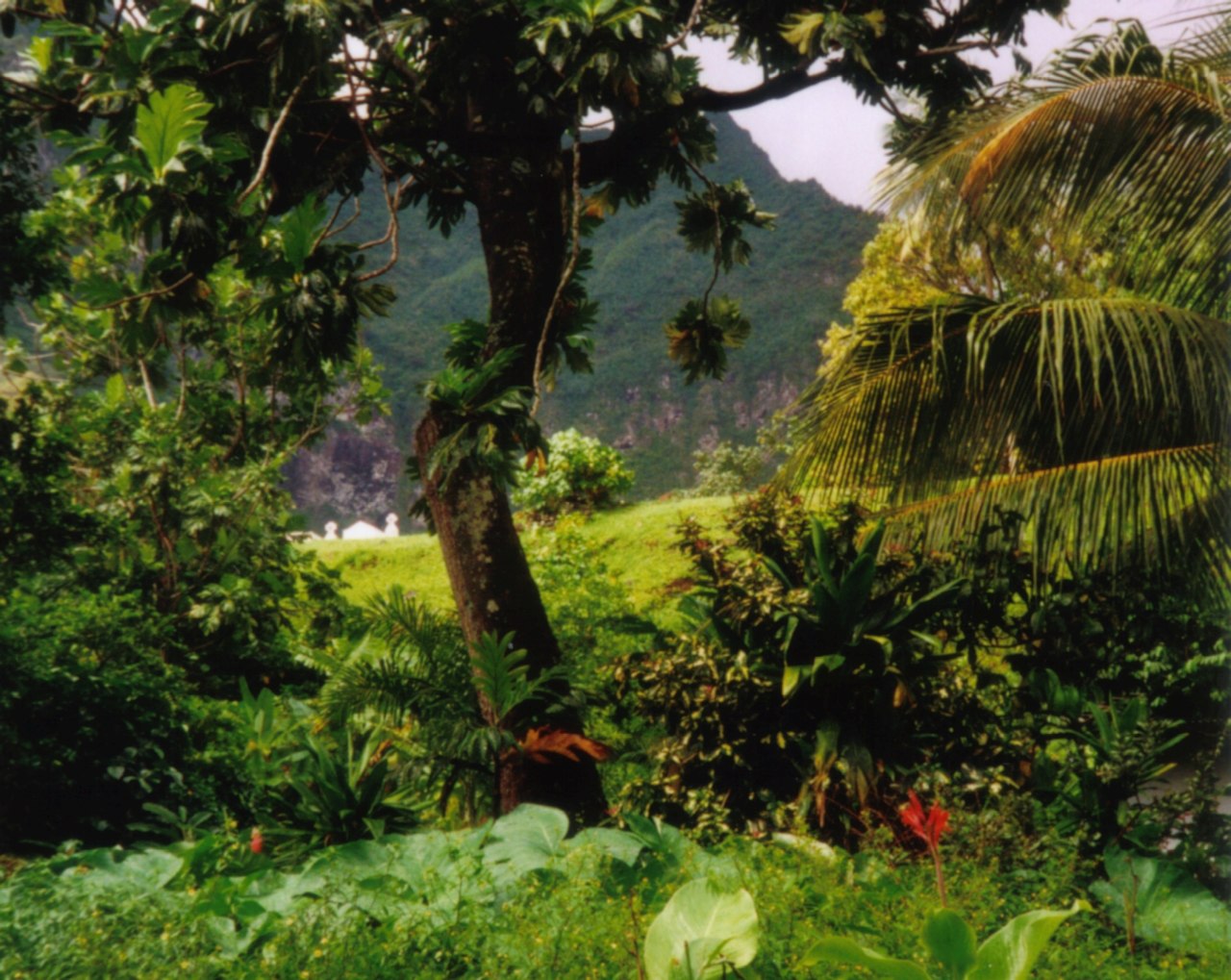
Según los estudios de huellas de ADN , el ancestro silvestre con semillas de Artocarpus altilis es Artocarpus camansi , que es nativo de Nueva Guinea , las islas Molucas y Filipinas . A. camansi fue domesticado y criado selectivamente en Polinesia, dando lugar a Artocarpus altilis , que en su mayoría no tiene semillas . El árbol del pan de Micronesia también muestra evidencia de hibridación con el Artocarpus mariannensis nativo , mientras que la mayoría de los cultivares polinesios y melanesios no lo hacen. Esto indica que Micronesia fue colonizada inicialmente por separado de Polinesia y Melanesia a través de dos eventos migratorios diferentes que luego entraron en contacto entre sí en el este de Micronesia. [34] [35] [36]

La palabra proto-malayo-polinesia reconstruida para el fruto del pan es *kuluʀ , que se convirtió en *kulur protooceánico y *kulu protopolinesio . Los cognados modernos incluyen kulur o kelur en sundanés y malayo ; kulu de Aceh ; kurur de Iban ; kulo o kolo en cebuano ; kula de Muna ; ulu de Mussau ; gulu de Kapingamarangi ; kulu de Wayan Fiji ; kuro de Emae ; kuru de Tuamotuan , Takuu y Rarotongan ; ʻuru de Tahití ; ʻulu de Samoa y Hawái ; y kuru maorí . Tenga en cuenta que en maorí, kuru solo se menciona en la tradición, pero no se refiere a la planta porque el fruto del pan no sobrevivió en Nueva Zelanda . [18] [37] [25] [38] [39] También cabe señalar que se cree que el fruto del pan sólo llegó a las islas occidentales del sudeste asiático (Java, Sumatra, península malaya) durante los últimos siglos, como resultado del comercio con las islas Molucas . [40]
Otra palabra reconstruida notable para el árbol del pan es *maRi o *mai protooceánico . Es una raíz común para las palabras para el árbol del pan en Micronesia , el norte y el oeste de Nueva Guinea , las Islas Salomón , las Islas del Almirantazgo , las Islas San Matías , Nueva Caledonia y partes del Pacífico central . El término en sí puede haber sido originalmente para Artocarpus mariannensis en lugar de Artocarpus altilis . Los cognados incluyen māi de Pohnpei , Mokil y Ngatik ; mai de Palau , Satawal y Tuvaluan ; mais de Puluwat ; maiyah de Yap ; y mei de Tonga , Niue y Marquesa . [18] [37] [25]
Artocarpus heterophyllus(Yaca)

La yaca ( Artocarpus heterophyllus ) fue domesticada de forma independiente en el sur y el sudeste asiático , como lo demuestra el hecho de que los nombres del sudeste asiático para la fruta no se derivan de las raíces sánscritas . Probablemente fue domesticada por primera vez por austronesios en Java o la península malaya . La palabra para yaca en proto-malayo-polinesio occidental se reconstruye como *laŋkaq . Los cognados modernos incluyen nangka en sundanés , javanés , malayo , balinés y cebuano ; langka en tagalo , pangasinán , bikol e ilocano ; lanka o nanka en chamorro ; nakan en kelabit ; nangke en wolio ; dangka en ibaloi ; y laka en lun dayeh . Sin embargo, cabe señalar que la fruta fue introducida recientemente en Guam a través de colonos filipinos cuando ambos formaban parte del Imperio español . [40] [17]
Bambusoideae (bambúes)

Varias especies de bambú ( subfamilia Bambusoideae ) se encuentran en el sudeste asiático insular, el sudeste asiático continental, el este de Asia y el sur de Asia. En las regiones austronesias, los diferentes tipos de bambú tienen diferentes nombres, así como los productos hechos con ellos. Se utilizan de diversas formas como materiales de construcción, aparejos de pesca, instrumentos musicales, cuchillos, recipientes para agua y comida, etc. Los brotes de bambú también son una fuente de alimento en el sudeste asiático. Los colonos austronesios trajeron algunas especies de bambú cuando colonizaron las islas del Pacífico. Entre ellas se incluyen el ʻohe ( Schizostachyum glaucifolium ), el bambú común ( Bambusa vulgaris ) y el bambú espinoso ( Bambusa bambos ). [41] [42]
Las palabras protoaustronesias reconstruidas que se referían al bambú incluyen *qauR , *kawayan , *buluq y *betung . Esta última entró en el protomalayo-polinesio y protooceánico como *bitung , con cognados que incluyen el sondanés awi bitung ; el fiyiano bitu ; y el tongano pitu . Sin embargo, la mayoría de los términos para el bambú en Polinesia se originaron del proto-sur-centro-pacífico *kofe (originalmente del proto-polinesio *kofe , "raíz"). Los cognados modernos incluyen el tongano y niue kofe ; el tokelauano , marquesano , tuamotuano y maorí kohe ; el rarotongano koʻe ; el samoano y tahitiano ʻofe ; y el hawaiano ʻohe . Algunos nombres también han cambiado para referirse a plantas similares al bambú; especialmente en islas donde no fueron introducidos o no sobrevivieron, como en Nueva Zelanda . [17] [41] [43]
Benincasa hispida(calabaza de cera)

Broussonetia papyrifera(papel morera)

La morera de papel ( Broussonetia papyrifera ), más conocida como " árbol de tela de tapa " en el Pacífico, se origina en regiones subtropicales de Asia continental y es una de las mejores pruebas de la hipótesis dominante de la "expansión de Taiwán" de Austronesia . Varios estudios genéticos han rastreado los orígenes de las poblaciones de morera de papel en el Pacífico remoto hasta Taiwán a través de Nueva Guinea y Sulawesi . En Filipinas , que estaba a lo largo de la ruta de expansión, la morera de papel es en su mayoría descendiente de introducciones modernas en 1935. Se presume que las antiguas introducciones de morera de papel se extinguieron en la prehistoria debido a su reemplazo por telas tejidas a mano, dado que la morera de papel generalmente solo sobrevive bajo el cultivo humano. Sin embargo, su ausencia en Filipinas subraya aún más sus orígenes en Taiwán, y no dentro del sudeste asiático insular. Además, las poblaciones de morera de papel en Nueva Guinea también muestran una afluencia genética de otra expansión fuera de Indochina y el sur de China . [44] [45] [46]

Se cree que es el cultivo de fibra más transportado en la prehistoria, habiéndose transportado junto con toda la gama de la expansión austronesia, a diferencia de la mayoría de los otros cultivos comensales en Oceanía. La morera de papel está presente en casi todas las islas o grupos de islas de Polinesia, incluidas la Isla de Pascua y Nueva Zelanda . Algunas poblaciones se han extinguido recientemente después de que dejaron de cultivarse, como en las Islas Cook y Mangareva , aunque existen relatos y muestras de corteza preparadas y herbarios de ellas en colecciones de museos reunidas por europeos durante el Período Colonial. Los polinesios las difundieron principalmente a través de la propagación vegetativa con esquejes y brotes de raíz. Rara vez se cultivaban a partir de semillas, ya que la mayoría de las plantas se cosechaban antes de la floración, cuando los tallos alcanzan alrededor de 1 pulgada (2,5 cm) de diámetro, como se describe en los relatos europeos del siglo XVIII. También se desconoce si las plantas salvajes se reproducían sexualmente, ya que las plantas son dioicas y requieren que haya especímenes masculinos y femeninos presentes en una isla. [44] [45]

La morera de papel se utiliza principalmente en las islas del Pacífico para hacer tela de corteza ( tapa en la mayoría de las lenguas polinesias). [44] [45] La tela de corteza también se puede hacer a partir de otros miembros de la familia de las moreras ( Moraceae ), incluidos Ficus (higos) y Artocarpus . La tela de corteza también se hacía ocasionalmente a partir de ortigas Pipturus , especialmente en Hawái . Sin embargo, la tela de corteza de mayor calidad era la de la morera de papel. [18]
La corteza de árbol se utilizaba principalmente para la ropa entre los antiguos austronesios y se fabricaba tradicionalmente utilizando batidores de piedra o madera característicos que se encuentran entre los artefactos más comunes encontrados en los sitios arqueológicos austronesios. Numerosos restos arqueológicos de batidores de corteza de árbol en el sur de China se han considerado como evidencia de que las tierras de origen austronesias anteriores a Taiwán estaban ubicadas en la región antes de la expansión hacia el sur de la dinastía Han , particularmente alrededor del delta del río Perla . Los restos más antiguos de este tipo provienen del sitio Dingmo en Guangxi , que data de alrededor de 7900 a . C. [47] La corteza de árbol siguió siendo una fuente importante de telas para ropa en la Melanesia precolonial, Polinesia y partes de Indonesia. Sin embargo, ha sido reemplazada en su mayoría por ropa de fibra tejida en la mayor parte del sudeste asiático insular y Micronesia. [18]
Existen numerosos nombres para la morera de papel en toda Austronesia, el más general se puede reconstruir como *malaw, protomalayo-polinesio del este central , que también se refiere al taparrabos y otras prendas de vestir hechas de corteza de morera de papel. Sus cognados incluyen Selaru mal ; Asilulu mala ai ; Buli māl ; Numfor mār ; Tanga , Tolai y Gedaged mal ; Rennellese mago ; Kairiru myal ; Lusi , Kove , Manam , Gitua , Mota , Niue , Futunan , Samoan , Tuvaluan , Nukuoro , Anuta y Hawaiian malo ; y Arosi , Rarotongan y Māori maro . [17]
En la Polinesia Oriental, los términos para la morera de papel también pueden reconstruirse como *aute , protopolinesio oriental-central , con cognados que incluyen ʻaute tahitiano y rarotongano ; ute marquesano ; wauke hawaiano ; aute rapa y maorí . [48]
En la mayor parte de Polinesia, el término para tela de corteza también se puede reconstruir a partir del proto-polinesio nuclear *taba , que significa "corteza", con cognados como wayan taba ; tongano , samoano , mangareva y rarotongano tapa ; y hawaiano kapa . Otros términos ampliamente utilizados para tela de corteza y morera de papel se derivan de la palabra reconstruida protopolinesia *siapo , con cognados como niue , tongano y marquesano hiapo ; y samoano y futunano oriental siapo . [18] Sin embargo, el término para batidor de tela de corteza se puede reconstruir más extensamente hasta el proto-malayo-polinesio *ike , con cognados como uma ike ; sa'a iki ; bauano , tongano y futunano oriental ike ; y samoano y hawaiano iʻe . [18]
Calophyllum inophyllum(mástil)

El Calophyllum inophyllum es un árbol maderero muy extendido, originario de Asia tropical. Destaca por su capacidad de crecer hasta alcanzar tamaños enormes en playas arenosas o rocosas de hábitats insulares y costeros, así como por su hábito de enviar grandes troncos arqueados sobre el agua, donde sus semillas se dispersan a través de las corrientes. [49] [50] Debido a estas características, el Calophyllum inophyllum es de particular importancia para la construcción naval tradicional de los barcos de estabilizadores austronesios más grandes y se llevaron con ellos cuando migraron a Oceanía y Madagascar. [50]
Otras especies del género Calophyllum también se utilizaron de manera similar, como Calophyllum soulattri , Calophyllum peekelii y Calophyllum goniocarpum . Las vetas de la madera de los miembros del género están entrelazadas de manera característica, lo que las hace más difíciles de trabajar pero también las hace más fuertes y más adecuadas para tallar formas intrincadas. Eran comparables en importancia a la de los robles en la construcción naval europea y las industrias madereras. [50] En muchas partes de Polinesia, los bosques de mástiles plantados en marae se consideraban sagrados y moradas de espíritus. Los mástiles también se tallaban en objetos religiosos como el tiki . [51] [52] También se mencionan comúnmente en los cantos y el folclore de la Polinesia . [53]

Varias partes de la madera del mástil eran fundamentales para la fabricación de canoas con estabilizadores. Las grandes extremidades curvas se tallaban comúnmente en las canoas que formaban la quilla de los barcos con estabilizadores austronesios. Las tracas , que se unen a la quilla mediante la técnica única austronesia de "coserlas" con una combinación de clavijas y orejetas atadas en lugar de clavos, también se pueden hacer de madera de mástil, pero es más común hacerlas de otras especies de madera "más blandas" como Artocarpus . Otras piezas se convirtieron en mástiles , flotadores de estabilizadores y largueros de estabilizadores. También se pueden tallar extremidades curvas más pequeñas en las costillas del barco. [50]
Además de la construcción naval, el aceite de tamanu extraído de las semillas de la fruta era importante en la cultura polinesia. Los aceites, así como las cataplasmas hechas de hojas y flores, también se utilizan comúnmente en la medicina tradicional. [49] [51] Las hojas contienen compuestos que son venenosos para los peces y pueden usarse como veneno para peces . [49]
La palabra protoaustronesia reconstruida para mastwood es *bitaquR , con cognados modernos que incluyen Ilocano bittáug ; Ifugao bitául ; Bikol , Cebuano , Maranao , Mansaka y Manobo bitáʻog o bitaʻug ; Nias bito ; btáʻəs palauanos ; Wetan witora ; y Asilulu hataul . [17] Las palabras malayo-polinesias occidentales para mastwood se derivan del doblete protoaustronesio *bintaŋuR , con cognados que incluyen iban , malayo y toba batak bintangur o bentangur ; wintangor tontemboano ; y vintáno malgache . [17] En proto-oceánico , la palabra reconstruida es pitaquR , con cognados que incluyen Nauna pitɨ ; Loniu pitow ; nali pirow ; seimat hita ; aua piʻaw ; pohnpeian isou ; rotuman hefau ; fijian vetau , tongan fetaʻu ; niue , samoan y tuvaluan fetau ; nukuoro hedau ; y rennellese hetaʻu . [17] En la mayoría de estos idiomas, el nombre se refiere específicamente a C. inophyllum , aunque en Ifugao, Maranao, Nias, Wetan y Fiji, el nombre se ha generalizado para referirse a árboles maderables grandes. [17] [54]
Otro conjunto de cognados para C. inophyllum en protooceánico puede reconstruirse como *tamanu . Su diferencia con *pitaquR no está clara, pero dada la distinción entre los términos en el reflejo de Mussau , *tamanu probablemente se refería originalmente a especímenes del árbol que crecen en el interior de las islas y no en las costas. Los cognados modernos incluyen tamanu de Mussau , Tongan , Niue , Samoan y Rarotongan ; damanu de Fiji ; y kamani de Hawái . [17]
Cananga odorata(ylang-ylang)

La Cananga odorata , con sus flores grandes y aromáticas, se utiliza para la ornamentación. La especie es originaria de Filipinas . [55] No se sabe si es originaria de Polinesia y Melanesia o si es una planta introducida. [56]
Agrios

Numerosas especies de Citrus son nativas del sudeste asiático insular, sudeste asiático continental, este de Asia, sur de Asia y Oceanía cercana. Los austronesios cultivaban y recolectaban una variedad de cítricos para alimentación, medicina y lavado, y las espinas se usaban como instrumentos de perforación para tatuajes . Citrus hystrix , Citrus macroptera y Citrus maxima también estaban entre las plantas de canoa que llevaron los viajeros austronesios hacia el este, a Micronesia y Polinesia . [57] La mayoría de los nombres polinesios que describen cítricos se denominan moli, en última instancia, del protooceánico * molis ; [58] [59] no se sabe si existe un vínculo con PMP * limaw (aunque sea indirecto) o no.
Cocos nucifera(Coco)
.png/1280px-Historical_Introduction_of_Coconuts_(Gunn,_Baudouin,&_Olsen,_2011).png)
La región entre el suroeste de Asia y Melanesia es el centro de origen de los cocos ( Cocos nucifera ), donde muestra la mayor diversidad genética. [63] [64] [65] [60] Un estudio de 2011 identificó dos subpoblaciones de cocos altamente diferenciadas genéticamente, una originaria del sudeste asiático insular (el grupo del Pacífico) y la otra de los márgenes meridionales del subcontinente indio (el grupo indoatlántico). El grupo del Pacífico es el único que muestra claras indicaciones genéticas y fenotípicas de que fueron domesticados; incluido el hábito enano, la autopolinización y la morfología redonda del fruto " niu vai " con mayores proporciones de endospermo a cáscara. La distribución de los cocos del Pacífico corresponde a las regiones colonizadas por los viajeros austronesios, lo que indica que su propagación fue en gran parte el resultado de las introducciones humanas. [60] [66]

Esto se manifiesta de forma más llamativa en Madagascar , una isla colonizada por marineros austronesios entre el 2000 y el 1500 a . C. Las poblaciones de cocoteros de la isla muestran una mezcla genética entre las dos subpoblaciones, lo que indica que los cocoteros del Pacífico fueron traídos por los colonos austronesios y que luego se cruzaron con los cocoteros indoatlánticos locales. [60] [66]
La mayoría de las palabras para "coco" en las lenguas austronesias se derivan del proto-malayo-polinesio *niuʀ . Los cognados modernos incluyen tagalo niyog ; Chamorro niyok ; malayo nyiur o nyior ; Tetum nuu ; Drehunu ; gilbertés nii ; hawaiano , samoano , tongano , fiyiano y rapa nui niu ; y malgache nio . [18] [67] [68] [69] [70]

Los estudios genéticos de los cocos también han confirmado poblaciones precolombinas de cocos en Panamá, en América del Sur. Sin embargo, no es nativo y muestra un cuello de botella genético resultante de un efecto fundador . Un estudio en 2008 mostró que los cocos en las Américas están genéticamente más relacionados con los cocos de las Filipinas , y no con ninguna otra población de cocos cercana (incluida la Polinesia ). Tal origen indica que los cocos no fueron introducidos de forma natural, como por las corrientes marinas. Los investigadores concluyeron que fue traído por los primeros navegantes austronesios a las Américas desde al menos 2250 AP, y puede ser una prueba de contacto precolombino entre culturas austronesias y culturas sudamericanas, aunque en la dirección opuesta a la que habían propuesto hipótesis tempranas como la de Heyerdahl. Se ve reforzado además por otra evidencia botánica similar de contacto, como la presencia precolonial de la batata en las culturas de Oceanía. [65] [62] [71] Durante la era colonial , los cocos del Pacífico se introdujeron en México desde las Indias Orientales Españolas a través de los galeones de Manila . [60]
A diferencia de los cocos del Pacífico, los cocos indoatlánticos fueron difundidos en gran medida por comerciantes árabes y persas en la costa este de África . Los cocos indoatlánticos también fueron introducidos en el océano Atlántico por barcos portugueses desde sus colonias en la costa de la India y Sri Lanka ; primero se introdujeron en la costa de África occidental , luego en el Caribe y la costa este de Brasil . Todas estas introducciones se produjeron en los últimos siglos, relativamente recientes en comparación con la difusión de los cocos del Pacífico. [60]
Coix lacryma-jobi(Las lágrimas de Job)

El tamaño y los nutrientes de las lágrimas de Job las distinguen de otros cereales antiguos y utilizados desde hace mucho tiempo, nativos de esta zona de Asia, y su uso bien establecido y registrado en prácticas culinarias indica una historia al menos proporcional a la del mijo y el arroz. La datación de un yacimiento en Shizitan ha presentado fechas tan tempranas como de 28.000 a 18.000 años atrás. [72] Los arqueólogos han encontrado evidencia que respalda que las lágrimas de Job están entre los primeros cereales domesticados en Asia, acompañados por el mijo. [73]
Colocasia esculenta(taro)

El taro ( Colocasia esculenta ), a veces denominado "taro verdadero", es uno de los cultivos cultivados más antiguos y anterior a la expansión austronesia. [6] El taro se encuentra ampliamente en las regiones tropicales y subtropicales del sur de Asia, el este de Asia, el sudeste de Asia, Papúa Nueva Guinea y el norte de Australia y es altamente polimórfico , lo que dificulta la taxonomía y la distinción entre tipos silvestres y cultivados. Se cree que fueron domesticados de forma independiente varias veces, y los autores dan posibles ubicaciones como Nueva Guinea , el sudeste asiático continental y el noreste de la India , basándose principalmente en el rango nativo supuesto de las plantas silvestres. [74] [75] [76] Sin embargo, estudios más recientes han señalado que el taro silvestre puede tener una distribución nativa mucho más grande de lo que se creía anteriormente, y es probable que los tipos de reproducción silvestre también sean autóctonos de otras partes del sudeste asiático insular. [77] [78]


Se han recuperado rastros arqueológicos de la explotación del taro en numerosos sitios anteriores a la expansión austronesia, aunque no se puede determinar si se trataba de tipos cultivados o silvestres. Entre ellos se incluyen las cuevas de Niah en Borneo , que datan de <40 000 AP ; [79] la cueva de Ille en Palawan , que data de al menos c. 11 000 AP ; [79] [80] el pantano de Kuk en Nueva Guinea , que data de entre 10 200 y 9910 cal AP ; [81] [82] y la cueva de Kilu en las Islas Salomón , que data de alrededor de c. 28 000 a 20 000 AP . [83] En el caso del pantano de Kuk, hay evidencia de que la agricultura formalizada surgió alrededor de c. 10 000 AP , con evidencia de parcelas cultivadas, aunque se desconoce qué planta se cultivaba. [84]

De todas formas, el taro se encontraba sin duda entre las plantas cultivadas por los austronesios, así como por las poblaciones anteriores en el sudeste asiático insular. Sin embargo, su importancia en el sudeste asiático insular había sido reemplazada en gran medida por el arroz, aunque todavía se lo planta en los márgenes de los arrozales en algunas comunidades. Siguió siendo un alimento básico en las islas de Melanesia y Polinesia, donde no se introdujo el arroz. Es una de las cuatro especies de aráceas (taros) cultivadas por los austronesios principalmente como fuente de cormos almidonados , las otras son Alocasia macrorrhizos , Amorphophallus paeoniifolius y Cyrtosperma merkusii . Son las más importantes y las más preferidas entre las cuatro, porque era menos probable que contuvieran los irritantes rafidios presentes en las otras plantas. [21] [85]
El taro también se identifica como uno de los alimentos básicos de Micronesia , a partir de evidencia arqueológica que data del Período Latte precolonial (c. 900 - 1521 d. C.), lo que indica que también lo llevaban los micronesios cuando colonizaron las islas. [86] [87] Debido a la falta de idoneidad de las islas de atolón bajas de la mayor parte de Micronesia, los micronesios innovaron cavando pozos que luego podían llenarse con abono adecuado para el cultivo de taro. [25] También se han identificado polen de taro y residuos de almidón en sitios Lapita anteriores , que datan de alrededor de c. 3050 - 2500 cal BP . [25]
Existen numerosos términos para el taro en las lenguas austronesias, tanto específicos como generalizados. El término protoaustronesio reconstruido para el taro es *cali , con cognados en las lenguas formosanas como Seediq sali , Thao lhari , Bunun tai y Amis tali . [17]
Se convirtió en *taləs en proto-malayo-polinesio , que a su vez se convirtió en *talos o *talo en proto-oceánico . Los cognados modernos incluyen Hanunó'o tálus ; Aborlan Tagbanwa talis ; Palawan Batak täläs ; Nias talõ ; talas malayo ; Minangkabau taleh ; Rejang y taleus sundanés ; cuentos javaneses ; Dáit palauano ; cuento rotinese ; y Tetun talas . [17] [88] [89] En las lenguas polinesias, los cognados incluyen motu , marovo , tongano , samoano , niue , futunan , talo tuvaluano ; Kwaio , Lau (Malaita) y Toqabaqita alo ; 'Āre'āre , arosi y bauro aro ; nakanamanga na-tale ; sye tal o nal ; dalo fiyiano y nukuoro ; tago rennellés ; taro anuta , rarotongano y maorí ; y kalo hawaiano . El nombre inglés de la planta se deriva de los nombres polinesios. [17] Una variedad roja de taro también tiene nombres derivados del protopolinesio reconstruido *pongi , con cognados que incluyen Niue pongi ; Marquesan poki ; Hawaiian poni ; y Māori pongi . [90]
En proto-malayo-polinesio occidental , otro término reconstruido es *kaladi , con cognados que incluyen Agutaynen , Sabah Bisaya , Iban , Tae' y Wolio kaladi ; keladi balinés y malayo ; y Mongondow koladi . [17]
Cordia subcordata(playa cordia)
.jpg/1280px-Cordia_subcordata_(4822100731).jpg)
La cordia de playa ( Cordia subcordata ) es un árbol maderable importante con madera ligera, de textura fina y algo blanda ideal para tallar. No tiene sabor y por lo tanto se usaba más comúnmente para tallar utensilios, tazas, cuencos y otros recipientes; así como tallas ornamentales e instrumentos musicales en toda Austronesia. La madera es inflamable y se usa comúnmente en Nueva Guinea como leña. En algunas culturas, la madera también se puede usar para construir remos y las quillas de los barcos. [91] [92] Las semillas también se pueden comer, aunque solo como alimento para la hambruna . Otras partes también se pueden usar para la medicina tradicional y para la extracción de tintes. Al igual que Calophyllum inophyllum , la cordia de playa se plantaba comúnmente en marae . Tienen importancia cultural y religiosa en algunas culturas como en Kiribati y las islas Karimunjawa de Indonesia . En Hawái, era tradicional plantar cordia de playa alrededor de las casas y usar sus flores de color naranja brillante como leis . [91] [93] [94] [95]
La cordia de playa, como la mayoría de los árboles preferidos por los austronesios, crece bien en suelos arenosos, arcillosos y rocosos y es un componente común de los bosques costeros y los manglares. En un principio se pensó que la cordia de playa era una especie introducida, pero ahora se sabe que es autóctona de la mayoría de las islas y costas del Indopacífico, y que se propaga de forma natural por sus semillas flotantes. Sin embargo, se introdujo deliberadamente en algunas islas, y las introducciones artificiales suelen crecer junto con otros árboles comunes cultivados por los austronesios, especialmente en los atolones de Micronesia. [91] [96] [97]
Los términos para beach cordia se reconstruyen al proto-malayo-polinesio *kanawa , con cognados que incluyen Iban kenawa ; Kanawa makasarese ; kəláu palauano ; kanawa gilbertés ; Tokelau kanava ; y Nukuoro ganava .
Otro conjunto de cognados se puede reconstruir como *toRu protooceánico , con cognados que incluyen to-tor nehaniano ; to-tol petatsiano ; tou fiyiano , tongano y rarotongano ; y kou hawaiano . [17] [98]
Un término reconstruido más antiguo es el protoaustronesio *qaNuNaŋ , sin embargo no es específico de la cordia de playa y puede referirse a otros miembros del género con frutos pegajosos, especialmente la baya de cola ( Cordia dichotoma ) y la lasura ( Cordia myxa ). Tampoco llegó a las lenguas oceánicas . Los cognados incluyen tsou həhngə ; isneg anúnang ; hanunó'o y cebuano anúnang ; maranao nonang ; manobo enunang ; mansaka anonang ; malayo , minangkabau , sasak , manggarai y rembong nunang ; y mongondow onunang . [17]
Cordyline fruticosa(él)

Ti ( Cordyline fruticosa ) es una planta parecida a una palmera que crece hasta 3 a 4 m (9,8 a 13,1 pies) de altura con un atractivo grupo de hojas ampliamente alargadas en forma de abanico y dispuestas en espiral en la punta del tronco delgado. Tiene numerosas variaciones de color, que van desde plantas con hojas rojas hasta cultivares verdes, amarillos y abigarrados . Su distribución nativa original es desconocida, pero se cree que es nativa de la región desde Bangladesh , hasta el sudeste asiático continental , el sur de China , Taiwán , el sudeste asiático insular , Nueva Guinea y el norte de Australia . Tiene la mayor diversidad morfológica en Nueva Guinea y se cree que ha sido ampliamente cultivada allí. Comúnmente se la identifica erróneamente como una " Dracaena ", junto con miembros del género Cordyline , debido a sistemas de clasificación anteriores. [99] [100]

Los austronesios lo llevaron por toda Oceanía, llegando hasta Hawái , Nueva Zelanda y la Isla de Pascua en su punto más lejano. Un tipo de ti particularmente importante en Polinesia es un cultivar de hojas verdes grandes cultivado por sus rizomas comestibles agrandados. A diferencia de las poblaciones de ti en el sudeste asiático y la zona cercana a Oceanía , este cultivar es casi completamente estéril en las islas más alejadas de la Polinesia oriental. Solo se puede propagar por esquejes de los tallos o los rizomas . Se especula que esto fue el resultado de una selección artificial deliberada , probablemente porque producen rizomas más grandes y menos fibrosos más adecuados para su uso como alimento. [99] [101] [102]
El ti tiene muchos usos, pero es más notable como una de las plantas más importantes relacionadas con las religiones animistas indígenas de los austronesios, junto con las higueras ( Ficus spp.). Se le considera ampliamente poseedor de poderes místicos o espirituales en varias culturas austronesias (así como papúes ). Entre muchos grupos étnicos de Austronesia se le considera sagrado. Las características comunes incluyen la creencia de que pueden contener almas y, por lo tanto, son útiles para curar enfermedades de " pérdida del alma " y para exorcizar contra espíritus malévolos, su uso en vestimentas y ornamentación rituales y su uso como marcadores de límites. Los cultivares rojos y verdes también representan comúnmente aspectos dualistas de la cultura y la religión y se usan de manera diferente en los rituales. Las plantas de ti rojas comúnmente simbolizan la sangre, la guerra y los vínculos entre los vivos y los muertos; mientras que las plantas de ti verdes comúnmente simbolizan la paz y la curación. [103] [104] [105] [101] También se utilizan ampliamente en la medicina tradicional, como tinte y como ornamentación en toda Austronesia y Nueva Guinea. [106] Sus usos rituales en las islas del sudeste asiático han quedado en gran medida eclipsados por la introducción del hinduismo, el budismo, las religiones islámica y cristiana, pero todavía persisten en ciertas áreas o son cooptados para los rituales de las nuevas religiones. [103]
En Polinesia, las hojas de la forma de hojas verdes se utilizan para envolver alimentos, forrar hornos de tierra y pozos de fermentación del árbol del pan , y sus rizomas se cosechan y procesan en una pulpa dulce similar a la melaza que se come como caramelo o se usa para producir un líquido similar a la miel que se usa en varios dulces. En Hawái , las raíces también se mezclan con agua y se fermentan en una bebida alcohólica conocida como okolehao . [99] [107] [108] [109] Las fibras extraídas de las hojas también se utilizan en cordelería y en la fabricación de trampas para pájaros. [107] Se cree que el consumo de ti como alimento, considerado como una planta sagrada y, por lo tanto, originalmente tabú , fue una innovación audaz de las culturas polinesias como respuesta a las condiciones de hambruna. Se cree que el levantamiento del tabú está vinculado al desarrollo del ritual de caminar sobre fuego . [103]
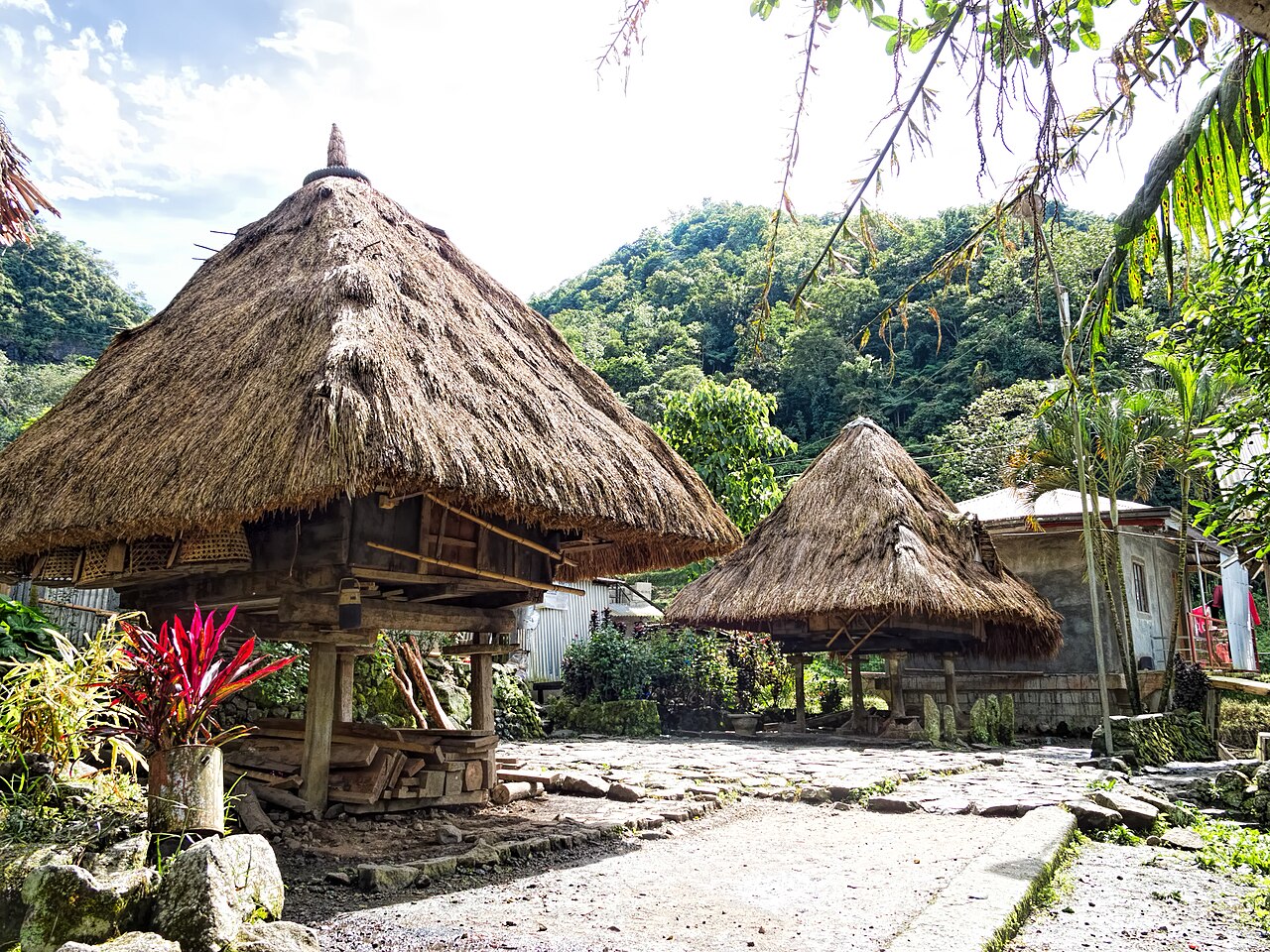
En el antisemitismo filipino , las babaylan (chamanas ) usaban comúnmente ti cuando realizaban rituales de mediumnidad o curación. Una creencia común en las culturas filipinas es que la planta tiene la capacidad innata de albergar espíritus . Entre el pueblo ifugao del norte de Luzón , se planta alrededor de terrazas y comunidades para ahuyentar a los malos espíritus y marcar los límites de los campos cultivados. Se cree que las hojas rojas atraen a los espíritus y se usan durante rituales importantes como parte de los tocados y se meten en brazaletes. En el pasado, también se usaba durante danzas ceremoniales llamadas bangibang , que realizaban tanto hombres como mujeres para los guerreros que morían en batalla o por medios violentos. También se utilizan para decorar objetos rituales. [110] [111] [112] [113] Entre el pueblo palaw'an , se planta en cementerios para evitar que los muertos se conviertan en espíritus malévolos. [114]

.jpg/1280px-Starr-030405-0072-Cordyline_fruticosa-habit-Makawao_Forest_Reserve-Maui_(24261783289).jpg)
En Indonesia , el ti rojo se usa de manera similar a como se hace en Filipinas. Entre los pueblos Dayak , Sundanese , Kayan , Kenyah , Berawan, Iban y Mongondow , el ti rojo se usa como protección contra los malos espíritus y como marcador de límites. También se usa en rituales como la curación y los funerales y es muy común plantarlo en arboledas sagradas y alrededor de santuarios. [103] [115] Los Dayak también extraen un tinte verde natural del ti. [116] Durante los rituales de curación del pueblo Mentawai , el espíritu dador de vida es atraído con canciones y ofrendas para que entre en los tallos del ti que luego se reconcilian con la persona enferma. [117] Entre el pueblo Sasak , las hojas verdes del ti se usan como parte de las ofrendas a los espíritus por parte de los chamanes belianos . [116] Entre el pueblo Baduy , el ti verde representa el cuerpo, mientras que el ti rojo representa el alma. Ambos se usan en rituales de plantación de arroz. También se plantan en cementerios. [118] [119] Entre los pueblos balineses y karo , las plantas ti se plantan cerca de los santuarios de la aldea o de la familia en un bosque sagrado . [120] [121] Entre el pueblo toraja , las plantas ti rojas se utilizan en rituales y como decoraciones de objetos rituales. Se cree que ocurren tanto en el mundo material como en el espiritual (una creencia común en el animismo austronesio). En el mundo espiritual, existen como aletas y colas de los espíritus. En el mundo material, son más útiles como guías utilizadas para atraer la atención de los espíritus. Las hojas rojas también simbolizan la sangre y, por lo tanto, la vida y la vitalidad. [122] [123] [124] Entre el pueblo ngaju , las plantas ti eran un símbolo de los bosques sagrados de los antepasados. También eran importantes en las promesas rituales dedicadas a los dioses superiores. Se consideraban un símbolo del "Árbol de la Vida" masculino, en una dicotomía con las especies de Ficus que simbolizan el "Árbol de los Muertos" femenino. [103]

En Nueva Guinea , los ti se plantan comúnmente para indicar la propiedad de la tierra para el cultivo y también se plantan alrededor de las casas de los hombres ceremoniales. También se utilizan en varios rituales y se asocian comúnmente con la sangre y la guerra. [125] [126] [127] Entre el pueblo Tsembaga Maring , se cree que albergan "espíritus rojos" (espíritus de hombres que murieron en batalla). Antes de una guerra altamente ritualizada (pero letal) por la propiedad de la tierra, se arrancan y se sacrifican cerdos a los espíritus. Después de las hostilidades, se vuelven a plantar en los nuevos límites de la tierra dependiendo del resultado de la pelea. Los hombres involucrados colocan ritualmente sus almas en las plantas. La guerra ritual ha sido suprimida por el gobierno de Papúa Nueva Guinea , pero partes de los rituales aún sobreviven. [105] [128] Entre el pueblo Ankave, el ti rojo es parte de su mito de la creación , que se cree que surgió del lugar del primer asesinato. [129] Entre los pueblos Mendi y Sulka se utilizan como tintes para pintar el cuerpo, y sus hojas se utilizan para adornos corporales y rituales de purificación. [130] Entre los Nikgini, las hojas tienen propiedades mágicas para traer buena suerte y se utilizan en la adivinación y en la decoración de objetos rituales. [131] Entre los Kapauku , las plantas ti se consideran plantas mágicas y se cree que son seres espirituales en sí mismas. A diferencia de otras plantas mágicas que están controladas por otros espíritus, las plantas ti tienen sus propios espíritus y son lo suficientemente poderosas como para comandar a otros seres espirituales. Las plantas rojas se utilizan en rituales de magia blanca , mientras que las plantas verdes se utilizan en rituales de magia negra . También se utilizan comúnmente en rituales de protección y salvaguarda. Entre los Baktaman, las plantas rojas se utilizan para ritos de iniciación, mientras que las plantas verdes se utilizan para la curación. Los pueblos de habla Ok también consideran a las plantas ti como su tótem colectivo . [103]
En la Melanesia insular , los ti son considerados sagrados por varios pueblos de habla austronesia y se utilizan en rituales de protección, adivinación y fertilidad. [103] Entre el pueblo Kwaio , los ti rojos se asocian con las disputas y la venganza, mientras que los ti verdes se asocian con los espíritus de los antepasados, los marcadores de los bosques sagrados y las protecciones contra el mal. Los Kwaio cultivan estas variedades en sus comunidades. [132] Entre el pueblo Maenge de Nueva Bretaña , las mujeres usan hojas de ti como faldas diarias. El color y el tamaño de las hojas pueden variar según las preferencias personales y la moda. Se comercializan regularmente nuevos cultivares con diferentes colores y se cultivan hebras de ti cerca del pueblo. Las hojas rojas solo las pueden usar las mujeres después de la pubertad. El ti también es la planta más importante en los rituales mágicos y curativos de los Maenge. Algunos cultivares de ti están asociados con espíritus sobrenaturales y tienen nombres y folclore a su alrededor. [133] En Vanuatu , las hojas de cordyline , conocidas localmente por el nombre bislama nanggaria , se usan metidas en un cinturón en danzas tradicionales como Māʻuluʻulu , y las diferentes variedades tienen significados simbólicos particulares. Las cordylines a menudo se plantan fuera de los edificios nakamal . [134] En Fiji , las hojas rojas de ti se usan como faldas para bailarines y se usan en rituales dedicados a los espíritus de los muertos. También se plantan alrededor de los edificios ceremoniales utilizados para rituales de iniciación. [103]

En Micronesia , las hojas de ti se entierran bajo las casas recién construidas en Pohnpei para protegerse de la brujería maligna. [125] En casos de muerte desconocida, los chamanes de Micronesia se comunican con el espíritu muerto a través de las plantas de ti, nombrando varias causas de muerte hasta que la planta tiembla. [101] También hay evidencia arqueológica de que los rizomas de las plantas se comían en el pasado en Guam antes del Período Latte . [135]
.jpg/1280px-Starr-080209-2628-Cordyline_fruticosa-rain_koa-Puu_Moaulanui-Kahoolawe_(24608599340).jpg)
En Polinesia , el ti verde se cultivaba ampliamente con fines alimenticios y religiosos. Se suele plantar alrededor de las casas, en lugares sagrados (incluidos marae y heiau ) y en tumbas. Las hojas también se llevan como amuleto cuando se viaja y se utilizan en rituales que permiten comunicarse con la especie. Al igual que en el sudeste asiático, se cree ampliamente que protegen contra los malos espíritus y la mala suerte; además de tener la capacidad de albergar espíritus de personas fallecidas, así como espíritus de la naturaleza. [99] [101] [107]

En el antiguo Hawái, se creía que la planta tenía un gran poder espiritual; solo los kahuna (chamanes) y los aliʻi (jefes) podían llevar hojas alrededor del cuello durante ciertas actividades rituales. Ti era sagrado para el dios de la fertilidad y la agricultura Lono , y la diosa del bosque y la danza hula , Laka . Las hojas de Ti también se usaban para hacer lei y para delinear los límites entre las propiedades. También se plantaba en las esquinas de la casa para mantener alejados a los malos espíritus. Hasta el día de hoy, algunos hawaianos plantan ti cerca de sus casas para atraer la buena suerte. Las hojas también se utilizan para andar en trineo de lava . Se atan varias hojas y la gente baja por las colinas sobre ellas. Las hojas también se usaban para hacer prendas de vestir, incluidas faldas que se usaban en espectáculos de danza. La falda hula hawaiana es una falda densa con una capa opaca de al menos cincuenta hojas verdes y la parte inferior (superior de las hojas) afeitada. El vestido de danza tongano , el sisi , es un delantal de unas 20 hojas, que se usa sobre un tupenu y está decorado con algunas hojas amarillas o rojas. [136] [137] [138]
En Nueva Zelanda , ciertos nombres de lugares se derivan del uso y el folclore del ti, como el bosque Puketī y Temuka . Las plantas de ti en Kaingaroa se conocen como nga tī whakāwe o Kaingaroa ("los árboles fantasma de Kaingaroa"), basándose en la leyenda de dos mujeres que se convirtieron en plantas de ti y aparentemente siguen a la gente que viaja por la zona. [107]
La palabra proto-malayo-polinesia reconstruida para ti es *siRi . Los cognados incluyen el malgache síly ; hermana palauana ; Ere y Kuruti siy ; Araki jihi ; Arosi diri ; Chuukese tii-n ; Wuvulu si o ti ; Tongano sī ; tī samoano , tahitiano y maorí ; y kī hawaiano . Los nombres en algunos idiomas también se han aplicado a los crotones de jardín ( Codiaeum variegatum ), que también tienen hojas rojas o amarillas. Los cognados del proto-malayo-polinesio proto-occidental *sabaqaŋ , de manera similar, se han aplicado tanto a los crotones de jardín como a las plantas de ti. [17] [139]
En Filipinas , también se las conoce por nombres derivados del protoaustronesio *kilala , "saber", debido a su uso en rituales de adivinación . Los cognados derivados de ese uso incluyen sagilala en tagalo ; y kilála o kilaa en visayo y bikol . En Nueva Zelanda, los términos para ti también se transfirieron al árbol de repollo nativo y estrechamente relacionado ( Cordyline australis ), como tī kōuka . [17] [139]
Cucumis melo(melón)

Cyrtosperma merkusii(taro gigante de pantano)

Dioscorea(batatas)
El ñame ( Dioscorea spp.) es un grupo muy grande de plantas nativas de las regiones tropicales y templadas cálidas del mundo. Varias especies de ñame fueron domesticadas y cultivadas de forma independiente en el sudeste asiático insular y Nueva Guinea por sus tubérculos almidonados , incluyendo el ube ( Dioscorea alata ), el ñame redondo ( Dioscorea bulbifera ), el ñame intoxicante ( Dioscorea hispida ), el ñame menor ( Dioscorea esculenta ), el ñame del Pacífico ( Dioscorea nummularia ), el ñame de cinco hojas ( Dioscorea pentaphylla ) y el ñame lápiz ( Dioscorea transversa ). [140] Entre estos, D. alata y D. esculenta eran los únicos cultivados y consumidos regularmente, mientras que el resto generalmente se consideraban alimentos de hambruna debido a sus niveles más altos de la toxina dioscorina , que requiere que se preparen correctamente antes del consumo. [141]
D. alata y D. esculenta eran las más adecuadas para el transporte a larga distancia en los barcos austronesios y fueron transportadas a través de toda o la mayor parte del área de expansión austronesia. D. alata , en particular, se introdujo en las islas del Pacífico y Nueva Zelanda. También fueron transportadas por los viajeros austronesios a Madagascar y las Comoras . [66] [142] [143]
Dioscorea alata(ube)

El ube ( Dioscorea alata ), también conocido como ñame mayor o ñame de agua, es uno de los cultivos básicos más importantes en las culturas austronesias. Es la principal especie cultivada entre Dioscorea , en gran parte debido a sus tubérculos mucho más grandes y su facilidad de procesamiento. [144] Su centro de origen es desconocido, pero la evidencia arqueológica sugiere que fue explotado en el sudeste asiático insular y Nueva Guinea antes de la expansión austronesia. Se cree que el ube es un verdadero cultígeno , solo conocido por sus formas cultivadas. Es poliploide y es estéril, por lo que no puede cruzar cuerpos de agua. Esto restringe su introducción en las islas puramente por la acción humana, lo que las convierte en un buen indicador del movimiento humano. Algunos autores han propuesto un origen en el sudeste asiático continental sin evidencia, pero muestra la mayor variabilidad fenotípica en Filipinas y Nueva Guinea . [145] [146] [147]

Basándose en la evidencia arqueológica de las primeras parcelas agrícolas y los restos de plantas en el yacimiento del pantano de Kuk , los autores han sugerido que se domesticó por primera vez en las tierras altas de Nueva Guinea alrededor de 10.000 años antes del presente y se extendió al sudeste asiático insular a través de la cultura Lapita alrededor de c. 4.000 años antes del presente , junto con D. nummularia y D. bulbifera . A su vez, se cree que D. esculenta fue introducida por la cultura Lapita en Nueva Guinea. También hay evidencia de una revolución agrícola durante este período traída por innovaciones del contacto con los austronesios, incluido el desarrollo del cultivo húmedo . [76] [148]
.jpg/1280px-Starr-061106-9588-Dioscorea_alata-habit-Maui_Nui_Botanical_Garden-Maui_(24239911794).jpg)
Sin embargo, también se han recuperado restos mucho más antiguos identificados como probablemente D. alata en las cuevas de Niah en Borneo ( Pleistoceno tardío , <40.000 AP ) y en la cueva de Ille en Palawan (c. 11.000 AP ), junto con restos del tóxico ubi gadong ( D. hispida ), que requiere procesamiento antes de que pueda ser comestible. Aunque no prueba el cultivo, sí muestra que los humanos ya tenían el conocimiento para explotar las plantas ricas en almidón y que D. alata era nativa del sudeste asiático insular. Además, abre la pregunta de si D. alata es una especie verdadera o se cultivaba mucho antes de lo que se cree. [140] [79] [80] [149] [150] [151]
El ube sigue siendo un cultivo importante en el sudeste asiático, en particular en Filipinas, donde esta variedad de color violeta intenso se utiliza ampliamente en diversos postres tradicionales y modernos. También sigue siendo importante en Melanesia , donde también se cultiva con fines ceremoniales vinculados al tamaño de los tubérculos en el momento de la cosecha. Sin embargo, su importancia en la Polinesia oriental y Nueva Zelanda ha disminuido tras la introducción de otros cultivos, en particular la batata . [144]
La palabra protoaustronesia reconstruida para ube es *qubi , que se convirtió en el protomalayo-polinesio *qubi y en el protooceánico *qupi . Tiene algunos de los reflejos más reconocibles y extendidos en las lenguas austronesias. Los cognados modernos incluyen Yami uvi ; Itbayaten ovi ; Bontoc y Hanunó'o ʻúbi ; ilocano , tagalo , cebuano , pangasinan , aklanon , itneg e itawis úbi o úbe ; Kalamian Tagbanwa kubi ; Maranao obi ; Tiruray'ubi ; Manobo uvi ; Kenyah , malayo , iban , balinés , sasak , mongondow y toba batak ubi ; uwi javanés ; Kelabit ubih ; Melanau ubey ; Ngaju Dayak owi ; óvy malgache ; Tsat phai ; Jarai hebey ; Moken koboi ; huwi sundanés ; tontemboan , bimanese y manggarai uwi ; Ngadha uvi ; ufi rotinese ; Erai uhi ; Selaru uh o uhi-re ; Watubela kuwi ; Buruese ubi-t ; Koiwai uf ; Buli arriba ; y Waropen uwi . [144] [17]
Entre las lenguas oceánicas , los cognados incluyen Nauna kuh ; Penchal kup ; Leipon uh ; Tolai arriba ; Lakalai la-huvi ; Gapapaiwa y Kilivila kuvi ; Papapana na-uvi ; Simbo , Bugotu y Nggela , y uvi de Fiji ; Kwaio , Niue y ufi samoano ; Sa'a , Arosi , Tuamotuan , Hawaiian y Rapa Nui uhi ; puauhi de las Marquesas ; Haununu a-uhi ; Avava '' o-ovi ; rennellés ʻuhi ; 'ufi tongano ; Anuta upi ; Rarotongan uʻi ; y maorí uwhi o uhi . [144] [17]
En algunos grupos étnicos, la palabra se ha generalizado o modificado para referirse a otros tipos de ñame, además de la batata y la mandioca . Otras palabras para ube también se derivan de los nombres ancestrales de otras especies de ñame. [144] [17]
Dioscorea bulbifera(ñame de aire)

El ñame del aire ( Dioscorea bulbifera ), también conocido como ñame amargo, es una de las especies de ñame menos cultivadas. Por lo general, solo se consume como alimento en caso de hambruna en las islas del sudeste asiático, Melanesia y Polinesia, debido a la toxicidad de algunas plantas silvestres o asilvestradas cuando no se cocinan correctamente. Sin embargo, es uno de los tres únicos ñames que fueron llevados por los austronesios a la remota Oceanía , los otros son D. alata y D. nummularia . La parte de la planta que se cosecha son los tubérculos aéreos, ya que no suele producir grandes tubérculos subterráneos. [23] [152]
Puede reconstruirse al protooceánico como *pwatika o *pʷatik , con cognados que incluyen Lou puet ; Lamusong patik ; Boanaki posika ; y Kwara'ae fasia . Sin embargo, en Lamusong su significado ha cambiado al ñame menor, mientras que en Boanaki, el significado ha cambiado a un término más generalizado para los ñames. También puede reconstruirse al protooceánico más generalizado *balai , que significa "ñame silvestre", que se convirtió en protomicronés *palai , con cognados que incluyen rotumano parai ; tongano , niue y samoano palai ; y rennellés pagai . [17]
Dioscorea esculenta(ñame menor)

El ñame menor ( Dioscorea esculenta ) es el segundo cultivo de ñame más importante entre los austronesios. Al igual que el D. alata , requiere un procesamiento mínimo, a diferencia de las otras especies de ñame más amargas. Sin embargo, tiene tubérculos más pequeños que el D. alata y suele ser espinoso. [153] Al igual que el D. alata , fue introducido en Madagascar y las Comoras por los austronesios, donde se extendió a la costa este de África . [154] [142] [155] También es un cultivo dominante en Oceanía cercana , sin embargo, no llegó a las islas más lejanas de Polinesia, estando ausente en Hawái y Nueva Zelanda . [156] [157] [158]
Se han recuperado granos de almidón identificados como del ñame menor en sitios arqueológicos de la cultura Lapita en Viti Levu , Fiji , que datan de alrededor de 3050 a 2500 cal BP . [159] También se han identificado rastros de ñames D. esculenta (junto con D. alata , D. bulbifera , D. nummularia y D. pentaphylla ) en el sitio de la cueva Mé Auré en Moindou , Nueva Caledonia , que datan de alrededor de 2700 a 1800 BP . [160] También se han recuperado restos de D. esculenta en sitios arqueológicos en Guam , que datan de alrededor de 1031 d . C. [135] Se cree que D. esculenta fue introducida por la cultura Lapita en Nueva Guinea alrededor de 4000 BP , junto con innovaciones agrícolas como el cultivo húmedo y la agricultura itinerante . [18] [76] [148] En los sitios arqueológicos de Nueva Guinea, se asocia con la aparición de poblaciones de alta densidad en las zonas costeras. [161]
Los términos para el ñame menor en las lenguas austronesias son en su mayoría formas afijadas o de dos palabras derivadas de la raíz *qubi para D. alata , como el samoano ufi lei , el sundanés ubi aung , el malayo ubi torak y el javanés ubi gemblii . Un término para el ñame menor se puede reconstruir en protofilipino como *tugiq , pero sus cognados se limitan a la isla de Luzón , incluyendo Ivatan togi ; Ilocano y Kankana-ey tugí ; Bontoc e Ifugao tugi ; y Tagalog tugiʻ . [17] No se puede reconstruir ningún término protooceánico para el ñame menor porque está ausente en Oceanía Remota . Sin embargo, se puede reconstruir en protooceánico occidental como *kamisa , *qamisa o *mamisa . [162]
Dioscorea hispida(ñame embriagador)
El ñame ( Dioscorea hispida ), que es intoxicante, es originario de Asia tropical y Nueva Guinea. Solo se cultiva mínimamente en partes de Java . En otros lugares se cosecha de forma silvestre. Al igual que D. bulbifera, tiene tubérculos tóxicos que deben prepararse correctamente antes de poder comerse, y por lo tanto solo eran adecuados para la alimentación en épocas de hambruna . [163] Sin embargo, es una de las especies de Dioscorea identificadas en el sitio arqueológico de las cuevas de Niah que data de <40.000 a . C. [79] [164] Sus nombres pueden reconstruirse como *gaduŋ protomalayo-polinesio occidental . Sus cognados modernos en la mayoría de las lenguas malayo-polinesias occidentales son gadung o gadong (también ubi gadung o ubi gadodong ). Los nombres también se aplican a la mandioca introducida, igualmente tóxica . [17]
Ficus(higueras)
Ficus es un género de unas 850 especies de árboles leñosos, arbustos, enredaderas, epífitas y hemiepífitas de la familia Moraceae , que se conocen colectivamente como higueras o brevas . Estas plantas son originarias de los trópicos, con algunas especies extendiéndose hasta la zona templada semicálida. A pesar de no ser un género exclusivo de las regiones austronesias, varias especies como ficus dammaropsis , ficus fistulosa , ficus hispida , ficus nota , ficus pseudopalma , ficus septica , ficus variegata , ficus aspera , ficus fraseri , ficus tinctoria , ficus ulmifolia , ficus wassa , ficus mutabilis , ficus deltoidea , ficus nota y ficus pseudopalma son endémicas de estas regiones, y desempeñaron un papel importante en las culturas austronesias. [165] [166] [167 ] [168 ] [169] [170] [171] [172] [ 173] [174] [175] [176]
Ficus áspera

Ficus aspera , también conocida como ficus mosaico , es una planta originaria de Vanuatu, en la región del Pacífico Sur. Los frutos de esta planta son colifloros (frutos que se forman a partir de sus tallos principales o troncos leñosos en lugar de brotes nuevos). La ficus mosaico se utiliza como planta ornamental. [173] [177]
Ficus dammaropsis
Ficus dammaropsis , conocida como kapiak en Tok pisin , es una higuera tropical con enormes hojas plegadas de 60 cm originaria de las tierras altas y la franja montañosa de Nueva Guinea . Su fruto es comestible, pero rara vez se come, excepto como alimento de emergencia. Cuando se consumen, las hojas tiernas se encurten o se hierven y se comen como ensalada con cerdo. [178]
Ficus fraseri
Ficus fraseru , también conocido como higuera de papel de lija blanca e higuera de papel de lija brillante, es una de varias especies de higos conocidos como higos de papel de lija . Esta higuera es originaria de Nueva Gales del Sur, Queensland y el norte de Nueva Caledonia y Vanuatu . Esta higuera crece como un arbusto o como un árbol, con una altura que varía entre 6 y 15 metros. Sus hojas miden de 6 a 14 cm de largo y de 2,5 a 6,5 cm de ancho en pecíolos de 1 a 2 cm de largo. Los higos redondeados miden de 1 a 1,5 cm de largo y comienzan de color amarillo, madurando a rojo anaranjado entre mayo y febrero en el área de distribución nativa de la especie. Estos son comestibles pero insípidos. [179] [174] [180] [181] Aunque rara vez se ve en cultivo, es una especie ornamental de rápido crecimiento. Se puede propagar fácilmente a partir de semillas.
Ficus nota

Ficus nota , es una especie de planta con flores conocida como tibig , que se encuentra cerca del agua a baja altitud. El tibig es originario de Filipinas. También se encuentra en partes del norte de Borneo, en Malasia. El árbol puede crecer hasta 9 metros de altura.
Los frutos también son comestibles para los humanos, aunque son bastante insípidos. Por lo general, se comen con azúcar y crema en Filipinas. Las hojas crudas también se comen como verdura. [182] [183] [184]
Ficus pseudopalma
Ficus pseudopalma , es una especie de higuera conocida comúnmente como higuera filipina , higuera filipina , higuera dracaena o higuera de hoja de palma . Es una especie endémica de Filipinas , especialmente de la isla de Luzón . [185] [186]
Se trata de un arbusto que crece erecto con un tallo desnudo y sin ramas, rematado con un grupo de hojas que le dan la apariencia de una palmera (de ahí el término pseudopalma en su nombre, que significa "palma falsa"). El fruto es un higo verde oscuro que crece en pares, cada fruto mide poco más de una pulgada de largo. [187]
En Luzón, esta planta se encuentra en hábitats de pastizales y bosques, donde se considera común. Los brotes de esta planta se consumen como un tipo de verdura, y existen varios usos tradicionales; entre estos está su uso como remedio para los cálculos renales , que se obtiene de las hojas. En la región de Bicol , la planta se conoce como Lubi-lubi , y las ojas se cocinan en leche de coco. Este arbusto también se ha utilizado como planta de jardinería en Hawái , pero nunca escapó del cultivo ni se estableció en estado silvestre, porque la especie de avispa que lo poliniza nunca llegó a las islas. [188] [189]
Ficus tinctoria

Ficus tinctoria , también conocido como ficus colorante o ficus jorobada , es un árbol perteneciente a una de las especies conocidas como higueras estranguladoras . Este se encuentra en Malasia, el norte de Australia y las islas del Pacífico Sur.
Las palmeras son especies hospedantes favorables. Los sistemas de raíces de la higuera colorante pueden unirse para ser autosuficientes, pero la epífita generalmente se cae si el árbol hospedante muere o se pudre. El pequeño fruto de color marrón óxido de la higuera colorante es la fuente de un tinte rojo que se usa en la fabricación tradicional de tejidos en algunas partes de Oceanía e Indonesia. El fruto también es comestible y es una fuente importante de alimento en los atolones bajos de Micronesia y Polinesia. [190] [191]
Ficus variegata
Ficus variegata es una especie de higuera tropical que se encuentra en varias partes de Asia, las islas del Pacífico y el sureste de Australia. Existen varios nombres para esta especie, como higuera común de tallo rojo , higuera de fruto verde e higuera abigarrada . [172] [171]
Ipomoea batatas(batata)
Lagenaria siceraria(calabaza de botella)
Morinda citrifolia(noni)

El noni ( Morinda citrifolia ) es originario del sudeste asiático y se extiende hasta Nueva Guinea y el norte de Australia . Crece fácilmente en entornos de playa y rocosos. Se ha introducido ampliamente en el Pacífico. Los austronesios utilizaban todas las partes de la planta para la medicina tradicional y la madera, pero su uso tradicional más común es para la extracción de tintes rojos o amarillos. También se creía tradicionalmente que el olor de la planta y la fruta repele los malos espíritus. La fruta también es comestible, pero normalmente solo se come como alimento en caso de hambruna . [192]
Hay varios términos para el noni que se pueden reconstruir. El más extendido es el proto-centro-oriental malayo-polinesio *ñəñu . Los cognados incluyen Kapampangan lino ; Tagalo y Bikol niño ; Cebuano ninú ; Nanom o nonom gedged ; Nombre de Takia ; nonu bimanés ; Tetun nenu-k ; Leti y Asilulu nenu ; Leti (Moa) nienu ; Wetan neni . Se convirtió en protooceánico *ñoñu , con cognados que incluyen Nali non ; Leipon y Wogeoñoñ ; Bipiñoy ; Gitua y Rarotongan nono ; gilbertés no ; Motu , Tonga , Niue , Futunan , Samoa , Tuvalu , Kapingamarangi , Nukuoro y Anuta nonu ; y el noni hawaiano (de donde se deriva el nombre en inglés). En algunos idiomas, el significado ha cambiado y ahora significa "árbol pequeño" o "arbusto" o las especies estrechamente relacionadas Morinda umbellata y Morinda bracteata . [17]
En malayo-polinesio occidental , otro término que se puede reconstruir es malayo-polinesio protooccidental *baŋkudu , que puede haberse referido originalmente a una especie diferente de Morinda . Sus cognados incluyen tagalo y cebuano bangkúro ; Agutaynen Bangkok ; Tausug , Toba Batak y bangkudu balinés ; cangkudu sundanés ; Sasak bengkudu ; Mongondow bongkudu; y mengkudu malayo . [17]
También hay conjuntos cognados más pequeños, como el protofilipino *apatut para el árbol y el protooceánico *gurat y *kurat para el tinte rojo producido a partir del árbol. [17]
Musa(plátanos)
.jpg/1280px-Starr-061106-1450-Musa_x_paradisiaca-Iholena_variety-Maui_Nui_Botanical_Garden-Maui_(24774954041).jpg)
La domesticación más temprana de plátanos ( Musa spp.) se produjo inicialmente a partir de individuos partenocárpicos (sin semillas) de Musa acuminata banksii que se encontraban de forma natural en Nueva Guinea , antes de la llegada de los hablantes de austronesio. Se han recuperado numerosos fitolitos de plátanos del yacimiento arqueológico del pantano de Kuk y datan de alrededor de 10.000 a 6.500 AP . Desde Nueva Guinea, los plátanos cultivados se extendieron hacia el oeste hasta el sudeste asiático insular por proximidad (no por migraciones). Se hibridaron con otras subespecies (posiblemente domesticadas de forma independiente) de Musa acuminata , así como con Musa balbisiana en Filipinas , el norte de Nueva Guinea y posiblemente Halmahera . Estos eventos de hibridación produjeron los cultivares triploides de plátanos que se cultivan comúnmente en la actualidad. Desde el sudeste asiático insular, se convirtieron en parte de los cultivos básicos de los pueblos austronesios y se extendieron durante sus viajes y antiguas rutas comerciales marítimas hacia Oceanía , África oriental , Asia meridional e Indochina . [6] [193] [194]

Estas introducciones antiguas dieron lugar al subgrupo de bananos que ahora se conoce como plátanos "verdaderos" , que incluye los plátanos de las tierras altas de África oriental y los plátanos del Pacífico (los subgrupos Iholena y Maoli-Popo'ulu ). Los plátanos de las tierras altas de África oriental se originaron a partir de poblaciones de bananos introducidas en Madagascar probablemente desde la región entre Java , Borneo y Nueva Guinea ; mientras que los plátanos del Pacífico se introdujeron en las islas del Pacífico desde el este de Nueva Guinea o el archipiélago de Bismarck . [6] [193]
Una segunda ola de introducciones extendió posteriormente los plátanos a otras partes de Asia tropical , particularmente Indochina y el subcontinente indio . [6] [193]
Musa abacá(abacá)
El abacá ( Musa textilis ), también conocido como cáñamo de Manila, se cultiva tradicionalmente por su fibra en Filipinas . En su día fue una de las principales fibras del mundo, valorada por su uso en tejidos suaves, brillantes y sedosos. Fue un importante producto de exportación de lujo de Filipinas durante la era colonial y fue introducido en Hawái y América Central por los europeos. Desde entonces ha sido reemplazado por fibras sintéticas como el rayón y el nailon . [195]
Musa×troglodita(plátano fe'i)
Los plátanos fe'i ( Musa × troglodytarum ), también escritos Fehi o Féi, son cultivares de plátano exclusivos de Melanesia , las islas Molucas y Polinesia . A diferencia de otros cultivares de plátano domesticados que se derivan de Musa acuminata y Musa balbisiana , se cree que los plátanos fe'i son híbridos derivados de especies completamente diferentes. Los progenitores propuestos de los plátanos fe'i incluyen Musa jackeyi , Musa lolodensis , Musa maclayi y Musa peekelii , todos ellos nativos de Nueva Guinea y las islas circundantes. Al igual que otros plátanos, se extendieron hacia el este hasta Polinesia para su uso como alimento. Sin embargo, están ausentes en el sudeste asiático insular, llegando solo hasta las islas Molucas. [195]
Myristica fragrans(nuez moscada)
La evidencia más antigua del uso de la nuez moscada ( Myristica fragrans ) proviene de restos de cerámica de 3500 años de antigüedad de la isla de Pulau Ai, una de las islas Banda en el este de Indonesia. [196] Las islas Banda consisten en once pequeñas islas volcánicas y son parte del grupo más grande de las islas Molucas . Estas islas fueron la única fuente de producción de nuez moscada y macis hasta mediados del siglo XIX. [197] Fue una de las especias comercializadas a través de la red de comercio marítimo de especias austronesia desde al menos 1500 a. C. [26]
En el siglo VI d. C., el uso de la nuez moscada se extendió a la India, y luego más al oeste hasta Constantinopla . [198] En el siglo XIII, los comerciantes árabes habían localizado el origen de la nuez moscada en las islas Banda, pero mantuvieron esta ubicación en secreto para los comerciantes europeos. [198]
Oryza sativa(arroz)

(8500 a 1500 a. C.)
Rice (Oryza sativa) is one of the most ancient Austronesian staples, and is likely to have been originally domesticated by their ancestors long before the Austronesian expansion. It remains the main crop plant cultivated in Island Southeast Asia.[199]
There are two most likely centers of domestication for rice as well as the development of the wetland agriculture technology. The first, and most likely, is in the lower Yangtze River, believed to be the homelands of early Austronesian speakers and associated with the Kauhuqiao, Hemudu, Majiabang, and Songze cultures. It is characterized by typical Austronesian innovations, including stilt houses, jade carving, and boat technologies. Their diet were also supplemented by acorns, water chestnuts, foxnuts, and pig domestication.[199][201][202][203][204][200][205]

The second is in the middle Yangtze River, believed to be the homelands of the early Hmong-Mien-speakers and associated with the Pengtoushan and Daxi cultures. Both of these regions were heavily populated and had regular trade contacts with each other, as well as with early Austroasiatic speakers to the west, and early Kra-Dai speakers to the south, facilitating the spread of rice cultivation throughout southern China.[200][199]
The spread of japonica rice cultivation to Southeast Asia started with the migrations of the Austronesian Dapenkeng culture into Taiwan between 5,500 and 4,000 BP. The Nanguanli site in Taiwan, dated to ca. 4,800 BP, has yielded numerous carbonized remains of both rice and millet in waterlogged conditions, indicating intensive wetland rice cultivation and dryland millet cultivation.[199]

From about 4,000 to 2,500 BP, the Austronesian expansion began, with settlers from Taiwan moving south to colonize Luzon in the Philippines, bringing rice cultivation technologies with them. From Luzon, Austronesians rapidly colonized the rest of Island Southeast Asia, moving westwards to Borneo, the Malay Peninsula and Sumatra; and southwards to Sulawesi and Java. By 2,500 BP, there is evidence of intensive wetland rice agriculture already established in Java and Bali, especially near very fertile volcanic islands.[199]
However, rice (as well as dogs and pigs) did not survive the first Austronesian voyages into Micronesia due to the sheer distance of ocean they were crossing. These voyagers became the ancestors of the Lapita culture. By the time they migrated southwards to the Bismarck Archipelago, they had already lost the technology of rice farming, as well as pigs and dogs. However, knowledge of rice cultivation is still evident in the way they adapted the wetland agriculture techniques to taro cultivation. The Lapita culture in Bismarck reestablished trade connections with other Austronesian branches in Island Southeast Asia.[199]
The Lapita culture also came into contact with the non-Austronesian (Papuan) early agriculturists of New Guinea and introduced wetland farming techniques to them. In turn, they assimilated their range of indigenous cultivated fruits and tubers, as well as reacquiring domesticated dogs and pigs, before spreading further eastward to Island Melanesia and Polynesia.[199]
Rice, along with other Southeast Asian food plants, were also later introduced to Madagascar, the Comoros, and the coast of East Africa by around the 1st millennium CE by Austronesian sailors from the Greater Sunda Islands.[142]
Much later Austronesian voyages from Island Southeast Asia succeeded in bringing rice to Guam during the Latte Period (1,100 to 300 BP). Guam is the only island in Oceania where rice was grown in pre-colonial times.[206][207]
Pandanus (pandan)
.jpg/1280px-Lauhala_weaver,_Pukoo,_Molokai_(PP-33-6-001).jpg)
Pandanus (Pandanus spp.) are very important cultivated plants in the Pacific, second only in importance and pervasiveness to coconuts. Every part of the plant is utilized, including for food, building materials, traditional medicine, and fiber and weaving materials in various cultures in Austronesia. The plants (particularly the fragrant flowers) also had spiritual significance among the native animist Austronesian religions.[208][209]

Pandanus were also profoundly crucial in enabling the Austronesian expansion. Their leaves were traditionally woven into mats used in the sails for Austronesian outrigger ships. Sails allowed Austronesians to embark on long-distance voyaging. In some cases, however, they were one-way voyages. The failure of pandanus to establish populations in Easter Island and New Zealand is believed to have isolated their settlements from the rest of Polynesia.[210][209]
The word for pandanus in Austronesian languages is derived from Proto-Austronesian *paŋudaN, which became Proto-Oceanic *padran and Proto-Polynesian *fara, the latter two usually referring specifically to Pandanus tectorius. Cognates in modern Austronesian languages include Kanakanavu pangətanə; Thao and Bunun panadan; Tagalog pandan; Chamorro pahong; Ratahan pondang; Malay pandan (from which the English name is derived from); Manggarai pandang; Malagasy fandrana; Lau fada-da; Fijian vadra; Samoan fala; Tongan fā; Tahitian fara; Hawaiian hala; and Māori whara or hara. Note that among the Formosan languages of Indigenous Taiwanese, the meaning of the words have largely shifted to mean "pineapple", a physically similar non-native European-introduced plant. In Māori, as well, the meaning has shifted to Astelia spp. and Phormium tenax (harakeke), similar plants used for weaving, since pandanus did not survive the voyage into New Zealand.[211][212]

Pandanus grow well in island habitats, being very salt-tolerant and easy to propagate, making them ideal plants for early Austronesian sailors. Like coconuts, they grow predominantly along strandlines, mangrove forests, and other coastal ecosystems. They can also be found in the understory of forests in larger islands. Others may also be found in highland groves, likely planted by humans. Both pandanus and coconuts are adapted to withstand the strong winds of the frequent typhoons of the Indo-Pacific. The greatest center of diversity of Pandanus is the western Pacific and Island Southeast Asia. The genus has around 600 species, but the most important and the most widespread group of species in Austronesian cultures and is the Pandanus tectorius complex.[213]

Pandanus tectorius in Oceania show evidence of long cultivations, with hundreds of different selectively bred cultivars which are primarily propagated through cuttings. These varieties often have different names in local languages and have different physical characteristics. The varieties are predominantly distinguished by the color and edibility of their fruit, but they may also be differentiated based on other criteria like the color and shape of their leaves used for weaving.[213]
Very old fossils of Pandanus tectorius have been recovered from Hawaii, dated to more than 1.2 million years old. This indicates that the plants once colonized Hawaii (and likely the rest of the Pacific islands) naturally through their buoyant fruits. However, useful domesticated varieties were carried by Austronesians from island to island. Especially since wild pandanus have calcium oxalate crystals (raphides) in their fruit tissue. They cause itchiness and irritation when eaten raw and thus need to be cooked. Domesticated varieties which have less raphides (which are also usually less fibrous and more nutritious), were therefore valued . It is thus considered both native and introduced.[213][209] There are also fossil evidence of pandanus fruits being harvested for food in New Guinea from archaeological sites dated to around 34,000 to 36,000 BP.[209]
Other important species of pandanus utilized by Austronesians include Pandanus amaryllifolius, Pandanus odorifer, Pandanus furcatus, Pandanus julianettii, Pandanus simplex, Pandanus utilis, Pandanus dubius, and Pandanus whitmeeanus, among many others. Pandanus odorifer is widespread in the region from western Micronesia, to Island Southeast Asia and South Asia. It is possibly a subspecies of Pandanus tectorius and they hybridize readily.[213] Pandanus amaryllifolius, the pandan, is another important species widely used as a spice in the cuisines of Southeast Asia for their vanilla-like fragrant leaves.[214]
Piper (peppers)
Peppers (Piper) ancestrally cultivated by Austronesians include the betel (Piper betle), cubeb pepper (Piper cubeba), kava (Piper methysticum), and the Javanese long pepper (Piper retrofractum). Many others were also harvested from the wild for medicinal or religious purposes, including Piper caducibracteum, Piper excelsum, Piper ornatum, and Piper sarmentosum.[215] Black pepper (Piper nigrum) and long pepper (Piper longum) were also extensively cultivated in Island Southeast Asia after early contact by Austronesian traders with South India and Sri Lanka.[216]
Piper betle (betel)

The betel (Piper betle) is one of the two plants that comprise the main ingredients of betel chewing, the other being the areca nut (Areca catechu). It is one of the most ubiquitous practices of the Austronesians. It is consumed by taking a leaf of betel, wrapping it around an areca nut and some lime (obtained from grinding seashells), and then chewing it for some time. It is a stimulant, inducing slight dizziness followed by euphoria and alertness. It is also highly addictive, damages the teeth and gums, and stains the teeth red.[26][25]

Based on archaeological, linguistic, and botanical evidence, betel chewing is most strongly associated with Austronesian cultures, despite its widespread adoption by neighboring cultures in prehistoric and historic times. The original range of betel is unknown, but Areca catechu is known to be originally native to the Philippines, where it has the greatest morphological diversity as well as the most number of closely related endemic species. It is unknown when the two were combined, as areca nut alone can be chewed for its narcotic properties.[26] In eastern Indonesia, however, leaves from the wild Piper caducibracteum (known as sirih hutan) are also harvested and used in place of betel leaves.[217]
The oldest unequivocal evidence of betel chewing is from the Philippines. Specifically that of several individuals found in a burial pit in the Duyong Cave site of Palawan island dated to around 4,630±250 BP . The dentition of the skeletons are stained, typical of betel chewers. The grave also includes Anadara shells used as containers of lime, one of which still contained lime. Burial sites in Bohol dated to the first millennium CE also show the distinctive reddish stains characteristic of betel chewing. Based on linguistic evidence of how the reconstructed Proto-Austronesian term *buaq originally meaning "fruit" came to refer to "areca nut" in Proto-Malayo-Polynesian, it is believed that betel chewing originally developed somewhere within the Philippines shortly after the beginning of the Austronesian expansion (~5,000 BP). From the Philippines, it spread back to Taiwan, as well as onwards to the rest of Austronesia.[26]

It reached Micronesia at around 3,500 to 3,000 BP with the Austronesian voyagers, based on both linguistic and archaeological evidence.[218] It was also previously present in the Lapita culture, based on archaeological remains from Mussau dated to around 3,600 to 2,500 BP. But it did not reach Polynesia further east. It is believed that it stopped in the Solomon Islands due to the replacement of betel chewing with the tradition of kava drinking prepared from the related Piper methysticum.[219][17] It was also diffused into East Africa via the Austronesian settlement of Madagascar and the Comoros by around the 7th century.[26]
The practice also diffused to the cultures the Austronesians had historical contact with. It reached South Asia by 3,500 BP, through early contact of Austronesian traders from Sumatra, Java, and the Malay Peninsula with the Dravidian-speakers of Sri Lanka and southern India. This also coincides with the introduction of Southeast Asian plants like Santalum album and Cocos nucifera, as well as the adoption of the Austronesian outrigger ship and crab-claw sail technologies by Dravidian-speakers. It Mainland Southeast Asia by 3,000 to 2,500 BP through trade with Borneo, as well as the settlement of the Champa polities in southern Vietnam. From there, it was spread northwards into China. Lastly, it reached Northern India by 500 BP through trade in the Bay of Bengal. From there it was spread westwards into Persia and the Mediterranean.[26][220][221]
There are very old claims of betel chewing dating to at least 13,000 BP at the Kuk Swamp site in New Guinea, based on probable Areca sp. recovered. However, it is now known that these might have been due to modern contamination of sample materials. Similar claims have also been made at other older sites with Areca sp. remains, but none can be conclusively identified as A. carechu and their association with betel peppers is tenuous or nonexistent.[26]
There are numerous cognate sets reconstructible in Austronesian languages relating to various aspects of betel chewing. Ranging from chewing something without swallowing to equipment used to climb areca nut palms to the betel spittle. One cognate set that can be reconstructed for betel pepper is Proto-Western Malayo-Polynesian *Rawed which became Proto-Philippine *gawed, with cognates including Yami gaod, Itbayaten gawed; Ilocano gawéd; Isneg khawád; Casiguran Dumagat gawə́d; and Ibaloy kawed; Balangaw lawɨ'd; Kalagan lawód; and Kenyah auat or awet.[17]
Two other cognate sets reached into Oceania. The first is Proto-Malayo-Polynesian *pu-pulu, which became Proto-Oceanic *[pu-]pulu. Cognates include Mussau ulo; Loniu pun; Bipi pun or puepun; Lukep ul; Takia ful; Gedaged fu; Manam ulusalaga; and Bugotu vu-vulu. The other is Proto-Meso-Melanesian *siqa(r,R)(a), with cognates including Kara and Lihir sie; Tabar sia; Patpatar sier; Tolai ier; Nehan hiara; Petats sil; Teop hia(kuru); Tinputz (ta)sian; Banoni siɣana; and Marovo hirata.[25][222]
Piper cubeba (cubeb pepper)
The cubeb pepper (Piper cubeba) are native to Island Southeast Asia. Like Piper retrofractum, however, it was only cultivated extensively in the Greater Sunda Islands for the spice trade. The Javanese protected the monopoly of the trade by sterilizing the seeds before trading them. It has a pungent smell, often compared to allspice, quite unlike that of the other culinary peppers. It also has a slightly bitter taste. It is notable as having reached as far as Greece during ancient times via the Silk Road. It was a valuable rare spice in Medieval Europe and the Middle East, reputed to have medicinal and magical properties. Medieval Arab physicians commonly used it for a range of treatments, ranging from treating infertility to poison antidotes. It is mentioned in The Book of One Thousand and One Nights as well as in the travelogues of Marco Polo. Its trade waned during the Colonial Era when the Portuguese Empire banned its importation to promote the black pepper produced by its own colonies.[223][224][225][226]
Piper excelsum (kawakawa)

Kawakawa (Piper excelsum) is a small tree or shrub endemic to New Zealand and nearby Norfolk Island and Lord Howe Island. It was exploited by Austronesian settlers based on previous knowledge of the kava, as the latter could not survive in the colder climates of New Zealand. The Māori name for the plant, kawakawa, is derived from the same etymon as kava, but reduplicated. It is a sacred tree among the Māori people. It is seen as a symbol of death, corresponding to the rangiora (Brachyglottis repanda) which is the symbol of life. Boughs of kawakawa are often used in purification rituals.[227]
However, kawakawa's resemblance to true kava is only superficial. Kawakawa roots do not have psychoactive properties. Instead, kawakawa's primary use is for traditional medicine.[227]
Piper methysticum (kava)
Kava (Piper methysticum) is a small tree or shrub believed to have been domesticated in either New Guinea or Vanuatu by Papuans. It is believed to be a domesticated variety of Piper subbullatum which is native to New Guinea and the Philippines.[222]


It was spread by Austronesians after contact into the rest of Polynesia. It is endemic to Oceania and is not found in other Austronesian groups. Kava has great cultural and religious significance among Polynesians. The roots are pounded and mixed with water then strained through fibers. The resulting cloudy gray liquid is bitter with mildly psychoactive and narcotic properties, with a common effect being numbness around the lips and mouth. However, it is not hallucinogenic nor addictive. The potency of the root depends on the age of the plants. The leaves and roots can also be chewed directly resulting in a numbing effect and relaxation. It is traditionally consumed both in everyday social interactions and in religious rituals. Kava reached Hawaii, but it is absent in New Zealand where it can not grow.[222][219][228]
Consumption of kava is also believed to be the reason why betel chewing, ubiquitous elsewhere, was lost for Austronesians in Oceania.[17]
According to Lynch (2002), the reconstructed Proto-Polynesian term for the plant, *kava, was derived from the Proto-Oceanic term *kawaRi in the sense of a "bitter root" or "potent root [used as fish poison]". It originally referred to Zingiber zerumbet, which was used to make a similar mildly psychoactive bitter drink in Austronesian rituals. Cognates for *kava include Pohnpeian sa-kau; Tongan, Niue, Rapa Nui, Tuamotuan, and Rarotongan kava; Samoan and Marquesan ʻava; and Hawaiian ʻawa. In some languages, most notably Māori kawa, the cognates have come to mean "bitter", "sour", or "acrid" to the taste.[222][229][218][25]
In the Cook Islands, the reduplicated forms of kawakawa or kavakava are also applied to the unrelated members of the genus Pittosporum. And in other languages like in Futunan, compound terms like kavakava atua refer to other species belonging to the genus Piper. The reduplication of the base form is indicative of falsehood or likeness, in the sense of "false kava".[227][228]
Piper retrofractum (Javanese long pepper)
The Javanese long pepper (Piper retrofractum) is native to Island Southeast Asia from the Philippines to Sumatra. Its northern range also extends to southern China, mainland Southeast Asia, Taiwan, and the Ryukyu Islands. However it was historically only cultivated in any great extent in the islands of Java and Bali, and surrounding islands, for the spice trade. Elsewhere it is mostly grown informally in the backyards of houses. It is very similar to the Indian long pepper (Piper longum) and is used in the same way in Southeast Asian cuisine.[27][155]
Saccharum (sugarcane)

There are two centers of domestication for sugarcane (Saccharum spp.): one for Saccharum officinarum by Papuans in New Guinea and another for Saccharum sinense by Austronesians in Taiwan and southern China. Papuans and Austronesians originally primarily used sugarcane as food for domesticated pigs. The spread of both S. officinarum and S. sinense is closely linked to the migrations of the Austronesian peoples.[231][232]

Saccharum officinarum was first domesticated in New Guinea and the islands east of the Wallace Line by Papuans, where it is the modern center of diversity. Beginning at around 6,000 BP they were selectively bred from the native Saccharum robustum. From New Guinea it spread westwards to Island Southeast Asia after contact with Austronesians, where it hybridized with Saccharum spontaneum.[232]
The second domestication center is mainland southern China and Taiwan where S. sinense (though other authors identify it as S. spontaneum) was one of the original major crops of the Austronesian peoples from at least 5,500 BP. Introduction of the sweeter S. officinarum may have gradually replaced it throughout its cultivated range in Island Southeast Asia.[18][230][233][234] From Island Southeast Asia, S. officinarum was spread eastward into Polynesia and Micronesia by Austronesian voyagers as a canoe plant by around 3,500 BP. It was also spread westward and northward by around 3,000 BP to China and India by Austronesian traders, where it further hybridized with Saccharum sinense and Saccharum barberi. From there it spread further into western Eurasia and the Mediterranean.[232][230]
The reconstructed word for "sugarcane" in Proto-Austronesian is *CəbuS or *təbuS, which became Proto-Malayo-Polynesian *təbuh, Proto-Oceanic *topu, and Proto-Polynesian *to.[25][235][236] Modern cognates include Hoanya and Bunun sibus; Rukai cobosə or tibóso; Tagalog tubó; Chamorro tupu; Murik Kayan tebu; Malay tebu; Old Sundanese teuwu; Modern Sundanese tiwu; Ansus tobu; Malmariv tov; Fijian dovu; Mele-Fila and Takuu toro; Samoan tolo; Tagula ro; Pohnpeian cheu; Tahitian to; Pukapukan, Rarotongan, and Tongan tō; Hawaiian kō; and Rapa Nui to or ta.[25][17] In Malagasy, however, the word for "sugarcane" is fary, which is instead derived from Proto-Austronesian *pajey, meaning "rice".[237]
Santalum album (sandalwood)
Santalum album is originally native to dry areas in Indonesia (Java and the Lesser Sunda Islands), the Philippines, and Western Australia, where it is found with close congeners.[238] It was introduced very early (c. 1500 BCE) into Dravidian regions of South Asia via the Austronesian maritime spice trade, along with other Austronesian domesticates like areca nut and coconuts. It first appears in archaeological records in South Asia in the southern Deccan by 1300 BCE. It became naturalized in these regions where dry sandy soils are common.[239] [26]
Solanum
.jpg/1280px-Solanum_lasiocarpum_-_Indian_nightshade_at_Kappimala,_Alakode_(1).jpg)
Several species of Solanum have been utilised as food and medicine by the Austronesian people. Species cultivated include Kangaroo apple (Solanum aviculare), poroporo (Solanum laciniatum), Indian nightshade (Solanum lasiocarpum), pacific tomato (Solanum repandum) and cannibals tomato (Solanum viride).
Syzygium
Trees in the genus Syzygium contain some of the most important fruit trees among Austronesian peoples. Species cultivated or harvested for their edible fruit include the Java plum (Syzygium cumini), jambos (Syzygium jambos), lubeg (Syzygium lineatum), swamp maire (Syzygium maire), mountain apple (Syzygium malaccense), lipote (Syzygium polycephaloides), and the Java apple (Syzygium samarangense), among others. Two species are also important sources of spice: the clove tree (Syzygium aromaticum) and Indonesian bay leaf (Syzygium polyanthum).[18]
Syzygium aromaticum (cloves)
Until the colonial era, cloves only grew on a few islands in the Moluccas (historically called the Spice Islands), including Bacan, Makian, Moti, Ternate, and Tidore.[240] One clove tree named Afo that experts believe is the oldest in the world on Ternate may be 350–400 years old.[241]
Cloves were first traded by the Austronesian peoples in the Austronesian maritime trade network (which began around 1500 BC, later becoming the Maritime Silk Road and part of the Spice Trade). The first notable example of modern clove farming developed on the east coast of Madagascar, and is cultivated in three separate ways, a monoculture, agricultural parklands, and agroforestry systems.[242]
Syzygium malaccense (mountain apple)

The mountain apple (Syzygium malaccense) along with the closely related species like the water apple (Syzygium aqueum) and the Java apple (Syzygium samarangense), are native throughout Island Southeast Asia and were cultivated since prehistory. They were all carried by Austronesians into the Pacific and planted deliberately.[10][243]

They were valued primarily for their abundant edible fruits. It is also used for timber (usually for building houses) and parts of the trees are used in traditional medicine. The attractive flowers are also worn as personal hair adornments and in making leis. They were primarily propagated through cuttings by Melanesians and Polynesians. The groves of mountain apples found in the Pacific are often remnants of ancient plantings, as the seeds of the fruits are too large to be dispersed by the native birds. Related species endemic to the Pacific Islands were also utilized similarly, like Syzygium corynocarpum and Syzygium neurocalyx.[10][244][243]
There numerous names for mountain apples in Austronesian languages. In the Philippines, the terms can be reconstructed to Proto-Philippine *makúpa, with cognates including Ilocano, Aklanon, and Cebuano makúpa; and Tagalog and Bikol makópa.[17]
In Oceania, there are several cognate sets reconstructible for mountain apples and related species. Four of which are *pokaq, *marisapa, *sakau and *cay, with limited reflexes and may have originally referred to other species. The most widespread cognate set, however, can be reconstructed to Proto-Oceanic *kapika. Its cognates include Mussau kaviu; Seimat ahi, Lou keik; Maenge and Nakanai gaiva; Tami kapig; Yabem àing; Motu gavika; Bola kavika; Babatana kapika; Gela gaviga; Kwara'ae ʻafiʻo; Paamese ahie; Wayan, Niue, East Uvean, and Bauan kavika; Tongan fekika; Anutan kapika; Marquesan kehika; Mangarevan keʻika; Tahitian ʻahiʻa; Hawaiian ʻoohiaʻai; Rarotongan kaʻika; and Māori kahika. In Māori, the names have shifted to Metrosideros fulgens, which have similar-looking flowers, as Malay apples did not survive into New Zealand.[17][222]
Tacca leontopetaloides (Polynesian arrowroot)
Polynesian arrowroot (Tacca leontopetaloides) is another ancient Austronesian root crop closely related to yams. It is originally native to Island Southeast Asia. It was introduced throughout the entire range of the Austronesian expansion, including Micronesia, Polynesia, and Madagascar. Polynesian arrowroot have been identified as among the cultivated crops in Lapita sites in Palau, dating back to 3,000 to 2,000 BP.[245] It was also introduced to Sri Lanka, southern India, and possibly also Australia through trade and contact.[246]

Polynesian arrowroot was a minor staple among Austronesians. The roots are bitter if not prepared properly, thus it was only cultivated as a secondary crop to staples like Dioscorea alata and Colocasia esculenta. Its importance increased for settlers in the Pacific Islands, where food plants were scarcer, and it was introduced to virtually all the inhabited islands. They were valued for their ability to grow in low islands and atolls, and were often the staple crops in islands with these conditions. In larger islands, they were usually allowed to grow feral and were useful only as famine food. Several cultivars have been developed in Polynesia due to the thousands of years of artificial selection. The starch extracted from the root with traditional methods can last for a very long time, and thus can be stored or traded.[245] The starch can be cooked in leaves to make starchy puddings.[247] Due to the introduction of modern crops, it is rarely cultivated today.[245]
The names for Polynesian arrowroot in Austronesian languages reflect its secondary importance as a crop. They are often reassignments from names of other starch crops, rather than specifically being for Polynesian arrowroot. Usually, the names of Polynesian arrowroot are transferred from the names of the sago palms (Metroxylon sagu), giant swamp taros (Cyrtosperma merkusii), and fermented breadfruit (Artocarpus altilis).[222]
Derivations from Proto-Malayo-Polynesian *sagu ("sago palm"), include Chamorro and Toba Batak sagu. Derivations from Proto-Polynesian *mā ("fermented breadfruit"), included Tongan māhoaʻa; Tokelauan mahoā; Anutan maoa; East Futunan māsoʻā; Samoan māsoā; and Tuvaluan māsoa. Derivations from Proto-Polynesian *bulaka (giant swamp taro) include Patpatar and Tolai pulaka. Derivations from Proto-Austronesian *biRaq (giant taro) include Äiwoo (to)piya. And finally, derivations from Proto-Oceanic Rabia (sago) include Bauan yabia; and Pileni, Rarotongan, and Hawaiian pia.[222]
Talipariti tiliaceum (sea hibiscus)
.jpg/1280px-Fleur_de_p%C5%ABrau_(hibiscus_tiliaceus).jpg)
Sea hibiscus (Talipariti tiliaceum) is a common tree in beaches in the tropical Indo-Pacific. It is widely used by Austronesian peoples for timber and fiber. It has several subspecies, two of which are endemic to the Philippines and Sulawesi, with the rest widespread throughout its range or native to large regions of Southeast Asia and the Pacific. The seeds remain viable for months after floating in the sea. However, no remains of beach hibiscus have been recovered from Polynesia prior to the Austronesian arrival, making it clear that they were introduced by Austronesian voyagers.[248][249]
The wood is soft and not very durable, so it is mostly only used for products like carvings, spears, bowls, and bracelets. However, it is also resistant to saltwater and thus can be used to make small canoes and outriggers. The wood is also preferred for fire making by friction. The fiber extracted from the bark is widely used to make cordage and for caulking. The bark is also used in the production of tempeh in Southeast Asia, and kava drinks in Polynesia. The attractive flowers are commonly made into leis in Hawaii.[250]
The terms for beach hibiscus can be reconstructed to Proto-Malayo-Polynesian *baRu, which became Proto-Oceanic *paRu and Proto-Micronesian *kili-fau. Modern cognates include Itbayaten vayu; Ilocano bagó; Kankana-ey bágo; Chamorro pagu; Tagalog balibago; Cebuano malabago or maribago; Maranao bago; Ngaju Dayak baro; Malagasy baro or varo; Malay baru; Javanese, Rembong, and Kambera waru; Sangir and Soboyo bahu; Makasar baru; Erai hau; Leti paru; Paulohi haru; Buruese fahu; Gitua paru; Mailu waru; Mota var or varu; Sye nau or vau; Anejom n-hau; Fijian vau; Tongan and Samoan fau; Rotuman, Rennellese, and Hawaiian hau; and Māori whau.[17]
In addition, there are numerous terms relating to the use of sea hibiscus for cordage and fiber in various Austronesian languages which can be traced back to Proto-Malayo-Polynesian or Proto-Austronesian, like *Calis, "rope".[17]
Thespesia populnea (Pacific rosewood)

The Pacific rosewood (Thespesia populnea) is closely related to beach hibiscus. They are similar in appearance and grow in the same habitats, thus they are commonly confused with each other. It is also used similarly among Austronesian cultures, being one of the main sources of bast fibers for the production of cordage and wood for Austronesian outrigger ships and carving. Pacific rosewood is native to the Old World tropics. Like beach hibiscus, the seeds remain viable for months after floating in the sea but no remains of T. populnea have been recovered from Polynesia prior to the Austronesian expansion. Thus it is regarded as deliberate introductions by Austronesian settlers.[248][249]
The trees were regarded as sacred in Polynesian culture, and were commonly planted in marae sites along with trees like Ficus, Fagraea berteroana, Casuarina equisetifolia and Calophyllum inophyllum.[248][249]
The terms for Pacific rosewood can be reconstructed to Proto-Malayo-Polynesian *balu, with cognates including Itbayaten valu; Malagasy válo; Simeulue falu; Ngela valu; Arosi haru; and Lonwolwol bal.[17] Another term which extends to Oceanic is Proto-Malayo-Polynesian *banaRu with cognates including Hanunó'o banagu; Tolai banar; Patpatar banaro; Mota vanau; and Pohnpeian pana.[17]
In Eastern Polynesia, most modern names can be reconstructed back to Proto-Eastern Oceanic *milo, with cognates including Tongan, Niue, Samoan, and Hawaiian milo; Rapa Nui, Tahitan, Tuamotuan, and Māori miro; and Marquesan miʻo. In some islands, the names have shifted to refer to trees that are used similarly, like Prumnopitys ferruginea in New Zealand and Sophora toromiro in Easter Island.[251]
Zingiberaceae (ginger family)
Gingers (family Zingiberaceae) were cultivated extensively by Austronesians for food, medicine, weaving materials, and for religious purposes. The most commonly cultivated species include the lengkuas (Alpinia galanga), fingerroot (Boesenbergia rotunda), turmeric (Curcuma longa), torch ginger (Etlingera elatior), and ginger (Zingiber officinale). Other species were also exploited at a smaller scale or harvested from the wild, including dwarf cardamom (Alpinia nutans), panasa cardamom (Amomum acre), white turmeric (Curcuma zedoaria), jiddo (Hornstedtia scottiana), white ginger lily (Hedychium coronarium), and bitter ginger (Zingiber zerumbet).[222][17][252]
Alpinia galanga (lengkuas)

The lengkuas (Alpinia galanga) is native to Southeast Asia. Its original center of cultivation during the spice trade was Java, and today it is still cultivated extensively in Island Southeast Asia, most notably in the Greater Sunda Islands and the Philippines. It is valued for its use in food and for traditional medicine and is regarded as being superior to ginger. It has a pungent smell reminiscent of black pepper. The red and white cultivars are often used differently, with the red cultivars being primarily medicinal, and the white cultivars being primarily a spice.[155][253] Lengkuas is also the source of the leaves used to make nanel among the Kavalan people of Taiwan, a rolled leaf instrument used as a traditional children's toy common among Austronesian cultures.[254]
Lengkuas can be reconstructed to Proto-Western Malayo-Polynesian *laŋkuas, with cognates including Ilokano langkuás; Tagalog, Bikol, Kapampangan, Visayan, and Manobo langkáuas or langkáwas; Aklanon eangkawás; Kadazan Dusun hongkuas; Ida'an lengkuas; Ngaju Dayak langkuas; Iban engkuas; and Malay lengkuas (from which the English name is derived from). Some of the names have become generalized and are also applied to other species of Alpinia as well as for Curcuma zedoaria.[17]
Curcuma longa (turmeric)
.jpg/1280px-Starr-170114-6480-Curcuma_longa-harvest-Hawea_Pl_Olinda-Maui_(32344662501).jpg)
There is strong evidence that turmeric (Curcuma longa) as well as the related white turmeric (Curcuma zedoaria) were independently domesticated by Austronesians. Turmeric has a very widespread distribution and names that pre-date contact with India, being found among all Austronesian regions with the exception of Taiwan. However, it was seemingly originally domesticated for the production of dyes, eventually contributing to the words for "yellow" and "red" in various Austronesian languages.[255]

The plant is important in the Philippines and Indonesia as a traditional dye for clothing and food coloring. It was particularly valued for coloring food offerings to spirits as well as body painting in religious rituals or social ceremonies. It is also used as a spice, as medicine and as food. Similar uses are also found in the other islands settled by Austronesians, including Madagascar and the Comoros in East Africa. In Micronesia, it was a valuable trade item acquired from Yap. In Polynesia and Melanesia, they are primarily used as body paint in rituals or as a cosmetic. The latter regions have been isolated for centuries from the rest of Island Southeast Asia prior to European contact.[255][256]
_3.jpg/1280px-Turmeric_(Curcuma_longa)_3.jpg)
There are two main cognate sets for C. longa and C. zedoaria (both of which produce yellow dye) in Austronesian languages. The first is reconstructed as Proto-Malayo-Polynesian *kunij which originally referred to turmeric. Its cognates include Ilocano, Kankana-ey, and Isneg kúnig; Bontoc kúnəg; Ifugao ūnig; Casiguran Dumagat kuneg; Iban and Malay kunyit; Toba Batak hunik; Javanese kunir; Sangir and Tae' kuniʻ; Uma kuni; Rembong kunis; Ngadha wuné; and Manggarai wunis. In Malagasy and Betsimisaraka, the cognates hónitra and húnitra have shifted meaning to a different plant used to make red dye. Other cognates like Ilocano kimmúnig; Uma mo-kuni, and Tae' pakuniran all mean "yellow" or "to dye something yellow".[255][17]
The other cognate set is derived from reconstructed Proto-Western-Malayo-Polynesian *temu, and originally meant C. zedoaria which was used primarily as a spice. It also sometimes shifted to ginger and other ginger-like plants used for cooking (rather than dye production). Its cognates include Kapampangan and Balinese tamu; Tagalog támo; Visayan tamangyan; Bukidnon tamohilang; Bikol tamahilan or tamaylan; Malay, Javanese, and Sasak temu; Makasarese tammu; and Malagasy tamutamu. In other Austronesian languages in East Africa, however, the other cognates mean "yellow", including Comorian Shibushi and Antemoro tamutamu; and Antambahoaka and Antankarana manamutamu.[255][17]
In Proto-Oceanic, there are two main cognate sets derived from reconstructed *aŋo and *deŋ(w)a, both are unrelated to the Proto-Malayo-Polynesian etymons. The latter probably originally applied to the dye produced from turmeric, while the former referred originally to the plant itself. Cognates include Fijian cango; and Tongan and Rennellese ango. Cognates that mean "yellow" also exist in numerous other languages in Near Oceania.[255][17]
.jpg/1280px-Zingiber_officinale_(Mindanao,_Phlippines).jpg)
Zingiber officinale (ginger)
Ginger (Zingiber officinale) is native to Island Southeast Asia and was probably originally domesticated by Austronesians. It is an ancient and ubiquitous crop among Austronesians, reaching all the way to Remote Oceania and Madagascar.[225][257][258] Aside from being used for cuisine, ginger appears to have significant religious and medicinal roles in early Austronesian cultures, based on the glosses it acquired. Ginger were chewed by shamans and spat out intermittently in rituals for healing, warding, and blessing ships.[17]
In Proto-Austronesian, the terms for ginger can be reconstructed to *dukduk. With cognates including Pazeh dukuduk; Thao suksuk; Tsou cucʻu; and Saaroa suusuku. This was replaced by *laqia in languages south of Taiwan.[17]
The terms for ginger beyond Taiwan can be reconstructed to Proto-Malayo-Polynesian *laqia, which became Proto-Oceanic *laqia and Proto-Central Polynesian *laya. Cognates include Ilocano, Agta, Isneg, Itawis, Kankana-ey, and Casiguran Dumagat layá; Bontoc, Ifugao and Kapampangan láya; Batad Ifugao lāya; Tagalog luya; Bikol láʻya; Visayan luyʻa; Tboli leʻiye; Kadazan Dusun hazo; Tombonuwo and Abai Sembuak layo; Ida'an Begak lejo; Basap, Long Anap Kenyah, Sangir, and Tontemboan lia; Lun Dayeh and Kelabit lieh; Berawan and Miriʼ lejeh; Narum lejieh; Kenyah (Òma Lóngh) lezó; Murik and Iban liaʻ; Kelai and Wahau Kenyah jeʻ; Segai aljoʻ; Modang lejao̯ʻ; Kiput lecih; Bintulu leza; Iban liaʻ; Dayak roiʻi; Jarai reya; Malay halia; Tialo loía; Balaesang láia; Bare'e leʻia; Tae laia or laya; Makasarese laia; Muna longhia; Bimanese rea; Manggarai, Roti, Erai, Leti, Wetan. and Lamaholot lia; and Sika and Ngadha lea; Kowiai and Kei leii. In Oceanic languages, cognates include Lou and Kairiru lei; Penchal lai; Ahus and Kurti liy; Drehet lip; Lindrow ley; Mussau and Wuvulu, Neham laia; Tanga lae; Lakalai la lahia; Gitua laea; Wedau naia; 'Āre'āre and Arosi ria; Sa'a lie; and Fijian cango laya.[17]
Zingiber zerumbet (bitter ginger)

Bitter ginger (Zingiber zerumbet) is native to tropical Asia and Australasia. Like the ginger, was carried by Austronesian settlers all the way to Remote Oceania during prehistoric times. Thus it is likely that it was originally domesticated by Austronesians. Remains of bitter ginger have also been identified from the Kuk Swamp archaeological site in New Guinea at the Phase 1 layers dated to 10,220 to 9,910 BP. However, whether they were cultivated or simply exploited from the wild is unknown.[259][229]
Bitter ginger is primarily used for traditional medicine. It also has mildly psychoactive properties when consumed, and thus had ritual importance among early Austronesian cultures. According to Lynch (2002), terms for bitter ginger in the sense of "bitter root" or "potent root [used as fish poison]", reconstructed as Proto-Oceanic *kawaRi, is believed to have been transferred to the kava (Piper methysticum), which has similar properties and is also bitter-tasting, when Austronesians of the Lapita culture first encountered it among the indigenous non-Austronesian peoples in Melanesia.[222][229][218]
Some reflexes of it still refer to bitter ginger, including Sissano (una)kaw; Gapapaiwa kaware; Tikopia, Anutan, and Wallisian kava-pui; Samoan ʻava-pui; Tahitian ava-puhi; and Hawaiian ʻawa-puhi.[222][229][218] Other reflexes also refer to other members of the genus Piper, to fish poison, or as words to describe bitter, sour, or acrid flavors.[25]
In non-Oceanic languages, terms for bitter ginger can be reconstructed to Proto-Western Malayo-Polynesian *lampuyaŋ, with cognates including Cebuano and Ngaju Dayak lampuyang; Javanese lempuyang; and Malay lempoyang.[17]
Animals
Domesticated, semi-domesticated, and commensal animals carried by Austronesian voyagers include the following:
Bubalus bubalis (water buffalo)

Water buffaloes are essential work animals in Austronesian paddy field agriculture and were carried along with rice to Island Southeast Asia from mainland Asia. Early introductions were specifically of the swamp-type water buffaloes (like the carabao), although they are increasingly being replaced by river-type water buffaloes imported from South Asia in recent times.[260]
The earliest remains of water buffaloes in Island Southeast Asia with signs of domestication comes from multiple fragmentary skeletal remains recovered from the upper layers of the Neolithic Nagsabaran site, part of the Lal-lo and Gattaran Shell Middens (~2200 BCE to 400 CE) of northern Luzon. Most of the remains consisted of skull fragments, almost all of which have cut marks indicating they were butchered. The remains are associated with red slipped pottery, spindle whorls, stone adzes, and jade bracelets; which have strong affinities to similar artifacts from Neolithic Austronesian archeological sites in Taiwan. Based on the radiocarbon date of the layer in which the oldest fragments were found, water buffaloes were first introduced to the Philippines by at least 500 BCE.[261][262]
The English term "carabao" is borrowed from the Spanish word carabao, which is derived from Eastern Visayan (likely Waray) karabàw.[263][264] Cognates include Cebuano kábaw, Tagalog kalabáw, Kavalan qabaw, Minangkabau kabau, Malay/Indonesian kerbau, and Javanese kebo.[265] These Austronesian terms appear to be loanwords from the Austroasiatic languages and likely derives from a secondary pre-colonial introduction of water buffaloes into Island Southeast Asia via western Indonesia.[266][267]
However, it is also clear that Austronesians already had ancient terms for the carabao, reconstructed as Proto-Austronesian *qaNuaŋ. Cognates include Papora loan, Thao qnuwan, Siraya luang, Rukai nwange, Ilocano nuang, Tagalog anwang or anowang, Kankanaey nuang, Isneg nuang, Itawis nwang, Bontoc nuwang, Ifugao nuwang, and Aklanon anwang. Cognates survive into Sulawesi, but the terms there apply to the related anoa. Similarly, Hanunó'o anwang also refers to the tamaraw of Mindoro, rather than the carabao. These terms spread southwards from Taiwan, indicating that domesticated carabaos were carried partially into the Philippines during the Austronesian expansion, but didn't move further south into the rest of Island Southeast Asia until the second introduction from Mainland Southeast Asia. The reason for this is unknown.[266][264][268]
Other native names for carabaos include damulag in Tagalog, Bikol, and Kapampangan; dueg in Pangasinan; and pagad in Ivatan.[269]
Bos javanicus domesticus (Bali cattle)
Bali cattle were domesticated in Bali from the wild banteng around 3500 BCE.
Canis lupus familiaris (dog)
.png/1280px-Map_depicting_possible_phylogeographic_origins_of_dingoes,_based_on_recent_genetic_evidence_(Fillios_&_Ta%C3%A7on,_2016).png)
Dogs were primarily valued for their social functions in various Austronesian cultures, acting as companions and pets. They were also trained to be hunting or guard dogs. Ornaments made from dog fur, teeth, and bones are found in archaeological sites throughout Austronesia. These could be traded as commodities, along with dog pups. Dogs were also sometimes eaten, but this varies by culture, with most groups refusing to eat dogs, while in others they were apparently a main food source.[270][271][272][273][274]

In 2020, an mDNA study of ancient dog fossils from the Yellow River and Yangtze River basins of southern China showed that most of the ancient dogs fell within haplogroup A1b, as do the Australian dingoes and the pre-colonial dogs of the Pacific, but in low frequency in China today. The specimen from the Tianluoshan archaeological site (Hemudu culture, pre-Austronesians), Zhejiang province dates to 7,000 YBP and is basal to the entire lineage. The dogs belonging to this haplogroup were once widely distributed in southern China, then dispersed through Southeast Asia into New Guinea and Oceania, but were replaced in China 2,000 YBP by dogs of other lineages.[275]
The origins of the dog (Canis lupus familiaris) population in Island Southeast Asia, Australia, and New Guinea are contentious, with various authors proposing origins from either Mainland Southeast Asia, Taiwan, or both at different times. These introduction events have been linked to the origin of the Australian dingoes and the New Guinea singing dogs, both of which are clearly descended from domesticated dogs. The specifics of which population they are derived from, who introduced them, and whether they come from a common ancestor, however, still do not have a consensus.[270][276][271]
Regardless, most authors agree that there were at least two introduction events. One arriving with Paleolithic maritime hunter-gatherers by at least 10,000 to 5,000 BP, and another arriving with later Neolithic seafaring migrations of farming and trading Austronesian peoples (via Taiwan) by at least by at least 5,000 BP. The Neolithic dogs are differentiated from previous populations in having the ability to digest starch, indicating that they accompanied humans who cultivated cereal crops.[270][276] The Neolithic introductions are believed to have partially replaced the original introductions and became the ancestors of the modern village dogs of Southeast Asia.[276][273] Austronesian dogs like the Taiwan dog were deeply valued as hunting companions (particularly for wild boar).[277][278][279] In the Philippines, dog remains have been found buried near or beside human graves in archaeological sites.[280]

.jpg/1280px-Hawaiian_petroglyph_of_a_dog_(8603570773).jpg)
The oldest archaeological remains of dogs in Island Southeast Asia and Oceania is a dog burial in Timor and dingo remains in Australia, both of which are dated to around 3,500 BP. The former are believed to have been part of the second wave and the latter from the first wave.[272][281][274]
From Island Southeast Asia, they were carried by Austronesian voyagers into Near Oceania.[271][272][274] However, unlike in Island Southeast Asia, dogs lost their economic importance as hunting animals among Austronesians that reached the smaller islands in Melanesia and Polynesia, which had no populations of wild boar or other large mammals that could be hunted. They became a competitor for limited food resources and thus were themselves eaten. The Austronesian domesticated dogs originally carried by the Lapita Culture migrations were eaten to extinction in many islands since ancient times.[279][282]
Thus Austronesian dogs were "lost" during the early colonization of Near Oceania. This caused a marked discontinuity in the genes of domesticated dogs, as well as the terms for "dog", among Austronesians in the Pacific Islands and Island Melanesia, in comparison to other Austronesian regions in Island Southeast Asia.[279][282]
However, dogs were later reintroduced from neighboring Papuan groups and were subsequently carried eastward into Polynesia by post-Lapita Austronesian migrations, reaching as far as Hawaii and New Zealand. Though these dogs were treated as food animals, rather than hunting companions.[279][282] Genetic studies have confirmed this, showing that Polynesian dogs are descended from the first wave of dog introductions and are not related to the dogs originating from Taiwan and the Philippines.[271][272][274] Dogs were historically eaten in Tahiti and other islands of Polynesia, including Hawaii[283][284] at the time of first European contact. James Cook, when first visiting Tahiti in 1769, recorded in his journal, "few were there of us but what allow'd that a South Sea Dog was next to an English Lamb, one thing in their favour is that they live entirely upon Vegetables".[285] Calvin Schwabe reported in 1979 that dog was widely eaten in Hawaii and considered to be of higher quality than pork or chicken. When Hawaiians first encountered early British and American explorers, they were at a loss to explain the visitors' attitudes about dog meat. The Hawaiians raised both dogs and pigs as pets and for food. They could not understand why their British and American visitors only found the pig suitable for consumption.[286] This practice seems to have died out, along with the native Hawaiian breed of dog, the unique Hawaiian Poi Dog, which was primarily used for this purpose.[287]
On certain Pacific islands, dogs died out after original settlement or were never brought by the settlers in the first place, notably: the Mariana Islands,[288] Palau,[289] Marshall Islands,[290] Gilbert Islands,[290] New Caledonia,[291] Vanuatu,[291][292] Tonga,[292] Marquesas,[292] Mangaia in the Cook Islands, Rapa Iti in French Polynesia, Easter Island,[292] Chatham Islands,[293] and Pitcairn Island (settled by the Bounty mutineers, who killed off their dogs in order to escape discovery by passing ships).[294]
Dogs were not introduced to Madagascar by Austronesians. A genetic study by Ardalan et al. (2015) revealed that the dog population in Madagascar were all derived solely from African dog populations and did not come from Southeast Asian dog populations. This aberrant origin is also reflected in the Malagasy languages, where the terms for "dog" originate entirely from African Bantu languages.[295][296] Given the inferred importance of dogs to Austronesian voyagers, the authors proposed that the Austronesian settlers in Madagascar may have initially brought dogs, but they either died or were used as food sources during the journey. Another possibility is that the limited initial number of Austronesian dogs may have simply resulted in their genes getting swamped by the influx of a far larger population of dogs from Africa.[295][296]
Gallus gallus (chicken)
_into_the_Pacific_via_the_Austronesian_migrations_(Thomson,_Lebrasseur,_&_Austin,_2014).png/1280px-thumbnail.png)
Junglefowl were one of the three main animals (along with domesticated pigs and dogs) carried by early Austronesian peoples from Island Southeast Asia in their voyages to the islands of Oceania.[298][297]
Sus scrofa domesticus (pig)
Pigs were one of the three main animals (along with domesticated chickens and dogs) carried by early Austronesian peoples from Island Southeast Asia in their voyages to the islands of Oceania.[298]
Rodentia (rodents)
The following rodent species are common in mainland Southeast Asia, but are restricted to areas of wet rice cultivation in western Indonesia (Sumatra and Java).[299]
The following two rodents are native to South Asia and also present in western Indonesian rice fields, so their presence in Island Southeast Asia cannot easily be explained by Austronesian expansions, but perhaps instead by the Indian Ocean trade.[299]
Mus terricolor (also known as Mus dunni)
Indigenous to northwestern India
Rattus nitidus (indigenous to Nepal)
This rat originated on the island of Flores in Indonesia.[300] Polynesians accidentally or deliberately introduced it to the islands they settled. This rat has been implicated in many of the extinctions of native birds and insects in the Pacific; these species had evolved in the absence of mammals and could not cope with predation by the rat.
See also
- Agriculture in Papua New Guinea
- Catamaran
- Crab claw sail
- Domesticated plants of Mesoamerica
- Genomics of domestication
- History of agriculture
- List of food origins
- Outrigger canoe
- Proto-Oceanic language § Lexicon
- Tanja sail
References
- ^ Chambers, Geoff (2013). "Genetics and the Origins of the Polynesians". eLS. John Wiley & Sons, Inc. doi:10.1002/9780470015902.a0020808.pub2. ISBN 978-0470016176.
- ^ Bellwood, Peter (2004). "The origins and dispersals of agricultural communities in Southeast Asia" (PDF). In Glover, Ian; Bellwood, Peter (eds.). Southeast Asia: From Prehistory to History. RoutledgeCurzon. pp. 21–40. ISBN 9780415297776.
- ^ Reilly, Kevin (2012). Volume I: Prehistory to 1450. The Human Journey: A Concise Introduction to World History. Vol. 1. Rowman & Littlefield Publishers, Inc. pp. 207–209. ISBN 9781442213869.
- ^ Liu, Li; Chen, Xingcan (2012). "Emergence of social inequality – The middle Neolithic (5000–3000 BC)". The Archaeology of China: From the Late Paleolithic to the Early Bronze Age. Cambridge World Archaeology. Cambridge University Press. p. 204. doi:10.1017/CBO9781139015301.007. ISBN 9780521644327.
- ^ Bourke, Richard Michael (2009). "History of agriculture in Papua New Guinea" (PDF). In Bourke, Richard Michael; Harwood, Tracy (eds.). Food and Agriculture in Papua New Guinea. ANU E Press. pp. 10–26. doi:10.22459/FAPNG.08.2009. ISBN 9781921536618.
- ^ a b c d e Denham, Tim (October 2011). "Early Agriculture and Plant Domestication in New Guinea and Island Southeast Asia". Current Anthropology. 52 (S4): S379–S395. doi:10.1086/658682. hdl:1885/75070. S2CID 36818517.
- ^ W. Arthur Whistler (1991). "Islands, Plants, and Polynesians—An Introduction to Polynesian Ethnobotany." National Tropical Botanical Garden c/o Botany Department University of Hawaii Honolulu, Hawaii 96822. Retrieved March 2022.
- ^ Kitalong, Ann Hillmann; Ballick, MichaelJ.; Rehuher, Faustina; Besebes, Meked; Hanser, Sholeh; Soaladaob, Kiblas; Ngirchobong, Gemma; Wasisang, Flora; Law, Wayne; Lee, Roberta; Tadeo, Van Ray; Kitalong, Clarence; Kitalong, Christopher (2011). "Plants, people and culture in the villages of Oikull and Ibobang, Republic of Palau". In Liston, Jolie; Clark, Geoffrey; Alexander, Dwight (eds.). Pacific Island Heritage: Archaeology, Identity & Community. Terra Australis. Vol. 35. ANU E Press. pp. 63–84. ISBN 9781921862489.
- ^ Theroux, Paul (December 2002). "The Hawaiians". National Geographic. 202 (6): 2–41.
- ^ a b c Blench, Roger (2004). "Fruits and arboriculture in the Indo-Pacific region". Bulletin of the Indo-Pacific Prehistory Association. 24 (The Taipei Papers (Volume 2)): 31–50.
- ^ Simanjuntak, Truman (2006). "Advancement of Research on the Austronesian in Sulawesi". In Simanjuntak, Truman; Hisyam, M.; Prasetyo, Bagyo; Nastiti, Titi Surti (eds.). Archaeology: Indonesian Perspective : R.P. Soejono's Festschrift. Indonesian Institute of Sciences (LIPI). pp. 223–231. ISBN 9789792624991.
- ^ Hasanuddin (2018). "Prehistoric sites in Kabupaten Enrekang, South Sulawesi". In O'Connor, Sue; Bulbeck, David; Meyer, Juliet (eds.). The Archaeology of Sulawesi: Current Research on the Pleistocene to the Historic Period. terra australis. Vol. 48. ANU Press. pp. 171–189. doi:10.22459/TA48.11.2018.11. ISBN 9781760462574. S2CID 134786275.
- ^ Larrue, Sébastien; Meyer, Jean-Yves; Chiron, Thomas (2010). "Anthropogenic Vegetation Contributions to Polynesia's Social Heritage: The Legacy of Candlenut Tree (Aleurites moluccana) Forests and Bamboo (Schizostachyum glaucifolium) Groves on the Island of Tahiti". Economic Botany. 64 (4): 329–339. Bibcode:2010EcBot..64..329L. doi:10.1007/s12231-010-9130-3. S2CID 28192073.
- ^ Weisler, Marshall I.; Mendes, Walter P.; Hua, Quan (2015). "A prehistoric quarry/habitation site on Moloka'i and a discussion of an anomalous early date on the Polynesian introduced candlenut (kukui, Aleurites moluccana)". Journal of Pacific Archaeology. 6 (1): 37–57.
- ^ Kirch, Patrick V. (1989). "Second Millennium B.C. Arboriculture in Melanesia: Archaeological Evidence from the Mussau Islands". Economic Botany. 43 (2): 225–240. Bibcode:1989EcBot..43..225K. doi:10.1007/BF02859865. S2CID 29664192.
- ^ Elevitch, Craig R.; Manner, Harley I. (2006). "Aleurites moluccana (kukui)". In Elevitch, Craig R. (ed.). Traditional Trees of Pacific Islands: Their Culture, Environment, and Use. Permanent Agricultural Resources (PAR). pp. 41–56. ISBN 9780970254450.
- ^ a b c d e f g h i j k l m n o p q r s t u v w x y z aa ab ac ad ae af ag ah ai aj ak al am an ao ap aq ar as at Blust, Robert; Trussel, Stephen (2013). "The Austronesian Comparative Dictionary: A Work in Progress". Oceanic Linguistics. 52 (2): 493–523. doi:10.1353/ol.2013.0016. S2CID 146739541.
- ^ a b c d e f g h i j k l Osmond, Meredith (1998). "Horticultural practices" (PDF). In Ross, Malcolm; Pawley, Andrew; Osmond, Meredith (eds.). The lexicon of Proto Oceanic : The culture and environment of ancestral Oceanic society. Vol. 1. Pacific Linguistics. pp. 115–142. doi:10.15144/PL-C152.115.
- ^ Nauheimer, Lars; Boyce, Peter C.; Renner, Susanne S. (April 2012). "Giant taro and its relatives: A phylogeny of the large genus Alocasia (Araceae) sheds light on Miocene floristic exchange in the Malesian region". Molecular Phylogenetics and Evolution. 63 (1): 43–51. Bibcode:2012MolPE..63...43N. doi:10.1016/j.ympev.2011.12.011. PMID 22209857.
- ^ Manner, Harley I. (2006). "Farm and Forestry Production Marketing Profile for Giant Tao (Alocasia macrorrhiza)" (PDF). In Elevitch, Craig R. (ed.). Specialty Crops for Pacific Island Agroforestry. Permanent Agricultural Resource (PAR).
- ^ a b c Matthews, Peter J. (1995). "Aroids and the Austronesians". Tropics. 4 (2/3): 105–126. doi:10.3759/tropics.4.105. S2CID 84341068.
- ^ Santosa, Edi; Lian, Chun Lan; Sugiyama, Nobuo; Misra, Raj Shekhar; Boonkorkaew, Patchareeya; Thanomchit, Kanokwan; Chiang, Tzen-Yuh (28 June 2017). "Population structure of elephant foot yams (Amorphophallus paeoniifolius (Dennst.) Nicolson) in Asia". PLOS ONE. 12 (6): e0180000. Bibcode:2017PLoSO..1280000S. doi:10.1371/journal.pone.0180000. PMC 5489206. PMID 28658282.
- ^ a b c McClatchey, Will C. (2012). "Wild food plants of Remote Oceania". Acta Societatis Botanicorum Poloniae. 81 (4): 371–380. doi:10.5586/asbp.2012.034.
- ^ Horrocks, M; Nieuwoudt, MK; Kinaston, R; Buckley, H; Bedford, S (13 November 2013). "Microfossil and Fourier Transform InfraRed analyses of Lapita and post-Lapita human dental calculus from Vanuatu, Southwest Pacific". Journal of the Royal Society of New Zealand. 44 (1): 17–33. doi:10.1080/03036758.2013.842177. S2CID 128880569.
- ^ a b c d e f g h i j k McLean, Mervyn (2014). Music, Lapita, and the Problem of Polynesian Origins. Polynesian Origins. ISBN 9780473288730.
- ^ a b c d e f g h i Zumbroich, Thomas J. (2007–2008). "The origin and diffusion of betel chewing: a synthesis of evidence from South Asia, Southeast Asia and beyond". eJournal of Indian Medicine. 1: 87–140.
- ^ a b Lim, T.K. (2012). Edible Medicinal and Non-Medicinal Plants. Springer. ISBN 9789048186617.
- ^ Orwa, C.; Mutua, A.; Kindt, R.; Jamnadass, R.; Anthony, S. (2009). Artocarpus heterophyllus (PDF). Agroforestree Database:a tree reference and selection guide v.4.0. World Agroforestry.
- ^ Mônica M., de Almeida-Lopes; de Souza, Kellina O.; Ebenezer, de Oliveira-Silva (2018). "Cempedak—Artocarpus champeden". In Rodrigues, Sueli; de Oliveira-Silva, Ebenezer; de Brito, Edy Sousa (eds.). Exotic Fruits: Reference Guide. Academic Press. pp. 121–127. doi:10.1016/B978-0-12-803138-4.00017-4. ISBN 9780128031384.
- ^ Orwa, C.; Mutua, A.; Kindt, R.; Jamnadass, R.; Anthony, S. (2009). Artocarpus lakoocha (PDF). Agroforestree Database:a tree reference and selection guide v.4.0. World Agroforestry.
- ^ Orwa, C.; Mutua, A.; Kindt, R.; Jamnadass, R.; Anthony, S. (2009). Artocarpus mariannensis (PDF). Agroforestree Database:a tree reference and selection guide v.4.0. World Agroforestry.
- ^ Abu Bakar, Fazleen Izzany; Abu Bakar, Mohd Fadzelly (2018). "Tarap—Artocarpus odoratissimus". In Rodrigues, Sueli; de Oliveira-Silva, Ebenezer; de Brito, Edy Sousa (eds.). Exotic Fruits: Reference Guide. Academic Press. pp. 413–418. doi:10.1016/B978-0-12-803138-4.00041-1. ISBN 9780128031384.
- ^ Madulid, Domingo A. (6 August 2011). "Artocarpus treculianus". Philippine Native Plants. The Philippine Star. Retrieved 14 January 2019.
- ^ a b Ragone, Diane (2006). "Artocarpus camansi (breadnut)" (PDF). In Elevitch, Craig R. (ed.). Species Profiles for Pacific Island Agroforestry. Permanent Agriculture Resources (PAR).
- ^ Zerega, N. J. C.; Ragone, D. & Motley, T.J. (2004). "The complex origins of breadfruit (Artocarpus altilis, Moraceae): Implications for human migrations in Oceania". American Journal of Botany. 91 (5): 760–766. doi:10.3732/ajb.91.5.760. PMID 21653430.
- ^ Matisoo-Smith, Elizabeth A. (3 November 2015). "Tracking Austronesian expansion into the Pacific via the paper mulberry plant". Proceedings of the National Academy of Sciences. 112 (44): 13432–13433. Bibcode:2015PNAS..11213432M. doi:10.1073/pnas.1518576112. PMC 4640783. PMID 26499243.
- ^ a b "*Kulu". Te Mära Reo: The Language Garden. Benton Family Trust. Retrieved 15 January 2019.
- ^ Blust, Robert (1989). "Austronesian Etymologies: IV". Oceanic Linguistics. 28 (2): 111–180. doi:10.2307/3623057. JSTOR 3623057.
- ^ Hull, Geoffrey (2000). "Historical phonology of Tetum". Studies in Languages and Cultures of East Timor. 3 (2000): 158–212.
- ^ a b Blench, Roger (2008). "A history of fruits on the Southeast Asian mainland" (PDF). In Osada, Toshiki; Uesugi, Akinori (eds.). Occasional Paper 4: Linguistics, Archaeology and the Human Past. Indus Project. pp. 115–137. ISBN 9784902325331.
- ^ a b "*Kofe". Te Mära Reo: The Language Garden. Benton Family Trust. Retrieved 15 January 2019.
- ^ Bellwood, Peter (2009). "Archaeology and the Origins of Language Families". In Bentley, R. Alexander; Maschner, Herbert D.G.; Chippindale, Christopher (eds.). Handbook of Archaeological Theories. AltaMira Press. pp. 225–244. ISBN 9780759100336.
- ^ Fowler, Cynthia (2005). "Why is maize a sacred plant? Social history and agrarian change in Sumba". Journal of Ethnobiology. 25 (1): 39–57. doi:10.2993/0278-0771(2005)25[39:WIMASP]2.0.CO;2. S2CID 37057768.
- ^ a b c Chang, Chi-Shan; Liu, Hsiao-Lei; Moncada, Ximena; Seelenfreund, Andrea; Seelenfreund, Daniela; Chung, Kuo-Fang (2015). "A holistic picture of Austronesian migrations revealed by phylogeography of Pacific paper mulberry". Proceedings of the National Academy of Sciences. 112 (44): 13537–13542. Bibcode:2015PNAS..11213537C. doi:10.1073/pnas.1503205112. PMC 4640734. PMID 26438853.
- ^ a b c Seelenfreund, Daniela; Clarke, Andrew C.; Oyanedel-Giaverini, Naria Factina; Piña-Muñoz, Ricardo; Lobos, Sergio; Matisoo-Smith, Lisa; Seelenfreund, A. (September 2010). "Paper mulberry (Broussonetia papyrifera) as a commensal model for human mobility in Oceania: Anthropological, botanical and genetic considerations". New Zealand Journal of Botany. 48 (3–4): 231–247. Bibcode:2010NZJB...48..231S. doi:10.1080/0028825X.2010.520323. hdl:10533/143279. S2CID 83993320.
- ^ González-Lorca, J.; Rivera-Hutinel, A.; Moncada, X.; Lobos, S.; Seelenfreund, D.; Seelenfreund, A. (2 April 2015). "Ancient and modern introduction of Broussonetia papyrifera ([L.] Vent.; Moraceae) into the Pacific: genetic, geographical and historical evidence". New Zealand Journal of Botany. 53 (2): 75–89. Bibcode:2015NZJB...53...75G. doi:10.1080/0028825X.2015.1010546. S2CID 54664583.
- ^ Li, Dawei; Wang, Wei; Tian, Feng; Liao, Wei; Bae, Christopher J. (December 2014). "The oldest bark cloth beater in southern China (Dingmo, Bubing basin, Guangxi)". Quaternary International. 354: 184–189. Bibcode:2014QuInt.354..184L. doi:10.1016/j.quaint.2014.06.062.
- ^ "*Aute". Te Mära Reo: The Language Garden. Benton Family Trust. Retrieved 15 January 2019.
- ^ a b c Orwa, C.; Mutua, A.; Kindt, R.; Anthony, S. (2009). "Calophyllum inophyllum" (PDF). Agroforestree Database:a tree reference and selection guide version 4.0. World Agroforestry.
- ^ a b c d Damon, Frederick H. (2016). "A Story of Calophyllum: From Ecological to Social Facts". Trees, Knots, and Outriggers: Environmental Knowledge in the Northeast Kula Ring. Berghahn Books. pp. 180–246. ISBN 9781785332333.
- ^ a b Dweck, A.C.; Meadows, T. (2002). "Tamanu (Calophyllum inophyllum) – the African, Asian, Polynesian and Pacific Panacea" (PDF). International Journal of Cosmetic Science. 24 (6): 341–348. doi:10.1046/j.1467-2494.2002.00160.x. PMID 18494888. S2CID 21847865. Archived from the original (PDF) on 19 January 2019. Retrieved 17 January 2019.
- ^ Halpern, Georges M.; Weverka, Peter (2002). The Healing Trail: Essential Oils of Madagascar. Basic Health Publications, Inc. pp. 43–50. ISBN 9781591200161.
- ^ Allen, James A. (2002). "Calophyllum inophyllum" (PDF). In Vozzo, J.A. (ed.). Tropical Tree Seed Manual. Agriculture Handbook. Vol. 721. US Department of Agriculture Forest Service. pp. 357–359.
- ^ Zorc, R. David (1995). "A Glossary of Austronesian Reconstructions". In Tryon, Darrell T.; Ross, Malcolm D.; Grimes, Charles E.; Clynes, Adrian; Adelaar, K.A. (eds.). Comparative Austronesian Dictionary: An Introduction to Austronesian Studies. Trends in Linguistics Documentation. Vol. 10. Mouton de Gruyter. ISBN 9783110884012.
- ^ "Cananga odorata (Lam.) Hook.f. & Thomson". Plants of the World Online. Royal Botanic Gardens, Kew. Retrieved 11 February 2019.
- ^ Whistler, W. Arthur (2009). "Ethnobotany". In Gillespie, Rosemary; Clague, David (eds.). Encyclopedia of Islands. Berkeley: University of California Press. ISBN 978-0-520-25649-1.
- ^ Blench, R.M. (2005). "Fruits and arboriculture in the Indo Pacific region". Bulletin of the Indo-Pacific Prehistory Association. 24: 31–50.
- ^ "Citrus (citrus) and Fortunella (kumquat)". Species Profiles for Pacific Island Agroforestry. April 2006. p. 4.
- ^ Ross, Malcolm D.; Andrew Pawley; Meredith Osmond (2008). The lexicon of Proto-Oceanic: Volume 3, Plants (PDF). Canberra: Pacific Linguistics 599. pp. 338–9. ISBN 9780858835894. OCLC 1075805883.
- ^ a b c d e f Gunn, Bee F.; Baudouin, Luc; Olsen, Kenneth M.; Ingvarsson, Pär K. (22 June 2011). "Independent Origins of Cultivated Coconut (Cocos nucifera L.) in the Old World Tropics". PLOS ONE. 6 (6): e21143. Bibcode:2011PLoSO...621143G. doi:10.1371/journal.pone.0021143. PMC 3120816. PMID 21731660.
- ^ Lutz, Diana (24 June 2011). "Deep history of coconuts decoded". The Source. Retrieved 10 January 2019.
- ^ a b Brouwers, Lucas (1 August 2011). "Coconuts: not indigenous, but quite at home nevertheless". Scientific American. Retrieved 10 January 2019.
- ^ Lalith, Perera; Suriya A.C.N., Perera; Champa K., Bandaranayake; Hugh C., Harries (2009). "Coconut". In Vollmann, Johann; Rajcan, Istvan (eds.). Oil Crops. Springer. pp. 370–372. ISBN 9780387775937. Archived from the original on 20 April 2016.
- ^ Chan, Edward; Elevitch, Craig R. (2006). "Cocos nucifera (coconut)" (PDF). In Elevitch, Craig R. (ed.). Species Profiles for Pacific Island Agroforestry. Permanent Agriculture Resources (PAR).
- ^ a b Baudouin, Luc; Lebrun, Patricia (26 July 2008). "Coconut (Cocos nucifera L.) DNA studies support the hypothesis of an ancient Austronesian migration from Southeast Asia to America". Genetic Resources and Crop Evolution. 56 (2): 257–262. doi:10.1007/s10722-008-9362-6. S2CID 19529408.
- ^ a b c Crowther, Alison; Lucas, Leilani; Helm, Richard; Horton, Mark; Shipton, Ceri; Wright, Henry T.; Walshaw, Sarah; Pawlowicz, Matthew; Radimilahy, Chantal; Douka, Katerina; Picornell-Gelabert, Llorenç; Fuller, Dorian Q.; Boivin, Nicole L. (14 June 2016). "Ancient crops provide first archaeological signature of the westward Austronesian expansion". Proceedings of the National Academy of Sciences. 113 (24): 6635–6640. Bibcode:2016PNAS..113.6635C. doi:10.1073/pnas.1522714113. PMC 4914162. PMID 27247383.
- ^ Blust, Robert (1988). "The Austronesian Homeland: A Linguistic Perspective" (PDF). Asian Perspectives. 26 (1): 45–67.
- ^ Elbert, Samuel H. (1964). "Hawaiian reflexes of Proto-Malayo-Polynesian and Proto-Polynesian reconstructed forms". The Journal of the Polynesian Society. 73 (4): 399–410. Archived from the original on 27 September 2021. Retrieved 15 January 2019.
- ^ Blust, Robert (2014). "Some Recent Proposals Concerning the Classification of the Austronesian Languages". Oceanic Linguistics. 53 (2): 300–391. doi:10.1353/ol.2014.0025. S2CID 144931249.
- ^ Ahuja, S.C.; Ahuja, Siddharth; Ahuja, Uma (2014). "Coconut – History, Uses, and Folklore" (PDF). Asian Agri-History. 18 (3): 221–248. Archived from the original (PDF) on 10 August 2017.
- ^ Ward, R. G.; Brookfield, M. (1992). "Special Paper: the dispersal of the coconut: did it float or was it carried to Panama?". Journal of Biogeography. 19 (5): 467–480. Bibcode:1992JBiog..19..467W. doi:10.2307/2845766. JSTOR 2845766.
- ^ Liu, Li; Duncan, Neil A.; Chen, Xingcan; Cui, Jianxin (September 2019). "Exploitation of job's tears in Paleolithic and Neolithic China: Methodological problems and solutions". Quaternary International. 529: 25–37. Bibcode:2019QuInt.529...25L. doi:10.1016/j.quaint.2018.11.019. ISSN 1040-6182 – via Science Direct.
- ^ Liu, Li; Duncan, Neil A; Chen, Xingcan; Liu, Guoxiang; Zhao, Hao (11 August 2015). "Plant domestication, cultivation, and foraging by the first farmers in early Neolithic Northeast China: Evidence from microbotanical remains". The Holocene. 25 (12): 1965–1978. Bibcode:2015Holoc..25.1965L. doi:10.1177/0959683615596830. ISSN 0959-6836.
- ^ Kreike, C.M.; Van Eck, H.J.; Lebot, V. (20 May 2004). "Genetic diversity of taro, Colocasia esculenta (L.) Schott, in Southeast Asia and the Pacific". Theoretical and Applied Genetics. 109 (4): 761–768. doi:10.1007/s00122-004-1691-z. PMID 15156282. S2CID 21917510.
- ^ Lebot, Vincent (2009). Tropical Root and Tuber Crops: Cassava, Sweet Potato, Yams and Aroids. Crop Production Science in Horticulture. Vol. 17. CABI. pp. 279–280. ISBN 9781845936211.
- ^ a b c Chaïr, H.; Traore, R. E.; Duval, M. F.; Rivallan, R.; Mukherjee, A.; Aboagye, L. M.; Van Rensburg, W. J.; Andrianavalona, V.; Pinheiro de Carvalho, M. A. A.; Saborio, F.; Sri Prana, M.; Komolong, B.; Lawac, F.; Lebot, V.; Chiang, Tzen-Yuh (17 June 2016). "Genetic Diversification and Dispersal of Taro (Colocasia esculenta (L.) Schott)". PLOS ONE. 11 (6): e0157712. Bibcode:2016PLoSO..1157712C. doi:10.1371/journal.pone.0157712. PMC 4912093. PMID 27314588.
- ^ Matthews, Peter J.; Nguyen, Van Dzu; Tandang, Daniel; Agoo, E. Maribel; Madulid, Domingo A. (2015). "Taxonomy and ethnobotany of Colocasia esculenta and C. formosana (Araceae): implications for the evolution, natural range, and domestication of taro". Aroideana. 38E (1). Archived from the original on 19 January 2019. Retrieved 18 January 2019.
- ^ Matthews, P.J.; Agoo, E.M.G.; Tandang, D.N.; Madulid, D.A. (2012). "Ethnobotany and Ecology of Wild Taro (Colocasia esculenta) in the Philippines: Implications for Domestication and Dispersal" (PDF). In Spriggs, Matthew; Addison, David; Matthews, Peter J. (eds.). Irrigated Taro (Colocasia esculenta) in the Indo-Pacific: Biological, Social and Historical Perspectives. Senri Ethnological Studies (SES). Vol. 78. National Museum of Ethnology, Osaka. pp. 307–340. ISBN 9784901906937. Archived from the original (PDF) on 19 January 2019. Retrieved 18 January 2019.
- ^ a b c d Barker, Graeme; Lloyd-Smith, Lindsay; Barton, Huw; Cole, Franca; Hunt, Chris; Piper, Philip J.; Rabett, Ryan; Paz, Victor; Szabó, Katherine (2011). "Foraging-farming transitions at the Niah Caves, Sarawak, Borneo" (PDF). Antiquity. 85 (328): 492–509. doi:10.1017/S0003598X00067909. S2CID 131187696. Archived from the original (PDF) on 19 January 2019. Retrieved 18 January 2019.
- ^ a b Balbaligo, Yvette (15 November 2007). "A Brief Note on the 2007 Excavation at Ille Cave, Palawan, the Philippines". Papers from the Institute of Archaeology. 18 (2007): 161. doi:10.5334/pia.308.
- ^ Fullagar, Richard; Field, Judith; Denham, Tim; Lentfer, Carol (May 2006). "Early and mid Holocene tool-use and processing of taro (Colocasia esculenta), yam (Dioscorea sp.) and other plants at Kuk Swamp in the highlands of Papua New Guinea". Journal of Archaeological Science. 33 (5): 595–614. Bibcode:2006JArSc..33..595F. doi:10.1016/j.jas.2005.07.020.
- ^ Denham, Tim P.; Golson, J.; Hughes, Philip J. (2004). "Reading Early Agriculture at Kuk Swamp, Wahgi Valley, Papua New Guinea: the Archaeological Features (Phases 1–3)". Proceedings of the Prehistoric Society. 70: 259–297. doi:10.1017/S0079497X00001195. S2CID 128780288.
- ^ Loy, Thomas H.; Spriggs, Matthew; Wickler, Stephen (1992). "Direct evidence for human use of plants 28,000 years ago: starch residues on stone artefacts from the northern Solomon Islands". Antiquity. 66 (253): 898–912. doi:10.1017/S0003598X00044811. S2CID 162663964.
- ^ Barker, Graeme; Hunt, Chris; Carlos, Jane (2011). "Transitions to Farming in Island Southeast Asia: Archaeological, Biomolecular and Palaeoecological Perspectives" (PDF). In Barker, Grame; Janowski, Monica (eds.). Why cultivate? Anthropological and Archaeological Approaches to Foraging–Farming Transitions in Southeast Asia. McDonald Institute for Archaeological Research. pp. 61–74. ISBN 9781902937588.
- ^ Barton, Huw (2012). "The reversed fortunes of sago and rice, Oryza sativa, in the rainforests of Sarawak, Borneo" (PDF). Quaternary International. 249: 96–104. Bibcode:2012QuInt.249...96B. doi:10.1016/j.quaint.2011.03.037.
- ^ "Ancient Chamorro Agricultural Practices". Guampedia. 10 February 2011. Retrieved 18 January 2019.
- ^ Dixon, Boyd; Walker, Samuel; Golabi, Mohammad H.; Manner, Harley (2012). "Two probably latte period agricultural sites in northern Guam: Their plants, soils, and interpretations" (PDF). Micronesica. 42 (1/2): 209–257.
- ^ "talas". Malay Literary Reference Centre. Kuala Lumpur: Dewan Bahasa dan Pustaka. Archived from the original on 3 June 2021. Retrieved 22 May 2022.
- ^ Syamsarul (2013). Kamus Bahasa Indonesia-Minangkabau [Indonesian-Minangkabau Dictionary] (PDF) (in Indonesian) (Revised ed.). Padang: Balai Bahasa Provinsi Sumatera Barat, Badan Pengembangan dan Pembinaan Bahasa, Kementerian Pendidikan dan Kebudayaan. p. 201. ISBN 9789790691254. Archived from the original (PDF) on 19 August 2021.
- ^ "*Talo/Taro". Te Mära Reo: The Language Garden. Benton Family Trust. Retrieved 18 January 2019.
- ^ a b c Friday, J.B.; Okano, Dana (2006). "Cordia subcordata (kou)" (PDF). In Elevitch, Craig R. (ed.). Species Profiles for Pacific Island Agroforestry. Permanent Agriculture Resources (PAR).
- ^ Ono, Rintaro; Addison, David J. (2013). "Historical Ecology and 600 Years of Fish Use on Atafu Atoll, Tokelau". In Ono, Rintaro; Morrison, Alex; Addison, David J. (eds.). Prehistoric Marine Resource Use in the Indo-Pacific Regions. terra australis. Vol. 39. ANU E Press. ISBN 9781925021264.
- ^ Sudarmin, M.Si; Pujiastuti, Sri Endang (2015). "Scientific Knowledge Based Culture and Local Wisdom in Karimunjawa for Growing Soft Skills Conservation" (PDF). International Journal of Science and Research. 4 (9): 598–604.
- ^ Boerger, Brenda H. (2009). "Trees of Santa Cruz Island and their Metaphors" (PDF). Proceedings of the Seventeenth Annual Symposium About Language and Society, Austin. Texas Linguistic Forum. Vol. 53. pp. 100–109. Archived from the original (PDF) on 21 September 2021. Retrieved 18 January 2019.
- ^ Kahn, Jennifer G.; Coil, James H. (2006). "What House Posts Tell Us about Status Difference in Prehistoric Society: An Interpretation of Charcoal Analysis, Sacred Woods and Inter-site Variability" (PDF). The Journal of the Polynesian Society. 115 (4): 319–352. Archived from the original (PDF) on 23 October 2023. Retrieved 18 January 2019.
- ^ Pebble, Matthew (2008). "No fruit on that beautiful shore: What plants were introduced to the subtropical Polynesian islands prior to European contact?" (PDF). In Clark, Geoffrey Richard; O'Connor, Sue; Leach, Bryan Foss (eds.). Islands of Inquiry: Colonisation, Seafaring and the Archaeology of Maritime Landscapes. terra australis. Vol. 29. ANU E Press. pp. 227–251. ISBN 9781921313905.
- ^ Millerstrom, Sidsel; Coil, James H. (2008). "Pre-Contact Arboriculture and Vegetation in the Marquesas Islands, French Polynesia: Charcoal Identification and Radiocarbon Dates from Hatiheu Valley, Nuku Hiva" (PDF). Asian Perspectives. 47 (2): 330–351. doi:10.1353/asi.0.0005. hdl:10125/17292. S2CID 161160463.
- ^ Green, Valerie J.; Green, Roger C. (2007). "An Accent on Atolls in Approaches to Population Histories of Remote Oceania". In Kirch, Patrick V.; Rallu, Jean-Louis (eds.). The Growth and Collapse of Pacific Island Societies: Archaeological and Demographic Perspectives. University of Hawai'i Press. pp. 232–256. ISBN 9780824831349.
- ^ a b c d Hinkle, Anya E. (May 2007). "Population structure of Pacific Cordyline fruticosa (Laxmanniaceae) with implications for human settlement of Polynesia". American Journal of Botany. 94 (5): 828–839. doi:10.3732/ajb.94.5.828. PMID 21636452.
- ^ Philip, Simpson (9 September 2012). "Cordyline fruticosa (ti plant)". Invasive Species Compendium. Centre for Agriculture and Bioscience International. Retrieved 19 January 2019.
- ^ a b c d Hinkle, Anya E. (2004). "The distribution of a male sterile form of ti (Cordyline fruticosa) in Polynesia: a case of human selection?" (PDF). The Journal of the Polynesian Society. 113 (3): 263–290. Archived from the original (PDF) on 5 July 2022. Retrieved 19 January 2019.
- ^ Trisha, Borland (2009). "Cordyline fruticosa: the distribution and continuity of a sacred plant" (PDF). UCB Moorea Class: Biology and Geomorphology of Tropical Islands. Student Research Papers, Fall 2009. University of California.
- ^ a b c d e f g h Ehrlich, Celia (2000). "'Inedible' to 'edible': Firewalking and the ti plant [Cordyline fruticosa (L.) A. Chev.]". The Journal of the Polynesian Society. 109 (4): 371–400. Archived from the original on 1 December 2019. Retrieved 21 January 2019.
- ^ Ehrlich, Celia (1989). "Special problems in an ethnobotanical literature search: Cordyline terminalis (L.) Kunth, the "Hawaiian ti plant"" (PDF). Journal of Ethnobiology. 9 (1): 51–63.
- ^ a b Rappaport, Roy A. (1989). Pigs for the Ancestors: Ritual in the Ecology of a New Guinea People, Second Edition. Waveland Press. pp. 19, 125, 231. ISBN 9781478610021.
- ^ Lense, Obed (1 April 2012). "The wild plants used as traditional medicines by indigenous people of Manokwari, West Papua". Biodiversitas. 13 (2): 98–106. doi:10.13057/biodiv/d130208.
- ^ a b c d Simpson, Philip (1 January 1997). "Are Cabbage Trees Worth Anything? Relating Ecological and Human Values in the Cabbage Tree, tī kōuka". The Journal of New Zealand Studies. 7 (1). doi:10.26686/jnzs.v7i1.395.
- ^ Lanier, Clint (10 November 2016). "Okolehao, the Sweet Hawaiian Moonshine With an Unsavory Past". Eater. Retrieved 21 January 2019.
- ^ Griffith, Robert Eglesfeld (1847). Medical Botany. Lea and Blanchard. p. 655.
- ^ van Schooneveld, Inge (18 July 2018). "Punnuk rice harvest ritual celebrates the Earth's abundance". Sinchi. Retrieved 19 January 2019.
- ^ de Guzman, Daniel (6 July 2018). "Flora De Filipinas: A Short Overview of Philippine Plant Lore". The Aswang Project. Retrieved 19 January 2019.
- ^ Harvest Rituals in Hapao (PDF). Social Practices, Rituals and Festive Events. International Information and Networking Centre for Intangible Cultural Heritage in the Asia-Pacific Region under the auspices of UNESCO (ICHCAP). Archived from the original (PDF) on 9 September 2018. Retrieved 19 January 2019.
- ^ Balangcod, T.D.; Balangcod, A.K. (January 2009). "Underutilized Plant Resources in Tinoc, Ifugao, Cordillera Administrative Region, Luzon Island, Philippines". Acta Horticulturae (806): 647–654. doi:10.17660/ActaHortic.2009.806.80.
- ^ Novellino, Dario (2001). "Palawan Attitudes Toward Illness" (PDF). Philippine Studies. 49 (1): 78–93.
- ^ Gunawan (2013). "Study Ethnobotany Andong Plants of the Genus Cordyline in the Dayaknese of Meratus Lok Lahung Village, Loksado, South Borneo". 4th International Conference on Global Resource Conservation & 10th Indonesian Society for Plant Taxonomy Congress. Brawijaya University. Archived from the original on 26 January 2020. Retrieved 19 January 2019.
- ^ a b Rahayu, Mulyati; Rustiami, Himmah; Rugayah (2016). "Ethnobotanical Study of Sasak Ethnic, East Lombok, West Nusa Tenggara" (PDF). Journal of Tropical Biology and Conservation: 85–99.
- ^ Loeb, E.M. (1929). "Shaman and Seer". American Anthropologist. 31 (1): 60–84. doi:10.1525/aa.1929.31.1.02a00050.
- ^ Hakim, Nurul (2006). Cultural and Spiritual Values of Forests in Bady Region, Banten, Indonesia. MSc Forest and Nature Conservation Policy. Wageningen University.
- ^ Iskandar, Johan; Iskandar, Budiawati S. (15 March 2017). "Various Plants of Traditional Rituals: Ethnobotanical Research Among The Baduy Community". Biosaintifika: Journal of Biology & Biology Education. 9 (1): 114. doi:10.15294/biosaintifika.v9i1.8117.
- ^ Domenig, Gaudenz (2014). Hoefte, Rosemarijn; Nordholt, Henk Schulte (eds.). Religion and Architecture in Premodern Indonesia: Studies in Spatial Anthropology. Verhandelingen van het Koninklijk Instituut voor Taal-, Land- en Volkenkunde. Vol. 294. BRILL. p. 74. ISBN 9789004274075.
- ^ Sumantera, I. Wayan (1999). "Plants Intertwined with Culture". Roots. 1 (19). Archived from the original on 19 January 2019. Retrieved 19 January 2019.
- ^ Nooy-Palm, Hetty (1979). The Sa'dan-Toraja: A Study of Their Social Life and Religion. Verhandelingen van het Koninklijk Instituut voor Taal-, Land- en Volkenkunde. Vol. 87. Springer. p. 225. ISBN 9789401771504.
- ^ Volkman, Toby Alice (1985). Feasts of Honor: Ritual and Change in the Toraja Highlands. Illinois studies in anthropology. Vol. 16. University of Illinois Press. ISBN 9780252011832.
- ^ Fox, James J. (2006). Inside Austronesian Houses: Perspectives on Domestic Designs for Living. ANU E Press. p. 21. ISBN 9781920942847.
- ^ a b Sheridan, Michael (1 January 2016). "Boundary Plants, the Social Production of Space, and Vegetative Agency in Agrarian Societies". Environment and Society. 7 (1): 29–49. doi:10.3167/ares.2016.070103.
- ^ West, Paige (2006). Conservation Is Our Government Now: The Politics of Ecology in Papua New Guinea. Duke University Press. p. 22. ISBN 9780822388067.
- ^ Morris, Brian (2006). Religion and Anthropology: A Critical Introduction. Cambridge University Press. p. 249. ISBN 9780521852418.
- ^ Rappaport, Roy A. (1967). "Ritual Regulation of Environmental Relations among a New Guinea People". Ethnology. 6 (1): 17–30. CiteSeerX 10.1.1.460.3366. doi:10.2307/3772735. JSTOR 3772735.
- ^ Bonnemère, Pascale (March 2018). "Actions, Relations and Transformations: The Cycle of Life According to the Ankave of Papua New Guinea" (PDF). Oceania. 88 (1): 41–54. doi:10.1002/ocea.5180.
- ^ Hill, Rowena Catherine (2011). Colour and Ceremony: the role of paints among the Mendi and Sulka peoples of Papua New Guinea (MSc). Durham University.
- ^ Nombo, Porer; Leach, James (2010). "Reite Plants: An Ethnobotanical Study in Tok Pisin and English" (PDF). Asia-Pacific Environment Monograph. Vol. 4. ANU E Press. ISBN 9781921666018.
- ^ Keesing, Roger M. (September 2012). "On not understanding symbols". HAU: Journal of Ethnographic Theory. 2 (2): 406–430. doi:10.14318/hau2.2.023. S2CID 143871873.
- ^ Panoff, Françoise (2018). Barbira-Freedman, Françoise (ed.). Maenge Gardens: A study of Maenge relationship to domesticates. pacific-credo Publications. doi:10.4000/books.pacific.690. ISBN 9782956398189.
- ^ Gray, Andrew (2012). The Languages of Pentecost Island. Manples (BFoV) Publishing. ISBN 9780956098542.
- ^ a b Moore, Darlene R. (2005). "Archaeological Evidence of a Prehistoric Farming Technique on Guam" (PDF). Micronesica. 38 (1): 93–120.
- ^ Kawate, M.; Uchida, J.; Coughlin, J.; Melzer, M.; Kadooka, C.; Kam, J.; Sugano, J.; Fukuda, S. (2014). "Ti Leaf (Cordyline terminalis or fruticosa) Diseases in Hawaii's Commercial Orchards" (PDF). HānaiʻAi/The Food Provider: 1–11. Archived from the original (PDF) on 10 December 2015. Retrieved 21 January 2019.
- ^ Gamayo, Darde (4 August 2016). "Ti Leaf: Canoe Plant of Ancient Hawai'i". Big Island Now. Retrieved 21 January 2019.
- ^ Da Silva, Alexandre (24 July 2005). "Thrill ride". Star Bulletin. Retrieved 21 January 2019.
- ^ a b "*Tï". Te Mära Reo: The Language Garden. Benton Family Trust. Retrieved 15 January 2019.
- ^ a b Barker, Graeme; Hunt, Chris; Barton, Huw; Gosden, Chris; Jones, Sam; Lloyd-Smith, Lindsay; Farr, Lucy; Nyirí, Borbala; O'Donnell, Shawn (August 2017). "The 'cultured rainforests' of Borneo" (PDF). Quaternary International. 448: 44–61. Bibcode:2017QuInt.448...44B. doi:10.1016/j.quaint.2016.08.018.
- ^ Bevacqua, Robert F. (1994). "Origin of Horticulture in Southeast Asia and the Dispersal of Domesticated Plants to the Pacific Islands by Polynesian Voyagers: The Hawaiian Islands Case Study" (PDF). HortScience. 29 (11): 1226–1229. doi:10.21273/HORTSCI.29.11.1226.
- ^ a b c Beaujard, Philippe (August 2011). "The first migrants to Madagascar and their introduction of plants: linguistic and ethnological evidence" (PDF). Azania: Archaeological Research in Africa. 46 (2): 169–189. doi:10.1080/0067270X.2011.580142. S2CID 55763047.
- ^ Walter, Annie; Lebot, Vincent (2007). Gardens of Oceania. IRD Éditions-CIRAD. ISBN 9781863204705.
- ^ a b c d e "*Qufi ~ Uwhi, uhi". Te Mära Reo: The Language Garden. Benton Family Trust. Retrieved 21 January 2019.
- ^ Malapa, R.; Arnau, G.; Noyer, J.L.; Lebot, V. (November 2005). "Genetic Diversity of the Greater Yam (Dioscorea alata L.) and Relatedness to D. nummularia Lam. and D. transversa Br. as Revealed with AFLP Markers". Genetic Resources and Crop Evolution. 52 (7): 919–929. doi:10.1007/s10722-003-6122-5. S2CID 35381460.
- ^ Cruz, V.M.V.; Altoveros, N.C.; Mendioro, M.S.; Ramirez, D.A. (1999). "Geographical patterns of diversity in the Philippine edible yam collection". Plant Genetic Resources Newsletter. 119: 7–11.
- ^ Paz, Victor J. (1999). "Neolithic Human Movement to Island Southeast Asia: The Search for Archaeobotanical Evidence". Bulletin of the Indo-Pacific Prehistory Association. 18 (Melaka Papers Vol. 2): 151–158. doi:10.7152/bippa.v18i0.11710 (inactive 6 September 2024).
{{cite journal}}: CS1 maint: DOI inactive as of September 2024 (link) - ^ a b Bayliss-Smith, Tim; Golson, Jack; Hughes, Philip (2017). "Phase 4: Major Disposal Channels, Slot-Like Ditches and Grid-Patterned Fields". In Golson, Jack; Denham, Tim; Hughes, Philip; Swadling, Pamela; Muke, John (eds.). Ten Thousand Years of Cultivation at Kuk Swamp in the Highlands of Papua New Guinea. terra australis. Vol. 46. ANU Press. pp. 239–268. ISBN 9781760461164.
- ^ Barton, Huw (2005). "The Case for Rainforest Foragers: The Starch Record at Niah Cave, Sarawak" (PDF). Asian Perspectives. 44 (1): 56–72. doi:10.1353/asi.2005.0005. hdl:10125/17222. S2CID 11596542.
- ^ Barton, Huw; Denham, Timothy (2011). "Prehistoric vegeculture and social life in Island Southeast Asia and Melanesia" (PDF). In Barker, Grame; Janowski, Monica (eds.). Why cultivate? Anthropological and Archaeological Approaches to Foraging–Farming Transitions in Southeast Asia. McDonald Institute for Archaeological Research. pp. 61–74. ISBN 9781902937588. Archived from the original (PDF) on 28 March 2019. Retrieved 21 January 2019.
- ^ Reynolds, Tim; Barker, Graeme; Barton, Huw; Cranbrook, Gathorne; Hunt, Chris; Kealhofer, Lisa; Paz, Victor; Pike, Alasdair; Piper, Philip; Rabett, Ryan; Rushworth, Gary; Stimpson, Christopher; Szabó, Katherine (2013). "The First Modern Humans at Niah, c. 50,000–35,000 Years Ago" (PDF). In Barker, Graeme (ed.). Rainforest Foraging and Farming in Island Southeast Asia. McDonald Institute for Archaeological Research. pp. 133–170. ISBN 9781902937540.
- ^ "Dioscorea bulbifera – Air Yam". Hawaiian Plants and Tropical Flowers. 5 November 2012. Retrieved 21 January 2019.
- ^ Andres, C.; AdeOluwa, O.O.; Bhullar, G.S. (2016). "Yam (Dioscorea spp.)". In Thomas, Brian; Murphy, Denis J.; Murray, Brian G. (eds.). Encyclopedia of Applied Plant Sciences (2nd ed.). Academic Press. pp. 435–441. ISBN 9780123948076.
- ^ Blench, Roger (2010). "Evidence for the Austronesian Voyages in the Indian Ocean" (PDF). In Anderson, Atholl; Barrett, James H.; Boyle, Katherine V. (eds.). The Global Origins and Development of Seafaring. McDonald Institute for Archaeological Research. pp. 239–248. ISBN 9781902937526.
- ^ a b c Hoogervorst, Tom (2013). "If Only Plants Could talk...: Reconstructing Pre-Modern Biological Translocations in the Indian Ocean" (PDF). In Chandra, Satish; Prabha Ray, Himanshu (eds.). The Sea, Identity and History: From the Bay of Bengal to the South China Sea. Manohar. pp. 67–92. ISBN 9788173049866.
- ^ Kirch, Patrick Vinton; Green, Roger C. (2001). Hawaiki, Ancestral Polynesia: An Essay in Historical Anthropology. Cambridge University Press. p. 267. ISBN 9780521788793.
- ^ Sykes, W. R. (December 2003). "Dioscoreaceae, new for the adventive flora of New Zealand". New Zealand Journal of Botany. 41 (4): 727–730. Bibcode:2003NZJB...41..727S. doi:10.1080/0028825X.2003.9512884. S2CID 85828982.
- ^ White, Lynton Dove. "Uhi". Na Meakanu o Wa'a o Hawai'i Kahiko: The "Canoe Plants" of Ancient Hawai'i. Retrieved 21 January 2019.
- ^ Horrocks, Mark; Nunn, Patrick D. (May 2007). "Evidence for introduced taro (Colocasia esculenta) and lesser yam (Dioscorea esculenta) in Lapita-era (c. 3050–2500cal.yrBP) deposits from Bourewa, southwest Viti Levu Island, Fiji". Journal of Archaeological Science. 34 (5): 739–748. Bibcode:2007JArSc..34..739H. doi:10.1016/j.jas.2006.07.011.
- ^ Horrocks, M.; Grant-Mackie, J.; Matisoo-Smith, E. (January 2008). "Introduced taro (Colocasia esculenta) and yams (Dioscorea spp.) in Podtanean (2700–1800 years BP) deposits from Mé Auré Cave (WMD007), Moindou, New Caledonia". Journal of Archaeological Science. 35 (1): 169–180. Bibcode:2008JArSc..35..169H. doi:10.1016/j.jas.2007.03.001.
- ^ Swadling, Pamela; Hide, Robin (2005). "Changing landscape and social interaction: looking at agricultural history from a Sepik–Ramu perspective" (PDF). In Pawley, Andrew; Attenborough, Robert; Golson, Jack; Hide, Robin (eds.). Papuan pasts: cultural, linguistic and biological histories of Papuan-speaking peoples. Pacific Linguistics. pp. 289–327. ISBN 9780858835627.
- ^ Andrew, Pawley (2017). "Were the First Lapita Colonisers of Remote Oceania Farmers as Well as Foragers?". In Piper, Philip J.; Matsumura, Hirofumi; Bulbeck, David (eds.). New Perspectives in Southeast Asian and Pacific Prehistory. terra australis. Vol. 45. ANU Press. pp. 293–310. ISBN 9781760460952.
- ^ "Root Crops: Yam". Retrieved 25 July 2021.
- ^ Oliveira, Nuno Vasco (2012). "Recovering, Analysing and Identifying Colocasia esculenta and Dioscorea spp. from Archaeological Contexts in Timor-Leste". Senri Ethnological Studies. 78: 265–284. doi:10.15021/00002521.
- ^ Ezedin, Z.; Weiblen, GD (27 September 2019). "Additions and changes to Ficus (Moraceae) in New Guinea with comments on the world's largest fig". Gardens' Bulletin Singapore. 71 (suppl.2): 197–216. doi:10.26492/gbs71(suppl.2).2019-15. ISSN 0374-7859. S2CID 208557447.
- ^ "Plants of the World Online". Retrieved 8 April 2019.
- ^ "Ficus hispida". ZipcodeZoo. Archived from the original on 30 August 2010. Retrieved 17 April 2012.
- ^ "Biotik.org". Ficus hispida. Archived from the original on 25 July 2010. Retrieved 17 April 2012.
- ^ "Ficus nota (Blanco) Merr". Plants of the World Online. The Trustees of the Royal Botanic Gardens, Kew. n.d. Retrieved 23 August 2020.
- ^ "Domesticated plants and animals of Austronesia". Germplasm Resources Information Network. Agricultural Research Service, United States Department of Agriculture.
- ^ a b Berg, C.C.; Corner E.J.H. (2005). "Moraceae". Flora Malesiana. Vol. 17. ISBN 1-930723-40-7.
- ^ a b Corner, E.J.H. (1965). "Check-list of Ficus in Asia and Australasia with keys to identification". The Gardens' Bulletin Singapore. (digitised, online, via biodiversitylibrary.org). 21 (1): 1–186. Retrieved 5 February 2014.
- ^ a b "Ficus aspera". International Plant Names Index (IPNI). Retrieved 14 February 2020.
- ^ a b "Ficus fraseri". Endémic – Faune & Flore de Nouvelle-Calédonie. Archived from the original on 16 July 2011. Retrieved 12 July 2008.
- ^ Useful Tropical Plants
- ^ Hassan, W. E. (2006). Healing Herbs of Malaysia. Kuala Lumpur: Federal Land Development Agency. ISBN 9789839954425.
- ^ "Ficus aspera G.Forst". The Plant List, A working list of all plant species. Retrieved 14 February 2020.
- ^ Ezedin, Z.; Weiblen, GD (27 September 2019). "Additions and changes to Ficus (Moraceae) in New Guinea with comments on the world's largest fig". Gardens' Bulletin Singapore. 71 (suppl.2): 197–216. doi:10.26492/gbs71(suppl.2).2019-15. ISSN 0374-7859. S2CID 208557447.
- ^ "Ficus fraseri". Australian Plant Name Index (APNI), IBIS database. Centre for Plant Biodiversity Research, Australian Government.
- ^ Nicholson, Nan & Hugh (1985). Australian Rainforest Plants. New South Wales: Terania Rainforest Nursery. ISBN 0958943605.
- ^ Low, T. (1991). Wild Food Plants Of Australia. Australia: Angus & Robertson. ISBN 0207169306.
- ^ "Ficus nota". Pacific Island Ecosystems at Risk. Hawaiian Ecosystems at Risk project. 1 January 1999. Retrieved 5 May 2009.
- ^ Fern, Ken. "Ficus note". Tropical Plants Database. Retrieved 18 May 2019.
- ^ "Tibig". Expanded National Greening Program. Department of Environment and Natural Resources, Republic of the Philippines. Archived from the original on 8 December 2022. Retrieved 18 May 2019.
- ^ <!- -Not stated--> (n.d.). "Ficus pseudopalma Blanco". Plants of the World Online. The Trustees of the Royal Botanic Gardens, Kew. Retrieved 23 August 2020.
- ^ Starr, F., et al. (2003). Ficus pseudopalma Fact Sheet. Hawaiian Ecosystems at Risk.
- ^ "Fruit and vegetables from the tropical forest" (PDF). Food & Fertilizer Technology Center. Archived from the original (PDF) on 24 July 2011. Retrieved 17 February 2022.
- ^ Villegas, KL and FA Pollisco Jr. (2008). Floral survey of Laiban sub-watershed in the Sierra Madre Mountain Range in the Philippines. Archived 2012-03-07 at the Wayback Machine Journal of Tropical Biology and Conservation 4(1) 1 -14.
- ^ "Terpenoids and sterols from the endemic and endangered Philippine trees Ficus pseudopalma and Ficus ulmifolia" (PDF). Philippine Journal of Science 138(2) 205. Archived from the original (PDF) on 30 April 2015. Retrieved 17 February 2022.
- ^ Liu W., Wang P., Li J., Liu Wenyao, and Li Hongmei (2014), Plasticity of source‐ water acquisition in epiphytic, transitional and terrestrial growth phases of Ficus tinctoria, Ecohydrol., 7; pages 1524–1533, doi:10.1002/eco.1475
- ^ "Mati – Te Māra Reo". termarareo.org. Retrieved 30 September 2020.
- ^ Nelson, Scot C. (2006). "Pandanus tectorius (pandanus)" (PDF). In Elevitch, Craig R. (ed.). Species Profiles for Pacific Island Agroforestry. Permanent Agriculture Resources (PAR). Archived from the original (PDF) on 31 August 2021. Retrieved 22 January 2019.
- ^ a b c Perrier, Xavier; Bakry, Frédéric; Carreel, Françoise; Jenny, Christophe; Horry, Jean-Pierre; Lebot, Vincent; Hippolyte, Isabelle (2009). "Combining Biological Approaches to Shed Light on the Evolution of Edible Bananas". Ethnobotany Research & Applications. 7: 199–216. doi:10.17348/era.7.0.199-216. hdl:10125/12515.
- ^ Fuller, Dorian Q; Boivin, Nicole; Hoogervorst, Tom; Allaby, Robin (2 January 2015). "Across the Indian Ocean: the prehistoric movement of plants and animals". Antiquity. 85 (328): 544–558. doi:10.1017/S0003598X00067934. S2CID 15456546.
- ^ a b Ploetz, Randy C.; Kepler, Angela Kay; Daniells, Jeff; Nelson, Scott C. (2007). "Banana and plantain — an overview with emphasis on Pacific island cultivars" (PDF). In Elevitch, Craig R. (ed.). Species Profiles for Pacific Island Agroforestry. Permanent Agriculture Resources (PAR).
- ^ Peter Lape; Emily Peterson; Daud Tanudirjo; Chung-Ching Shiung; Gyoung-Ah Lee; Judith Field; Adelle Coster (2018). "New Data from an Open Neolithic Site in Eastern Indonesia". Asian Perspectives. 57 (2): 222–243. doi:10.1353/asi.2018.0015. hdl:10125/72091. S2CID 165484454.
- ^ "Mryristicin - - Molecule of the Month - August 2014 (HTML version)". www.chm.bris.ac.uk. Archived from the original on 6 October 2022. Retrieved 28 April 2022.
- ^ a b Pickersgill, Barbara (2005). Prance, Ghillean; Nesbitt, Mark (eds.). The Cultural History of Plants. Routledge. p. 166. ISBN 0415927463.
- ^ a b c d e f g h Bellwood, Peter (9 December 2011). "The Checkered Prehistory of Rice Movement Southwards as a Domesticated Cereal—from the Yangzi to the Equator" (PDF). Rice. 4 (3–4): 93–103. Bibcode:2011Rice....4...93B. doi:10.1007/s12284-011-9068-9. S2CID 44675525.
- ^ a b c He, Keyang; Lu, Houyuan; Zhang, Jianping; Wang, Can; Huan, Xiujia (7 June 2017). "Prehistoric evolution of the dualistic structure mixed rice and millet farming in China". The Holocene. 27 (12): 1885–1898. Bibcode:2017Holoc..27.1885H. doi:10.1177/0959683617708455. S2CID 133660098.
- ^ Normile, Dennis (1997). "Yangtze seen as earliest rice site". Science. 275 (5298): 309–310. doi:10.1126/science.275.5298.309. S2CID 140691699.
- ^ Vaughan, DA; Lu, B; Tomooka, N (2008). "The evolving story of rice evolution". Plant Science. 174 (4): 394–408. Bibcode:2008PlnSc.174..394V. doi:10.1016/j.plantsci.2008.01.016.
- ^ Harris, David R. (1996). The Origins and Spread of Agriculture and Pastoralism in Eurasia. Psychology Press. p. 565. ISBN 978-1-85728-538-3.
- ^ Zhang, Jianping; Lu, Houyuan; Gu, Wanfa; Wu, Naiqin; Zhou, Kunshu; Hu, Yayi; Xin, Yingjun; Wang, Can; Kashkush, Khalil (17 December 2012). "Early Mixed Farming of Millet and Rice 7800 Years Ago in the Middle Yellow River Region, China". PLOS ONE. 7 (12): e52146. Bibcode:2012PLoSO...752146Z. doi:10.1371/journal.pone.0052146. PMC 3524165. PMID 23284907.
- ^ Hsieh, Jaw-shu; Hsing, Yue-ie Caroline; Hsu, Tze-fu; Li, Paul Jen-kuei; Li, Kuang-ti; Tsang, Cheng-hwa (24 December 2011). "Studies on Ancient Rice—Where Botanists, Agronomists, Archeologists, Linguists, and Ethnologists Meet". Rice. 4 (3–4): 178–183. Bibcode:2011Rice....4..178H. doi:10.1007/s12284-011-9075-x. S2CID 37711686.
- ^ Carson, Mike T. (2012). "An overview of latte period archaeology" (PDF). Micronesica. 42 (1/2): 1–79.
- ^ Peterson, John A. (2012). "Latte villages in Guam and the Marianas: Monumentality or monumenterity?" (PDF). Micronesica. 42 (1/2): 183–08.
- ^ Baba, Shigeyuki; Chan, Hung; Kezuka, Mio; Inoue, Tomomi; Chan, Eric (2016). "Artocarpus altilis and Pandanus tectorius: Two Important Fruits of Oceania with Medicinal Values". Emirates Journal of Food and Agriculture. 28 (8): 531. doi:10.9755/ejfa.2016-02-207.
- ^ a b c d Gallaher, Timothy (2014). "The Past and Future of Hala (Pandanus tectorius) in Hawaii". In Keawe, Lia O'Neill M.A.; MacDowell, Marsha; Dewhurst, C. Kurt (eds.). ʻIke Ulana Lau Hala: The Vitality and Vibrancy of Lau Hala Weaving Traditions in Hawaiʻi. Hawai'inuiakea School of Hawaiian Knowledge; University of Hawai'i Press. doi:10.13140/RG.2.1.2571.4648. ISBN 9780824840938.
- ^ Kirch, Patrick Vinton (2012). A Shark Going Inland Is My Chief: The Island Civilization of Ancient Hawai'i. University of California Press. pp. 25–26. ISBN 9780520953833.
- ^ Wolff, John U. (2018). Proto-Austronesian Phonology with Glossary. Vol. II. Cornell Southeast Asia Program Publications. p. 927. ISBN 9781501735998.
- ^ "The Evolution of Plant Names". Te Mära Reo: The Language Garden. Benton Family Trust. Retrieved 15 January 2019.
- ^ a b c d Thomson, Lex A.J; Englberger, Lois; Guarino, Luigi; Thaman, R.R.; Elevitch, Craig R. (2006). "Pandanus tectorius (pandanus)" (PDF). In Elevitch, Craig R. (ed.). Species Profiles for Pacific Island Agroforestry. Permanent Agriculture Resources (PAR).
- ^ Castro, Irma Remo (2006). A Guide to Families of Common Flowering Plants in the Philippines. University of the Philippines Press. pp. 144–145. ISBN 9789715425254.
- ^ Wiersema, John H.; León, Blanca (2016). World Economic Plants: A Standard Reference (2nd ed.). CRC Press. ISBN 9781466576810.
- ^ Krishnamurthy, K.S.; Parthasarathy, V.A.; Saji, K.V.; Krishnamoorthy, B. (2010). "Ideotype concept in black pepper (Piper nigrum L.)". Journal of Spices and Aromatic Crops. 19 (1 & 2): 1–13.
- ^ Cunningham, A.B.; Ingram, W.; DaosKadati, W.; Howe, J.; Sujatmoko, S.; Refli, R.; Liem, J.V.; Tari, A.; Maruk, T.; Robianto, N.; Sinlae, A.; Ndun, Y.; Made Maduarta, I.; Sulistyohardi, D.; Koeslutat, E. (2011). Hidden economies, future options: trade in non-timber forest products in eastern Indonesia. Australian Centre for International Agricultural Research (ACIAR). ISBN 9781921738685.
- ^ a b c d Heathcote, Gary M.; Diego, Vincent P.; Ishida, Hajime; Sava, Vincent J. (2012). "An osteobiography of a remarkable protohistoric Chamorro man from Taga, Tinian". Micronesica. 43 (2): 131–213.
- ^ a b Lebot, V.; Lèvesque, J. (1989). "The Origin and Distribution of Kava (Piper methysticum Forst. F., Piperaceae): A Phytochemical Approach". Allertonia. 5 (2): 223–281.
- ^ Mahdi, Waruno (1999). "The Dispersal of Austronesian boat forms in the Indian Ocean". In Blench, Roger; Spriggs, Matthew (eds.). Archaeology and Language III: Artefacts languages, and texts. One World Archaeology. Vol. 34. Routledge. pp. 144–179. ISBN 978-0415100540.
- ^ Gilboa, Ayelet; Namdar, Dvory (9 February 2016). "On the Beginnings of South Asian Spice Trade with the Mediterranean Region: A Review". Radiocarbon. 57 (2): 265–283. doi:10.2458/azu_rc.57.18562. S2CID 55719842.
- ^ a b c d e f g h i j Ross, Malcolm (2008). "Other cultivated plants". In Ross, Malcolm; Pawley, Andrew; Osmond, Meredith (eds.). The lexicon of Proto Oceanic: The culture and environment of ancestral Oceanic society. Vol. 3. Pacific Linguistics. pp. 389–426. ISBN 9780858835894.
- ^ Ravindran, P.N. (2017). The Encyclopedia of Herbs and Spices. CABI. ISBN 9781780643151.
- ^ Wiart, Christophe (2006). Medicinal Plants Of The Asia-pacific: Drugs For The Future?. World Scientific. ISBN 9789814480338.
- ^ a b Dalby, Andrew (2002). Dangerous Tastes: The Story of Spices. University of California Press. ISBN 9780520236745.
- ^ Snodgrass, Mary Ellen (2013). World Food: An Encyclopedia of History, Culture and Social Influence from Hunter Gatherers to the Age of Globalization: An Encyclopedia of History, Culture and Social Influence from Hunter Gatherers to the Age of Globalization. Sharpe Reference. ISBN 9781317451600.
- ^ a b c "Kawa ~ Kawakawa". Te Mära Reo: The Language Garden. Benton Family Trust. Retrieved 15 January 2019.
- ^ a b "*Kava ~ *Kavakava". Te Mära Reo: The Language Garden. Benton Family Trust. Retrieved 15 January 2019.
- ^ a b c d Lynch, John (2002). "Potent Roots and the Origin of kava". Oceanic Linguistics. 41 (2): 493–513. doi:10.1353/ol.2002.0010. S2CID 145424062.
- ^ a b c Daniels, Christian; Menzies, Nicholas K. (1996). Needham, Joseph (ed.). Science and Civilisation in China: Volume 6, Biology and Biological Technology, Part 3, Agro-Industries and Forestry. Cambridge University Press. pp. 177–185. ISBN 9780521419994.
- ^ Daniels, John; Daniels, Christian (April 1993). "Sugarcane in Prehistory". Archaeology in Oceania. 28 (1): 1–7. doi:10.1002/j.1834-4453.1993.tb00309.x.
- ^ a b c Paterson, Andrew H.; Moore, Paul H.; Tom L., Tew (2012). "The Gene Pool of Saccharum Species and Their Improvement". In Paterson, Andrew H. (ed.). Genomics of the Saccharinae. Springer Science & Business Media. pp. 43–72. ISBN 9781441959478.
- ^ Aljanabi, Salah M. (1998). "Genetics, phylogenetics, and comparative genetics of Saccharum L., a polysomic polyploid Poales: Andropogoneae". In El-Gewely, M. Raafat (ed.). Biotechnology Annual Review. Vol. 4. Elsevier Science B.V. pp. 285–320. ISBN 9780444829719.
- ^ Baldick, Julian (2013). Ancient Religions of the Austronesian World: From Australasia to Taiwan. I.B.Tauris. p. 2. ISBN 9780857733573.
- ^ Blust, Robert (1984–1985). "The Austronesian Homeland: A Linguistic Perspective". Asian Perspectives. 26 (1): 44–67. hdl:10125/16918.
- ^ Spriggs, Matthew (2 January 2015). "Archaeology and the Austronesian expansion: where are we now?". Antiquity. 85 (328): 510–528. doi:10.1017/S0003598X00067910. S2CID 162491927.
- ^ Adelaar, Alexander (2016). "Austronesians in Madagascar: A Critical Assessment of the Works of Paul Ottino and Philippe Beaujard". In Campbell, Gwyn (ed.). Early Exchange between Africa and the Wider Indian Ocean World. Palgrave Series in Indian Ocean World Studies. Palgrave Macmillan. pp. 77–112. ISBN 9783319338224.
- ^ "Santalum album L." Plants of the World Online. Royal Botanic Gardens Kew. Retrieved 19 June 2024.
- ^ Fuller, Dorian Q.; Boivin, Nicole; Castillo, Cristina Cobo; Hoogervorst, Tom; Allaby, Robin G. (2015). "The archaeobiology of Indian Ocean translocations: Current outlines of cultural exchanges by proto-historic seafarers". In Tripati, Sila (ed.). Maritime Contacts of the Past: Deciphering Connections Amongst Communities. Delhi: Kaveri Books. pp. 1–23. ISBN 9788192624433.
- ^ Turner, Jack (2004). Spice: The History of a Temptation. Vintage Books. pp. xxvii–xxviii. ISBN 978-0-375-70705-6.
- ^ Worrall, Simon (23 June 2012). "The world's oldest clove tree". BBC News Magazine. Retrieved 24 June 2012.
- ^ Arimalala, Natacha; Penot, Eric; Michels, Thierry; Rakotoarimanana, Vonjison; Michel, Isabelle; Ravaomanalina, Harisoa; Roger, Edmond; Jahiel, Michel; Leong Pock Tsy, Jean-Michel; Danthu, Pascal (August 2019). "Clove based cropping systems on the east coast of Madagascar: how history leaves its mark on the landscape". Agroforestry Systems. 93 (4): 1577–1592. Bibcode:2019AgrSy..93.1577A. doi:10.1007/s10457-018-0268-9. ISSN 0167-4366. S2CID 49583653.
- ^ a b Whistler, W. Arthur; Elevitch, Craig R. (2006). "Syzygium malaccense (Malay apple) (beach hibiscus)" (PDF). In Elevitch, Craig R. (ed.). Traditional Trees of Pacific Islands: Their Culture, Environment, and Use. Permanent Agricultural Resources (PAR). pp. 41–56. ISBN 9780970254450.
- ^ Dotte-Sarout, Emilie (2016). "Evidence of forest management and arboriculture from wood charcoal data: an anthracological case study from two New Caledonia Kanak pre-colonial sites". Vegetation History and Archaeobotany. 26 (2): 195–211. doi:10.1007/s00334-016-0580-0. S2CID 132637794.
- ^ a b c Farley, Gina; Schneider, Larissa; Clark, Geoffrey; Haberle, Simon G. (December 2018). "A Late Holocene palaeoenvironmental reconstruction of Ulong Island, Palau, from starch grain, charcoal, and geochemistry analyses". Journal of Archaeological Science: Reports. 22: 248–256. Bibcode:2018JArSR..22..248F. doi:10.1016/j.jasrep.2018.09.024. hdl:1885/159550. S2CID 135051639.
- ^ Spennemann, Dirk H.R. (1994). "Traditional Arrowroot Production and Utilization in the Marshall Islands". Journal of Ethnobiology. 14 (2): 211–234.
- ^ Thaman, R.R. (1994). "Ethnobotany of the Pacific Island Coastal Plains". In Morrison, John; Geraghty, Paul; Crowl, Linda (eds.). Fauna, Flora, Food and Medicine: Science of Pacific Island Peoples. Vol. 3. Institute of Pacific Studies. pp. 147–184. ISBN 9789820201064.
- ^ a b c Prebble, Matiu; Anderson, Atholl (2012). "The archaeobotany of Rapan rockshelter deposits" (PDF). In Anderson, Atholl; Kennett, Douglas J. (eds.). Taking the High Ground: The archaeology of Rapa, a fortified island in remote East Polynesia. terra australis. Vol. 37. ANU E Press. pp. 77–95. ISBN 9781922144256.
- ^ a b c Dotte-Sarout, Emilie; Kahn, Jennifer G. (November 2017). "Ancient woodlands of Polynesia: A pilot anthracological study on Maupiti Island, French Polynesia". Quaternary International. 457: 6–28. Bibcode:2017QuInt.457....6D. doi:10.1016/j.quaint.2016.10.032.
- ^ Elevitch, Craig R.; Thomson, Lex A.J. (2006). "Hibiscus tiliaceus (beach hibiscus)" (PDF). In Elevitch, Craig R. (ed.). Traditional Trees of Pacific Islands: Their Culture, Environment, and Use. Permanent Agricultural Resources (PAR). pp. 41–56. ISBN 9780970254450.
- ^ "*Milo". Te Mära Reo: The Language Garden. Benton Family Trust. Retrieved 22 January 2019.
- ^ Ujang, Zanariah; Nordin, Nurul Izza; Subramaniam, Thavamanithevi (December 2015). "Ginger Species and Their Traditional Uses in Modern Applications". Journal of Industrial Technology. 23 (1): 59–70. doi:10.21908/jit.2015.4 (inactive 6 September 2024).
{{cite journal}}: CS1 maint: DOI inactive as of September 2024 (link) - ^ Ravindran, P.N.; Pillai, Geetha S.; Babu, K. Nirmal (2004). "Under-utilized herbs and spices". In Peter, K.V. (ed.). Handbook of Herbs and Spices. Vol. 2. Woodhead Publishing. ISBN 9781855737211.
- ^ Cheng, Lancini Jen-Hao (2014). Taxonomies of Taiwanese Aboriginal Musical Instruments (PDF) (PhD). University of Otago.
- ^ a b c d e Kikusawa, Ritsuko; Reid, Lawrence A. (2007). "Proto who utilized turmeric, and how?" (PDF). In Siegel, Jeff; Lynch, John; Eades, Diana (eds.). Language Description, History and Development: Linguistic indulgence in memory of Terry Crowley. John Benjamins Publishing Company. pp. 339–352. ISBN 9789027292940. Archived from the original (PDF) on 25 November 2021. Retrieved 18 January 2019.
- ^ McClatchey, W. (1993). "Traditional use of Curcuma longa (Zingiberaceae) in Rotuma". Economic Botany. 47 (3): 291–296. Bibcode:1993EcBot..47..291M. doi:10.1007/bf02862297. S2CID 20513984.
- ^ Viestad, Andreas (2007). Where Flavor Was Born: Recipes and Culinary Travels Along the Indian Ocean Spice Route. Chronicle Books. p. 89. ISBN 9780811849654.
- ^ Ravindran, P.N.; Nirmal Babu, K. (2016). Ginger: The Genus Zingiber. CRC Press. p. 7. ISBN 9781420023367.
- ^ Allaby, Robin (2007). "Origins of Plant Exploitation in Near Oceania: A Review". In Friedlaender, Jonathan S. (ed.). Genes, Language, & Culture History in the Southwest Pacific. Human Evolution Series. Oxford University Press. p. 191. ISBN 9780198041085.
- ^ Groves, Colin P. (2006). "Domesticated and Commensal Mammals of Austronesia and Their Histories". In Bellwood, Peter; Fox, James J.; Tryon, Darrell (eds.). The Austronesians: Historical and Comparative Perspectives. ANU E Press. pp. 161–174. ISBN 1920942858. JSTOR j.ctt2jbjx1.11.
- ^ Amano, Noel; Piper, Philip J.; Hung, Hsiao-chun; Bellwood, Peter (2013). "Introduced Domestic Animals in the Neolithic and Metal Age of the Philippines: Evidence From Nagsabaran, Northern Luzon". The Journal of Island and Coastal Archaeology. 8 (3): 317–335. doi:10.1080/15564894.2013.781084. S2CID 131368496.
- ^ Mijares, Armand Salvador B. (2006). "The early Austronesian migration to Luzon: perspectives from the Peñablanca Cave Sites". Indo-Pacific Prehistory Association Bulletin. 26: 72–78. CiteSeerX 10.1.1.403.7868. doi:10.7152/bippa.v26i0.11995 (inactive 6 September 2024).
{{cite journal}}: CS1 maint: DOI inactive as of September 2024 (link) - ^ Roberts, E. A. (2014). A Comprehensive Etymological Dictionary of the Spanish Language with Families of Words based on Indo-European Roots. Vol. I (A–G). XLibris LLC. p. 311. ISBN 9781493191109.
- ^ a b William Henry Scott (1990). "Sixteenth-century Visayan Food and Farming". Philippine Quarterly of Culture and Society. 18 (4): 291–311. JSTOR 29792029.
- ^ Cockrill, W. R., ed. (1977). The Water Buffalo (PDF). Animal Production and Health Series. Vol. 4. Food and Agriculture Organization of the United Nations. ISBN 978-9251001080. Archived from the original (PDF) on June 16, 2013. Retrieved February 23, 2013.
- ^ a b Blust, Robert; Trussel, Stephen. "*qaNuaŋ". Austronesian Comparative Dictionary. Retrieved 7 January 2024.
- ^ "Kabaw". Binisaya – Cebuano Dictionary and Thesaurus. Bin. Retrieved 10 August 2017.
- ^ Zorc, R. David Paul (1982). Core Etymological Dictionary of Filipino (PDF). Vol. fasc. 3. Darwin Community College, PNC-La Salle-Ateneo Consortium, Linguistic Society of the Philippines, Surian ng Wikang Pambansa.
- ^ Estrada-Villegas, Valente (1952). Carabao Husbandry. Manila: D.P. Perez. p. 24.
- ^ a b c d Fillios, Melanie A.; Taçon, Paul S.C. (2016). "Who let the dogs in? A review of the recent genetic evidence for the introduction of the dingo to Australia and implications for the movement of people". Journal of Archaeological Science: Reports. 7: 782–792. Bibcode:2016JArSR...7..782F. doi:10.1016/j.jasrep.2016.03.001.
- ^ a b c d Bulmer, Susan (2001). "Lapita dogs and singing dogs and the history of the dog in New Guinea". In Clark, Geoffrey Richard; Anderson, Atholl; Vunidilo, Tarisi (eds.). The Archaeology of Lapita Dispersal in Oceania: Papers from the Fourth Lapita Conference, June 2000, Canberra, Australia. Pandanus Books. pp. 183–202. ISBN 9781740760102.
- ^ a b c d Greig, Karen; Boocock, James; Prost, Stefan; Horsburgh, K. Ann; Jacomb, Chris; Walter, Richard; Matisoo-Smith, Elizabeth; Kayser, Manfred (2015). "Complete Mitochondrial Genomes of New Zealand's First Dogs". PLOS ONE. 10 (10): e0138536. Bibcode:2015PLoSO..1038536G. doi:10.1371/journal.pone.0138536. PMC 4596854. PMID 26444283.
- ^ a b O'Connor, Sue; Mahirta; Tanudirjo, Daud; Ririmasse, Marlon; Husni, Muhammad; Kealy, Shimona; Hawkins, Stuart; Alifah (4 December 2017). "Ideology, Ritual Performance and Its Manifestations in the Rock Art of Timor-Leste and Kisar Island, Island Southeast Asia". Cambridge Archaeological Journal. 28 (2): 225–241. doi:10.1017/S0959774317000816. S2CID 165822029.
- ^ a b c d Greig, Karen; Boocock, James; Allen, Melinda S.; Matisoo-Smith, Elizabeth; Walter, Richard (2018). "Ancient DNA Evidence for the Introduction and Dispersal of Dogs (Canis familiaris) in New Zealand". Journal of Pacific Archaeology. 9 (1): 1–10.
- ^ Zhang, Ming; Sun, Guoping; Ren, Lele; Yuan, Haibing; Dong, Guanghui; Zhang, Lizhao; Liu, Feng; Cao, Peng; Ko, Albert Min-Shan; Yang, Melinda A.; Hu, Songmei; Wang, Guo-Dong; Fu, Qiaomei (2020). "Ancient DNA evidence from China reveals the expansion of Pacific dogs". Molecular Biology and Evolution. 37 (5): 1462–1469. doi:10.1093/molbev/msz311. PMC 7182212. PMID 31913480.
- ^ a b c Sacks, Benjamin N.; Brown, Sarah K.; Stephens, Danielle; Pedersen, Niels C.; Wu, Jui-Te; Berry, Oliver (2013). "Y Chromosome Analysis of Dingoes and Southeast Asian Village Dogs Suggests a Neolithic Continental Expansion from Southeast Asia Followed by Multiple Austronesian Dispersals". Molecular Biology and Evolution. 30 (5): 1103–1118. doi:10.1093/molbev/mst027. PMID 23408799.
- ^ Wright, Nick (2020). "Taiwan Indigenous people and Animals". Retrieved 20 March 2024.
- ^ Cook, Chris; Stevenson, Johm (2005). The Routledge Companion to World History Since 1914. New York: Routledge. p. 376. ISBN 0415345847.
- ^ a b c d Blust, Robert; Trussel, Stephen. "*asu₁". Austronesian Comparative Dictionary. Retrieved 20 March 2024.
- ^ Ochoa, Janine Therese (2005). "In dogged pursuit: A reassessment of the dog's domestication and social incorporation". Hukay. 8: 37–66.
- ^ Savolainen, Peter; Leitner, Thomas; Wilton, Alan N.; Matisoo-Smith, Elizabeth; Lundeberg, Lundeberg (6 August 2004). "A detailed picture of the origin of the Australian dingo, obtained from the study of mitochondrial DNA". Proceedings of the National Academy of Sciences. 101 (33): 12387–12390. Bibcode:2004PNAS..10112387S. doi:10.1073/pnas.0401814101. PMC 514485. PMID 15299143.
- ^ a b c Greig, K.; Gosling, A.; Collins, C. J.; Boocock, J.; McDonald, K.; Addison, D. J.; Allen, M. S.; David, B.; Gibbs, M.; Higham, C. F. W.; Liu, F.; McNiven, I. J.; O’Connor, S.; Tsang, C. H.; Walter, R.; Matisoo-Smith, E. (14 June 2018). "Complex history of dog (Canis familiaris) origins and translocations in the Pacific revealed by ancient mitogenomes". Scientific Reports. 8 (1): 9130. Bibcode:2018NatSR...8.9130G. doi:10.1038/s41598-018-27363-8. hdl:1885/265530. PMC 6002536. PMID 29904060.
- ^ Titcomb, M (1969). Dog and Man in the Ancient Pacific. Honolulu: Bernice P. Bishop Museum Special Publication 59. ISBN 978-0-910240-10-9.
- ^ Ellis, W (1839). Polynesian Researches. Vol. 4. London: Fisher, Jackson. ISBN 978-1-4325-4966-4.
- ^ Mumford, David (1971). The Explorations of Captain James Cook in the Pacific. New York: Dover Publications. ISBN 978-0-486-22766-5.
- ^ Schwabe, Calvin W. (1979). Unmentionable cuisine. University of Virginia Press. p. 168. ISBN 978-0-8139-1162-5.
- ^ Frederic Wood-Jones (February 1931). "The Cranial Characters of the Hawaiian Dog". Journal of Mammalogy. 12 (1): 39–41. doi:10.2307/1373802. JSTOR 1373802.
- ^ Hung, H.; Carson, Mike T.; Bellwood, Peter; et al. (2011). "The first settlement of Remote Oceania: The Philippines to the Marianas". Antiquity. 85 (329): 909–926. doi:10.1017/S0003598X00068393. S2CID 163099583.
- ^ Osborne, Douglas (1966). The archaeology of the Palau Islands. Bernice P. Bishop Museum Bulletin. Vol. 230. p. 29. ISBN 978-0-910240-58-1.
- ^ a b Urban, Manfred (1961). Die Haustiere der Polynesier. Göttingen: Häntzschel.
- ^ a b Matisoo-Smith, Elizabeth (February 2015). "Ancient DNA and the human settlement of the Pacific: A review". Journal of Human Evolution. 79: 93–104. Bibcode:2015JHumE..79...93M. doi:10.1016/j.jhevol.2014.10.017. PMID 25556846.
- ^ a b c d Forster, Johann Reinhold (1778). Observations Made During a Voyage Round the World. p. 188.
- ^ Sharp, Andrew (1964). Ancient Voyagers in Polynesia. Berkeley: University of California Press. p. 120.
- ^ "Pitcairn's Island". The Asiatic Journal and Monthly Register for British and Foreign India, China, and Australia. 10: 38. 1820.
- ^ a b Ardalan, Arman; Oskarsson, Mattias C.R.; van Asch, Barbara; Rabakonandriania, Elisabeth Rabakonandriania; Savolainen, Peter (2015). "African origin for Madagascan dogs revealed by mtDNA analysis". Royal Society Open Science. 2 (5): 140552. Bibcode:2015RSOS....240552A. doi:10.1098/rsos.140552. PMC 4453261. PMID 26064658.
- ^ a b van Asch, Barbara (12 June 2015). "Madagascan dogs hail from Africa, unlike their human counterparts". The Conversation. The Conversation Media Group Ltd. Retrieved 15 January 2019.
- ^ a b Thomson, Vicki A.; Lebrasseur, Ophélie; Austin, Jeremy J.; Hunt, Terry L.; Burney, David A.; Denham, Tim; Rawlence, Nicolas J.; Wood, Jamie R.; Gongora, Jaime; Girdland Flink, Linus; Linderholm, Anna; Dobney, Keith; Larson, Greger; Cooper, Alan (April 2014). "Using ancient DNA to study the origins and dispersal of ancestral Polynesian chickens across the Pacific". Proceedings of the National Academy of Sciences. 111 (13): 4826–4831. Bibcode:2014PNAS..111.4826T. doi:10.1073/pnas.1320412111. PMC 3977275. PMID 24639505.
- ^ a b Piper, Philip J. (2017). "The Origins and Arrival of the Earliest Domestic Animals in Mainland and Island Southeast Asia: A Developing Story of Complexity". In Piper, Philip J.; Matsumura, Hirofumi; Bulbeck, David (eds.). New Perspectives in Southeast Asian and Pacific Prehistory. terra australis. Vol. 45. ANU Press. ISBN 9781760460945.
- ^ a b Groves, Colin P. 2006. Domesticated and Commensal Mammals of Austronesia and Their Histories. In Bellwood, Peter; Fox, James J; Tryon, Darrell, eds. (2006). The Austronesians: Historical and Comparative Perspectives. ANU Press. doi:10.22459/A.09.2006. hdl:2027/mdp.39015051647942. ISBN 9780731521326.
- ^ Thomson, Vicki; Aplin, Ken P.; Cooper, Alan; Hisheh, Susan; Suzuki, Hitoshi; Maryanto, Ibnu; Yap, Grace; Donnellan, Stephen C. (17 March 2014). Lalueza-Fox, Carles (ed.). "Molecular Genetic Evidence for the Place of Origin of the Pacific Rat, Rattus exulans". PLOS ONE. 9 (3): e91356. Bibcode:2014PLoSO...991356T. doi:10.1371/journal.pone.0091356. ISSN 1932-6203. PMC 3956674. PMID 24637896.